
20Ah vs 34Ah Mobility Battery: A Technical Comparison and Upgrade Guide
Upgrading your mobility scooter's power source isn't always as simple as choosing the highest capacity available on the shelf. While a higher ampere-hour rating offers extended travel distances, the physical footprint of the battery often dictates your final choice. You likely want the peace of mind that comes with a longer range, especially if you've ever worried about your scooter cutting out whilst you're far from home. This technical comparison of the 20ah vs 34ah mobility battery clarifies the critical differences in range, dimensions, and compatibility to ensure you select the correct power source for your specific equipment.
We will examine the physical fitment requirements for the Lucas 12V 34Ah sealed AGM deep cycle battery versus the more compact 20Ah alternative. This guide outlines how to measure your battery tray accurately and confirms whether your existing charger can handle a higher capacity. By the end of this article, you will understand why a 34Ah battery provides roughly 70% more range and whether your scooter's chassis is designed to accommodate that increased volume. We provide the exact technical data needed to make an informed, confident purchase for your mobility needs.
Key Takeaways
- Understand how 12V cells function in series to power 24V systems and why ampere-hour ratings are the primary indicator of your scooter's potential runtime.
- Compare the performance differences of a 20ah vs 34ah mobility battery to determine which capacity provides the necessary range for your specific travel habits.
- Learn the essential physical measurements for battery trays to ensure a 34Ah upgrade is compatible with your scooter's chassis and internal housing.
- Evaluate whether a lightweight 20Ah battery is more suitable for frequent car transport or if the deep cycle performance of a 34Ah unit is required for inclines.
- Recognise the technical advantages of Lucas sealed AGM batteries and how to utilise specialist advice to guarantee a correct first-time fitment.
Understanding Ampere Hours (Ah) in Mobility Scooter Batteries
An Ampere-hour (Ah) is the technical unit used to measure the electric charge a battery can deliver over a specific period. Think of it as the volume of the energy reservoir inside your battery cells. In any 20ah vs 34ah mobility battery comparison, the higher number indicates a larger reservoir of power. Most mobility scooters operate on a 24V system. This is achieved by connecting two 12V batteries in series. This configuration combines the voltage of both units whilst keeping the Ah rating consistent across the pair. If you install two 34Ah batteries, your system remains 34Ah at 24V.
The Ah rating acts as your scooter's fuel tank. A 34Ah battery holds significantly more energy than a 20Ah unit, which directly translates to more miles per charge. It is a common misconception that a larger battery makes a scooter faster. It doesn't. Your top speed is governed by the motor and the electronic controller. Upgrading your 20ah vs 34ah mobility battery simply allows you to maintain that speed for a longer duration before the voltage drops and the scooter requires a recharge.
The Role of Deep Cycle AGM Technology
Mobility equipment requires a specific type of power delivery known as deep cycle. Unlike car batteries designed for a short, high-intensity burst to start an engine, mobility batteries provide a steady flow of energy over many hours. All mobility scooter batteries UK users should select are built using Sealed Lead Acid (SLA) or Absorbent Glass Mat (AGM) technology. These designs are entirely maintenance-free and spill-proof. The internal glass mat absorbs the acid, making the battery resistant to vibrations and safe for transport in the boot of a car or on public transport.
How Ah Impacts Your Daily Range
The simple rule of thumb is that higher Ah equals more miles. A standard 20Ah pack might cover short local trips, but a 34Ah pack provides the headroom needed for longer excursions. However, your actual range depends on several external variables. Heavy loads, steep inclines, and cold weather all pull more current from the cells, depleting the energy faster than on flat, level ground. If you notice your range dropping unexpectedly even with high-capacity cells, consult our mobility scooter battery troubleshooting guide to identify potential faults in your charging routine or scooter wiring.
20Ah vs 34Ah: Performance and Range Comparison
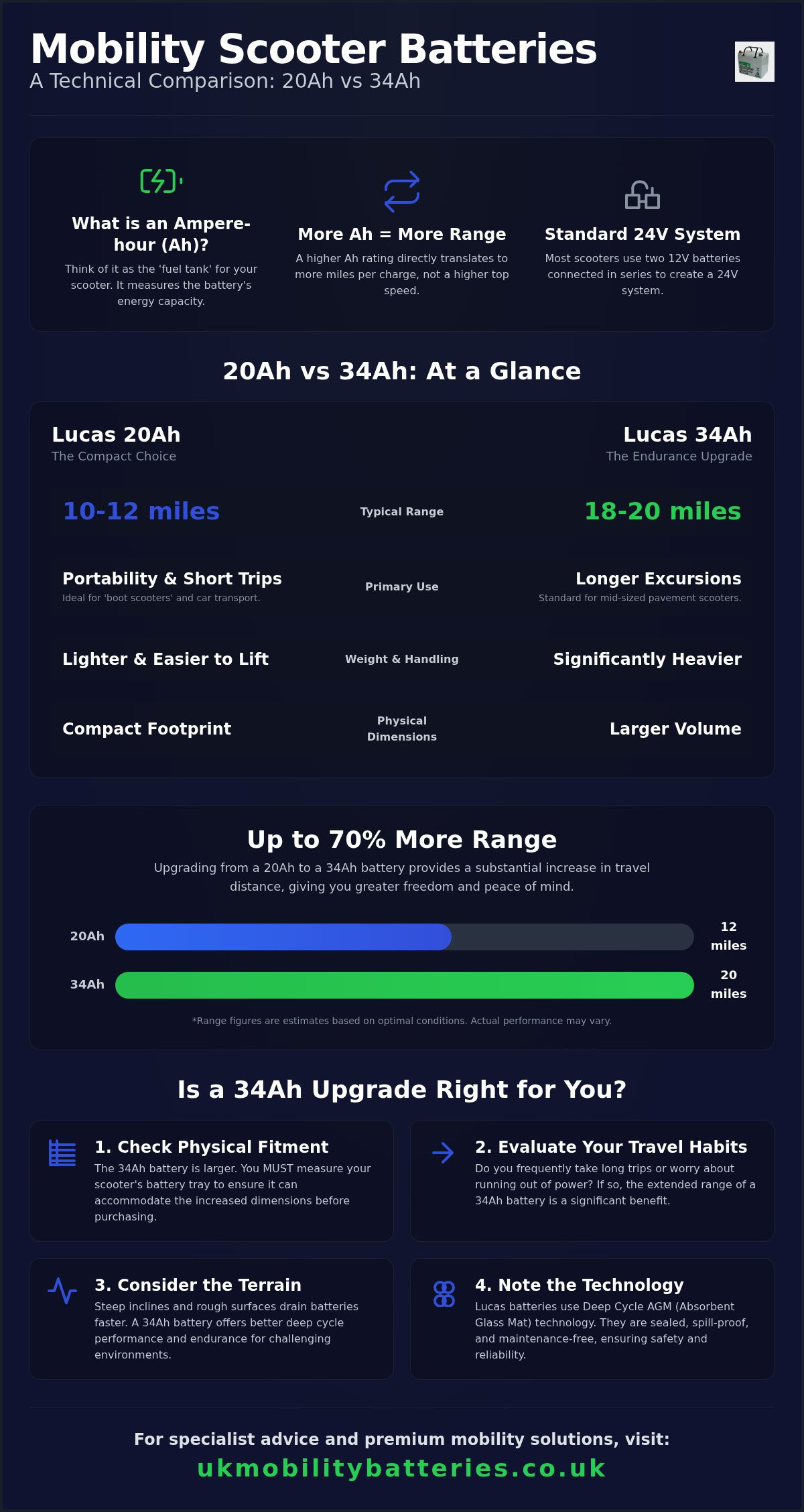
Selecting between a 20ah vs 34ah mobility battery requires a clear understanding of your daily travel requirements and the physical limitations of your equipment. A standard 20Ah battery pack typically offers a range of approximately 10 to 12 miles on a full charge. In contrast, upgrading to a 34Ah pack can extend this distance to between 18 and 20 miles. These figures are estimates based on flat terrain and optimal conditions; actual performance varies based on user weight and ambient temperature.
Battery longevity is also tied to the Depth of Discharge (DoD). If you frequently take short trips of 5 miles, a 34Ah battery will only be discharged by roughly 15%, whereas a 20Ah battery would be depleted by 25%. Shallow discharge cycles generally extend the overall lifespan of AGM cells. This means a higher capacity battery might last for more years before requiring replacement, even if you don't always use the full range. Weight is the primary trade-off. A 34Ah battery is significantly heavier than a 20Ah unit, which affects how easily the scooter can be dismantled and lifted.
20Ah: The Choice for Portability
The 20Ah capacity is the industry standard for "boot scooters" designed for car transport. These models prioritse low component weight to ensure the user or a carer can lift the battery box into a vehicle without strain. It provides a reliable balance for users who mainly visit shopping centres or navigate paved urban environments. For those with ultra-lightweight travel scooters where space is even more restricted, the 12v 12ah mobility battery serves as a smaller alternative, though it offers a much shorter operational window.
34Ah: The Pavement Scooter Standard
Mid-sized pavement scooters usually utilise the 34Ah capacity as their baseline. This size is ideal for users who rely on their scooter as a primary mode of transport for local errands and supermarket trips. It handles the increased power demands of larger motors and more substantial chassis frames with ease. The 12v 34ah deep cycle battery is the preferred choice for durability, providing consistent voltage even when tackling moderate inclines or uneven footpaths. If you're unsure which capacity your current charger supports, you can contact our technical team for expert guidance on compatible upgrades.
The Physical Factor: Dimensions and Compatibility
The most common error when evaluating a 20ah vs 34ah mobility battery is assuming the higher capacity unit will fit into an existing battery box. It won't. Whilst the electrical system can technically handle the increase in ampere-hours, the physical chassis of your scooter often cannot. A 34Ah battery is not simply a larger version of a 20Ah cell; it belongs to a different physical classification altogether. If your scooter was manufactured specifically for 20Ah batteries, the battery tray is likely too narrow to accommodate an upgrade.
Standard 20Ah dimensions are approximately 181mm x 77mm x 167mm. In contrast, standard 34Ah dimensions are approximately 195mm x 130mm x 164mm. Whilst the height remains similar, the 34Ah unit is nearly double the width of the 20Ah unit. This 53mm difference in width is the primary reason why 34Ah batteries are rarely compatible with compact boot scooters. Before purchasing, you must verify that your battery box has the necessary internal volume to house the larger footprint of a higher capacity cell.
Measuring Your Battery Tray Correctly
To ensure a successful fitment, measure the internal length, width, and height of the existing battery box. Do not measure the external casing, as the plastic walls and mounting brackets reduce the usable space inside. You must also account for cable clearance and terminal positioning. If your scooter's wiring loom sits directly on top of the battery, you need at least 15mm of additional height to avoid pinching the cables. In the UK, 34Ah batteries used for mobility applications almost always follow the U1 Group Size standard for dimensions.
Terminal Types and Connectors
The connection method often changes when moving between these two capacities. 20Ah batteries typically utilise 6.35mm spade connectors, also known as F2 terminals, which allow the wires to slide on. Larger 34Ah batteries usually feature bolt-through terminals, such as M5 or M6 threads, which require a nut and bolt to secure the eyelet. If your current scooter uses spade connectors, you will need to modify the wiring or use an adapter to fit a 34Ah unit. You can refer to our technical guide on how to change mobility scooter batteries for detailed safety instructions regarding terminal configurations and secure installation.
When to Choose 20Ah and When to Upgrade to 34Ah
Determining the ideal capacity for your equipment involves balancing your daily mileage against the physical practicalities of the scooter itself. The 20ah vs 34ah mobility battery decision often comes down to how you use and transport your vehicle. If you own a boot scooter that you dismantle frequently for car travel, the 20Ah battery is usually the superior choice. Its lower weight ensures that the battery pack remains manageable for lifting into a vehicle boot without excessive physical strain. Smaller travel scooters are engineered around this specific weight-to-power ratio to maintain their portable nature.
Conversely, a 34Ah battery is the logical upgrade for users who prioritise range over portability. If your daily route involves tackling steep hills, traversing uneven pavement, or completing a longer-than-average commute, the increased capacity is essential. The extra ampere-hours provide a necessary buffer; they ensure the motor receives consistent voltage even under high load. For those using ultra-compact scooters where a 20Ah unit won't fit, the Lucas 12V 9Ah uprated battery offers a minor boost in runtime within a very small footprint.
Budget vs. Longevity
Whilst a pair of 20Ah batteries has a lower initial purchase price, the 34Ah alternative often represents better value over a three-year period. This is due to the reduced strain on the cells. Because a 34Ah battery isn't depleted as deeply during a typical trip, it undergoes fewer high-stress discharge cycles. This shallower depth of discharge preserves the chemistry of the AGM plates, often resulting in a longer overall service life. UK Mobility Batteries maintains a comprehensive stock of both capacities with fast national delivery to ensure you can replace failed units quickly.
Charger Compatibility Check
Your current charging equipment may dictate your battery choice. A standard 20Ah battery is comfortably replenished by a 2A or 4A charger. However, if you upgrade to a 34Ah system, a 2A charger will be significantly slower; it may take over 15 hours to achieve a full charge from a low state. For efficient operation, a 34Ah battery ideally requires a charger rated between 4A and 8A. You should also avoid using high-output chargers on smaller 20Ah batteries, as excessive current can cause the cells to overheat and vent. To ensure you select the correct technical match for your scooter, view our full range of Lucas mobility batteries today.
Premium Lucas Solutions from UK Mobility Batteries
Lucas has established itself as the gold standard for mobility power across the United Kingdom. When evaluating a 20ah vs 34ah mobility battery, selecting a Lucas unit ensures you receive a product specifically engineered for deep-cycle performance and long-term durability. These batteries are entirely maintenance-free and feature a leak-proof design, making them safe for indoor storage and use on public transport. UK Mobility Batteries prioritises these technical attributes to ensure users maintain their independence without the risk of equipment failure.
Eligible customers in the UK can benefit from VAT relief on their battery purchases. This scheme is available to individuals who are chronically sick or disabled and are purchasing the equipment for personal use. Because mobility scooter batteries are considered essential parts for a disability aid, they are zero-rated for VAT. This provides a significant cost reduction on premium Lucas 12V 20Ah and 34Ah units, ensuring that high-performance power remains affordable for those who rely on it most.
Why Choose Lucas AGM Batteries?
Lucas deep-cycle cells are manufactured using high-purity lead and heavy-duty internal plates. This robust construction allows for a higher number of discharge cycles compared to standard budget alternatives. The Absorbent Glass Mat (AGM) technology provides superior vibration resistance, which is essential for navigating uneven UK pavements, gravel paths, and dropped kerbs. Every Lucas battery supplied is factory-fresh and undergoes rigorous voltage testing to ensure it meets its rated capacity before dispatch. This commitment to quality control prevents the common issue of receiving shelf-worn stock that has lost its charge over time.
Expert Support and National Delivery
Selecting the correct capacity is vital for both scooter performance and component longevity. If you're unsure about the 20ah vs 34ah mobility battery fitment for your specific chassis or battery box, our technical team provides expert support to clarify compatibility. We always recommend replacing batteries in pairs to maintain a balanced electrical system. Mixing old and new cells, or batteries of different capacities, creates an internal resistance imbalance that quickly degrades the newer unit. With our efficient national delivery network, we provide a reliable solution for users who need to restore their mobility quickly after a battery failure. View our full range of Lucas mobility batteries and order online today.
Selecting Your Ideal Mobility Power Solution
The 20ah vs 34ah mobility battery decision rests on balancing your physical space constraints against your daily travel objectives. Whilst the 34Ah unit offers a significant range increase for longer commutes and steeper terrain, the 20Ah battery remains the standard for users who prioritise lightweight portability and frequent car transport. Accurate measurement of your battery tray is the most critical step before committing to an upgrade. If you don't have the internal width for a larger casing, sticking with a high-quality 20Ah pair is the safest technical choice.
UK Mobility Batteries provides the full range of premium Lucas AGM cells to ensure your equipment remains dependable in all UK conditions. We offer fast national delivery and expert technical support to help you confirm fitment and terminal compatibility. Whether you require the compact efficiency of a travel battery or the deep-cycle endurance of a larger unit, we have the stock ready for immediate dispatch.
Browse Lucas 12V 20Ah and 34Ah Mobility Batteries to find your perfect match. Restoring your scooter's performance with a reliable pair of batteries ensures you can travel with complete confidence.
Frequently Asked Questions
Can I use a 34Ah battery instead of a 20Ah battery?
Yes, you can use a 34Ah battery as an upgrade, provided your scooter's battery tray has enough physical space to accommodate the larger size. Electrically, both batteries operate at 12V, so the motor and controller will function correctly. The primary advantage of this switch is a significant increase in travel distance between charges.
Will a 34Ah battery fit in my 20Ah battery box?
In most cases, a 34Ah battery will not fit in a box designed specifically for 20Ah units. The 34Ah casing is approximately 53mm wider than the 20Ah version, which usually exceeds the internal tolerances of compact battery housings. You must measure the internal length, width, and height of your tray before attempting an upgrade to avoid fitment issues.
How much more range will I get with 34Ah batteries?
You can expect a range increase of approximately 70% when comparing the 20ah vs 34ah mobility battery capacities. Whilst a standard 20Ah pack typically covers 10 to 12 miles, a 34Ah pack is capable of achieving 18 to 20 miles under similar conditions. Actual mileage varies based on the total load carried and the steepness of the terrain you navigate.
Is a 34Ah battery heavier than a 20Ah battery?
Yes, a 34Ah battery is substantially heavier than a 20Ah unit because it contains more lead plates to store additional energy. This weight difference is a vital consideration if you frequently dismantle your scooter for car transport. If lifting the battery pack is a daily requirement, the lighter 20Ah model is often the more practical choice for maintaining independence.
Do I need a new charger if I upgrade to 34Ah?
You might not strictly need a new charger, but your existing unit may be inefficient for the higher capacity. A standard 2A charger will take considerably longer to replenish a 34Ah battery, often requiring over 15 hours for a full cycle. For the best performance, we recommend using a 4A to 8A charger to ensure the larger cells are topped up within a reasonable timeframe.
Are 20Ah and 34Ah batteries interchangeable on all scooters?
They are not universally interchangeable due to differences in physical dimensions and terminal configurations. Many 20Ah batteries utilise slide-on spade connectors, whereas 34Ah batteries often feature bolt-through terminals. You should only attempt to swap these sizes if your scooter's chassis is designed to accept multiple battery footprints and your wiring loom matches the terminal type.
What is the physical size difference between 20Ah and 34Ah?
The 34Ah unit is significantly larger, measuring roughly 195mm x 130mm x 164mm compared to the 20Ah dimensions of 181mm x 77mm x 167mm. This means the 34Ah battery is nearly double the width of the 20Ah model. This increased volume is necessary to house the heavy-duty plates required for the extended deep-cycle runtime provided by the larger cell.
How long do 20Ah mobility batteries usually last?
A high-quality 20Ah AGM battery typically provides a service life of 12 to 18 months with consistent care. The overall lifespan of your 20ah vs 34ah mobility battery depends heavily on your charging behaviour and how deeply you deplete the cells. To maximise longevity, you should charge the batteries after every use and avoid leaving them in a discharged state for extended periods.