
The Ultimate Guide to Mobility Scooter Batteries UK: Selection, Care, and Performance
Your independence relies entirely on the technical integrity of the chemical cells hidden beneath your seat. Selecting the right mobility scooter batteries UK for your specific requirements is the difference between a reliable daily commute and the constant fear of being stranded.
It's understandable to feel concerned about battery failure whilst away from home, particularly when the technical difference between a 34Ah and a 50Ah unit isn't immediately obvious. Many owners worry about purchasing an incompatible size or a battery that cannot handle the rigorous demands of daily use in the British climate.
This guide ensures you never have to guess again, providing the exact data needed to choose, maintain, and optimise your power source for long-term reliability. We will cover how to identify precise replacement specifications, the advantages of uprating to higher capacity Lucas AGM models, and the specific charging protocols required to extend equipment service life.
Key Takeaways
- Understand why most mobility scooter batteries UK operate on a 24V system using two 12V deep-cycle batteries wired in series for consistent power delivery.
- Evaluate the technical specifications of AGM and Gel chemistries to determine the optimal maintenance-free solution for your specific equipment requirements.
- Calculate precise Amp-hour requirements and understand how uprating to high-capacity Lucas batteries enhances overall travel distance and reliability.
- Master the "Golden Rule" of charging and the essential initial break-in period to ensure your cells reach their full performance potential.
- Recognise the physical and performance-based indicators of battery degradation to ensure timely, compatible replacement from a technical specialist.
Understanding Mobility Scooter Batteries: The UK Essentials
A mobility battery is a technical component engineered for a specific discharge profile. Unlike batteries designed for automotive or standby applications, the mobility scooter batteries UK users require are deep-cycle units. These are built to provide a steady, reliable flow of electricity over several hours rather than a single high-current burst. This sustained energy delivery is vital for maintaining consistent torque and speed throughout your journey.
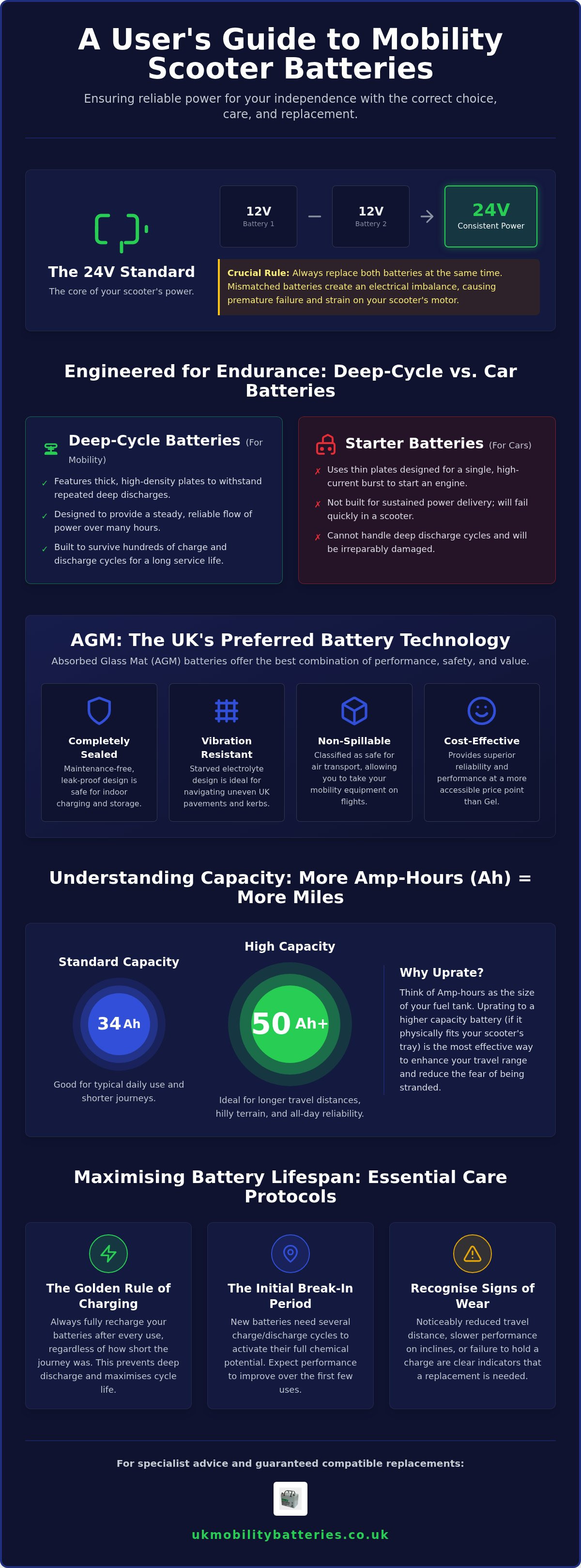
A thorough approach to Understanding Mobility Scooters reveals that the battery is the most critical consumable part of the machine. Most modern scooters operate on a 24V (Volt) circuit. To achieve this, manufacturers install two 12V batteries connected in series. This configuration is standard across the industry, typically using Sealed Lead Acid (SLA) technology. These units are maintenance-free, meaning they don't require acid top-ups and are safe for indoor storage and transport.
Sourcing mobility scooter batteries UK from a dedicated national retailer is vital for performance. Batteries are perishable chemical products that begin to degrade the moment they leave the factory. Specialist retailers maintain high stock turnover, ensuring you receive "fresh" cells with full chemical potential. This is amongst the most important factors in determining the eventual lifespan of your equipment.
- Reduced transit time prevents deep self-discharge during storage.
- Technical compatibility verification for specific UK scooter models.
- Compliance with the UK Medical Devices Regulations 2002.
Why Deep-Cycle Batteries Differ from Car Batteries
Deep-cycle batteries are fundamentally different from car batteries. A car battery is designed for "cranking" power, delivering hundreds of amps for a few seconds to start an engine. Once started, the alternator takes over. Mobility scooters don't have alternators. Instead, they rely solely on the stored energy in the batteries for every mile of travel. Using a standard starter battery in a scooter leads to immediate failure because the thin lead plates cannot handle repeated deep discharges. Mobility-specific cells feature thicker, high-density plates that survive hundreds of charge and discharge cycles.
The Role of the 24V Power Circuit
Whilst mobility batteries are sold as individual 12V units, they function as a single 24V power pack. You must always replace both batteries at the same time. Installing a new battery alongside an old one creates an electrical imbalance. The older, weaker battery will have higher internal resistance, forcing the new battery to overwork. This imbalance often results in the new battery failing prematurely. Additionally, an uneven pair can lead to erratic voltage delivery, which puts unnecessary strain on the scooter's motor controller and can cause the machine to stall on inclines.
AGM vs Gel: Choosing the Right Technology for Your Needs
The two primary technologies for mobility scooter batteries UK owners must choose between are AGM (Absorbed Glass Mat) and Gel. Both are classified as Valve Regulated Lead Acid (VRLA) batteries. This means they are completely sealed and maintenance-free. You don't need to top up acid levels or check fluid reservoirs. Their "leak-proof" design is a critical safety feature, allowing the batteries to be operated in any orientation without the risk of corrosive spills. This makes them ideal for indoor storage and charging. Adhering to official fire safety advice ensures these sealed units remain the safest option for home environments.
Whilst both chemistries are reliable, AGM is the most popular choice in the UK. This is largely due to its superior cost-to-performance ratio. AGM batteries use a fine fiberglass mat to "starve" the electrolyte, making them highly efficient at delivering power when needed. They provide excellent reliability for the vast majority of scooter users at a more accessible price point than Gel alternatives.
The Advantages of Sealed AGM Batteries
Lucas 12V 34Ah Sealed AGM Deep Cycle Battery units utilise a starved electrolyte design that prevents any liquid movement within the case. This construction provides exceptional vibration resistance, which is vital for navigating uneven UK pavements and kerbs. Because there's no free-flowing liquid, these batteries are classified as non-spillable and are air-transportable. This allows you to take your mobility equipment on flights without the safety restrictions associated with traditional "wet" lead-acid batteries. They also offer a lower internal resistance, which allows for slightly faster charging times compared to Gel equivalents.
When to Consider Gel Chemistry
Gel batteries use a silica additive to turn the sulphuric acid into a thick, jelly-like substance. This chemistry is specifically designed for high-mileage users who discharge their batteries deeply every day. If you regularly cover 10 or 15 miles in a single trip, the increased cycle life of a Gel battery may justify the higher initial investment. However, Gel batteries are sensitive to charging voltages and require specific chargers to prevent "bubble" formation in the gel. For most standard applications, premium AGM units like those found at UK Mobility Batteries provide the necessary durability without the added expense or charging complexity of Gel technology.
Calculating Capacity: The Mobility Scooter Battery Amp Hour Guide
Amp-hours (Ah) represent the electrical capacity of the battery. Think of this as the size of your fuel tank. A higher Ah rating means the battery can deliver a specific current for a longer duration. For mobility scooter batteries UK, this directly translates to the distance you can travel between charges. Standard sizes range from small 7Ah units found in boot scooters to heavy-duty 150Ah batteries used in large, all-terrain models. Choosing the correct capacity ensures your scooter has enough energy to complete your intended journeys without the risk of a mid-trip failure.
Technical accuracy is paramount when selecting a replacement. Whilst Ah determines range, the physical dimensions of the battery case are fixed. You must ensure the length, width, and height of the new unit match your scooter's battery tray exactly. Referencing the BHTA battery safety guide provides additional context on why using correctly rated and sized equipment is essential for maintaining the safety certifications of your device. An ill-fitting battery can lead to loose connections or physical damage to the battery casing during transit.
Uprating Your Power: 7Ah vs 9Ah Batteries
One common technical upgrade involves swapping standard 7Ah cells for the Lucas 12V 9Ah Uprated Battery. These units occupy the exact same physical footprint, typically 151mm x 65mm x 94mm, but utilise a higher density of internal lead plates. This upgrade provides approximately 25% more range. It's a practical solution for users who find their current travel scooter struggling to complete longer trips or losing power on local inclines. Uprating is a simple "drop-in" replacement that requires no modification to the battery box or wiring, making it an efficient way to enhance your independence.
Matching Capacity to Scooter Class
The capacity you require depends on the classification of your scooter. Class 2 scooters, often designed for pavement use and easy dismantling, typically utilise batteries ranging from 12Ah to 34Ah. These are sufficient for short trips to local shops. In contrast, Class 3 road-legal scooters require 50Ah to 100Ah+ units to support higher speeds of 8mph and longer journeys. You should consult the Mobility Scooter Battery Sizes UK reference guide to verify the exact dimensions and Ah ratings required for your specific model. Selecting mobility scooter batteries UK with insufficient capacity for a Class 3 scooter will lead to rapid voltage drops and may damage the motor controller over time.
Extending Mobility Scooter Battery Life through Expert Care
The longevity of mobility scooter batteries UK owners rely on depends heavily on precise chemical management. The "Golden Rule" of battery maintenance is to never leave your cells in a discharged state. When a lead-acid battery remains flat, a process called sulphation occurs, where lead sulphate crystals harden on the plates. This reduces the battery's ability to hold a charge and is the primary cause of premature failure. To maintain peak performance, you should connect your scooter to the charger as soon as possible after every journey.
New batteries do not deliver their maximum range immediately upon installation. They require a "break-in" period of approximately 15 to 20 charge and discharge cycles to reach their full chemical capacity. During this initial phase, the internal plates gradually activate and optimise their surface area. It's advisable to limit your journey distance for the first fortnight after fitting new Lucas batteries to avoid deep discharge whilst the cells are still conditioning.
The Correct Charging Routine
Consistency is more important than duration when it comes to charging. You should charge your batteries after every trip, regardless of whether you only travelled a few hundred yards. Modern automatic chargers are designed to transition into a "float" mode once the batteries are full, which maintains the voltage without causing damage. However, you must always use the charger specifically calibrated for your scooter model. Using an incompatible or higher-output charger can lead to overheating and internal plate damage. For a more detailed technical breakdown, consult our guide on overcharging mobility batteries.
Winter Maintenance and Storage
The UK winter climate presents a significant challenge for chemical power sources. Freezing temperatures can reduce the effective capacity of mobility scooter batteries UK by up to 30%. This is not a permanent fault, but a result of the chemical reactions slowing down in the cold. If your scooter is not in regular use during the winter months, follow these technical storage protocols:
- Ensure the batteries are fully charged before placing the scooter in storage.
- Top up the charge at least once every month to counteract natural self-discharge.
- Avoid storing batteries directly on cold concrete floors; the thermal conduction can accelerate energy loss.
- If possible, store the battery pack in a dry, frost-free environment.
Adhering to these maintenance standards ensures your equipment remains dependable year-round. Ensure your equipment is powered by the highest quality cells by browsing our full range of Lucas mobility batteries today.
Buying Replacement Mobility Scooter Batteries in the UK
Identifying the precise moment to source mobility scooter batteries UK is critical to maintaining your equipment's operational readiness. You'll likely notice signs of chemical degradation long before the cells fail entirely. A primary indicator is a significant reduction in torque when navigating inclines that the machine previously handled with ease. If your scooter feels sluggish on hills or the battery meter drops into the red significantly faster than usual, the internal resistance of the cells has likely increased beyond efficient levels.
Purchasing from a specialist national retailer offers technical advantages over general marketplaces. Specialists ensure that stock is rotated frequently, meaning the batteries haven't sat discharged in a warehouse for months. Logistics are equally important; because batteries are heavy, hazardous goods, they require specific handling. Our process for fast delivery for mobility batteries ensures that replacement units arrive in peak condition, ready for the initial conditioning cycles described in previous sections.
Environmental responsibility is a legal and ethical requirement when handling lead-acid components. These batteries are almost 98% recyclable. You must never dispose of old units in household waste. Instead, they should be taken to a local authority household waste and recycling centre or a dedicated battery collection point. Most UK civic amenity sites provide specific containers for lead-acid batteries to ensure the lead and plastic materials are reclaimed safely.
VAT Relief for Disabled Customers
Individuals with a qualifying disability or long-term illness are eligible to purchase mobility batteries at 0% VAT rather than the standard 20%. This is a government-mandated entitlement for equipment specifically designed for mobility assistance. The process is straightforward; you simply complete a self-declaration form at the point of purchase stating your eligibility. To understand how this affects your total expenditure, refer to our Mobility Scooter Battery Price UK guide, which details current market costs and the impact of VAT exemption.
Safe Fitting and Installation
Before ordering, check your existing terminal configuration. UK scooters typically use one of three types: threaded inserts, bolt-through terminals, or spade connectors. We recommend taking a clear photograph of the existing wiring harness before disconnecting the old units. This provides a visual reference for the series connection, ensuring you don't accidentally reverse the polarity during installation. Once fitted, ensure the terminals are tightened securely to prevent arcing. If the scooter fails to power up after installation, consult our troubleshooting guide to identify common connection faults or fuse issues.
Securing Your Long-Term Mobility Independence
Maintaining your independence depends on precise technical selection and disciplined maintenance. Correctly identifying the Amp-hour capacity and physical footprint of your mobility scooter batteries UK ensures a perfect fit and consistent torque. By adhering to the Golden Rule of immediate charging and protecting your equipment from the UK winter, you can significantly extend the operational life of your cells.
Choosing a dependable power source provides the final layer of security for your daily journeys. Lucas batteries offer the technical superiority and durability needed for reliable performance. Our specialist team provides expert technical support and VAT relief is available on all mobility-specific orders to ensure you receive the most cost-effective solution. Browse our range of premium Lucas mobility batteries with fast UK delivery. With the correct technical setup, your scooter will remain a dependable partner for all your daily travels.
Frequently Asked Questions
How long do mobility scooter batteries typically last in the UK?
Most mobility scooter batteries UK owners use will last between 12 and 18 months under standard operating conditions. Whilst some premium units can reach three years of service, this depends entirely on charging frequency and depth of discharge. Heavy daily use or leaving batteries in a flat state will significantly shorten this lifespan.
Can I replace my 34Ah batteries with 50Ah for more range?
You can only upgrade from 34Ah to 50Ah if your scooter's battery compartment has the necessary physical clearance. A 50Ah battery is considerably larger and heavier than a 34Ah unit. Always measure the internal tray dimensions before purchasing, as an oversized battery will prevent the cover from closing securely and may affect the scooter's balance.
Why does my mobility scooter lose power on hills?
Power loss on inclines usually indicates that your batteries are reaching the end of their service life. As the cells age, their internal resistance increases, preventing them from delivering the high current required for climbing. This sluggishness is often the first sign that you need to source replacement mobility scooter batteries UK to ensure continued reliability.
Do I need to charge my mobility scooter every night?
You should charge your scooter after every trip to maintain optimal chemical health. Even if you've only covered a short distance, the technical requirement is to replenish the energy immediately. This prevents the lead plates from sulphating, which is the primary cause of capacity loss and premature failure in lead-acid systems.
What is the difference between AGM and Gel mobility batteries?
AGM batteries use a fiberglass mat to trap electrolyte, whilst Gel batteries use a silica additive to create a jelly-like substance. AGM units are the standard choice for most UK users due to their lower cost and high reliability. Gel batteries are specialised for extreme, high-mileage users who discharge their equipment deeply every single day.
Can I take my mobility scooter batteries on an aeroplane?
Most sealed AGM and Gel mobility batteries are classified as non-spillable and are safe for air travel. Lucas AGM batteries meet IATA requirements for air transport. You must inform your airline in advance and provide the technical specification to confirm the batteries are sealed and cannot leak during the flight.
How do I know what size battery my mobility scooter needs?
Identify the required size by checking the printed label on your existing batteries for the Amp-hour (Ah) rating and voltage. You must also measure the length, width, and height of the battery casing in millimetres. If the label is illegible, consult your scooter's technical manual or contact a specialist retailer with your specific model name.
Is it better to leave my mobility scooter on charge all the time?
Leaving your scooter on charge is safe and beneficial if you use a modern automatic smart charger. These devices switch to a float mode once the batteries reach full capacity, preventing overcharging whilst keeping the cells topped up. However, you should still check the equipment periodically if it's being stored for several weeks without use.