
12V 12Ah Mobility Battery: Technical Specifications and Replacement Guide
A single incorrect terminal choice or a slight mismatch in dimensions can render a new power cell useless, leaving you without the mobility you rely on. When your travel range begins to dwindle, the anxiety of being stranded becomes a daily concern rather than a distant possibility. Selecting a premium 12v 12ah mobility battery isn't just about restoring power; it's about ensuring 100% compatibility with your scooter's 24V system and 0.250 inch F2 spade connectors.
You likely want a dependable solution that removes the guesswork from technical specifications and terminal types. It's frustrating when technical jargon makes a simple replacement feel like a gamble. This guide provides the exact data needed to select, fit, and maintain your power source with confidence. We'll examine the specific benefits of Lucas maintenance-free AGM technology, explain the installation process for series-connected configurations, and share proven methods to maximise your battery's service life.
Key Takeaways
- Identify the precise physical dimensions and terminal requirements necessary to ensure a 100% compatible fit within your mobility device's battery chassis.
- Verify whether a 12v 12ah mobility battery is the correct power specification for your specific model from leading UK brands such as Pride, Drive, and Electric Mobility.
- Understand the technical advantages of Deep Cycle AGM technology, including its maintenance-free, leak-proof construction and superior vibration resistance.
- Learn a methodical, step-by-step procedure for safely removing and replacing battery units while avoiding common electrical installation risks.
- Master the essential charging protocols required to prevent irreversible sulphation and maximise the operational lifespan of your Lucas batteries.
Understanding 12V 12Ah Mobility Battery Specifications
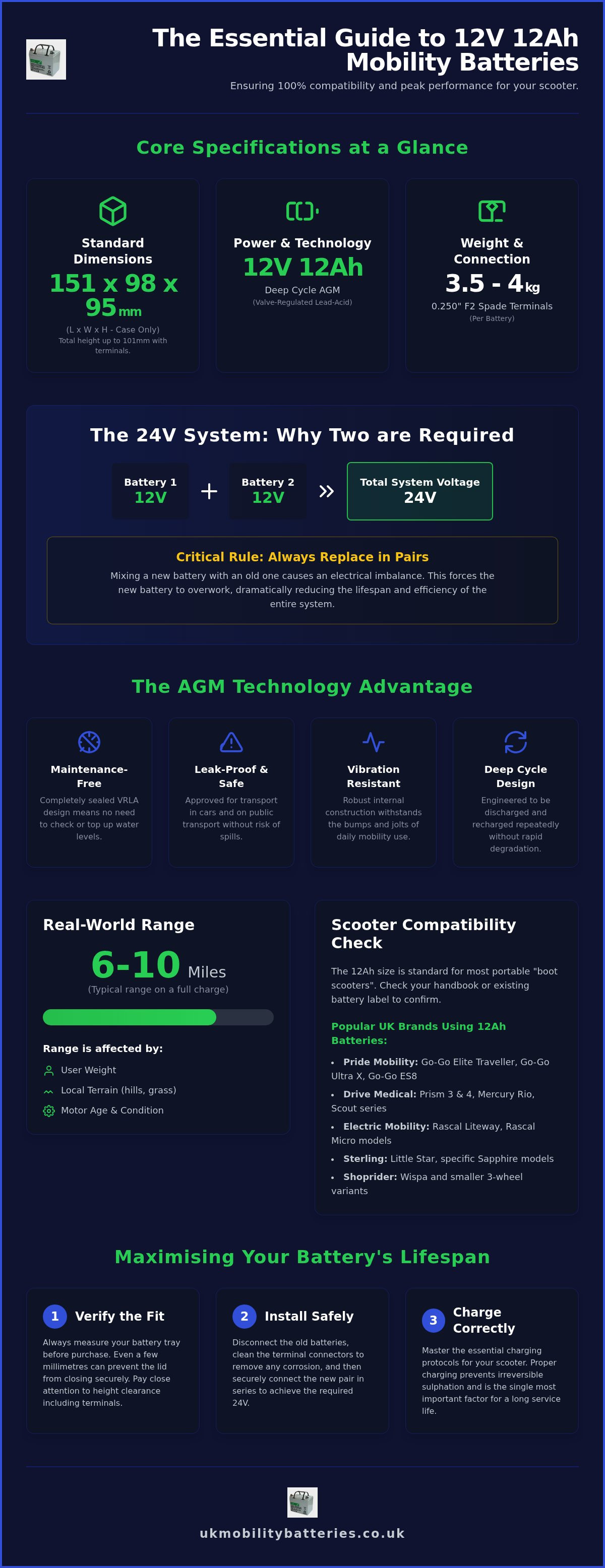
The 12v 12ah mobility battery is the industry-standard power unit for small, portable mobility scooters and lightweight electric wheelchairs. These batteries are designed specifically for deep-cycle performance, meaning they can be discharged and recharged repeatedly without immediate damage to the internal cells. As a specific type of VRLA (Valve-Regulated Lead-Acid) battery, these units are completely sealed and maintenance-free. This construction is vital for equipment that is frequently disassembled, transported in car boots, or taken on public transport where spill-proof safety is a legal requirement.
Physical dimensions for this battery class are strictly standardised. A typical unit measures 151mm in length, 98mm in width, and 95mm in height. These precise measurements ensure that two batteries can fit side-by-side within the compact battery boxes found on travel scooters. Weight is another critical specification for users to consider. Each individual 12Ah battery weighs between 3.5kg and 4kg. Since most mobility devices operate on a 24V system, they require two units connected in series, adding a total of approximately 8kg to the weight of the battery pack. This weight directly influences the portability of the scooter during lifting and storage.
Standard Dimensions and Fitment Protocols
Whilst 151mm x 98mm x 95mm is the accepted industry case size, you must always measure your existing battery tray before purchasing replacements. Even a few millimetres of variance can prevent the battery box lid from closing securely. Pay particular attention to the height clearance. The 95mm measurement usually refers to the battery casing, but the total height including the F2 spade terminals can reach 101mm. If your battery box has a shallow profile or integrated wiring looms, this extra height is a critical factor. Ensure the terminal connectors are clean and free from corrosion before sliding the new units into position.
Amp-Hour (Ah) Ratings and Range Expectations
The "12Ah" designation indicates the battery's capacity, which is the total amount of electrical energy it can store. In the mobility industry, this is typically measured at the C20 rate. This means the battery can deliver 0.6 Amps of current consistently over a 20-hour period. In real-world terms, a 12v 12ah mobility battery provides enough range for short trips, typically covering between 6 and 10 miles on a full charge. However, mileage varies significantly based on the user's weight, the age of the motor, and the local terrain. Frequent use on steep inclines or soft grass will deplete the capacity faster than travel on flat, paved pavements. These batteries are the standard threshold for "boot scooters" where the priority is a balance between moderate range and low lifting weight.
Scooter Compatibility: Which Models Use 12Ah Batteries?
Most portable mobility scooters, often referred to as travel or boot scooters, utilise the 12Ah size as their primary power source. These devices are engineered for easy disassembly into lightweight components. Whilst they are common, never assume compatibility based on appearance alone. Verification involves checking the existing battery label or the manufacturer's handbook to ensure the voltage and amp-hour ratings match. If you are unsure about your specific model, you can view our full range of Lucas mobility batteries to find a technical match.
It's standard practice to replace both units simultaneously. Most mobility scooters operate on a 24V system, which requires two 12V batteries connected in series. Mixing an old battery with a new one creates an electrical imbalance. This leads to the newer battery working harder to compensate for the weaker cell, ultimately reducing the efficiency and lifespan of the entire system. Beyond scooters, these batteries are also found in specific lightweight electric wheelchairs and medical ceiling hoists used in home care environments.
To verify compatibility with major UK brands, check your model against this general list of users:
- Pride Mobility: Go-Go Elite Traveller, Go-Go Ultra X, and Go-Go ES8 models.
- Drive Medical: Prism 3 and 4, Mercury Rio, and the Scout series.
- Electric Mobility: Rascal Liteway and Rascal Micro models.
- Sterling: Little Star and specific Sapphire models.
- Shoprider: Wispa and many smaller 3-wheel variants.
Popular UK Scooter Models and Series
The Pride Go-Go series remains the most prevalent user of the 12v 12ah mobility battery in the UK. These models often house the batteries in a single plastic case that drops onto the chassis. For Drive Medical Prism or Mercury Rio owners, the batteries are usually tucked under the seat in individual bags or a combined tray. Regardless of the housing, the internal connection typically uses standard spade terminals. Always ensure these connections are tight to prevent power cut-outs whilst driving.
Upgrading Capacity: Can You Fit 14Ah or 15Ah?
Users often ask if they can install a 14Ah or 15Ah battery to gain extra range. The answer depends entirely on the physical dimensions of the battery box. Whilst many 14Ah units share the 151mm x 98mm footprint, some are slightly taller. If the dimensions match, the upgrade is usually straightforward. However, you must ensure your off-board charger is compatible with the higher capacity. In some cases, even a Lucas 12V 9Ah uprated battery can offer performance benefits for those prioritising weight over maximum distance. Always verify that the F2 spade terminals are in the same orientation to prevent straining the internal wiring loom.
Why AGM Technology is Essential for Mobility Use
Not all lead-acid batteries are engineered for the same purpose. A standard automotive battery is a "starter" unit designed to provide a high burst of current for a few seconds. In contrast, a 12v 12ah mobility battery must provide a steady, lower current over several hours. This requirement demands Deep Cycle AGM (Absorbed Glass Mat) technology. The internal construction uses a fine fiberglass mat to absorb the sulphuric acid electrolyte, making the battery entirely spill-proof and leak-proof. This design is critical for mobility scooters that are frequently tilted or dismantled for car boot transport.
Safety and transport regulations also dictate the need for AGM units. Because the electrolyte is trapped in mats rather than sloshing as a liquid, these batteries are classified as non-hazardous for air travel under IATA (International Air Transport Association) regulations. This allows users to take their mobility devices on flights without the complications associated with "wet" batteries. Additionally, the tightly packed internal structure provides superior vibration resistance. This durability is vital for scooters used on uneven pavements, kerbs, and gravel paths, where constant jolting could otherwise cause internal plate damage in a standard battery.
Sealed Lead Acid (SLA) vs. AGM Construction
It is a common point of confusion, but AGM is actually a superior subset of Sealed Lead Acid (SLA) technology. Whilst both are maintenance-free and never require water topping, AGM units offer better electrical performance and faster charging. These batteries are also classified as VRLA (Valve Regulated Lead Acid) designs. They incorporate a one-way pressure relief valve that manages internal gas pressure. This safety feature prevents the casing from bulging or cracking during the charging process, ensuring the unit remains dependable throughout its service life.
Deep Cycle Performance for Daily Use
Mobility applications require "cyclic" use, which involves discharging the battery during the day and recharging it overnight. Lucas batteries are manufactured with heavy-duty lead plates and high-density active material to withstand these repeated cycles. Standard batteries would fail within weeks under such stress. A key technical metric here is the Depth of Discharge (DoD). Depth of Discharge (DoD) refers to the percentage of the battery that has been discharged relative to its overall capacity; the deeper the discharge, the shorter the total cycle life. By using premium AGM technology, users can achieve more charge-discharge cycles before the capacity begins to drop, providing better long-term value and reliability.
How to Replace Your 12V 12Ah Batteries Safely
Replacing a 12v 12ah mobility battery requires precision to ensure electrical safety and system longevity. Before starting, you must turn off the ignition and remove the key. This prevents accidental short circuits during the removal process. Most boot scooters house batteries in a detachable plastic pack; unscrew the base or lid to access the internal cells. Take a photograph of the existing wiring before disconnecting any cables to serve as a reliable reference for reassembly.
Identifying the terminal type is the next critical step. These batteries typically use Faston (spade) terminals in two sizes: F1 (4.8mm) or F2 (6.35mm). The 12v 12ah mobility battery most commonly utilises the wider F2 terminal. If your connectors feel loose on the new battery pins, they may need gentle tightening with pliers to maintain a secure electrical contact. Once the new units are seated, ensure they are held firmly by any internal brackets or foam padding to prevent movement during transit.
Lead-acid batteries contain hazardous materials and must never be disposed of in domestic waste. Take your old units to a local household waste recycling centre. Most centres provide dedicated bins for lead-acid batteries, where the lead and plastic can be reclaimed for manufacturing new power cells. Responsible disposal ensures that up to 98% of the battery components are recycled.
Wiring in Series for 24V Mobility Systems
To create the 24V output required by your scooter motor, you must wire the two 12V units in series. This is achieved by using a "bridge" wire to connect the positive (+) terminal of the first battery to the negative (-) terminal of the second battery. The remaining positive and negative terminals are then connected to the main scooter plug. Never mix old and new batteries in this configuration. An aged battery has higher internal resistance, which will cause the new unit to overcharge and fail prematurely.
Terminal Security and Corrosion Prevention
Loose terminals are a common cause of intermittent power loss and heat build-up. Ensure every spade connector is pushed fully onto the terminal pin. To prevent oxidation, apply a thin layer of petroleum jelly or dedicated terminal grease to the metal contacts. This is especially vital for scooters stored in damp sheds or garages. If you experience issues after installation, consult our guide on mobility scooter battery troubleshooting. For a reliable replacement, you can order Lucas 12V 12Ah mobility batteries directly from our specialist inventory.
Extending the Life of Your Lucas 12V 12Ah Batteries
Maximising the service life of a 12v 12ah mobility battery depends largely on adherence to a disciplined charging routine. The "Golden Rule" for mobility users is to charge the batteries after every significant use, regardless of how much capacity remains. Leaving batteries in a partially discharged state triggers a chemical process known as sulphation. During this process, lead sulphate crystals form on the battery plates and gradually harden. Once these crystals solidify, they reduce the active surface area of the internal plates, leading to a permanent loss of capacity and eventual battery failure.
Lucas batteries are engineered to higher manufacturing standards than budget alternatives. This provides better resilience against the stresses of daily cyclic use. As a trusted British heritage brand, Lucas utilises high-purity lead and advanced AGM separators to ensure consistent performance over hundreds of charge cycles. However, even premium units require correct environmental conditions. Extreme temperatures are detrimental to battery health. Storing your scooter in a cool, dry environment helps maintain the chemical stability of the cells. Excessive heat can accelerate internal grid corrosion, whilst extreme cold slows down the chemical reaction required to provide power.
Charging Regimes for Optimum Health
For daily users, an 8 to 12 hour "deep charge" should be performed at least once a week. This extended period allows the smart charger to reach the "float" stage, ensuring every cell within the 24V system is balanced and fully saturated. Always leave the charger connected until the green light indicator appears. Disconnecting the unit prematurely prevents the 12v 12ah mobility battery from reaching a state of full chemical recovery. If you are concerned about leaving the equipment plugged in, consult our guide on overcharging mobility batteries to understand how modern chargers protect your investment.
Storage Advice for Seasonal Users
If you don't intend to use your scooter during the winter months, you must still maintain the batteries. Lead-acid units suffer from a natural self-discharge rate. Without a "top-up" charge every 30 days, the voltage will drop below a critical threshold. Once it falls too low, the charger may no longer recognise the battery, rendering it useless when spring arrives. Never store your battery pack directly on a cold concrete floor. Concrete acts as a heat sink, drawing thermal energy away from the cells and causing temperature fluctuations that can affect the electrolyte's efficiency. Instead, store the pack on a wooden shelf or a piece of cardboard in a frost-free area to preserve its operational integrity.
Restoring Your Scooter's Range and Reliability
Restoring your travel range depends on selecting a high-quality 12v 12ah mobility battery that matches your equipment's technical requirements. By verifying the 151mm x 98mm x 95mm dimensions and ensuring the F2 spade terminals are secure, you can avoid common fitment issues. Adhering to the established "Golden Rule" of charging after every significant use and maintaining a balanced 24V series connection will protect your investment and prevent the irreversible damage caused by sulphation.
As an official Lucas battery stockist, we provide premium AGM solutions designed for the rigorous demands of the UK mobility market. Our team offers expert technical support for all major mobility brands to ensure you receive the correct power unit for your specific equipment. With fast UK mainland delivery, you can restore your independence without unnecessary delay. Maintaining your mobility should be a straightforward and dependable process.
Browse our range of Lucas 12V 12Ah Mobility Batteries today to ensure your scooter remains ready for every journey.
Frequently Asked Questions
Can I use a 12V 14Ah battery instead of a 12V 12Ah?
Yes, you can use a 14Ah battery provided the physical dimensions fit within your battery tray or plastic housing. Most 14Ah units share the same 151mm x 98mm footprint, but you must verify the total height including the terminal connectors. Uprating to a higher capacity provides approximately 15% more travel range without requiring any modifications to the scooter's electrical system.
How long should a 12V 12Ah mobility battery last?
A 12v 12ah mobility battery typically provides 12 to 18 months of service with regular daily use. With meticulous charging habits and climate-controlled storage, some users achieve up to three years of operational life. Factors such as user weight, local terrain, and the depth of discharge during each journey will influence the total number of cycles the battery can perform before failing.
Do I need to buy two batteries or just one?
You should almost always buy two batteries to replace a complete set. Mobility scooters operate on a 24V system that requires two 12V units connected in series. Installing a single new battery alongside an old one causes an electrical imbalance; the older battery's higher internal resistance will force the new unit to overcharge, leading to the premature failure of the entire power pack.
Are these batteries safe for taking on an aeroplane?
Yes, Lucas AGM batteries are classified as non-spillable and are safe for air travel under IATA regulations. Because the electrolyte is absorbed into fibreglass mats, they are leak-proof even if the casing is tilted or damaged. You should always notify your airline in advance to confirm their specific handling procedures for mobility aids and to ensure the battery terminals are protected against short circuits.
What is the difference between an AGM and a Gel battery for a 12Ah size?
AGM batteries use a fibreglass mat to hold the electrolyte, whereas Gel batteries use a silica additive to turn the acid into a thick paste. For the 12Ah size used in portable boot scooters, AGM is the industry standard due to its superior vibration resistance and lower cost. Gel batteries are typically reserved for larger, road-legal scooters that undergo more frequent, heavy-duty deep discharging cycles.
Why does my new battery seem to have less range in the winter?
Cold temperatures slow down the internal chemical reactions within the battery cells. When the mercury drops, the battery's internal resistance increases, which temporarily reduces the available capacity. You may notice a 20% to 30% reduction in travel range during frosty conditions. Storing the battery pack indoors in a temperate environment whilst not in use helps mitigate this seasonal loss of performance.
How do I know if my 12V 12Ah battery is failing?
The most common sign of failure is a significant and sudden reduction in travel range. If your scooter struggles to climb familiar hills or cuts out under load, the 12v 12ah mobility battery is likely reaching the end of its service life. You may also notice the charger reaching the "green light" stage much faster than usual, indicating that the internal plates can no longer hold a full charge.
Can I charge my 12Ah batteries with a standard car battery charger?
No, you must never use a standard car charger on small mobility batteries. Car chargers deliver a high-amperage output designed for large starter batteries, which will overheat and damage the delicate internal plates of a 12Ah deep-cycle unit. Always use a dedicated 24V smart charger specifically rated for AGM or Gel mobility applications to ensure the voltage is regulated correctly.