
Mobility Scooter Battery Testing: A Comprehensive Step-by-Step Guide
A 12V reading on your multimeter does not guarantee a healthy battery; in fact, it often masks deep-seated capacity issues. You might recognise the frustration of a battery indicator that shows a full charge at home but drops rapidly whilst you are out. This discrepancy often leads to anxiety over being stranded or confusion regarding conflicting technical data. Accurate mobility scooter battery testing is the only way to determine if your power cells are genuinely failing or if another electrical fault is at play.
We understand that the cost of premature replacements is a significant concern for most owners. This guide provides a practical, step-by-step framework to help you identify failure with precision. You will learn the critical difference between static voltage and capacity under load, providing you with a definitive pass or fail result. By following these technical procedures, you can make an informed decision on whether to invest in new Lucas AGM batteries or continue using your current set with confidence.
Key Takeaways
- Identify whether your mobility issues stem from a charger fault or genuine capacity loss by monitoring battery behaviour during use.
- Perform accurate mobility scooter battery testing at home using a digital multimeter to measure the static voltage of individual 12V units.
- Learn why resting voltage can be deceptive and how to execute a real-world load test to assess the true health of your deep-cycle batteries.
- Determine when to trust your own diagnostic results and when to seek professional conductance testing for high-stakes equipment decisions.
- Understand the technical necessity of replacing AGM batteries in pairs to maintain electrical balance and extend the service life of your scooter.
Identifying the Need for Mobility Scooter Battery Testing
Most mobility scooters rely on a pair of 12V lead-acid units connected in series to provide a 24V output. Over time, the internal chemistry of a deep-cycle battery degrades, leading to a loss of total capacity. This degradation isn't always obvious during a quick visual check or a simple voltage reading. Effective mobility scooter battery testing begins with observing how the vehicle behaves under real-world conditions. Identifying these patterns early prevents the inconvenience of a total power failure whilst you are away from home.
Common Symptoms of Battery Failure
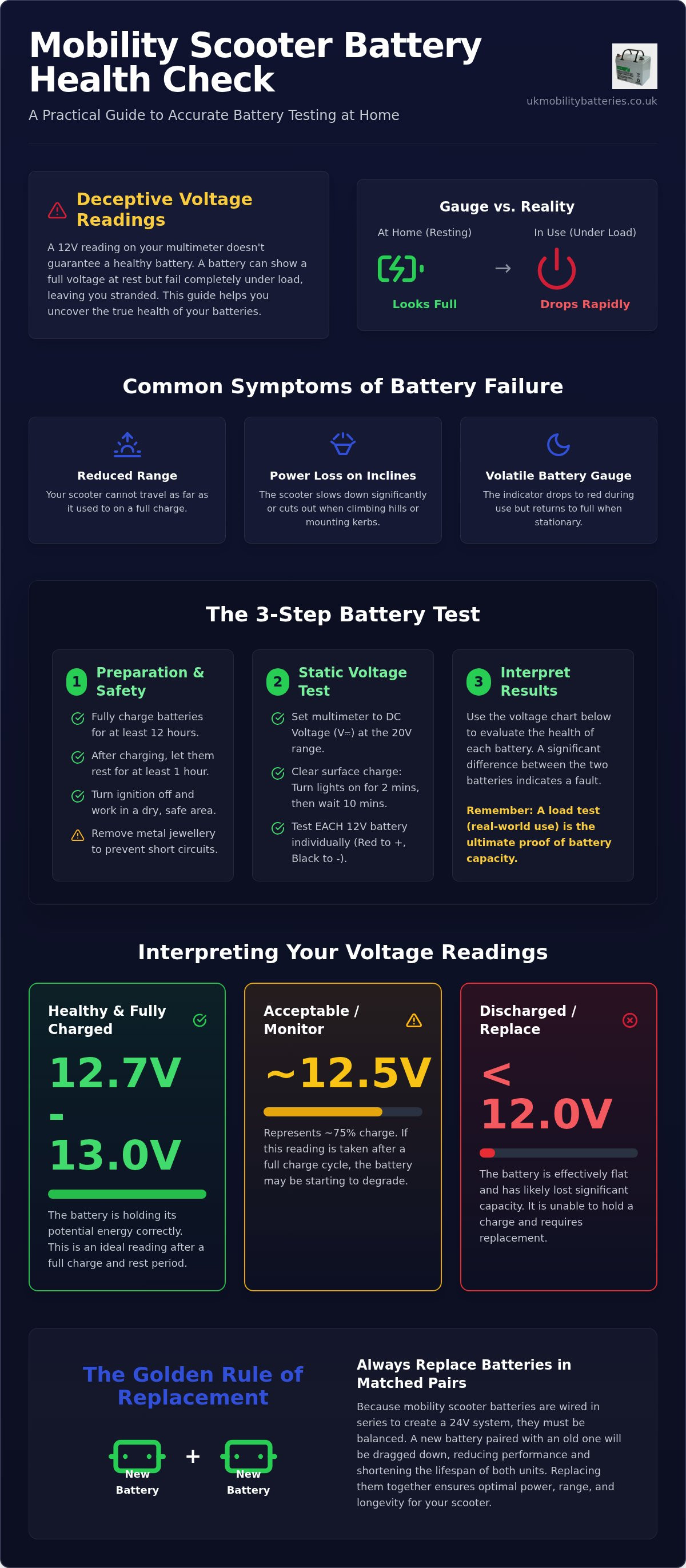
Battery health is best measured by its ability to maintain a steady current under load. If you find your range has decreased significantly compared to its original performance, the internal resistance of the cells has likely increased. You might notice the scooter slows down or cuts out entirely when climbing slight inclines or mounting kerbs. Another key indicator is a volatile battery gauge. If the needle or LED display drops into the red zone during acceleration but immediately returns to full when you stop, the batteries can no longer hold the necessary amperage.
Distinguishing Faults and Safety
It is vital to determine if the issue lies with the power cells or the charging unit. A faulty charger might indicate a full charge when it hasn't actually reached the required float voltage. Conversely, if one battery in the pair has failed, it will drag down the performance of the healthy unit. Because mobility batteries are wired in series, they must always be tested and replaced as a matched set to ensure electrical balance. Before you start any diagnostic work, you must observe basic safety protocols. Ensure the ignition is off and you are working in a dry, well-ventilated area. Remove any metal jewellery to prevent accidental short circuits across the terminals.
Pre-Test Requirements
For accurate mobility scooter battery testing results, you must prepare the equipment correctly. Batteries should be charged for a minimum of 12 hours before testing to ensure they have reached their maximum potential. Once the charge cycle is complete, let the batteries rest for at least an hour. This allows the surface charge to dissipate, giving you a more accurate resting voltage. Check the terminals for any signs of white powdery corrosion or loose bolts. Clean, tight connections are essential for obtaining precise data during the multimeter phase of the diagnostic process.
The Static Voltage Test: Using a Multimeter
A digital multimeter is the primary tool for initial mobility scooter battery testing. To begin, set your multimeter dial to the DC voltage setting, usually denoted by a "V" with a straight line above it. Select the 20V range to ensure the device can accurately display the decimal points required for a precise reading. Connect the red probe to the positive terminal and the black probe to the negative terminal of a single battery unit. You must measure each 12V battery individually rather than the combined 24V output to identify if one unit is underperforming compared to its partner.
Removing the Surface Charge
A common diagnostic error occurs when testing batteries immediately after disconnecting the charger. This often results in a "false high" reading caused by surface charge. To clear this, turn on the scooter's lights or move the vehicle slightly for two minutes. Switch everything off and wait for ten minutes. This waiting period allows the chemical reaction inside the AGM cells to stabilise, providing a true reflection of the resting voltage. Skipping this step can lead to an overly optimistic assessment of a failing battery.
In a series system, a single weak cell can cripple the entire pack. If you find a significant voltage disparity between the two units, it usually indicates that at least one requires replacement. For reliable performance, many users opt for Lucas AGM batteries known for their consistent discharge rates and durability. Monitoring these values regularly helps you track the natural decline of the battery's service life over several years.
Interpreting Voltage Results
Voltage alone doesn't tell the whole story, but it provides a baseline for health. A battery that reads 12.0V is not half full; it is technically fully discharged. Use the following technical classifications to evaluate your readings:
- 12.7V to 13.0V: This range indicates a healthy, fully charged state. It suggests the internal chemistry is capable of holding its potential energy.
- 12.5V: This represents approximately 75% charge. While acceptable, it warrants closer monitoring if the battery was recently on a charge cycle.
- Below 12.0V: This reading signifies significant discharge or potential internal cell damage. If a battery remains at this level despite charging, it has likely reached the end of its functional life.
It's a common misconception that 12.0V represents a functional battery. In reality, lead-acid and AGM batteries operate within a narrow voltage window. Once a unit drops to 12.0V, it has reached its 100% depth of discharge. Operating a scooter at this level puts excessive strain on the motor and can lead to permanent plate sulphation. This chemical hardening further reduces future capacity, making the battery unable to accept a full charge in subsequent cycles.
The Load Test: Measuring Performance Under Pressure
Static voltage testing confirms the state of charge, but it cannot measure the battery's ability to deliver sustained current. This is why mobility scooter battery testing must include a load assessment to be truly comprehensive. A battery might show a perfect 12.8V at rest but possess high internal resistance that causes the voltage to collapse the moment the motor draws power. This phenomenon often points to a "collapsed cell" within the 12V block. Without load testing, you risk misdiagnosing a faulty battery as a motor or controller issue, leading to unnecessary and expensive repairs.
The On-Scooter Load Test
A practical way to test capacity at home involves using the scooter itself as the load. Connect your multimeter probes to the terminals of one battery, ensuring they are secure. Observe the resting voltage, then engage the drive lever. For the most accurate result, perform this test on a carpeted surface or a slight incline to increase electrical resistance. A healthy 12V battery should maintain a reading above 11.5V under moderate load. If the reading plunges below 10.5V immediately, the battery has failed. It's essential to repeat this process for the second battery in the pair; a failure in just one unit will compromise the entire 24V system.
Using Professional Load Testing Tools
For a more precise diagnostic, a dedicated 100-amp load tester provides a controlled environment. These handheld devices use a high-resistance heating element to simulate the heavy current draw required for hill climbing or rapid acceleration. When using this tool, you must strictly follow the 10-second rule. Never apply the load for longer than ten seconds, as the heat generated can damage the AGM plates if sustained. This tool removes the variables of scooter motor efficiency and focuses solely on the battery's chemical health.
Standard UK load testers feature a colour-coded scale that simplifies mobility scooter battery testing results. A healthy unit will stay firmly in the green sector throughout the ten-second window. If the needle drifts into the yellow zone or drops rapidly into the red "Fail" section, the internal chemistry is no longer capable of supporting deep-cycle operation. This technical certainty is vital before you decide to invest in high-performance replacements such as Lucas 12V 34Ah Sealed AGM Deep Cycle Battery or the larger 55Ah variants designed for extended range.
Professional Diagnostics vs. DIY Testing
Home-based mobility scooter battery testing provides a solid foundation for diagnosis, but it can't always replicate the precision of laboratory-grade equipment. A digital multimeter is excellent for identifying dead cells or charging discrepancies. It lacks the capability to measure the actual available Amp-Hour (Ah) capacity. If your scooter continues to underperform despite positive voltage and load results, the fault may lie elsewhere in the drivetrain. Mechanical resistance or electronic controller failures often mimic the symptoms of a dying battery.
The Limitations of DIY Testing
DIY methods focus primarily on voltage drop and immediate resistance. They don't account for the gradual loss of active material on the lead plates, which reduces the total energy reservoir over time. Intermittent faults, such as a loose spade connector or a frayed loom, can also produce readings that suggest a failing battery when the cells are actually healthy. For a deeper look at identifying these specific issues, refer to our guide on Mobility scooter battery troubleshooting.
Sometimes the battery is the victim rather than the cause. Worn motor brushes or a failing speed controller can draw excessive current, causing even healthy batteries to overheat or cut out prematurely. Professional technicians often use conductance testers to measure the State of Health (SOH) and State of Charge (SOC) independently. This non-invasive test sends a specific frequency through the battery to map its internal surface area. It provides a more granular view of the battery's condition than a simple load test ever could.
Finding a Reliable Testing Partner
If you choose to visit a local specialist, ask for a full discharge test report. This process involves discharging the batteries at a controlled rate until they reach the cut-off voltage, measuring exactly how many Amp-Hours remain. It's the most definitive form of mobility scooter battery testing available. A reputable shop will provide a printed report showing the discharge curve. If the results confirm that a replacement is necessary, selecting premium Lucas mobility batteries ensures you're installing components designed for high-cycle longevity.
UK Mobility Batteries acts as a technical partner for customers navigating these diagnostic hurdles. Our team understands the technical specifications of Lucas AGM units and can help interpret your multimeter readings. If you're unsure about your results, you can view our technical resources for further guidance before making a purchase decision. Accurate data ensures you only replace parts when they've truly reached the end of their service life.
Interpreting Results and Replacing Your Batteries
Once you've completed your mobility scooter battery testing, the data will clearly indicate if the cells have reached their end-of-life. If the voltage drops below 10.5V under load or the resting voltage remains below 12.0V after a full charge cycle, replacement is the only reliable solution. The "Golden Rule" of mobility maintenance is to always replace batteries in pairs. Because these units are connected in series, a new battery paired with an old, high-resistance unit will be forced to overwork, leading to the premature failure of the new component and potential damage to the charger.
Selecting the correct Amp-hour (Ah) rating is essential for maintaining your scooter's intended range. Most small boot scooters use 12V 12Ah or 20Ah units, whilst larger pavement scooters require 34Ah, 50Ah, or 55Ah capacities. In many cases, you can upgrade your capacity within the same physical footprint. For example, users with standard 7Ah battery boxes often opt for Lucas 12V 9Ah uprated batteries to gain approximately 25% more runtime without needing a larger battery box or modifications to the chassis.
Matching Specifications
Before purchasing, verify the physical dimensions of your current batteries. Even a 5mm difference in width or height can prevent the battery cover from closing securely or put undue pressure on the internal wiring. You should also check the terminal types; most smaller batteries use F1 or F2 spade connectors, whilst larger deep-cycle units use bolt-through terminals. Understanding these physical attributes is just as important as knowing how long do mobility scooter batteries last, as it ensures a safe and reliable electrical connection for the duration of the battery's life.
Installation and Initial Charging
When installing your new Lucas AGM units, ensure the terminals are tightened firmly to prevent vibration-induced arcing. The most critical step occurs immediately after installation: the initial charge. New batteries are typically shipped at a partial state of charge and must be charged for a full 12 to 24 hours before their first use. This process balances the cells and ensures maximum capacity from the very first journey.
Avoid the common mistake of "short-cycling," which involves using the scooter for very short trips and immediately putting it back on charge. This behaviour can lead to a reduction in total cycle life. Following a proper charging regime, as detailed in our mobility scooter battery range guide, will help you extract the maximum service life from your investment. Finally, remember that lead-acid batteries are 98% recyclable. Take your old units to a local household waste recycling centre to ensure they are processed responsibly and kept out of landfill.
Restoring Reliable Range Through Technical Diagnostics
Accurate mobility scooter battery testing is the most effective way to eliminate range anxiety and prevent the cost of unnecessary replacements. By distinguishing between simple surface charge and genuine capacity loss, you can maintain your equipment with professional precision. It's important to remember that resting voltage provides only a baseline; a true health assessment requires monitoring performance under load. When your diagnostics confirm that a pair of batteries has failed, selecting high-quality AGM replacements ensures your scooter remains dependable for years to come.
As an official Lucas battery stockist, we provide the technical data and premium products needed to keep you mobile. We offer free technical advice for all UK customers to help interpret complex readings and ensure a perfect fit. If you require a replacement, we provide next-day delivery on our range of deep-cycle AGM units. View our range of high-performance Lucas mobility batteries today. Taking control of your battery maintenance ensures your next journey remains safe and uninterrupted.
Frequently Asked Questions
Can I test my mobility scooter battery with a standard car battery tester?
No, you shouldn't use a standard car battery tester for this purpose. Car testers are designed to measure Cold Cranking Amps (CCA), which is a high-burst current used to start an engine. Mobility batteries are deep-cycle units designed for steady, long-term discharge. Using a CCA tester on an AGM mobility battery will provide an irrelevant reading and may give a "good" result for a battery that lacks the capacity to power a scooter for more than a few minutes.
What voltage should a 12V mobility scooter battery read when fully charged?
A healthy, fully charged 12V Lucas AGM battery should show a resting voltage between 12.7V and 13.0V. If your battery reads 12.5V or lower immediately after a full 12-hour charge and a rest period, it indicates that the internal chemistry is degrading. Any battery reading below 12.0V is technically fully discharged and requires immediate attention to prevent permanent plate sulphation.
How do I know if my mobility scooter charger is broken or the batteries are dead?
You can identify the culprit by measuring the voltage at the charging port whilst the charger is connected. A functional 24V charger should output between 28V and 29V during the bulk charging phase. If the charger stays on a "full" green light but your mobility scooter battery testing shows a resting voltage below 12.5V, the batteries are likely unable to accept a charge. If the charger never shows a green light, the charging unit itself may have a blown fuse or a failed internal circuit.
Is it possible to test a mobility scooter battery without a multimeter?
Yes, you can perform a basic "real-world" load test by observing the scooter's battery indicator during use. Drive the scooter up a moderate incline or across a grass surface and watch the display. If the needle or LEDs plunge into the red zone under acceleration but jump back to full when you stop, the batteries have high internal resistance. This behaviour is a definitive sign that the cells can no longer provide the necessary current for high-torque tasks.
Why does my battery indicator show full but the scooter stops on hills?
This happens because the batteries are holding a "surface charge" but have no actual depth of capacity. When you hit a hill, the motor demands a high current draw that the degraded internal plates cannot provide. This causes the voltage to sag instantly below the controller's safety cut-off point. The scooter stops to protect the electronics, even though the static voltage appeared healthy just moments before.
How often should I perform a health check on my mobility batteries?
We recommend performing mobility scooter battery testing every six months. Regular checks help you track the natural decline of the cells and prevent the risk of being stranded. It's especially important to test your batteries before the winter months, as cold temperatures reduce chemical activity and can cause a borderline battery to fail completely when you need it most.
Can a dead battery be revived with a special charger?
Generally, a dead AGM mobility battery cannot be revived to a reliable state. Whilst some "smart" chargers offer a desulphation mode, this rarely restores enough capacity for safe mobility use. Once the active material on the lead plates has shed or a cell has collapsed, the battery is chemically compromised. Investing in a new pair of Lucas batteries is the only way to ensure the reliability required for daily travel.
What is the most accurate way to test deep-cycle AGM batteries?
A controlled discharge test is the most accurate diagnostic method. This involves discharging a fully charged battery at a specific rate until it reaches 10.5V, whilst measuring the time taken. This provides a precise Amp-hour (Ah) capacity result. Whilst a multimeter provides a good snapshot, a discharge test is the only way to prove exactly how much "fuel" is left in your battery's reservoir.