
Mobility Scooter Battery Range Guide: Maximising Your Distance in 2026
The mileage figure printed on your mobility scooter's specification sheet is rarely a guaranteed distance; it is a laboratory estimate that often fails to account for the realities of British pavement conditions. You've likely experienced the frustration of an inconsistent battery gauge or the genuine fear of being stranded away from home because your power levels dropped unexpectedly during a cold snap. This mobility scooter battery range guide moves beyond marketing estimates to provide the technical data required to calculate your actual travel potential with precision.
We recognise that choosing between a Lucas 12V 34Ah or a 55Ah battery involves more than just picking a larger number. It requires a clear understanding of how weight, terrain, and temperature interact with your scooter's electrical system. You'll learn exactly how to match the correct Ah capacity to your specific model and discover practical charging protocols to maximise the lifespan of your Lucas replacement batteries. We will also cover the 2026 TSA and FAA regulations to ensure your travel plans remain uninterrupted by technical compliance issues whilst you are on the move.
Key Takeaways
- Understand why manufacturer distance estimates often differ from real-world performance on UK pavements and how to adjust your expectations accordingly.
- Use this mobility scooter battery range guide to calculate how Amp Hour (Ah) capacity directly correlates to your daily mileage potential and equipment weight.
- Learn how to mitigate the effects of cold British winters and hilly terrain on your battery's chemical efficiency to avoid being stranded.
- Discover the technical advantages of using Lucas AGM batteries and how a proper initial charge cycle extends their long-term range and durability.
- Identify the specific battery capacity, from 7Ah to 55Ah, required to support your specific scooter model and travel frequency.
Understanding Mobility Scooter Battery Range and Capacity
Range is defined as the total distance a mobility scooter can travel starting from a 100% charge until the battery is entirely depleted. Most manufacturers provide "ideal condition" figures, which are often recorded on flat, indoor surfaces with a lightweight rider. This mobility scooter battery range guide focuses on the technical variables that actually determine how far you can travel in daily life. Real-world range is rarely a fixed number; it is a variable outcome of your equipment's capacity and the environment in which you drive.
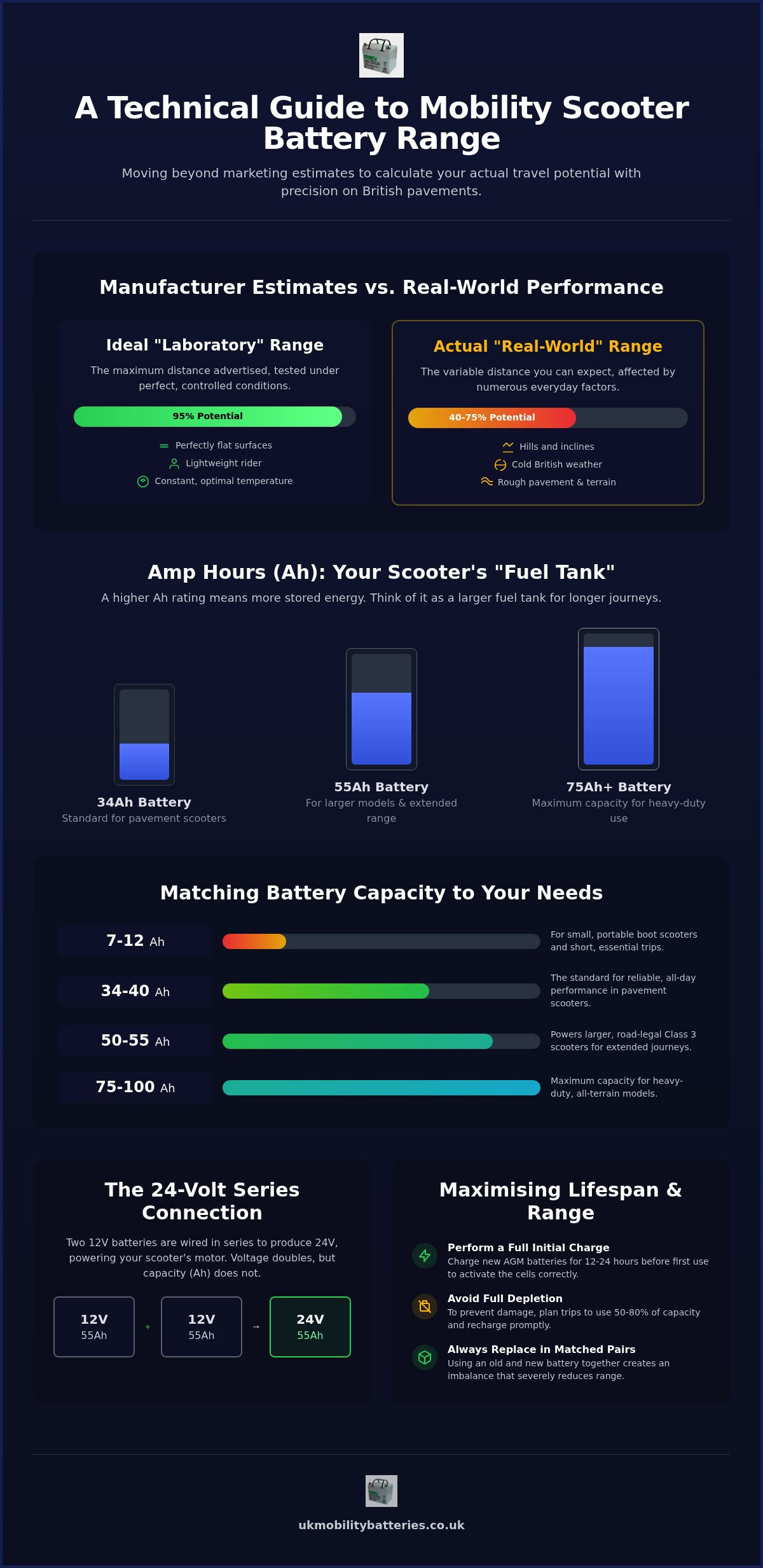
Amp Hours (Ah) represent the "fuel tank" size for your electric motor. A battery with a higher Ah rating stores more energy, allowing for longer journeys. For example, a Lucas 12V 55Ah battery provides a significantly larger energy reservoir than a 34Ah model. Whilst the physical dimensions of the battery often increase with capacity, the electrical principle remains the same. A larger capacity allows the motor to draw current for a longer duration before the voltage drops to a level that triggers the scooter's safety cut-off.
The Role of the 24V System in Range
Standard mobility scooters operate on a 24V circuit. This is achieved by using two 12V batteries connected in series. When you connect batteries this way, the voltage doubles whilst the Amp Hour capacity remains that of a single unit. It's vital to use a matched pair of identical batteries from the same production batch. If one battery is weaker or older than its partner, it will drain faster and create an electrical bottleneck. This imbalance reduces your total range and can lead to the scooter entering "limp home" mode prematurely. You must always replace both batteries simultaneously to maintain voltage stability and optimise distance.
Sealed AGM vs Gel: Range Implications
Most UK mobility scooters utilise Sealed AGM (Absorbent Glass Mat) technology. AGM batteries, such as the Lucas 12V 34Ah Sealed AGM Deep Cycle Battery, are designed to handle frequent, deep discharges without losing capacity. They provide a consistent flow of power, which is essential for maintaining speed over long distances. Gel batteries are an alternative, but they often require specific charging profiles and can be more sensitive to initial setup. For a deeper technical dive into why these chemistries matter, you can explore our guide on AGM mobility battery benefits. Choosing the correct chemistry ensures your scooter maintains its range potential throughout its service life.
The Science of Amp Hours: How Capacity Dictates Distance
The Amp Hour (Ah) rating is the most critical metric in any mobility scooter battery range guide. It measures the total volume of electrical charge a battery can deliver at a specific voltage over a set period. In simple terms, if a battery is rated at 20Ah, it can theoretically provide one amp of current for 20 hours. For a mobility scooter, this rating acts as the capacity of your "fuel tank." A higher Ah rating allows your motor to draw power for longer durations before the voltage drops below the functional threshold.
Mobility batteries are specifically engineered as deep-cycle units. Unlike car batteries, which provide a high-amperage burst to start an engine, deep-cycle AGM batteries are built to provide a steady, low-level current over many hours. They feature thicker lead plates that withstand the chemical stress of being discharged and recharged repeatedly. Using a standard automotive battery in a scooter would result in immediate range failure and permanent cell damage within a few weeks of use.
Calculating Your Battery’s Energy Reserves
Manufacturers determine capacity using the "20-hour rate" standard. This provides a consistent benchmark for comparing different models. Industry benchmarks such as the RESNA wheelchair standards define these testing frameworks to ensure that batteries meet specific safety and performance criteria. However, you should not plan to use 100% of this capacity on every trip. To maintain the health of your cells, you should aim to use only 50-60% of the total Ah. Repeatedly "running to empty" causes sulphation on the lead plates, which permanently reduces your maximum distance over time.
Uprating Your Capacity for Extra Miles
Many scooters allow for "uprating," which involves replacing a standard battery with a higher-capacity version that shares the same physical footprint. For example, replacing a standard set with the Lucas 12V 9Ah Uprated Sealed AGM Battery instead of the base 7Ah model provides a roughly 28% increase in potential distance. This is a practical way to gain extra range without modifying the scooter's chassis or battery tray.
Whilst higher Ah batteries are heavier due to the increased lead content, the gain in energy density almost always outweighs the impact of the additional weight. A heavier battery set might increase the scooter's total mass by 2-4kg, but the electrical reserves provided by the extra Amp Hours will still result in a net gain in mileage. If your tray dimensions permit, choosing a higher Ah Lucas battery is the most efficient method for maximising your travel radius.
Battery Size Comparison: Estimating Range from 7Ah to 100Ah
Selecting the correct capacity is the most effective way to ensure your equipment meets your daily travel requirements. This mobility scooter battery range guide categorises batteries into three primary performance tiers based on their Amp Hour ratings and the classes of scooter they typically power. Whilst manufacturer claims vary, these benchmarks provide a realistic expectation of distance for users in the UK who navigate varied pavement conditions and urban environments.
- Small Travel Scooters (7Ah - 12Ah): These lightweight units are designed for portability and easy dismantling. A pair of Lucas 12V 12Ah Mobility Batteries typically offers a range of 6 to 10 miles. They are ideal for indoor shopping centres or flat, paved areas near your home.
- Mid-Sized Pavement Scooters (20Ah - 34Ah): Often used for daily independence, a 34Ah setup provides a reliable distance of 12 to 20 miles. This capacity is the standard for Class 2 scooters that are not intended for road use but require more stamina for town travel.
- Large Road-Legal Scooters (50Ah - 100Ah+): Class 3 scooters require heavy-duty power to maintain higher speeds. Capacities like the Lucas 12V 55Ah Sealed AGM Mobility Batteries enable travel between 25 and 35 miles on a single charge, depending on the terrain.
Common Capacity Benchmarks for Lucas Batteries
The Lucas 12V 12Ah unit is the industry standard for boot scooters. It balances weight for easy lifting with enough power for short, local trips. For users requiring greater autonomy, the Lucas 12V 34Ah Sealed AGM Deep Cycle Battery is the "workhorse" of the range. It provides the necessary energy density for extended town use and longer suburban journeys. For those with heavy-duty Class 3 road scooters, 75Ah and 100Ah configurations offer the maximum available range for long-distance travel across challenging routes.
Why Range Varies Between Similar Ah Sizes
Technical performance is not solely dictated by the number on the label. A mobility scooter battery guide will often highlight that battery age is a primary factor in range degradation. Over time, the internal chemistry of the cells changes through repeated use. A two-year-old 34Ah battery will physically hold less charge than a brand-new unit. You can refer to our checklist on battery lifespan to understand how these chemical changes impact your daily mileage.
Manufacturing quality also plays a vital role in consistent distance. Premium Lucas AGM batteries use high-purity lead plates that maintain their charge-holding capacity more effectively than budget alternatives. Whilst two batteries might both be rated at 34Ah, the Lucas unit will typically deliver more stable voltage throughout the discharge cycle. This prevents the scooter's control system from prematurely reducing speed or entering a low-power mode as the battery nears 50% capacity.
Environmental and User Factors That Impact Real-World Range
Whilst Amp Hour capacity provides the baseline for your distance, external variables often determine whether you reach your destination comfortably. This mobility scooter battery range guide identifies the technical and environmental factors that accelerate energy depletion. In the UK, the most significant environmental challenge is the climate. Cold temperatures increase the internal resistance within AGM batteries, making it harder for the cells to release energy efficiently. This chemical slowdown occurs because the molecules within the electrolyte move less freely in the cold.
Terrain also plays a decisive role in energy consumption. Driving on a flat pavement requires minimal torque, but ascending an incline forces the motor to draw significantly higher current. A route with frequent hills can reduce your estimated range by up to 30% compared to level ground. Similarly, user weight and additional cargo, such as heavy shopping bags or front-mounted baskets, increase the energy cost of every mile travelled. Every additional kilogramme of weight requires the motor to work harder, which drains the battery faster.
Mechanical efficiency is equally important for preserving your travel radius. Low tyre pressure creates a larger contact patch with the ground, increasing rolling resistance and forcing the battery to work harder to maintain speed. Regular maintenance of your scooter's tyres and transaxle ensures that the energy stored in your batteries is used for propulsion rather than overcoming mechanical friction. For consistent performance in all conditions, ensure you are using a high-quality power source from our range of Lucas mobility batteries.
Managing Temperature for Better Distance
Batteries can lose approximately 20% of their effective capacity when the ambient temperature drops below 10°C. To mitigate this, you should store your scooter or battery pack in a temperate indoor environment rather than a cold garage or shed. Charging the batteries immediately before a journey helps to warm the cells internally through the chemical process of charging. This internal heat can improve performance during the initial miles of a winter outing.
Driving Style and Range Conservation
Your behaviour at the controls directly impacts energy consumption. Frequent stop-start driving is highly inefficient because the motor requires a massive surge of current to overcome inertia. Once you reach a steady cruising speed, the current draw stabilises. You should also use the speed dial strategically; operating at the maximum setting on a Class 3 scooter consumes disproportionately more power than a moderate, steady pace. Planning your route to avoid the steepest inclines will ensure you retain enough capacity for the return leg of your trip.
Selecting and Maintaining Premium AGM Batteries for Optimal Range
Securing a consistent travel radius requires more than just high-capacity hardware; it demands a disciplined approach to maintenance. Choosing Lucas AGM batteries ensures that your power source is built for the specific demands of deep-cycle use in the British climate. These batteries are maintenance-free and sealed, but their long-term performance is heavily influenced by how you handle them during the first few weeks of ownership. This mobility scooter battery range guide emphasises that range preservation is a continuous process of proper charging and storage.
The critical first charge is a step often overlooked by users. When you receive new batteries, you must "condition" them by providing a full, uninterrupted charge of at least 12 to 24 hours before your first journey. This initial cycle allows the internal chemistry to reach its peak potential. Following this, you should adopt a habit of charging your scooter after every outing. Even if you've only covered a mile, replenishing the energy immediately prevents the lead plates from sitting in a partially discharged state, which is the primary cause of sulphation and capacity loss.
You can identify range decline by monitoring how your scooter behaves under load. If the battery gauge drops significantly when you encounter a small kerb or a slight incline, the internal resistance of the cells is likely increasing. This is a clear indicator that the batteries are approaching the end of their functional life. If your mileage has dropped noticeably, it's essential to replace the batteries before a total failure occurs whilst you are away from home.
The UK Mobility Batteries Advantage
As a national specialist, we ensure that every order consists of fresh, high-quality stock delivered quickly across the UK. Our technical team provides expert support to help you determine if you require a 12v 7ah battery for mobility scooter or a larger capacity upgrade for a Class 3 model. We exclusively supply matched pairs for every order. This ensures both batteries share the electrical load equally, preventing the premature failure of a single unit and maintaining 24V system stability throughout your journey.
Next Steps: Restoring Your Scooter’s Independence
Before ordering, you should measure your existing battery tray to ensure compatibility with higher Ah upgrades. Use our technical specifications to match the physical dimensions and terminal types of your current setup. If your travel distance has decreased suddenly rather than gradually, consult our troubleshooting guide to identify potential electrical faults or charging issues. To ensure your equipment is ready for your next trip, Browse our full range of Lucas mobility batteries for fast UK delivery.
Advancing Your Mobility with Reliable Energy Solutions
Maximising your distance in 2026 requires a technical approach to both battery selection and daily maintenance. As established in this mobility scooter battery range guide, the relationship between your chosen Amp Hour capacity and the specific demands of the British climate dictates your real-world mileage. By selecting a high-capacity Lucas AGM unit and adhering to strict charging protocols, you can eliminate the fear of a flat battery whilst away from home. Consistent performance is a result of using matched pairs that maintain voltage stability throughout the discharge cycle.
As an official Lucas battery stockist, we provide maintenance-free AGM technology specifically engineered for deep-cycle mobility applications. Our specialist UK technical support is available to ensure you select the correct capacity for your 24V system, guaranteeing electrical stability and peak range performance. Using the data provided in this guide allows you to make an informed decision based on your specific travel needs and scooter model.
Shop Premium Lucas Mobility Batteries with Fast UK Delivery today to restore your equipment's reliability. With the right power source and better charging habits, you can travel with complete confidence and reclaim your independence.
Frequently Asked Questions
How far can a mobility scooter go on a single charge?
Travel distance is primarily dictated by the Amp Hour (Ah) rating of your battery set. Small travel scooters using 12Ah batteries typically achieve 6 to 10 miles, whilst mid-sized models with 34Ah batteries can cover 12 to 20 miles. Large, road-legal scooters equipped with 55Ah or 75Ah batteries are capable of 25 to 35 miles. These estimates are based on level terrain and moderate ambient temperatures.
Does a 50Ah battery provide more range than a 34Ah battery?
Yes, a 50Ah battery provides significantly more range because it has a larger electrical capacity. In technical terms, the Lucas 12V 50Ah Mobility Battery offers approximately 47% more energy storage than a 34Ah unit. This larger "fuel tank" allows the motor to run for longer durations before the voltage drops to the cut-off threshold, provided the battery fits your scooter's tray.
Why does my mobility scooter range decrease in the winter?
Cold temperatures increase the internal resistance of AGM batteries, which slows down the chemical reaction required to release power. When the temperature drops below 10°C, your effective capacity can decrease by up to 20%. This mobility scooter battery range guide recommends storing your scooter indoors and charging it immediately before use during winter to keep the cells at an efficient operating temperature.
Can I upgrade my scooter batteries to a higher Amp Hour capacity?
You can upgrade your capacity as long as the new batteries fit within the physical dimensions of your scooter's battery tray. Many users swap a standard 7Ah unit for a Lucas 12V 9Ah Uprated Sealed AGM Battery to gain extra mileage without changing the battery box. Always check the length, width, and height specifications before purchasing an uprated set to ensure a secure fit.
How often should I charge my batteries to maintain maximum range?
You should charge your batteries after every single trip, regardless of how short the journey was. Leaving AGM batteries in a partially discharged state leads to sulphation, where lead sulphate crystals harden on the internal plates. This process permanently reduces the amount of energy the battery can hold. Consistent charging after use is the most effective way to preserve your maximum travel distance over time.
Will a heavier user reduce the range of the mobility scooter?
Yes, total weight is a critical factor in energy consumption. A heavier load requires the motor to produce more torque to overcome inertia and maintain speed, which draws a higher current from the batteries. Carrying heavy shopping bags or fitting heavy accessories will have a similar effect, reducing the total mileage you can achieve on a single charge compared to a lighter configuration.
How do I know if my batteries are losing their range due to age?
The most common sign of age-related decline is "voltage sag," where the battery gauge drops rapidly when you encounter a hill or a kerb. If your scooter feels sluggish or the power indicator enters the red zone much sooner than it used to, the internal chemistry is likely failing. Most mobility batteries provide peak performance for 12 to 18 months before a noticeable reduction in range occurs.
Can I use one new battery with one old battery to save money?
No, you must always replace mobility batteries in matched pairs to ensure 24V system stability. An old battery has higher internal resistance and will "pull down" the new battery, forcing it to work harder to compensate for the imbalance. This results in poor range performance and will cause the new battery to fail prematurely. Always install two identical Lucas batteries from the same production batch for optimal results.