
How Long Do Mobility Scooter Batteries Last? A Complete Lifespan Checklist
You're halfway through a trip to the high street when your scooter's speed begins to lag and the battery indicator drops into the red unexpectedly. This uncertainty is a common source of frustration for many users who rely on their equipment for daily independence. You need to know exactly how long do mobility scooter batteries last to avoid the risk of being stranded with a flat unit. It's perfectly normal to feel confused by the conflicting information surrounding different battery technologies and their respective travel ranges.
This guide provides the technical data required to understand the expected lifespan of your power source in both miles and years. We'll examine the performance profiles of reliable Lucas sealed AGM mobility batteries and explain how specific user behaviour directly impacts long-term durability. You will find a practical checklist to identify early signs of failure amongst your cells and professional tips to maintain your travel range. Whilst every battery eventually requires replacement, understanding these technical specifications ensures you can manage your equipment with total confidence.
Key Takeaways
- Understand the critical distinction between daily travel range and total service life to accurately determine how long do mobility scooter batteries last.
- Identify how technical variables, such as total load weight and local terrain gradients, directly influence the discharge rate of your 24V battery system.
- Evaluate the performance differences between maintenance-free AGM and longer-lasting Gel technologies to select the most efficient power source for your requirements.
- Recognise the primary indicators of battery degradation, such as reduced performance on inclines, before they lead to total equipment failure.
- Learn essential maintenance protocols, including the 8-hour charging rule, to extend the functional lifespan of your Lucas mobility batteries.
Understanding Mobility Scooter Battery Life: Range vs. Lifespan
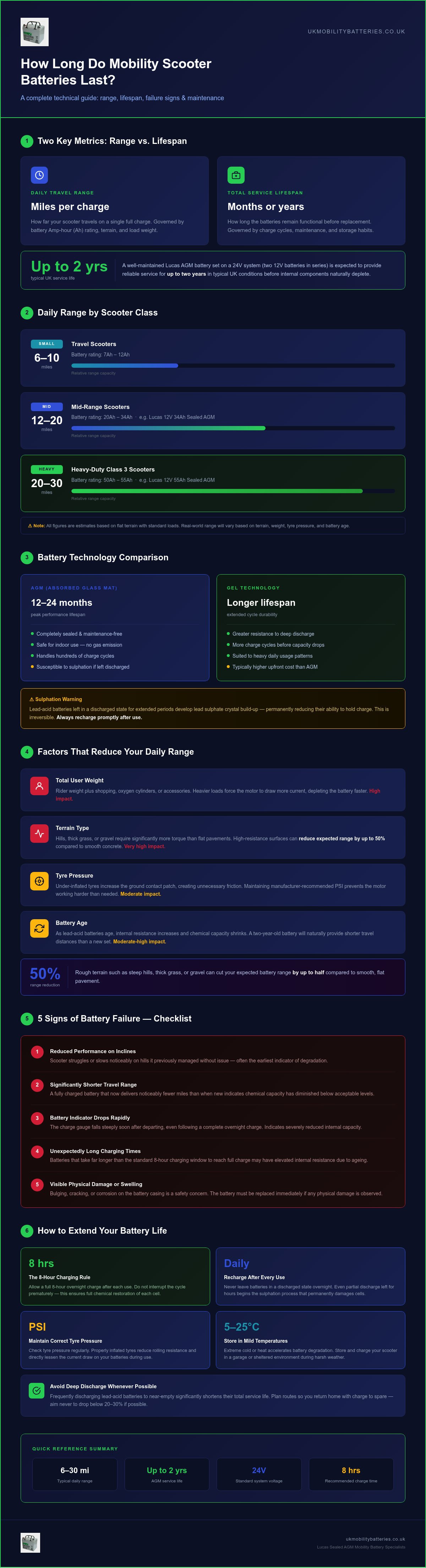
To accurately determine how long do mobility scooter batteries last, you must first distinguish between two separate technical metrics: daily travel range and total service lifespan. Daily range refers to the specific distance your equipment can cover on a single full charge. In contrast, service lifespan denotes the total duration of time, usually measured in months or years, that the batteries remain functional before requiring replacement. It is a common mistake to conflate these two figures, but they are governed by different physical and chemical factors.
Most modern mobility scooters operate using a 24V system. This electrical configuration is achieved by connecting two 12V batteries in series. For example, a pair of Lucas 12V 34Ah Sealed AGM Deep Cycle Batteries provides the necessary voltage and capacity for mid-sized scooters. A high-quality AGM battery typically maintains peak performance for 12 to 24 months. Whilst some users may extend this duration through diligent maintenance, those with heavy daily usage patterns will notice a gradual degradation in performance as the unit approaches the end of its chemical life. Performance often begins to drop amongst users who frequently discharge their batteries to near-empty levels.
Daily Range: How Many Miles Can You Travel?
Daily range is primarily dictated by the Amp-hour (Ah) rating of your battery set. You can view the Ah rating as the size of your scooter's fuel tank. Higher ratings allow for longer journeys between charges. Typical performance expectations include:
- Small Travel Scooters: Usually equipped with 7Ah to 12Ah batteries, these offer a range of approximately 6 to 10 miles per full charge.
- Mid-Range Scooters: Utilising 20Ah to 34Ah batteries, these typically provide 12 to 20 miles of travel.
- Heavy-Duty Class 3 Scooters: Using 50Ah or 55Ah units, such as the Lucas 12V 55Ah Sealed AGM Mobility Batteries, these can cover 20 to 30 miles.
These figures represent estimates based on flat terrain and standard loads. When considering how long do mobility scooter batteries last on a daily basis, you must account for the specific Amp-hour capacity of your installed cells.
Total Lifespan: How Long Before Replacement is Needed?
Total lifespan is measured in charge cycles rather than miles. A single cycle represents one full discharge and a subsequent full recharge. Quality Lucas AGM batteries are engineered to handle hundreds of these cycles before their chemical capacity drops below a functional level. Paradoxically, infrequent use can be just as detrimental as heavy use. If lead-acid batteries are left in a discharged state for long periods, they suffer from sulphation. This process involves the buildup of lead sulphate crystals, which permanently reduces the battery's ability to hold a charge. In typical UK conditions, a well-maintained Lucas battery set is expected to provide reliable service for up to two years before the internal components naturally deplete.
Factors That Dictate Your Daily Battery Range (The Range Checklist)
While manufacturers provide estimated mileage for their equipment, the reality of how long do mobility scooter batteries last on a single charge depends on several operational variables. Range is not a static figure. It fluctuates based on how and where you use your scooter. To get the most out of your 24V system, you should monitor the following technical factors that influence energy consumption.
- Total User Weight: This includes the weight of the rider plus any shopping, oxygen cylinders, or accessories carried on the chassis. Heavier loads require the motor to draw more current, which depletes the battery faster.
- Terrain Type: Driving on steep hills, thick grass, or gravel requires significantly more torque than traveling on flat pavements. High-resistance surfaces can reduce your expected range by half compared to smooth concrete.
- Tyre Pressure: Under-inflated tyres increase the contact patch with the ground, creating unnecessary friction. Keeping tyres at the manufacturer's recommended PSI ensures the motor doesn't have to work harder than necessary.
- Battery Age: As lead-acid batteries age, their internal resistance increases and their chemical capacity shrinks. A two-year-old battery will naturally provide a shorter travel distance than a new set of Lucas mobility batteries.
The Impact of Temperature and Weather
Environmental conditions play a major role in electrical efficiency. Cold UK winters can temporarily reduce battery capacity by up to 30% because the chemical reaction inside the AGM cells slows down in low temperatures. This is a temporary physical effect, but it means your winter journeys will be shorter. You should store your equipment in a dry, temperature-controlled centre rather than a freezing outdoor shed or garage. For more detailed seasonal advice, refer to our guide on winter mobility scooter battery care to prevent permanent damage during the colder months.
Driving Habits and Speed
Your driving style determines your daily energy efficiency. Constant stop-start acceleration consumes significantly more power than maintaining a steady cruising speed. Additionally, using integrated electrical accessories like high-intensity lights, indicators, and heated seats increases the total draw on your power source. For users who frequently use these features or carry extra weight, upgrading to a Lucas 12V 9Ah Uprated Sealed AGM Battery provides a useful capacity buffer. This extra headroom helps maintain a reliable travel range despite high-demand driving habits amongst premium scooter models.
Lifespan Expectations for Different Battery Technologies
The choice of battery technology is the primary technical factor determining how long do mobility scooter batteries last in a real-world setting. There are three main classifications used in the UK mobility market: Sealed Lead Acid (specifically AGM), Gel, and Lithium-Ion. Each technology offers a different balance between initial purchase cost and total service duration. Understanding these differences allows you to select a power source that matches your specific travel frequency and budget.
Sealed Lead Acid (SLA) batteries using Absorbent Glass Mat (AGM) technology are the industry standard. These units, such as the Lucas 12V 34Ah Sealed AGM Deep Cycle Battery, provide a reliable balance of performance and affordability. Whilst Gel batteries can offer a slightly extended lifespan of 18 to 30 months, they carry a significantly higher price point. Lithium-Ion batteries represent the top tier for longevity, often lasting 3 to 5 years, but they are only compatible with specific scooters designed for lithium power and require specialised chargers. For most UK users, Lucas AGM batteries remain the favoured choice for their dependability and safety during transit.
The AGM Advantage for Mobility
Absorbent Glass Mat technology is specifically engineered for the rigours of mobility use. In an AGM battery, the electrolyte is held in a glass-fibre mat between the lead plates. This design makes the unit completely spill-proof and vibration-resistant. It's an essential safety feature for users who transport their scooters in cars or aeroplanes. Because these batteries are sealed, they are maintenance-free. You don't need to check water levels or manage acid leaks. For a deeper look at the technical specifications, you can read our guide on AGM mobility battery benefits. This technology ensures consistent power delivery amongst a wide range of ambient temperatures.
The Relationship Between Capacity and Durability
Battery capacity, measured in Amp-hours (Ah), directly impacts how long do mobility scooter batteries last before they degrade. Larger batteries, such as 50Ah or 55Ah units, generally handle deep discharge cycles better than smaller ones. This occurs because a 5-mile journey might only use 20% of a large battery's capacity, whereas the same journey could use 60% of a smaller battery's energy. Constant deep discharging, where you use more than 50% of the available capacity, shortens the total service life. It is vital to match the correct Ah rating to your scooter's requirements. For those using compact travel scooters, the 12v 7ah battery for mobility scooter is a standard entry-level size that provides sufficient power for local trips whilst keeping the equipment lightweight.
Checklist: 5 Signs of Mobility Scooter Battery Failure
Identifying the precise moment your power source requires replacement is essential for maintaining your independence and safety. When determining how long do mobility scooter batteries last, you must move beyond theoretical cycle counts and observe real-world performance symptoms. These indicators often appear gradually. If you ignore the early signs of degradation, you risk a total loss of power whilst away from your home centre.
- Significant Reduction in Range: If your equipment once covered five miles but now struggles to complete a two-mile local journey, the chemical capacity of the cells has likely depleted.
- Sluggish Performance on Inclines: Motor draw is at its highest on hills. If your scooter crawls or stalls on gradients it previously climbed with ease, the batteries can no longer provide the necessary current.
- Rapid Battery Indicator Fluctuations: Watching the gauge dive into the red as soon as you accelerate, only for it to bounce back when you stop, indicates high internal resistance.
- Extended Charging Durations: If the charger remains on the 'red' or 'amber' setting for more than 14 hours without reaching the 'green' float stage, the internal plates are likely too degraded to accept a full charge.
- Physical Casing Changes: Inspect your battery set for any signs of swelling, bulging, or leakage. Physical deformation is a serious safety hazard and requires immediate replacement of the pair.
Identifying Voltage Drop and Sluggishness
You can perform a basic health check using the 'heavy thumb' test. Whilst the scooter is stationary, observe your battery display and then apply full throttle. A healthy set of Lucas batteries will show a minimal, temporary dip. If the needle or LED bars drop significantly under this load, the batteries are failing to maintain voltage. This often explains why a battery might show as 'full' on the charger but fail within minutes of use. The scooter's own display is a useful diagnostic tool for monitoring these real-time voltage drops before they lead to a breakdown.
Charging Irregularities to Watch For
Be wary of 'false full' charges. This occurs when a charger switches to green almost immediately after being plugged in, despite the scooter having been used. It indicates that the batteries have lost their ability to store energy. Because mobility scooters use a 24V system, a 'dead cell' in just one 12V unit will ruin the performance of the entire pair. If your equipment exhibits these irregularities, consult our guide on mobility scooter battery troubleshooting for advanced diagnostic steps. If you have confirmed a failure, you can find high-performance replacement mobility scooter batteries to restore your travel range and reliability.
How to Extend Your Mobility Scooter Battery Life
Whilst technical specifications provide a baseline, the primary factor in how long do mobility scooter batteries last is the strictness of your charging discipline. Proper maintenance protocol can mean the difference between a battery set that lasts 12 months and one that remains functional for over 24 months. By following a methodical approach to energy management, you can preserve the chemical integrity of your Lucas AGM batteries and maintain a consistent travel range.
The most important habit to adopt is the '8-hour rule'. You should always charge your batteries for at least 8 to 12 hours after every significant use. Modern smart chargers are designed to move through various stages, including a bulk charge and a final 'float' stage. Avoid 'short-cycling' your equipment. If you only plug in the charger for 30 minutes to 'top up' the power, the battery never reaches the essential saturation point required to balance the cells. Continuous short-cycling leads to premature capacity loss.
Never allow your batteries to sit in a flat or heavily discharged state. You should connect your scooter to the charger immediately after returning from a journey. This prevents the chemical process of sulphation, where lead sulphate crystals harden on the battery plates. Once these crystals form, they act as an insulator and permanently reduce the total energy the unit can store. Additionally, always ensure your charger is technically compatible with the Amp-hour rating of your Lucas batteries to avoid under-charging or over-heating the cells.
The Importance of the Initial Charge
The first 24 hours of a battery's life are critical for its long-term performance. When you receive new units, you must charge them for 12 to 24 hours before their first outing. This initial deep charge ensures the chemistry is fully activated. Furthermore, a new battery set requires a 'break-in' period. It typically takes 10 to 15 full charge and discharge cycles before the batteries reach their maximum operating capacity. For more information on maintaining safety during these periods, refer to our expert guide on can you overcharge a mobility scooter battery.
Correct Storage Procedures
Environmental management is vital for preserving battery health during periods of inactivity. You should never store your mobility batteries directly on a cold concrete floor, as this can accelerate the self-discharge rate. Instead, keep the equipment in a dry, temperate environment. If you plan to store your scooter over the winter months, follow the 'top-up' rule. Even when not in use, you should charge the batteries at least once every three to four weeks to counteract natural energy loss. If your current set no longer holds a reliable charge despite these efforts, you can view our full range of replacement mobility batteries with fast UK delivery to restore your independence.
Maintaining Long-Term Mobility and Reliability
Managing how long do mobility scooter batteries last requires a combination of technical awareness and consistent maintenance discipline. By recognising the early indicators of voltage drop and adhering to strict charging protocols, you can ensure your 24V system provides peak performance throughout its service life. High-performance Lucas AGM technology offers the durability needed for daily UK travel, provided you avoid deep discharge cycles and store your equipment in a temperate environment. Understanding the distinction between daily range and total lifespan allows you to plan your journeys with confidence.
We provide expert technical support for all UK customers alongside competitive pricing on all battery sizes. Our specialist focus on Lucas brand batteries ensures you receive dependable power specifically engineered for mobility requirements. Shop our range of premium Lucas mobility batteries with fast UK delivery to restore your travel range and maintain your daily independence. With the right technical care and high-quality cells, you can enjoy reliable, worry-free journeys for many miles to come.
Frequently Asked Questions
Can I leave my mobility scooter on charge all the time?
Yes, you can leave your scooter on charge provided you use a modern smart charger that features an automatic 'float' or 'maintenance' mode. These chargers stop the high-current flow once the battery reaches 100% capacity, preventing internal heat damage. Keeping the charger connected ensures the cells remain at peak voltage and are ready for your next journey without the risk of overcharging.
Should I wait for the battery to be completely flat before charging?
No, you shouldn't wait for the batteries to be completely flat. Deeply discharging lead-acid batteries to near-empty levels causes significant chemical stress and accelerates the buildup of lead sulphate crystals. It's best practice to charge your equipment after every journey, regardless of the distance travelled, to maintain a high state of charge and protect the internal lead plates.
How many years do mobility scooter batteries usually last?
Quality units typically provide between 12 and 24 months of reliable service in standard UK conditions. When considering how long do mobility scooter batteries last, you must account for the specific number of charge cycles and your daily depth of discharge. A well-maintained Lucas AGM battery set is engineered to handle hundreds of cycles before you'll notice a significant decline in travel range or power.
What is the difference between AGM and Gel mobility batteries?
The primary technical difference lies in how the electrolyte is stabilised within the casing. AGM (Absorbent Glass Mat) batteries use a fine fibreglass mat to soak up the acid, making them maintenance-free and spill-proof for transit. Gel batteries use a silica additive to turn the electrolyte into a jelly-like substance; they can offer a slightly longer service life but typically require a higher initial financial investment.
Why does my mobility scooter battery die so fast in the winter?
Low temperatures slow down the chemical reactions inside the battery cells, which temporarily reduces the available capacity. In cold UK winters, you might experience a range reduction of up to 30% compared to summer performance levels. Storing your scooter in a temperature-controlled centre or garage, rather than a freezing outdoor shed, helps to mitigate this temporary loss of electrical efficiency.
Can I replace just one battery if the other is still working?
No, you must always replace mobility batteries in pairs to ensure the 24V system remains balanced. If you install a new unit alongside an old one, the older battery's higher internal resistance will force the new battery to work harder. This imbalance leads to the rapid degradation and premature failure of the new unit, resulting in inconsistent power delivery whilst you're driving.
How do I know what size battery my mobility scooter needs?
You can determine the required size by checking the Amp-hour (Ah) rating printed on the label of your existing batteries. Common sizes for UK scooters include the Lucas 12V 12Ah for travel models or the Lucas 12V 34Ah for mid-sized equipment. It is also essential to measure the physical length, width, and height of the battery tray to ensure technical compatibility with the replacement units.
Do new mobility scooter batteries need to be 'broken in'?
Yes, new mobility batteries require a 'breaking in' period of approximately 10 to 15 cycles to reach their full chemical capacity. You should also ensure the first charge lasts for 12 to 24 hours before your initial outing. During the first few weeks of use, you'll likely notice a gradual improvement in travel range as the lead plates amongst the cells become fully activated.