
Mobility Scooter Battery Connector Types: A Technical Identification Guide
Buying a replacement battery based on your scooter model alone is a technical gamble that often ends with a set of wires that simply do not match. Many owners find themselves confused by the distinction between internal battery terminals and external charging ports; a mistake that can lead to expensive returns or genuine safety risks. Understanding the specific mobility scooter battery connector types used in your device is the only way to guarantee a seamless installation and reliable electrical performance.
We recognise the frustration of purchasing premium power cells only to discover the terminals are the incorrect width for your existing leads. This guide provides a definitive technical identification of every major internal and external connector to ensure your replacement Lucas AGM batteries fit perfectly and perform safely. We shall examine the precise millimetre dimensions of F1 and F2 spade terminals, the utility of Anderson power poles, and the specific configurations of XLR charging ports. You will gain the technical confidence to determine if you need a new wiring harness or if a standard drop-in replacement is sufficient for your mobility needs.
Key Takeaways
- Distinguish between Faston spade terminals (F1 vs F2) and nut-and-bolt inserts to ensure a precise physical fit for your internal wiring harness.
- Identify the most common mobility scooter battery connector types, including the industry-standard 3-pin XLR and coaxial charging ports used on travel scooters.
- Recognise critical signs of connector degradation, such as black soot from arcing or green copper sulphate corrosion, to maintain electrical safety.
- Simplify the replacement process by matching your scooter's amp-hour (Ah) capacity with the correct standardised terminal size found on Lucas AGM batteries.
- Understand the technical requirements for reusing or replacing your scooter's wiring harness when installing new power cells.
Understanding the Mobility Scooter Battery Connector Ecosystem
The mobility scooter battery connector ecosystem represents the critical electrical interface between the battery cells, the motor controller, and the external charger. It is not a single component but a series of interconnected parts that ensure electricity flows safely from the storage cells to the motor. Identifying the correct mobility scooter battery connector types is essential for maintaining battery longevity and operational safety. A mismatched or poorly seated connector can lead to electrical resistance, which generates excessive heat and may eventually cause terminal melting or circuit failure.
Choosing the wrong connector often results in a battery that is physically impossible to install without modifying the original wiring. This can void warranties and compromise the integrity of the scooter's electrical system. For owners of UK mobility equipment, technical accuracy is paramount because the standardisation of parts varies between lightweight travel models and heavy-duty road-legal scooters. When selecting replacement Lucas AGM batteries, ensuring the terminal type matches your harness is the most critical step in the procurement process.
Internal vs External: Where is your connector?
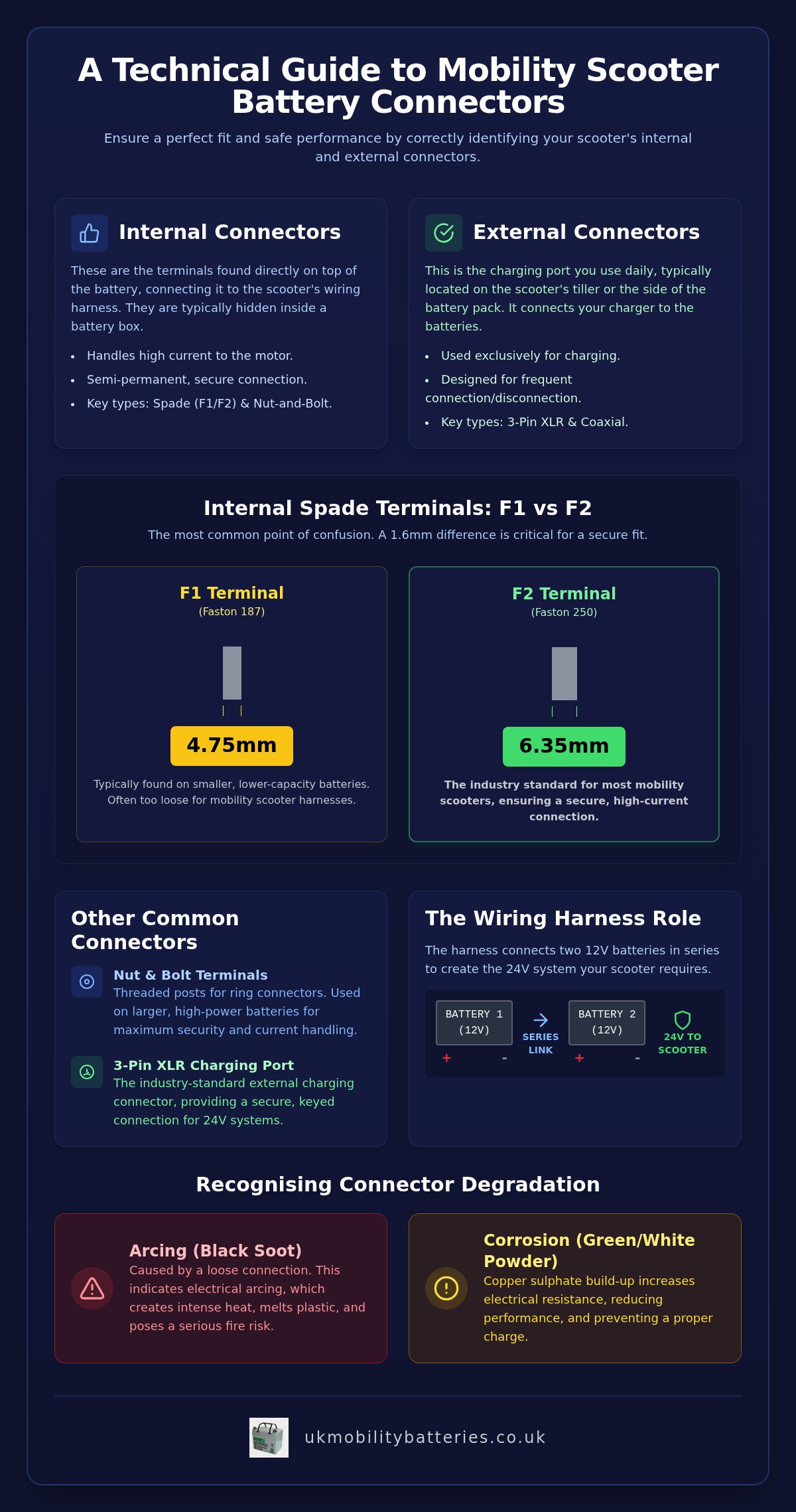
Identifying where your connectors are located is the first step in technical identification. Internal battery terminals are found directly on the top of the battery casing, usually hidden inside a plastic shroud or battery box. These require a secure physical connection to the scooter's wiring harness using either spade terminals or bolt-through connectors. In contrast, the external charging port is the interface you interact with daily. This port is typically situated on the tiller or the side of the battery pack. The wiring harness acts as the bridge, transferring power from the external port to the internal terminals, and finally to the motor controller. External interfaces frequently employ XLR charging port connectors to provide a secure, three-pin connection for 24V systems.
Common Materials and Durability Standards
Reliability in mobility applications depends on the quality of the contact materials used in mobility scooter battery connector types. Most high-quality connectors utilise silver-plated or copper contacts. These metals offer superior conductivity and resist the oxidation that often plagues cheaper alternatives. Durability is further enhanced by robust plastic housings, which are designed to prevent accidental short circuits whilst you are handling the batteries during installation. Within the UK mobility industry, you will find a standardised colour-coding system: red leads signify the positive terminal, whilst black leads indicate the negative. Maintaining these connections is vital, as even minor corrosion on a silver-plated terminal can significantly reduce the range of your scooter by increasing the voltage drop across the system.
Internal Battery Connector Types: Terminals and Harnesses
Internal mobility scooter battery connector types are the physical contact points located directly on the battery casing. These differ from external charging ports because they are semi-permanent connections designed to stay joined whilst the scooter is in operation. Most small-to-mid-sized scooters utilize spade terminals, whereas larger, road-legal models require threaded nut-and-bolt inserts to handle higher current demands. Identifying these correctly is the only way to ensure your wiring loom attaches securely without modification.
The wiring harness, or loom, plays a vital role in the electrical system. Because mobility scooters operate on a 24V system, the harness connects two 12V batteries in series. This is achieved by linking the positive terminal of the first battery to the negative terminal of the second. If your harness shows signs of brittle insulation or loose crimps, it should be replaced alongside your batteries to prevent voltage drops or intermittent power loss.
Spade Terminals: F1 vs F2 Measurements
Spade connectors, often referred to as Faston terminals, are flat metal tabs that protrude from the battery top. They come in two standard widths that are easily confused. F1 terminals measure 4.75mm wide and are typically found on smaller standby batteries. However, F2 terminals, which measure 6.35mm wide, are the standard for most mobility applications. The wider F2 surface area is necessary to manage the sustained amp draw of a mobility motor.
If your harness is fitted with F2 female connectors but you purchase batteries with F1 tabs, the connection will be dangerously loose. This gap causes electrical arcing and can melt the plastic battery shroud. When selecting Lucas 12V 7Ah sealed AGM batteries, always verify that the terminal width matches your existing harness clips for a vibration-resistant fit.
Threaded Insert and Bolt Terminals
High-capacity batteries, generally those 34Ah and above, utilize threaded lead inserts rather than protruding tabs. These are classified by their metric diameter, typically M5, M6, or M8. The scooter's wiring harness ends in a ring terminal, which is secured to the battery using a hex-head bolt and washer. This provides a high-torque, low-resistance connection suitable for deep-cycle applications.
Precision is required during installation. Over-tightening can strip the soft lead threads inside the battery, whilst under-tightening leads to heat buildup. When fitting new batteries to mobility scooter, you must never reuse corroded or rusted bolts. Even a small amount of oxidation on the hardware can impede power flow and reduce your scooter's maximum range. Replacing the hardware ensures the electrical path remains clear and efficient.
For a reliable power solution, you can browse our range of replacement Lucas AGM batteries which feature standardised terminal sizes compatible with most UK mobility harnesses.
External Charging Port Connectors: XLR and Brand-Specific Plugs
Whilst internal terminals facilitate the permanent link between batteries, external mobility scooter battery connector types define how you interface with your charging equipment. The most prevalent standard in the UK mobility industry is the 3-pin XLR connector. This circular, robust plug is designed to handle the 24V output of standard mobility chargers. However, smaller travel scooters and heavy-duty off-road models often deviate from this standard, utilising coaxial barrel connectors or high-current Anderson Powerpoles to suit their specific power profiles.
Proprietary variations are also common amongst major manufacturers such as Pride, TGA, and Shoprider. These brands occasionally utilise brand-specific plug shapes or keyed configurations to ensure users only use the manufacturer's approved charging hardware. Using an incorrect external connector can cause permanent damage to the scooter's charging circuit or the battery controller, making precise identification a prerequisite for any maintenance task.
The 3-Pin XLR: Pin-out Configurations
The standard UK configuration for a mobility XLR plug follows a specific electrical pin-out: Pin 1 carries the Positive (+) charge, Pin 2 carries the Negative (-) charge, and Pin 3 serves as the 'Inhibit' or neutral line. The inhibit function is a critical safety feature; it signals the scooter's controller to disable the motor whilst the charger is physically connected. This prevents the scooter from being driven away while still plugged into a wall socket. If your scooter fails to move after a full charge, a fault in the Pin 3 connection is a frequent culprit.
Technical identification also requires distinguishing between male and female components. On most UK systems, the 'female' socket is located on the scooter tiller or battery box, featuring three recessed holes. The 'male' plug is found on the charger lead, featuring three protruding pins. Ensure these pins are straight and free from debris before every connection to maintain a low-resistance path for the charging current.
Specialised and Legacy Connectors
Beyond the XLR standard, you may encounter several specialised mobility scooter battery connector types based on the age and class of the vehicle:
- Coaxial (Barrel) Connectors: These small, cylindrical plugs are found on lightweight travel scooters. They are typically rated for lower amperages (2A to 3A) and do not feature an inhibit pin.
- Anderson Powerpole Connectors: These genderless, modular connectors are used in heavy-duty applications and quick-release battery packs. They are colour-coded and designed for high-vibration environments.
- 2-Pin Square Connectors: Often found on legacy electric wheelchairs, these are becoming less common but still require specific chargers.
You should perform a regular visual inspection of your charging port. Look for signs of 'burnt' pins, which appear as blackened metal or melted plastic around the contact points. This usually indicates a loose connection that has caused arcing. If you detect these signs, both the charger plug and the scooter socket should be replaced to prevent a fire hazard. Maintaining clean, tight external connections ensures that your Lucas AGM batteries receive a consistent, healthy charge throughout their lifespan.
Troubleshooting Connector Failure and Wear
Connectors often represent the weakest link in a mobility scooter's electrical system. Because these vehicles are subject to constant vibration from pavements and uneven surfaces, the mobility scooter battery connector types you utilise can degrade over time. Identifying failure early prevents total power loss whilst you are away from home. Common indicators of failure include visible arcing, heavy oxidation, and physical loosening of the harness contacts.
Arcing occurs when a connection is loose, causing electricity to jump across a gap. This produces intense heat, which leaves black soot or melted plastic around the battery terminals. Similarly, moisture ingress leads to the formation of copper sulphate, often seen as a 'green crust' on the terminals. This substance acts as an insulator, significantly restricting power flow and causing the scooter to stutter or fail under load. If you experience intermittent power loss, use a multimeter to check for continuity across the wiring harness. A healthy loom should show near-zero resistance from the charging port to the battery terminals.
Visual Inspection Guide
Healthy silver-plated contacts should be bright and reflective, whereas oxidised ones appear dull, grey, or pitted. You should also check for 'heat stress' in the wiring harness; this typically manifests as discoloured, brittle, or hardened insulation near the connector ends. If the plastic has turned brown or yellow, the wire has likely been subjected to excessive current or a poor connection. Finally, test the tension of your spade connectors. They must require a firm, purposeful pull to remove. If they slide off the terminal tab with minimal effort, they will inevitably vibrate loose during travel, leading to a breakdown.
Preventative Maintenance for Connectors
Applying a thin layer of dielectric grease to your terminals is an effective way to protect mobility scooter battery connector types from moisture and atmospheric corrosion. This non-conductive, silicone-based lubricant seals the metal contacts without interfering with the electrical flow. To safely clean terminals, disconnect the batteries entirely to avoid a short circuit. Use a fine wire brush or a dedicated electrical contact cleaner to remove oxidation. However, if the copper wire inside the insulation appears blackened or the terminal tabs are severely pitted, cleaning is only a temporary fix. In these instances, you should replace the entire wiring loom to ensure long-term reliability.
For a more detailed look at electrical issues, refer to our guide on mobility scooter battery troubleshooting. If your inspection reveals damaged terminals that cannot be salvaged, it is time to invest in a new set of high-quality Lucas AGM batteries to restore your scooter's performance and safety.
Selecting Batteries to Match Your Connector Type
The final step in the technical identification process is selecting a battery that aligns with your specific mobility scooter battery connector types. It's not enough to match the voltage; you must ensure the physical terminal interface is compatible with your scooter's current-carrying capacity. Generally, batteries with lower amp-hour (Ah) ratings utilise F2 spade terminals, whilst higher-capacity deep-cycle units require threaded inserts to handle the increased electrical load. Matching these correctly prevents the need for terminal adapters, which can introduce unwanted resistance into the circuit.
Physical dimensions are equally critical. When you install new batteries, you must account for the height of the connectors and the thickness of the wiring harness. If the terminals are too tall or the bolts protrude too far, they may foul the battery box lid, preventing it from closing securely. This can lead to water ingress or mechanical damage to the terminals under the weight of the seat. If you intend to upgrade mobility scooter battery capacity, verify that the new, larger cells still accommodate your original harness without stretching the cables or straining the crimped joints.
The Lucas Advantage: Standardised Fittings
Lucas AGM batteries are the primary choice for UK mobility applications because they adhere to standardised terminal specifications. Whether you require a Lucas 12V 7Ah unit with spade tabs or a 55Ah deep-cycle battery with M6 inserts, the fittings are designed for universal compatibility with standard UK harnesses. This ensures a 'drop-in' replacement experience, eliminating the need for crimping new connectors or modifying the factory loom. The consistency in manufacturing means that the terminal positions remain predictable, allowing your existing harness to reach the contact points without tension.
AGM (Absorbent Glass Mat) technology offers a distinct advantage for connector health. Unlike older gel or flooded cells, these maintenance-free batteries are completely sealed. This prevents the escape of acid vapours that typically cause terminal corrosion and 'green crust' buildup. By choosing Lucas AGM cells, you provide a cleaner environment for your mobility scooter battery connector types, extending the life of both the battery and the wiring harness contacts.
Final Checklist Before Ordering
Before completing your purchase, perform this final technical verification to ensure total compatibility:
- Check 1: Confirm your internal terminals. Are they 6.35mm F2 spades or threaded M5/M6 bolt-on inserts?
- Check 2: Verify your charging port. Is it a standard 3-pin XLR or a specialised coaxial barrel plug?
- Check 3: Inspect the wiring harness. Is the insulation flexible and the contacts bright, or does the loom need replacing amongst the new batteries?
If your connector appears non-standard or you are unsure about the terminal sizing for a specific Lucas model, contact our technical team for bespoke advice. Ensuring the correct interface at the point of purchase prevents installation delays and guarantees the electrical safety of your mobility equipment.
Securing Your Mobility with Technical Precision
Accurate identification of your mobility scooter battery connector types is the final safeguard against electrical failure and mechanical incompatibility. By distinguishing between internal F2 spade terminals and external 3-pin XLR configurations, you ensure your scooter remains both safe and reliable for daily use. Selecting genuine Lucas AGM technology further protects your investment; these maintenance-free cells eliminate the risk of acid vapours corroding your expensive wiring harness.
We provide expert technical support to assist with fitting and compatibility questions, ensuring you receive the correct power solution the first time. Our inventory features standardised fittings designed for seamless integration with the UK's most popular scooter models. You can browse our range of Lucas AGM mobility batteries with standard UK connectors today to benefit from fast UK-wide delivery on all battery orders. Taking the time to verify your terminal measurements now will provide peace of mind and long-term performance on every journey.
Frequently Asked Questions
What is the most common battery connector for mobility scooters?
The 3-pin XLR plug is the industry standard for external charging, whilst F2 spade terminals are the most frequent internal mobility scooter battery connector types. These F2 terminals measure 6.35mm in width and provide the necessary surface area to handle the sustained current required by the motor. Lucas AGM batteries are manufactured with these standard fittings to ensure immediate compatibility with most UK mobility harnesses.
Can I change the connector type on my mobility scooter?
You can technically change a connector, but it requires specialised tools and electrical knowledge. Changing internal terminals involves cutting the existing harness and crimping on new spade or ring connectors to match a different battery type. We advise against modifying external charging ports because it can lead to wiring errors that bypass critical safety features like the inhibit function, which prevents the scooter from moving whilst plugged in.
How do I know if my battery connector is F1 or F2?
You must measure the width of the flat metal tab on top of the battery using a ruler or calliper. An F1 terminal is exactly 4.75mm wide, whilst an F2 terminal is 6.35mm wide. F2 is the standard for mobility applications. If you use F1 batteries in a harness designed for F2, the connection will be loose, leading to electrical arcing and potential melting of the plastic shroud.
Why is my mobility scooter battery connector getting hot?
Heat is almost always caused by electrical resistance at the connection point. This resistance stems from loose terminals, heavy oxidation, or internal wire fatigue within the harness. If your mobility scooter battery connector types feel hot to the touch during or after a journey, you must inspect the tension of the spade clips or the tightness of the terminal bolts immediately to prevent a fire hazard.
Are all 3-pin XLR chargers the same for mobility scooters?
No, they're not universal. Whilst the physical shell is the same, the internal pin-out and the output amperage can differ between manufacturers. Most UK scooters use Pin 1 for Positive and Pin 2 for Negative, but some legacy models vary. Always verify that the charger's output matches your battery's capacity to avoid overcharging or damaging the internal plates of your AGM cells.
What should I do if my battery terminals are corroded?
Minor corrosion can be removed using a fine wire brush or a dedicated electrical contact cleaner whilst the batteries are disconnected. If the metal is deeply pitted or the copper wire inside the harness has turned black, cleaning won't restore a safe connection. In these cases, you must replace the harness to maintain the performance and safety of your new Lucas batteries.
Do new batteries come with the wiring harness included?
Replacement batteries are typically sold as individual units and don't include the wiring harness. You're expected to transfer your existing loom from the old batteries to the new ones during installation. If your harness is brittle or the connectors are loose, we recommend purchasing a replacement loom alongside your new power cells to ensure a reliable electrical path for the motor.
Can I use a different charger if the connector fits the port?
You should only use a different charger if the voltage, amperage, and pin configurations are identical to your original equipment. Even if the plug fits, a charger designed for lithium batteries will destroy AGM cells due to different charging profiles. Using a charger with an excessively high amp rating for smaller batteries, such as 7Ah or 12Ah units, can cause the batteries to overheat and swell.