
Can I Upgrade My Mobility Scooter Battery? The Technical Guide to Uprating and Range Extension
What if your travel scooter could cover significantly more ground simply by utilising the latent space already available inside your battery box? Many users find themselves asking, "can I upgrade mobility scooter battery packs to get more range?" and the answer is usually a definitive yes, provided you understand the specific technical constraints of your equipment. You likely value the independence your scooter provides, but that freedom feels limited when you are constantly checking the charge meter or worrying about being stranded whilst out on an essential trip.
It is a common frustration to find that standard factory-fitted batteries do not quite meet your daily mileage requirements or long-term performance expectations. This guide promises to show you how to safely increase your range by selecting uprated specifications, such as moving from a standard 7Ah to a high-performance Lucas 9Ah unit within the same physical footprint. We will detail exactly how to check your tray dimensions, explain the practical benefits of deep-cycle AGM technology, and outline how eligible UK users can claim 0% VAT relief on their replacement batteries to ensure a cost-effective and reliable upgrade.
Key Takeaways
- Understand that when asking "can I upgrade mobility scooter battery" units, you are usually looking to increase the Amp-Hour (Ah) rating whilst maintaining the required 12V voltage for each battery in your 24V system.
- Learn how uprated battery models, such as the Lucas 12V 9Ah, provide higher capacity and extended range within the exact physical dimensions of a standard 7Ah unit.
- Master the essential "Will it Fit?" checklist, covering precise physical dimensions, terminal types like F1 and F2 spade connectors, and battery charger compatibility.
- Compare the performance benefits of moving from standard AGM to high-performance Deep Cycle AGM or Gel alternatives to suit your specific daily usage patterns.
- Follow a methodical selection process to identify your current battery specifications and find the maximum compatible capacity that will fit securely within your existing battery tray.
Understanding Mobility Scooter Battery Upgrades: Capacity vs. Range
Many users ask, "can I upgrade mobility scooter battery units to achieve better performance?" A technical upgrade refers specifically to increasing the Amp-Hour (Ah) rating of the power source whilst keeping the voltage identical to the manufacturer's original specification. Most modern scooters utilise a 24V system. This is achieved by connecting two 12V VRLA (Valve-Regulated Lead-Acid) batteries in series. Replacing your batteries is simply a maintenance task to restore original performance. An upgrade involves selecting a higher capacity model to enhance the vehicle's utility and endurance.
Users typically seek these improvements to gain a greater travel range or better performance on inclines. A higher capacity battery also tends to have a longer overall lifespan. This is because a larger battery undergoes shallower discharge cycles during typical daily use. Shallow cycles put less stress on the internal lead plates compared to deep discharges. If you find your current range insufficient for your daily schedule, an upgrade is the most direct solution.
The Role of Amp-Hours (Ah) in Scooter Performance
Think of Amp-Hours as the size of your scooter's fuel tank. A higher Ah rating means the battery can deliver a specific amount of current for a longer duration. If you move from a 7Ah to a 9Ah setup, you are effectively increasing your potential mileage. It's vital to understand that upgrading the Ah does not increase the top speed of the scooter. Speed is governed by the motor and controller settings. Instead, you are gaining endurance. You can travel further between charges without the anxiety of a flat battery. This extra capacity is especially useful if you regularly navigate hilly terrain or carry heavy shopping.
Voltage Consistency: The Golden Rule of Upgrading
You must never alter the voltage of your system. If your scooter requires a 24V input (two 12V units), you cannot install 24V batteries or attempt to bypass the original configuration. Doing so will blow the electronic controller or cause permanent damage to the motor. For a deeper look at basic system setups, consult The Ultimate Guide to Mobility Scooter Batteries UK which covers selection and care in detail. Keeping the voltage consistent is the primary safety requirement. Your upgrade should focus entirely on the Ah rating within the physical limits of your battery tray.
Uprated Batteries: Maximising Power Within the Same Physical Footprint
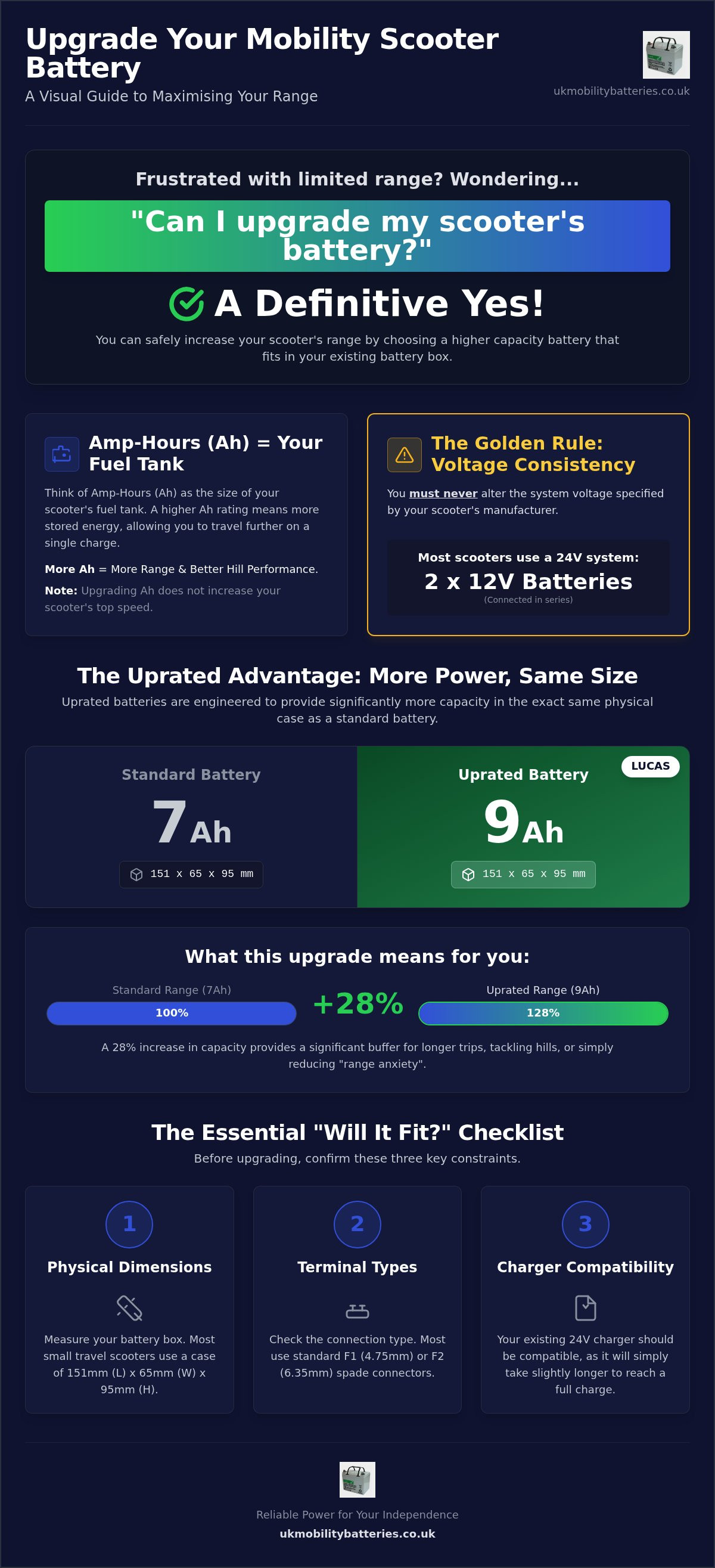
The concept of uprating provides a direct answer for those wondering "can I upgrade mobility scooter battery" systems without modifying the vehicle itself. An uprated battery is designed to provide a higher Amp-Hour capacity within the exact same physical casing as a lower-rated model. This is particularly common with small travel scooters that typically use a 7Ah battery. By switching to an uprated 9Ah model, you gain a 28% increase in total energy storage without needing to alter your battery box or tray.
This capacity boost is achieved through denser internal plate construction and improved chemical efficiency. For users of lightweight, boot-sized scooters, this extra capacity translates into more reliable performance, especially when tackling steeper inclines or operating in cold winter temperatures where battery efficiency naturally drops. Uprating is the most efficient method to extend your daily range whilst maintaining the portability of your current scooter.
The Lucas 12V 9Ah Advantage
The Lucas 12V 9Ah Uprated battery is specifically engineered to replace standard 7Ah units. It maintains the industry-standard dimensions of 151mm (Length) x 65mm (Width) x 95mm (Height). This precision ensures a drop-in fit for almost all travel scooters using the standard small battery box.
The performance gains are practical rather than theoretical. With a 28% larger energy reserve, you have a significant buffer for those days when you need to travel slightly further than usual. This extra density also means the battery doesn't have to work as hard to provide the same output, which can contribute to a longer service life. If you are currently using standard 7Ah units, you can view our range of uprated Lucas mobility batteries to find a compatible replacement.
When to Choose Uprated AGM over Standard
Choosing an uprated 9Ah battery is a cost-effective alternative to purchasing a new, larger scooter simply to gain more range. It is an efficient way to breathe new life into an existing travel scooter that struggles to complete your desired routes. When performing this upgrade, you must replace both batteries in the 24V pair at the same time. Installing a new 9Ah battery alongside an old 7Ah unit will cause an electrical imbalance; this will lead to the premature failure of the new cell.
Another benefit of this specific upgrade is charger compatibility. Because the 9Ah model still utilises standard Absorbent Glass Mat (AGM) technology, you do not need to purchase a specialised charger. Your existing 2A or 3A off-board charger will work perfectly. It will simply take a slightly longer period to reach a full state of charge due to the increased capacity. This makes the 9Ah uprate the simplest technical upgrade available for the travel scooter market.
Essential Constraints: Dimensions, Terminal Types, and Charger Compatibility
When assessing "can I upgrade mobility scooter battery" options, the primary barrier is often physical space rather than electrical capacity. Every scooter has a fixed battery tray or shroud designed for a specific case size. You must verify the length, width, and height of the replacement unit before purchase. A common error is measuring only the old battery casing and neglecting the height of the terminals. If the terminals sit too high, they may contact the metal underside of the seat or the battery box lid, creating a short-circuit risk.
Weight is another critical factor often overlooked during an upgrade. Increasing the Amp-Hour rating requires more lead plates, which adds mass. For example, moving from a 12Ah to a Lucas 12V 20Ah Mobility Battery adds several kilograms to each pack. If you frequently lift your battery boxes into a car boot, ensure the increased weight remains manageable for your physical capabilities. The added weight also places a slightly higher load on the motor, though this is usually offset by the increased energy density.
Charger output must also be considered. A standard 2A charger provided with small travel scooters is technically compatible with larger 20Ah upgrades, but the charging duration will increase. To calculate the approximate time, divide the battery capacity by the charger output. A 20Ah battery will take approximately 10 hours to charge from empty using a 2A charger. If you upgrade to much larger 50Ah or 75Ah units, you will likely need to move to a 5A or 8A charger to maintain sensible charging cycles.
Measuring Your Battery Box Correctly
Always measure the internal clear space of the battery shroud rather than just the dimensions of the existing units. This allows you to see if there is any "dead space" that could accommodate a larger battery casing. Ensure there is at least 5mm of clearance around the sides to allow for heat dissipation and easy removal. The C-rating of a mobility battery indicates the rate at which a battery is discharged relative to its maximum capacity, which is essential for calculating how much of that upgraded range is actually usable under constant load.
Terminal and Connector Compatibility
Before ordering, you must perform the task of identifying terminal types used on your current setup. Most small scooters use F1 (4.75mm) or F2 (6.35mm) spade connectors. Larger batteries, such as the Lucas 34Ah range, typically use nut-and-bolt or "flag" terminals. Never attempt to crimp or modify original wiring looms to force a fitment. Using incorrect connectors or loose adapters creates electrical resistance, which generates heat and can melt the plastic battery casing or damage the scooter's controller.
Technology Upgrades: Moving from Standard AGM to High-Performance Solutions
When evaluating if you can upgrade mobility scooter battery performance, the internal chemistry is as critical as the external dimensions. All modern mobility batteries are sealed lead-acid (SLA) variants. This means they are maintenance-free and do not require topping up with water. However, the internal construction varies significantly between standard standby units and high-performance deep cycle models. Choosing the right technology ensures your scooter handles daily demands without premature capacity loss.
The primary choice for most UK users remains between Absorbent Glass Mat (AGM) and Gel technologies. Standard AGM batteries are cost-effective and provide reliable power for moderate use. In contrast, Gel batteries utilise a thickened silica electrolyte. This makes them more resilient to deep discharge and high vibration, though they carry a higher initial price point. For most mid-range scooters, a high-quality Deep Cycle AGM unit represents the best balance of performance and value for money.
The Deep Cycle Advantage
Deep cycle batteries are engineered specifically for the repetitive discharge and recharge cycles required by mobility equipment. Unlike standby batteries used in emergency lighting, which are designed for rare power outages, deep cycle models like the Lucas 12V 34Ah Sealed AGM Deep Cycle Battery feature thicker lead plates. These robust plates withstand the chemical stress of being drained to 50% or more on a daily basis. Standard plates would warp or shed material under this load.
Using the wrong technology is a primary cause of premature failure. If you install a standard standby battery in a scooter, it will likely lose its ability to hold a charge within months. You can read more about identifying these issues in our guide to troubleshooting battery failure. Selecting a purpose-built mobility battery ensures your upgrade provides the longevity you expect from a premium brand like Lucas.
Is Lithium Worth the Upgrade?
By July 2026, Lithium-ion (specifically LiFePO4) technology has become increasingly accessible in the UK market. These batteries offer a lifespan of 8 to 15 years and a weight reduction of up to 70% compared to lead-acid equivalents. This is a significant advantage for users who must regularly dismantle their scooters for transport. Whilst Lithium offers these benefits, it is not a simple drop-in replacement for every vehicle.
Lithium batteries require a dedicated charger with a specific profile to avoid cell damage. Additionally, many older scooter controllers are calibrated for the steady voltage drop of lead-acid batteries. They may not accurately report the remaining charge of a Lithium unit, which maintains a high voltage until it is nearly depleted. For these reasons, high-quality AGM batteries remain the favourite for reliability and predictable performance. You can order premium Lucas mobility batteries directly from our online store to ensure your upgrade meets these technical standards.
Step-by-Step Guide to Selecting and Fitting Your Battery Upgrade
Successfully executing an upgrade requires a methodical approach to ensure compatibility and safety. If you have determined that you can upgrade mobility scooter battery capacity within your existing tray, follow these five technical steps to complete the transition. This process ensures that your new power source integrates perfectly with your scooter's electrical system without causing mechanical strain or electrical faults.
- Step 1: Document Current Specifications. Identify the Amp-Hour (Ah) rating on your existing battery labels and record the precise physical dimensions (Length x Width x Height).
- Step 2: Research Uprated Alternatives. Look for batteries with a higher Ah rating that share the same footprint, such as moving from a 7Ah to a 9Ah unit or a 12Ah to a 14Ah unit.
- Step 3: Verify Terminal Layout. Check if your batteries use Layout 0 or Layout 1 configurations. Terminal positions must match your original units to ensure the existing wiring loom reaches the connectors without tension.
- Step 4: Purchase Matched Pairs. Always replace both batteries simultaneously. Mixing different capacities or ages leads to unbalanced charging, which causes the weaker battery to fail prematurely.
- Step 5: Secure Fitting. Place the batteries into the tray and ensure they are seated firmly. For bolt-through terminals, apply the correct torque to ensure a vibration-resistant connection.
The Fitting Process: Safety First
Electrical safety is essential during the installation phase. You should always disconnect the negative (black) terminal first to prevent accidental sparking if your spanner touches any metal part of the scooter frame. Before attaching the new units, clean the cable connectors with a wire brush to remove any existing oxidation. Applying a thin layer of petroleum jelly to the terminals after tightening helps to prevent future corrosion and maintains a high-quality electrical contact. You must recycle your old lead-acid batteries at a local authorised recycling centre to ensure they are processed according to environmental regulations.
Post-Installation: Calibrating Your New Upgrade
Your new batteries require a specific initialisation routine to reach their peak performance levels. Perform a "first charge" of 12 to 14 hours before your first trip, regardless of what the charger's indicator light suggests. This initial long soak ensures that both 12V units are perfectly balanced at a full state of charge. New lead-acid batteries typically require a "breaking-in" period of 15 to 20 discharge cycles before the internal chemistry reaches its maximum capacity. For comprehensive advice on long-term maintenance and charging protocols, consult our Expert Guide to Battery Care to maximise the lifespan of your upgrade.
Maximising Your Scooter's Range and Reliability
Determining if you can upgrade mobility scooter battery specifications requires balancing technical constraints with your specific range requirements. You now understand that uprating from a standard 7Ah to a 9Ah unit provides a 28% capacity increase within the same physical footprint. Success relies on ensuring your replacement units match the original voltage and physical dimensions whilst providing the robust deep cycle performance necessary for daily use. Always prioritise matched pairs and correct terminal layouts to maintain the electrical integrity of your vehicle.
As an official Lucas battery stockist, we provide high-performance solutions designed for the UK mobility market. Our team offers specialist technical support to help you identify the correct uprated specifications for your specific model. We ensure your independence is maintained through reliable power and fast, national delivery across the United Kingdom. Take the next step in extending your travel distance today and regain confidence in your equipment's performance.
Shop our range of Lucas Uprated Mobility Batteries for fast UK delivery
Frequently Asked Questions
Can I replace my 34Ah batteries with 50Ah ones for more range?
Yes, you can replace 34Ah batteries with 50Ah models if the physical dimensions of your battery tray allow it. The Lucas 12V 50Ah Mobility Battery is physically larger than the 34Ah version, so measuring the internal clear space of your compartment is essential before purchase. This upgrade provides a substantial range increase but adds significant weight to the scooter. You should also verify that your charger can handle the increased capacity within a reasonable timeframe to avoid undercharging.
Will an uprated 9Ah battery damage my small travel scooter?
An uprated 9Ah battery won't damage your small travel scooter because the voltage remains a consistent 12V. The scooter's controller only draws the power it needs to operate the motor at any given time. Using a Lucas 12V 9Ah Uprated Sealed AGM Battery simply provides a larger energy reserve for your travels. This allows for longer trips and better performance in cold weather without risking any electrical damage to the vehicle's internal components or wiring loom.
Do I need a new charger if I upgrade to a higher amp-hour battery?
You don't always need a new charger, but your existing unit will take longer to complete a full charging cycle. If you significantly increase capacity, for example from 12Ah to 50Ah, a standard 2A charger will take over 20 hours to reach 100%. This can lead to undercharging if you use the scooter daily. We recommend moving to a higher output charger, such as a 5A or 8A model, to maintain healthy charging patterns and ensure the batteries are ready for use.
Can I mix a new upgraded battery with one of my old batteries?
No, you must never mix a new upgraded battery with an old one in your scooter's 24V system. Batteries connected in series must have identical internal resistance and capacity to charge and discharge evenly. An older battery will have a different chemical profile, which causes the new battery to overcharge or work harder than intended. This imbalance results in the premature failure of both units, effectively wasting your investment in the new uprated battery.
How much extra range will I get by upgrading from 12Ah to 14Ah?
Upgrading from 12Ah to 14Ah typically provides an approximate 15% increase in your travel range. Whilst this sounds modest, it provides a vital energy buffer for navigating steeper hills or operating during winter months when battery efficiency naturally drops. When users ask "can I upgrade mobility scooter battery" units for more mileage, we suggest checking tyre pressure and load weight too. These factors influence the final distance you can cover alongside the increased amp-hour capacity.
Is it difficult to fit upgraded batteries myself?
Most users find it relatively easy to fit upgraded batteries using basic household tools like a spanner or a cross-head screwdriver. Many modern scooters feature a simple plastic shroud or a removable battery box that opens with just a few screws. You must follow a methodical approach by disconnecting the negative terminal first to avoid sparks. If your upgrade uses different terminal types, such as moving from spade connectors to bolt-on terminals, ensure you have the correct connectors before starting the job.
Will upgrading my battery void my mobility scooter's warranty?
Upgrading to a higher capacity battery shouldn't void your scooter's warranty, but you should always verify the manufacturer's specific terms first. Batteries are generally viewed as consumable parts that require regular replacement throughout the vehicle's life. As long as the voltage is correct and the installation doesn't damage the wiring or controller, the warranty usually remains intact. Some manufacturers might insist on specific brand specifications, so checking your manual before purchasing an uprated Lucas battery is a wise precaution.
What should I do if the upgraded batteries are slightly too tall for the box?
If the upgraded batteries are too tall for the box, you must not attempt to force the lid closed or modify the casing. Terminals that sit too high can touch the metal underside of the seat or the frame, which creates a dangerous short-circuit risk. You must ensure there is at least a 5mm clearance between the terminal tops and any part of the scooter frame. If they don't fit safely and securely, you'll need to revert to a standard height model to maintain safety.