
Mobility Scooter Batteries: UK Winter Guide (2026)
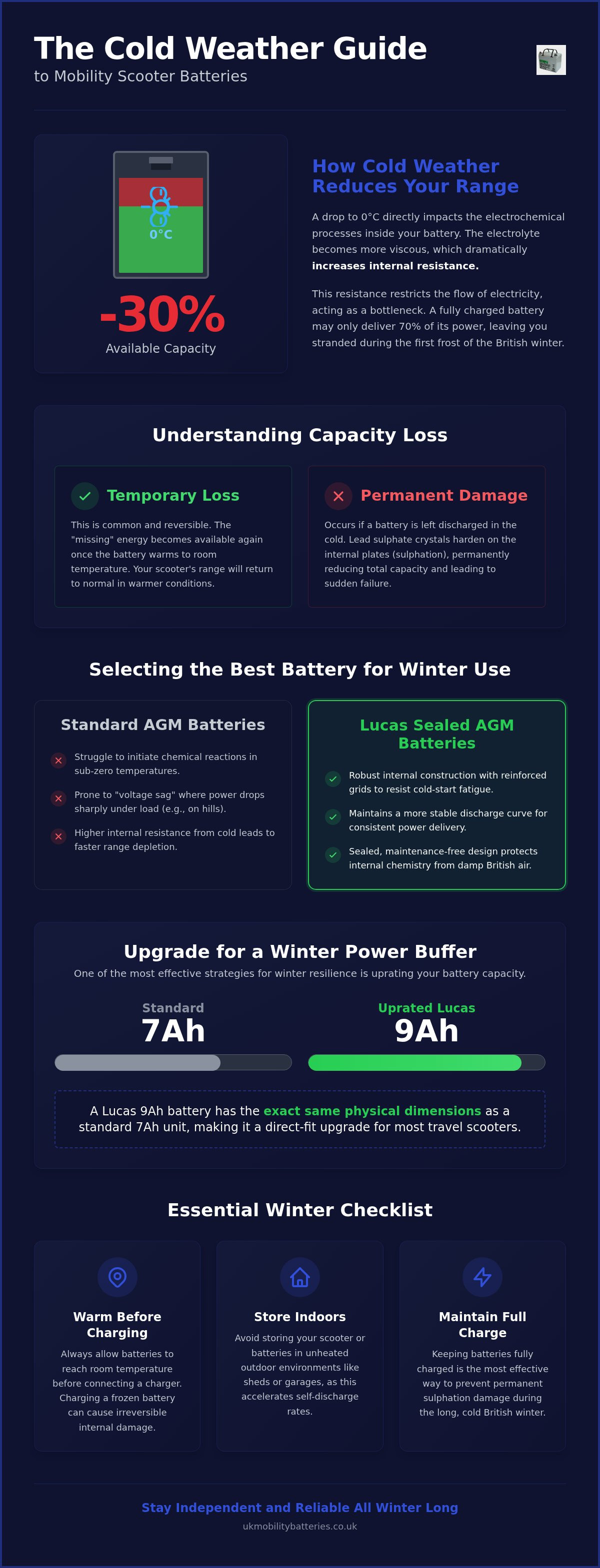
A drop in temperature to 0°C can instantly reduce your battery's available capacity by up to 30%. This chemical throttling is the primary reason many users find themselves stranded during the first frost of the British winter. It is a common frustration to plan a journey only to watch your battery indicator drop far faster than usual. This leads to a genuine fear of the scooter cutting out in a public place or leaving you unable to return home. Selecting the right mobility scooter batteries for cold weather is essential for maintaining independence during the colder months.
You don't have to accept a significant loss in performance just because the temperature drops. This guide provides the technical data you need to protect your travel range and choose the most resilient power cells for the UK climate. You will learn how to maintain your current setup, why specific brands like Lucas handle the cold more effectively, and the exact charging routine required to keep your scooter operational. We provide a clear, professional breakdown of winter battery management to ensure your equipment remains dependable regardless of the weather.
Key Takeaways
- Understand how internal resistance at 0°C reduces battery capacity by up to 30% and impacts your winter travel range.
- Identify why Lucas sealed AGM units are the most resilient mobility scooter batteries for cold weather compared to standard alternatives.
- Discover the advantages of upgrading to uprated 9Ah batteries to provide a necessary power buffer during the British winter.
- Learn the essential safety protocol of allowing batteries to reach room temperature before connecting a charger to prevent internal damage.
- Optimise your storage strategy to avoid the accelerated self-discharge rates common in unheated outdoor environments like sheds.
How Cold Weather Affects Mobility Scooter Battery Performance
Dropping temperatures directly impact the electrochemical processes within a sealed lead-acid battery. In a standard AGM unit, the electrolyte is held in absorbent glass mats. As the temperature falls, this electrolyte becomes more viscous, which significantly increases internal resistance. This resistance acts like a bottleneck; it restricts the flow of electrical current and makes it harder for the battery to deliver power to the motor. Consequently, a battery that provides 100% capacity at 25°C may only deliver 70% to 80% of its rated capacity when the temperature hits 0°C. Selecting high-quality mobility scooter batteries for cold weather is vital to mitigate these effects and maintain a consistent travel range.
The Chemistry of Cold: Why AGM Batteries Slow Down
Temperature serves as a thermal catalyst; lower temperatures reduce the kinetic energy of ions, which slows their movement through the electrolyte in sealed lead-acid units. This physical slowdown means that a battery might show a full charge on a digital display whilst stationary, but fail to maintain that voltage under load. You might notice the battery gauge dip sharply when climbing a hill or moving off from a standstill. Winter conditions in the UK often involve damp ground, leaf mulch, or mud, which increases rolling resistance for the scooter's tyres. This combination of increased mechanical demand and reduced chemical efficiency leads to rapid range depletion. Understanding how batteries work in the cold helps users anticipate these performance shifts before they become problematic during a journey.
Temporary vs Permanent Capacity Loss
Capacity loss in winter is typically temporary. The missing energy becomes accessible again once the battery core warms up to room temperature amongst other environmental factors. However, cold weather can lead to permanent degradation if the charge level drops too low. When a battery is left in a discharged state in freezing conditions, lead sulphate crystals can harden on the internal plates. This process, known as sulphation, reduces the active surface area available for chemical reactions and permanently lowers the battery's total capacity. Older batteries often fail the first frost test of the year because their internal resistance is already high due to age. The additional strain of the cold pushes them beyond their operational limits, often leading to a sudden failure where the scooter cuts out unexpectedly. Maintaining a high state of charge is the most effective way to prevent this permanent damage whilst navigating the British winter.
Selecting the Best Mobility Scooter Batteries for Winter Use
Choosing the right hardware is the most effective way to counter the capacity drops described previously. Whilst standard batteries may suffice in summer, the British winter requires a higher specification of cell design. Lucas Sealed AGM batteries are the preferred choice for this climate due to their robust internal construction and deep-cycle capabilities. These units are designed to withstand the higher internal resistance caused by low temperatures without compromising the integrity of the lead plates. Reliability is not just about the brand; it is about the physical thickness of the internal components and their ability to sustain a chemical reaction in sub-zero conditions.
The Lucas Advantage: Reliability in Low Temperatures
Premium manufacturing standards directly influence how a battery performs under thermal stress. Lucas 12V 7Ah Sealed AGM Batteries feature reinforced internal grids that resist cold-start fatigue. In cheaper alternatives, the chemical reaction often struggles to initiate in sub-zero temperatures. This leads to voltage sag where the scooter lacks power even when the gauge shows a partial charge. Lucas units maintain a more stable discharge curve. Their maintenance-free design is particularly beneficial amongst winter users who cannot easily access battery terminals for inspection during inclement weather. These batteries remain sealed, preventing electrolyte evaporation and protecting the internal chemistry from the damp British air.
Uprating Your Capacity for a Winter Buffer
One of the most effective strategies for winter resilience is uprating your battery capacity. Many travel scooters come standard with 7Ah units, but these can often be replaced with a Lucas 12V 9Ah Uprated Sealed AGM Battery. The physical dimensions of the 9Ah unit are identical to the 7Ah version. This means it fits into the same battery box without any modification. This extra 2Ah provides a 28% increase in raw capacity. This acts as a vital insurance policy. When the cold throttles your battery by 20%, the uprated unit still provides more usable energy than a standard battery would at room temperature. You can find more details on this in our ultimate guide to mobility scooter batteries UK.
When selecting mobility scooter batteries for cold weather, always verify the Amp-hour (Ah) rating against your typical daily mileage. For larger scooters, moving from a 34Ah to a 50Ah or 55Ah unit provides a significant safety margin for longer trips in the frost. It is essential to ensure that whilst you increase the capacity, the physical footprint remains compatible with your scooter tray. Checking dimensions is a simple but critical step. If you are preparing your vehicle for the months ahead, you can view the full range of winter-ready batteries to find the correct fit for your specific model.
Essential Winter Charging Protocols to Prevent Range Loss
Charging mobility scooter batteries for cold weather requires a shift from standard summer habits. The chemical resistance discussed earlier doesn't just affect power output; it also impacts how the battery accepts current. Charging a battery when its internal temperature is near freezing can lead to permanent cell damage and significantly reduced service life. To maintain the health of your Lucas AGM units, you must adjust your charging rhythm to account for the thermal environment.
The "Warm-Up" Rule: Avoiding Thermal Shock
Plugging in your charger immediately after returning from a cold trip is a common mistake. Cold batteries have higher internal resistance, and forcing current into them can cause "gassing," where the electrolyte breaks down and escapes through safety valves. The optimal charging temperature for AGM units is typically between 15°C and 25°C. You must allow the battery core to stabilise before introducing a charge.
Follow these steps to acclimatise your equipment safely:
- Bring the scooter or battery pack into a heated hallway or room.
- Wait for at least 60 to 90 minutes to allow the internal core temperature to rise naturally.
- Ensure the battery casing feels neutral to the touch before connecting the charger.
- Avoid placing the battery directly against a radiator, as rapid, uneven heating can warp the internal plates.
Winter Charging Frequency and Duration
Winter demand requires a full deep-charge cycle rather than short bursts. A quick one-hour "top-up" is ineffective because the final 10% of capacity, known as the "float" stage, takes the longest to achieve in cold conditions. You should aim for a continuous 8-12 hour charging period. This duration ensures the chemistry is fully balanced and the voltage is topped up to its maximum potential. Using a smart charger is highly recommended whilst the scooter is idle, as it will automatically switch to a trickle charge once the battery is full.
Even if you don't use the scooter for several days, the batteries should still be charged at least once a week. Self-discharge rates can fluctuate in unheated environments. Letting the voltage drop too low in the frost can lead to the plates freezing, which causes the casing to bulge and crack. If your unit has been left flat in the cold and fails to take a charge even after warming up, you may need to follow our technical guide on how to change mobility scooter batteries to restore your vehicle's reliability. Consistent charging is the most effective way to prevent the sulphation that typically occurs during the British winter.
Safe Storage and Maintenance During the British Winter
Correct storage is as critical as charging technique when managing mobility scooter batteries for cold weather. Many users store their scooters in unheated sheds or garages, which can act as "battery killers" during a typical British winter. These environments often fluctuate in temperature and suffer from high humidity. When a battery is left in a freezing, damp environment, the casing can contract and the internal chemistry can stabilise at a point where it no longer responds to a standard charger. If you cannot store the entire scooter indoors, you should remove the battery pack and keep it in a dry, room-temperature environment to preserve its service life.
Managing Self-Discharge in the Cold
All lead-acid batteries experience a natural phenomenon called self-discharge, where they lose energy even when not in use. Whilst cold temperatures actually slow down the internal chemical reactions that cause self-discharge, the damp conditions found in UK outbuildings can create conductive paths across the battery surface. This leads to a faster drain than expected. If you are storing your scooter for several weeks, using a dedicated trickle charger or "battery tender" is the most effective solution. This device monitors the voltage and provides small amounts of current only when needed. For units that have been left for months and fail to respond, consult our guide on mobility scooter battery troubleshooting to identify if the cells are recoverable or require replacement.
Protecting Terminals from Damp and Salt
Winter road conditions introduce salt and grit, which can easily find their way into the battery compartment. Combined with condensation from the damp air, this creates a corrosive environment for electrical connections. Corroded terminals increase electrical resistance, which forces the battery to work harder and reduces your overall range. Amongst your regular maintenance tasks, you should inspect the terminals for any white, powdery deposits. Cleaning these with a wire brush and applying a thin layer of petroleum jelly or a dedicated terminal protector spray creates a moisture-proof barrier. Ensure the battery box remains dry by wiping away any visible condensation after a trip. If your current connections are heavily corroded or the battery casing is bulging, it is safer to order a replacement Lucas battery set to ensure reliable performance during the frost.
Organising a monthly health check is essential for any equipment stored over the off-season. This simple routine prevents the voltage from dropping below the critical 12.0V threshold, which is the point where permanent sulphation begins. A quick visual inspection and a full 12-hour charge once every four weeks will keep the internal lead plates active and ready for use when the weather improves. This methodical approach ensures your mobility scooter batteries for cold weather remain a dependable asset rather than a point of failure.
Upgrade Your Power: Premium Lucas Batteries for All-Weather Reliability
UK Mobility Batteries acts as a national specialist for Lucas sealed AGM products. When your current equipment fails during the first frost, you need a dependable replacement that matches the specific requirements of the British climate. We provide a comprehensive range of mobility scooter batteries for cold weather, ensuring that every user, from travel scooter owners to heavy-duty vehicle operators, can find a compatible power solution. Our inventory is organised by capacity and physical dimensions to simplify the technical selection process.
The Lucas range is designed to cover all major scooter classifications:
- Lucas 12V 20Ah Mobility Battery: Ideal for compact, boot-style travel scooters.
- Lucas 12V 34Ah Sealed AGM Deep Cycle Battery: A standard fit for many mid-range pavement scooters.
- Lucas 12V 50Ah and 55Ah Sealed AGM Mobility Batteries: Engineered for large, road-legal Class 3 vehicles.
Identifying the correct replacement requires checking the Amp-hour (Ah) rating and the physical footprint of your existing units. We provide technical dimension charts for every product to ensure a precise fit within your battery tray. This prevents the common issue of ordering a battery that is electrically compatible but physically too large for the compartment.
Why Choose Lucas AGM Technology?
Lucas AGM technology is engineered for high-stakes reliability. These batteries feature deep-cycle capabilities, which means they can handle the repeated discharge and recharge cycles typical of winter use without significant degradation. The sealed, spill-proof design is maintenance-free. This allows for safe indoor storage and charging as recommended in our thermal management protocols. This robust construction is essential for both electric wheelchairs and scooters, providing a steady voltage output even when external temperatures drop towards freezing. The internal lead plates are thicker than those found in budget alternatives, offering better resistance to the chemical throttling caused by the cold.
Fast Delivery to Get You Moving Again
A battery failure often occurs unexpectedly when the temperature first drops. Our direct-to-consumer model focuses on speed and efficiency. We offer fast national delivery across the UK to ensure you aren't housebound due to equipment failure. For those using specialised mobility aids, you can also view our selection of the best batteries for electric wheelchairs to find all-weather alternatives. Selecting premium mobility scooter batteries for cold weather is a practical investment in your independence. You can browse our full inventory online and use our technical specifications to confirm compatibility before ordering.
Maintaining Reliable Mobility Throughout the British Winter
Managing your equipment during the colder months requires a combination of technical knowledge and high-specification hardware. You can mitigate the significant capacity drops seen at 0°C by following strict room-temperature charging protocols and ensuring your terminals remain free from winter road salt. Whilst environmental factors are unavoidable, selecting the correct mobility scooter batteries for cold weather remains the most effective strategy for preserving your travel range. Premium Lucas deep-cycle technology is engineered specifically to handle the increased internal resistance of sub-zero temperatures, providing a level of reliability that standard alternatives often lack.
If your current cells are struggling with the first frost, our expert technical support team can help you identify the correct uprated replacement from our inventory. We provide national UK delivery to ensure you don't remain housebound during a cold snap. Browse our full range of Lucas Mobility Batteries with fast UK delivery and secure your independence for the season ahead. With the right maintenance and a resilient power source, you can continue to use your scooter with confidence throughout the winter.
Frequently Asked Questions
Why does my mobility scooter battery die faster in the winter?
Cold temperatures increase the internal resistance within the battery cells, which chemically throttles the power output. This means the battery must work harder to deliver the same amount of current to the motor. At 0°C, a standard unit might only provide 70% of its rated capacity compared to its performance at room temperature. This physical slowdown is why you experience a reduced travel range when using mobility scooter batteries for cold weather.
Can I leave my mobility scooter on charge all the time during winter?
You should only leave your scooter on charge if you are using a modern smart charger with a float mode. These devices automatically switch to a trickle charge once the battery reaches full capacity, which prevents overcharging whilst maintaining the voltage. If your charger is an older, basic model, it's safer to disconnect it after 12 hours. Constant charging with a smart unit helps prevent the internal plates from freezing during a severe UK frost.
Is it safe to store my mobility scooter in a cold garage?
Storing a scooter in an unheated garage is acceptable for the frame, but it acts as a battery killer for the power cells. Damp air and fluctuating temperatures accelerate terminal corrosion and lead to a faster self-discharge rate. If you must use a garage, try to remove the battery pack and store it in a dry, heated hallway. This simple step preserves the chemical integrity of the lead plates and ensures the vehicle remains reliable.
Should I bring my batteries inside during a frost?
Bringing your batteries inside is the most effective way to maintain their health during a frost. The internal core temperature of the battery determines how efficiently it accepts and holds a charge. If the cells are near freezing, they cannot reach their full capacity. Always ensure the battery has acclimatised to room temperature for at least 90 minutes before plugging it in to avoid gassing or permanent thermal shock to the internal components.
What is the best type of battery for cold weather use?
Lucas Sealed AGM batteries are the most resilient choice for the British climate. These premium deep-cycle units feature reinforced internal grids that withstand the heavy discharge cycles common in winter. Unlike standard lead-acid versions, these maintenance-free batteries are designed to maintain a stable voltage curve even in sub-zero conditions. They offer superior durability and performance when compared to budget alternatives, making them the best type of mobility scooter batteries for cold weather.
How often should I charge my scooter if I am not using it in winter?
You should charge your batteries at least once every four weeks if the scooter is idle. Even without use, batteries experience a natural self-discharge that is often exacerbated by damp winter air. A full 12-hour charge cycle once a month prevents the voltage from dropping below the critical 12.0V threshold. This routine stops lead sulphate crystals from hardening on the plates, which is the primary cause of permanent capacity loss during the off-season.
Can I upgrade to a higher Amp-hour battery for better winter range?
You can often upgrade to a higher Amp-hour (Ah) rating as long as the physical dimensions match your battery tray. For example, replacing a standard Lucas 12V 7Ah unit with a Lucas 12V 9Ah Uprated version provides a 28% increase in capacity without requiring more space. This extra power acts as a vital buffer. It ensures that even when the cold reduces your capacity by 20%, you still have more usable energy than a standard battery.
What are the signs that my batteries have been damaged by the cold?
A bulging or cracked battery casing is a definitive sign of cold-weather damage, often caused by the internal electrolyte freezing whilst the battery was flat. Other symptoms include the battery gauge dropping instantly to red when you attempt to move, or the unit failing to reach a full status on the charger after 12 hours. If you notice these signs, the cells have likely suffered from permanent sulphation and will require a professional replacement.