
Mobility Chair Batteries: The Complete Technical Guide to Replacement and Care
Your mobility chair's independence isn't defined by its motor or its seat; it is entirely dependent on the chemical energy stored within its battery cells. You likely rely on your electric wheelchair for daily freedom, which makes the prospect of a sudden power failure whilst away from home a significant source of anxiety. Understanding the technical specifications of mobility chair batteries is the only way to eliminate this uncertainty and ensure your equipment performs as the manufacturer intended.
We agree that the technical jargon surrounding Amp Hour (Ah) ratings and physical dimensions is often confusing and makes the replacement process feel unnecessarily complex. This guide provides the expert technical data required to select, fit, and maintain high-performance Lucas AGM batteries. You'll learn how to restore your chair's original travel range and ensure long-term reliability through proper care. We will cover everything from identifying the correct voltage and capacity to following safe, maintenance-free installation procedures for your specific device.
Key Takeaways
- Understand why sealed AGM technology is the preferred industry standard for maintenance-free operation and deep-cycle durability.
- Master the technical process of measuring battery dimensions and selecting the appropriate Amp Hour (Ah) rating for your mobility chair batteries.
- Learn the electrical risks of mixing old and new units and why replacing batteries in pairs is critical for maintaining performance.
- Gain clear instructions on safe installation, including the correct terminal disconnection order and the use of insulated tools to prevent sparking.
- Identify the specific Lucas AGM battery specifications required to restore your wheelchair's factory travel range and reliability.
Understanding Mobility Chair Battery Technology and Chemistry
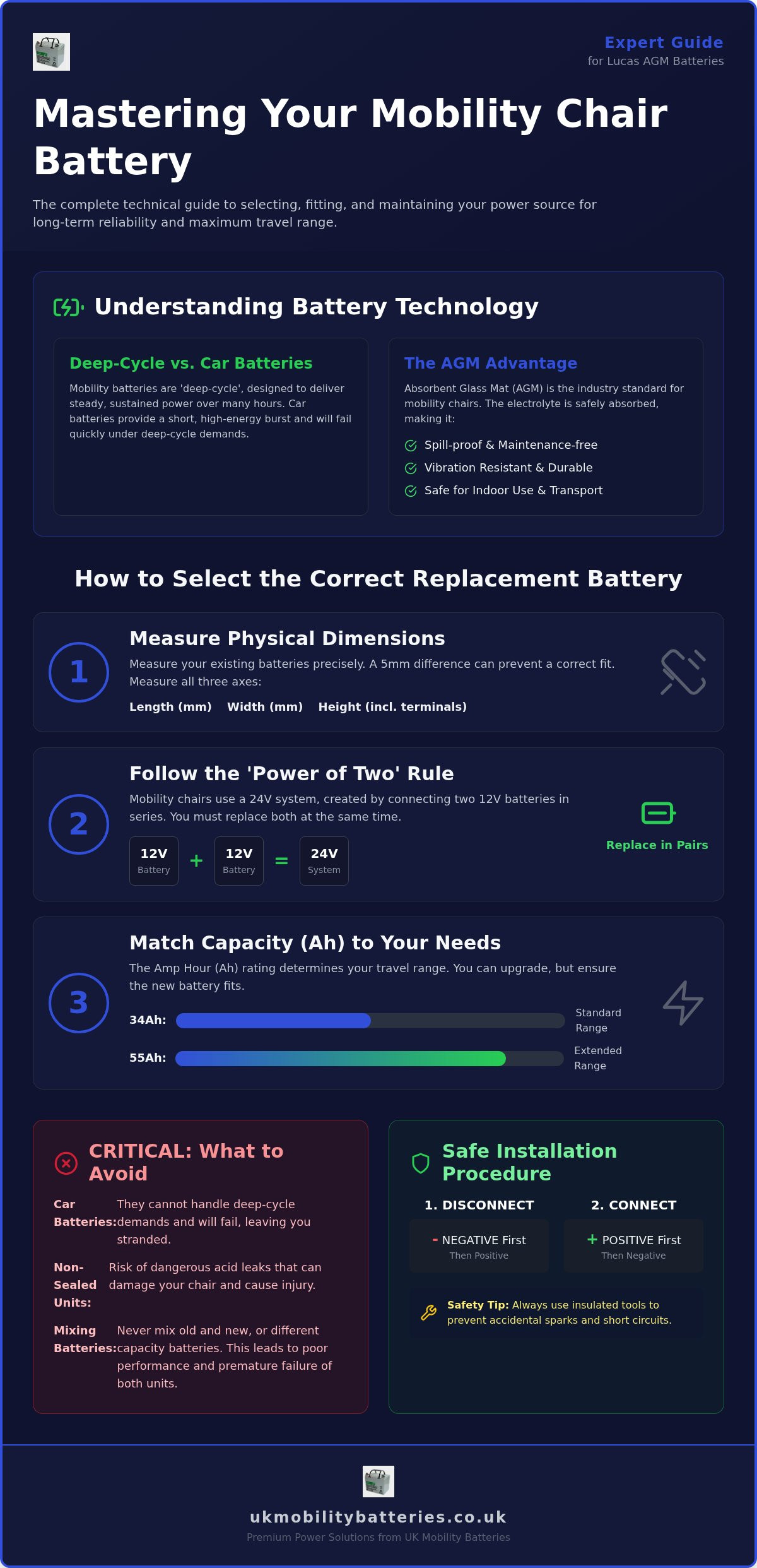
Mobility chair batteries are designed specifically for deep-cycle performance. Unlike automotive batteries which provide a short burst of energy to start an engine, these cells must deliver sustained power over several hours of operation. This specific discharge behaviour ensures your chair maintains consistent speed and torque even as the charge level depletes. Modern Motorized wheelchair battery technology typically utilises Sealed Lead Acid (SLA) designs, which are essential for both user safety and equipment longevity.
The majority of these power solutions use Absorbent Glass Mat (AGM) technology. In an AGM cell, the electrolyte is suspended in a fine fibreglass mat between the lead plates. This construction makes the battery spill-proof and maintenance-free; it doesn't require regular water top-ups like traditional lead-acid units. It's the industry standard because it allows for high discharge rates whilst remaining safe for use in indoor environments and on public transport.
AGM vs Gel: Choosing the Right Power Solution
AGM technology offers superior vibration resistance. This is vital for chairs used on uneven pavements or frequently transported in vehicles. These units are often more cost-effective than Gel alternatives and provide excellent power density for daily use. Because they're completely sealed, they support the manoeuvrability of the chair by allowing the battery to be installed securely without the risk of electrolyte leaks. This reliability makes them the primary choice for modern powerchairs.
The Dangers of Using Non-Specialist Batteries
You must never fit a standard car battery to your mobility equipment. Car batteries are "cranking" batteries designed for high-current bursts; they'll fail prematurely if subjected to the deep-cycle demands of mobility chair batteries. Using non-sealed units also introduces a severe risk of acid leaks, which can damage the chair's internal electronics and pose a health hazard. Genuine mobility cells feature Valve Regulated Lead Acid (VRLA) safety valves. These components manage internal pressure, ensuring the battery remains stable during the charging and discharging process.
How to Measure and Select Your Replacement Battery
Accurate measurement is the most critical stage when purchasing mobility chair batteries. Battery compartments in electric wheelchairs are designed with minimal tolerance; even a 5mm discrepancy in height can prevent the battery cover from securing correctly. You must measure the length, width, and total height of your existing units. When measuring height, ensure you include the terminal connectors in your calculation, as this is often the point of interference with the chair's chassis or casing.
Every mobility chair operates on a 24V circuit, which follows the 'Power of Two' rule. This means the system requires two 12V batteries connected in series to provide the necessary voltage to the motor controller. You should always replace both units simultaneously to ensure balanced internal resistance and optimal charging behaviour. Selecting the correct chemistry is equally vital, especially for travel; non-spillable AGM units are generally permitted for air transport under FAA regulations on mobility batteries, provided they are properly secured.
Matching Capacity to Your Mobility Requirements
The Amp Hour (Ah) rating determines the total energy capacity of the cell. Whilst you can often upgrade to a higher Ah rating to increase your travel range, you must check the physical dimensions first. For example, moving from a 34Ah to a 50Ah battery will significantly increase your daily mileage, but it also adds substantial weight to the chair. A Lucas 12V 34Ah battery is suitable for many mid-range powerchairs, whereas heavy-duty models typically require the 50Ah or 55Ah variants to manage the higher current draw of larger motors.
Identifying Terminals and Connectors
Identifying the correct terminal type is essential for a safe electrical connection. Smaller boot scooters often use T1 or T2 spade connectors, while larger chairs utilise flag terminals or nut-and-bolt inserts. You must also verify the terminal orientation (positive and negative placement). Short wiring looms leave little room for error; if the terminals are on the wrong side, the cables will not reach. For a detailed breakdown of specific hardware, consult our guide on mobility scooter battery terminal types. Once you've confirmed your dimensions and terminal needs, you can browse our full range of Lucas mobility batteries to find the exact match for your equipment.
Why You Must Replace Mobility Chair Batteries in Pairs
Replacing mobility chair batteries in pairs isn't a sales recommendation; it's a fundamental requirement of electrical physics. When you install a new battery alongside an aged unit, you create an immediate technical imbalance within the 24V system. The older battery will have a significantly higher internal resistance compared to the fresh unit. Because these cells are wired in series, the new battery is forced to work harder to compensate for the inefficiency of its partner, leading to rapid degradation and premature failure of the expensive new component.
This imbalance also compromises your charging equipment. Most mobility chargers are designed to monitor the combined voltage of the 24V circuit rather than the individual health of each 12V cell. If one battery is degraded, the charger may fail to identify the correct "float" or "cut-off" voltage. This often results in the healthy battery being overcharged whilst the weaker unit remains undercharged. Over time, this thermal stress can cause the casing of the healthy battery to swell, rendering your investment useless within months. Buying a matched pair ensures that both units age at the same rate, providing a consistent discharge curve and protecting the long-term health of your chair's electronics.
Understanding Series Wiring in 24V Systems
In a series configuration, the positive terminal of one 12V battery is connected to the negative terminal of the second. This combines their voltage to reach the 24V required by the chair's motor controller. If the voltage output amongst the two units differs by even a small margin, the controller may interpret this as a system fault. Common signs of an imbalanced pair include the chair "stuttering" during hill climbs or the battery gauge dropping rapidly under load, only to recover when the chair is stationary. Matching the capacity and age of both units is the only way to ensure the controller receives a stable, high-quality current.
Maximising Lifespan Through Synchronised Replacement
Synchronised replacement allows both batteries to follow the same charge and discharge cycles from day one. This prevents the formation of "dead cells" which occur when one battery is repeatedly discharged deeper than its partner. By ensuring equal load distribution, you maintain the chemical stability of the lead plates inside the AGM casing. For more detailed technical advice on maintaining your power cells, consult our ultimate guide to mobility scooter batteries UK. Following a strict replacement schedule for the entire pair is always more cost-effective than attempting to "patch" a failing system with a single new unit.
Fitting and Installing Your New Chair Batteries Safely
Safe installation of mobility chair batteries requires methodical preparation and the correct technical equipment. You must work in a dry, well-lit environment with enough space to move around the chair. Before starting, gather a set of insulated spanners. Unlike standard metal tools, insulated versions prevent accidental short-circuiting if you touch the tool against the chair's metal chassis whilst it's in contact with a live terminal. High-current arcing from a mobility battery can cause severe burns or damage the chair's sensitive electronic controller.
Before removing the old units, inspect the battery tray and wiring loom. Check for signs of cable corrosion, which often appears as a white or green powdery deposit on the connectors. If you find corrosion, clean the terminals with a wire brush or replace the leads entirely. Frayed wires or cracked insulation must be addressed immediately to prevent electrical fires. Ensure the battery tray is free of grit or debris; even small stones can vibrate against the battery casing during travel, eventually leading to a breach in the plastic shell.
Step-by-Step Installation Protocol
Begin by removing the seat assembly or the protective plastic battery shroud according to the manufacturer's manual. Once the batteries are accessible, follow this specific disconnection sequence to ensure safety:
- Disconnect the negative (black) lead first. This breaks the electrical return path and minimises the risk of sparking if your tool touches the frame.
- Disconnect the positive (red) lead second. Lift the old batteries out carefully; remember that 50Ah and 55Ah units are significantly heavy.
- Position the new batteries. Ensure they are seated flat and secure them using the original brackets or straps to prevent movement during transit.
- Connect the positive (red) lead first. This is the reverse of the removal process.
- Connect the negative (black) lead last. Tighten all bolts firmly but avoid over-tightening, which can crack the lead terminals.
Post-Installation Health Check
Once fitted, you must follow the 'Initial Charge' rule. Even if the batteries arrive showing a high voltage, you must charge them for at least 12 to 14 hours before the first use. This saturation charge is vital for the chemical health of new AGM cells and ensures they reach their full capacity. If the chair doesn't power on, check for reversed polarity or a loose circuit breaker. For reliable performance, ensure you are using high-quality Lucas mobility chair batteries that meet your equipment's exact specifications.
Premium Power Solutions from UK Mobility Batteries
UK Mobility Batteries operates as a specialist UK retailer, providing a comprehensive inventory of Lucas mobility chair batteries ranging from 7Ah to 55Ah capacities. Lucas is a technical leader in deep-cycle power solutions, and their AGM range is engineered specifically for the rigorous demands of electric wheelchairs. These units are completely maintenance-free and feature a sealed, spill-proof design. This construction is vital for active users who require safe equipment for indoor use, car transport, and public accessibility. Our stock includes versatile options such as the Lucas 12V 20Ah and 50Ah mobility batteries to suit a wide variety of chassis designs.
The Lucas 12V AGM Advantage
The inventory includes precise solutions for every equipment class. Small boot scooters typically utilise the Lucas 12V 7Ah mobility battery, while mid-range models benefit from the Lucas 12V 34Ah Sealed AGM Deep Cycle Battery. For heavy-duty powerchairs requiring maximum torque and extended range, the Lucas 12V 55Ah variant provides the necessary high-current discharge. Lucas AGM technology offers a superior cyclic life compared to standard budget alternatives. These cells are built with robust lead plates to withstand repeated deep discharge cycles. This ensures the battery maintains its original capacity for a longer duration, significantly reducing the total cost of ownership for the user.
Expert Support and National Reliability
Identifying the correct technical specification amongst our stock is a priority for our support team. We understand that matching physical dimensions and terminal types is high-stakes for your independence. Our technical team provides expert guidance to ensure you select a battery that fits your compartment perfectly. UK Mobility Batteries focuses on maintaining fresh stock levels. We ensure that our batteries haven't been stored for extended periods, which preserves their chemical integrity and shelf life. With fast national delivery and dedicated UK-based support, we ensure your mobility chair remains roadworthy and reliable. Our commitment to technical accuracy means you can shop with confidence, knowing your new power cells will restore your chair's factory travel range and performance.
Restoring Your Mobility Chair's Performance and Range
Selecting the correct mobility chair batteries is a technical requirement that directly impacts your daily independence. By prioritising precise measurements, matching Amp Hour ratings, and always replacing your cells in pairs, you eliminate the electrical imbalances that lead to premature failure. Following a methodical installation protocol ensures your equipment remains safe and operates at its peak efficiency during long-distance travel.
As a specialist Lucas battery supplier, UK Mobility Batteries provides the expert technical support team required to verify your equipment's specific needs. We offer next-day UK delivery on our full inventory to minimise your downtime and restore your chair's original range immediately. You can browse our full range of premium Lucas mobility batteries to find the exact power solution for your device. With high-performance AGM technology and a dedicated maintenance routine, you can navigate your environment with total confidence in your chair's reliability.
Frequently Asked Questions
How long do mobility chair batteries typically last?
Most mobility chair batteries provide a functional lifespan of 12 to 18 months with regular daily use. This duration depends heavily on your charging habits and the depth of discharge during each trip. Deep-cycle AGM batteries, such as the Lucas range, are engineered for high cyclic durability, but frequently depleting them below 50% capacity will shorten their overall life. Storing them in a cool, dry environment helps maintain chemical stability.
Can I replace my 42Ah batteries with 50Ah batteries for more range?
You can upgrade to 50Ah batteries if the physical dimensions are compatible with your chair's battery tray. Increasing the Amp Hour (Ah) rating provides a larger energy reservoir, which directly extends your travel range between charges. However, you must verify that the compartment can accommodate the slightly larger casing and the additional weight. Upgrading to Lucas 12V 50Ah Mobility Batteries is a common technical solution for users requiring higher daily mileage.
How often should I charge my electric wheelchair batteries?
You should charge your batteries after every use, even if you have only travelled a short distance. Leaving mobility chair batteries in a partially discharged state triggers sulphation, a chemical process that permanently reduces the battery's capacity. For the best results, connect your charger overnight for at least 8 to 10 hours. If you aren't using the chair for several weeks, perform a full refresh charge at least once a month.
Are mobility chair batteries eligible for VAT relief in the UK?
Yes, batteries designed specifically for use in mobility equipment are eligible for VAT relief under UK law. To qualify for this exemption, the individual using the equipment must have a long-term illness or disability. You'll need to complete a simple self-declaration form at the point of purchase to confirm your eligibility. Note that general-purpose batteries do not qualify for this relief, even if you intend to fit them into a mobility device.
Can I use a car battery charger on my mobility chair batteries?
No, you must never use a standard car battery charger on sealed AGM mobility cells. Car chargers typically deliver a high-amperage "bulk" charge that can cause sealed units to overheat and vent gas through their safety valves. Specialist mobility chargers use a sophisticated three-stage charging profile, bulk, absorption, and float, which is designed to safely manage the specific chemistry of deep-cycle batteries without causing internal plate damage or casing swelling.
What should I do with my old mobility chair batteries?
Old lead-acid batteries are classified as hazardous waste and must be recycled at a licensed facility. Most local authority recycling centres in the UK accept these batteries free of charge. You should never dispose of them in your domestic waste bins. Professional recycling allows for the reclamation of lead and plastic components for use in new manufacturing, preventing sulphuric acid and lead from contaminating the environment through landfill disposal.
Why is my mobility chair losing power on hills?
Power loss during hill climbs is a primary indicator that your mobility chair batteries are reaching the end of their service life. As cells age, their internal resistance increases, making it difficult for them to deliver the high current required for high-torque tasks like climbing inclines. This causes a sharp voltage drop, which may trigger the chair's controller to reduce speed or cut power entirely to protect the sensitive electronic systems from damage.
Can I take my AGM mobility batteries on an aeroplane?
Yes, AGM batteries are classified as "non-spillable" and are generally permitted for air travel under CAA and IATA regulations. You must notify your airline in advance to confirm their specific procedures. Unlike lithium-ion batteries, which have strict Watt-hour limits, sealed AGM batteries can usually remain in the chair during transit. Ensure the terminals are protected against short circuits and the battery is securely fastened within its housing before arriving at the airport.