
Maintenance-Free Mobility Scooter Batteries: The Complete 2026 UK Technical Guide
The term "maintenance-free" is a rigorous technical safety standard rather than a simple marketing convenience. For the 350,000 mobility scooter users across the UK, selecting the correct maintenance-free mobility scooter batteries is the difference between reliable daily travel and the anxiety of a mid-journey failure. This designation specifically refers to the superior oxygen recombination of Absorbent Glass Mat (AGM) technology. This system effectively eliminates the need for hazardous electrolyte top-ups and prevents the risk of acid spills during transport or storage.
You likely want a power source that performs consistently without the risk of leaks or the complexity of manual upkeep. This technical guide identifies how maintenance-free AGM technology ensures reliable, safe, and efficient power for your mobility scooter or wheelchair. We provide the data required to distinguish between AGM and Gel systems; clarify 2026 UK airline safety regulations for non-spillable cells; and help you calculate the exact Amp-hour capacity required for your specific equipment. This ensures you remain mobile and compliant with the latest British Standards, including BS ISO 7176-31:2023.
Key Takeaways
- Understand why modern VRLA standards ensure your power source is safe for air travel and doesn't leak acid during transit.
- Learn how the oxygen recombination process in maintenance-free mobility scooter batteries removes the need for manual electrolyte top-ups.
- Identify the correct Amp-hour (Ah) capacity and physical dimensions to ensure your replacement battery fits and performs as expected.
- Master the critical 24-hour charging regime and storage practices necessary to maintain optimal battery health and range.
- Gain technical clarity on terminal types and connector configurations to ensure full compatibility with Lucas deep-cycle AGM products.
What Defines a Maintenance-Free Mobility Scooter Battery?
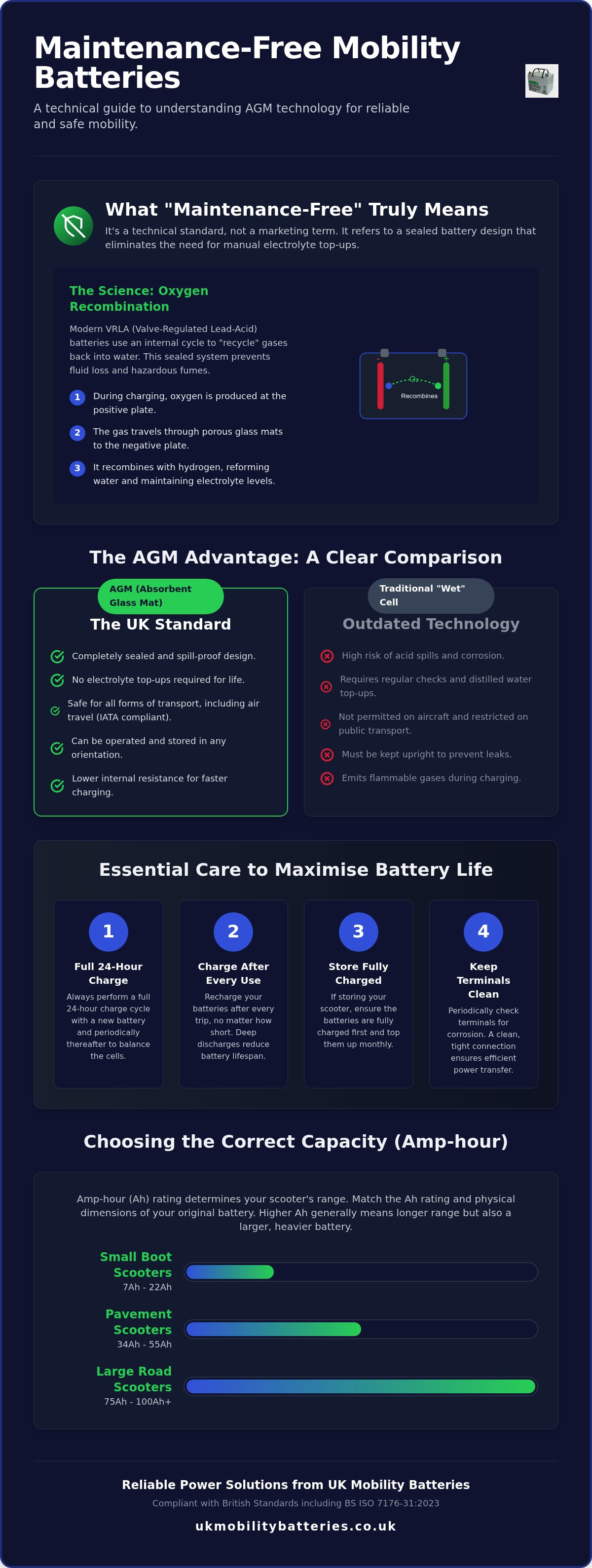
Technical definitions matter when choosing maintenance-free mobility scooter batteries. This classification describes a battery that uses a sealed system to prevent electrolyte loss through evaporation. In older "wet" lead-acid designs, the chemical reaction during charging released gases, which eventually lowered the fluid level and exposed the internal plates. Modern Valve-Regulated Lead-Acid (VRLA) batteries solve this through a recombination process. Oxygen produced at the positive plate during charging migrates to the negative plate to reform water. This internal cycle ensures the battery remains functional for its entire service life without external intervention.
It's vital to understand that "maintenance-free" refers specifically to the absence of fluid top-ups. It isn't a suggestion that the battery requires zero care. You must still manage the state of charge and ensure the terminals remain clean. However, the removal of the "topping up" requirement has transformed the user experience, especially for those with limited dexterity or those who store their equipment inside their homes where acid fumes would be unacceptable.
The End of Topping Up: Wet vs. Sealed Batteries
Traditional flooded batteries were often messy and high-maintenance. They required periodic inspections and the manual addition of distilled water. If the fluid level dropped too low, the lead plates would oxidise and fail prematurely. Spillage was a constant threat, often leading to acid burns on carpets or severe corrosion on the scooter's metal frame. Sealed units, such as the Lucas 12V 34Ah Sealed AGM Deep Cycle Battery, eliminate these physical risks. By trapping the electrolyte within glass mats, these batteries can be stored or operated in various orientations without leaking. This is particularly advantageous for folding travel scooters that are frequently lifted and tilted into car boots.
Safety Standards and Air Travel Compliance
Safety classifications dictate how you can travel with your equipment. Most airlines and public transport providers require batteries to be "non-spillable" to meet IATA (International Air Transport Association) safety standards. Because maintenance-free mobility scooter batteries don't contain free-flowing liquid acid, they are permitted in the holds of aeroplanes, provided they are correctly declared. VRLA technology provides the essential foundation for modern mobility safety by combining gas recombination with pressure relief valves. This ensures that even in the rare event of overcharging, the battery remains stable and secure during transit.
The AGM Advantage: Why Sealed Technology is the UK Standard
AGM technology represents the technical standard for maintenance-free mobility scooter batteries across the UK. Unlike traditional batteries where lead plates are submerged in liquid acid, AGM units utilise ultra-fine glass fibre mats. These mats act as a separator, soaking up the electrolyte and holding it in a stable, "starved" state against the plates. This physical construction prevents leaks and allows for a more robust internal design. It's a significant upgrade over older technologies, providing a power source that is both durable and spill-proof.
The core of this efficiency is the internal recombination process. During the charging cycle, the battery generates oxygen. In a standard flooded battery, this gas would escape into the atmosphere, eventually requiring the user to replenish the water levels. In an AGM cell, the oxygen moves through the porous glass mats to the negative plate. Here, it recombines with hydrogen to form water, effectively recycling the electrolyte. This internal cycle is why these units never require topping up.
Oxygen Recombination: The Science of Sealed Cells
VRLA (Valve-Regulated Lead-Acid) batteries feature a one-way pressure relief valve. This valve remains closed under normal operating conditions, maintaining the internal pressure required for gas recombination. This mechanism makes the battery significantly safer for use in enclosed spaces like hallways, cupboards, or vehicles, as it does not emit explosive gases during standard charging. Adhering to fire service safety advice regarding correct charger usage further ensures home safety. Technically, this setup results in lower internal resistance. This allows the battery to deliver power more efficiently and recharge faster than traditional alternatives.
Mobility applications require deep-cycle performance. Batteries like the Lucas 12V 50Ah Mobility Battery are engineered to withstand repeated discharge and recharge cycles without losing capacity. The tightly packed internal structure also provides superior vibration resistance. This protects the lead plates when travelling over uneven UK pavements or dropped kerbs, preventing internal damage that often causes premature failure in lesser batteries.
Why We Recommend Lucas AGM Batteries
Lucas has established itself as a dependable specialist in the UK mobility market. Their build quality remains consistent across the entire range, from the small Lucas 12V 7Ah Sealed AGM Batteries to the high-capacity 55Ah units. This reliability is crucial for users who depend on their scooters for daily independence. For a broader look at maintaining these units, see The Ultimate Guide to Mobility Scooter Batteries UK. If you need help identifying the correct model for your equipment, our team provides expert technical support to ensure a perfect fit for your specific scooter or wheelchair.
Choosing the Correct Capacity: From 7Ah to 100Ah+
Ampere-hours (Ah) represent the total electrical charge a battery can deliver. Think of this as the "fuel tank" of your scooter. A higher Ah rating allows for a longer range between charges. However, capacity isn't just about distance; it also affects the physical weight of the unit. Larger maintenance-free mobility scooter batteries are significantly heavier and require more internal space. You must check the label on your existing batteries for the Ah rating and physical dimensions before ordering. If your battery box has extra room, you can often upgrade to a higher capacity for increased range, provided the dimensions remain compatible with the housing.
You must always replace batteries in pairs. Mobility scooters typically operate on a 24V system using two 12V batteries connected in series. Mixing an old battery with a new one creates a technical imbalance. The older, weaker cell will drag down the performance of the new one, leading to premature failure of both units. Reliable, balanced performance requires matched cells from the same production batch to ensure consistent voltage delivery across the system.
Small to Medium Scooters (7Ah to 22Ah)
Boot scooters and foldable travel models generally utilise batteries between 7Ah and 22Ah. These are designed for portability and short-distance travel, such as trips to local shops or flat pavements. For instance, many users compare the Lucas 12V 7Ah against the 9Ah uprated version. The 9Ah model occupies the same physical footprint but provides roughly 28% more capacity, offering a useful range boost without increasing the size of the battery pack. Whilst AGM is the standard for these models, users exploring lithium alternatives should consult the BHTA lithium battery safety guide for specific technical requirements. Always verify the length, width, and height of your battery tray before purchasing to ensure a perfect fit.
Heavy Duty and Road-Legal Scooters (34Ah to 100Ah+)
Class 3 scooters are road-legal and require substantial power for sustained speeds of 8mph and climbing steeper inclines. These vehicles typically require maintenance-free mobility scooter batteries ranging from 34Ah to 100Ah+. The Lucas 12V 34Ah and 55Ah batteries are common choices for these heavy-duty applications. Because these units hold a much larger charge, they require more powerful charging units. A standard 2A charger used for small scooters won't suffice; you'll need a robust charger delivering between 5A and 8A to ensure a full charge within a 12-hour window. Using an undersized charger on high-capacity batteries can lead to "sulphation," which permanently reduces the battery's ability to hold a charge.
Essential Care for Maintenance-Free Batteries: Charging and Storage
The term "maintenance-free" is a technical description of the sealed chemical system that prevents fluid loss. It isn't a suggestion that maintenance-free mobility scooter batteries require no care at all. For these units, the most critical form of maintenance is a consistent and correct charging programme. Neglecting the charge state is the primary cause of premature capacity loss. Unlike older nickel-cadmium cells, modern AGM batteries don't suffer from "memory effect." They actually prefer shallow discharges. Discharging your battery completely before recharging causes significant internal stress and shortens the component's lifespan.
Using a compatible smart charger is essential for preventing overcharging. These devices use a three-stage charging cycle: bulk, absorption, and float. This process ensures the battery reaches its full chemical potential without overheating the sealed unit. If you're concerned about safety or efficiency, always verify that your charger matches the specific Amp-hour (Ah) rating of your Lucas batteries. If you need a replacement power source, you can buy Lucas mobility batteries online for reliable national UK delivery.
The Correct Charging Regime
Adhering to a strict charging routine ensures your scooter remains ready for use whilst protecting your investment. Follow these two fundamental steps:
- Step 1: Always charge your scooter after every trip. It doesn't matter if you only travelled a few hundred yards; replenishing the energy immediately prevents sulphation.
- Step 2: Leave the charger connected until the green light indicates a full state. This often takes 8 to 12 hours. For a deeper look at safety and myths, read our guide: Can You Overcharge a Mobility Scooter Battery?
UK Winter Storage and Temperature Protection
The UK climate poses specific challenges for maintenance-free mobility scooter batteries. Sub-zero temperatures can reduce available battery capacity by up to 30% during the winter months. This isn't a permanent defect, but it does mean your range will be significantly shorter on a cold January morning than in the middle of June. If you plan to store your scooter in a garage or shed, bring the battery pack indoors if possible to protect it from the frost.
When the scooter isn't in use for extended periods, the batteries will naturally self-discharge. You must perform a top-up charge every 4-6 weeks to keep the internal chemistry active. A fully charged battery is much less likely to freeze and crack its casing than a flat one. Maintaining a high state of charge ensures the electrolyte remains stable even when the mercury drops below zero.
Reliable Power Solutions from UK Mobility Batteries
Selecting maintenance-free mobility scooter batteries from a specialist retailer like UK Mobility Batteries ensures you receive a product engineered for deep-cycle mobility use. Generic online marketplaces often list batteries that appear identical but lack the internal plate density required for the heavy discharge cycles of a mobility scooter. We focus exclusively on the mobility sector, providing technical specifications that allow you to verify compatibility before purchase. This specialist approach reduces the risk of ordering underpowered cells that fail prematurely under the weight and power demands of a modern scooter or electric wheelchair.
Our commitment to technical accuracy extends to our national UK delivery network. We understand that a failed battery pack results in a total loss of independence. For 2026, we've optimised our logistics to ensure fast delivery across the UK mainland, getting you back on the move as quickly as possible. Every battery we dispatch is a genuine Lucas product, arriving fully charged and ready for installation in your equipment's battery tray or box.
Why Choose Lucas Batteries?
Lucas remains a cornerstone of the British mobility and automotive sectors. Their batteries are designed with high-density lead plates and premium glass mat separators. This robust internal construction provides superior durability and a longer service life compared to budget alternatives. Whether you're using the Lucas 12V 12Ah Mobility Battery for a compact travel scooter or the Lucas 12V 55Ah Sealed AGM Mobility Batteries for a road-legal Class 3 vehicle, the build quality remains consistent. If you're planning to perform the swap yourself, our technical resources provide a clear How to Change Mobility Scooter Batteries guide to assist with the process.
Expert Support and Delivery
Identifying the correct terminal type and connector configuration is a common point of confusion. Terminals can vary from standard F1 or F2 spade connectors to bolt-through M5 or M6 threads. Our team provides expert technical support to help you identify these physical attributes before you place an order. We prioritise uncomplicated technical data over marketing jargon, ensuring you have the exact dimensions and Amp-hour ratings required for your specific scooter model. This no-nonsense guidance saves time and prevents the hassle of returning heavy items due to fitment errors.
If you're unsure which capacity is right for your daily range requirements, we can help you compare options like the Lucas 12V 7Ah vs the uprated 9Ah version. You can browse our full range of maintenance-free mobility batteries today to find the exact power solution for your needs.
Securing Your Mobility with Reliable AGM Technology
Selecting the correct maintenance-free mobility scooter batteries requires a focus on technical compatibility and rigorous charging habits. It's essential to match the Amp-hour capacity to your scooter's specific requirements and adhere to a consistent charging regime to ensure maximum range and safety. Modern VRLA standards provide the non-spillable security needed for both home storage and air travel, removing the risks associated with older lead-acid designs.
UK Mobility Batteries is an official Lucas battery stockist, providing expert technical support for UK customers to ensure perfect terminal and connector identification. Our fast national delivery network ensures you receive your matched pair of deep-cycle cells without delay. Order your replacement Lucas mobility batteries here to restore your vehicle's performance with industry-standard power. You can move forward with confidence knowing your equipment is powered by professional-grade technology.
Frequently Asked Questions
Do maintenance-free mobility scooter batteries ever need water?
No, these batteries never require distilled water top-ups. They use a sealed Valve-Regulated Lead-Acid (VRLA) design where gases recombine internally to form water. Attempting to open the casing or add fluid will break the factory seal and void your warranty. This sealed construction prevents electrolyte evaporation and acid leaks, making the units safer for indoor use and transport compared to older flooded designs.
How long do maintenance-free AGM batteries typically last?
AGM batteries typically last between 12 and 24 months with regular use. Your specific lifespan depends heavily on charging habits and the average depth of discharge. If you discharge the cells below 50% every day, they'll fail sooner than those kept at a higher state of charge. Following a strict charging regime and storing the batteries correctly during winter can help you reach the upper end of this range.
Can I use a car battery charger on my maintenance-free mobility battery?
You shouldn't use a standard car battery charger for your mobility equipment. Car chargers deliver a high-amperage "bulk" charge that can cause sealed AGM cells to overheat and vent. Mobility scooters require a specific three-stage smart charger that matches the battery's Amp-hour (Ah) rating. Using the wrong equipment leads to "gassing" and permanent internal damage, which compromises the battery's safety and overall capacity.
What are the signs that my maintenance-free battery is starting to fail?
The most common sign of failure is a noticeable reduction in your travel range. You might find the scooter struggles on inclines or feels sluggish even after a full charge. If the battery meter drops into the red shortly after leaving home, the maintenance-free mobility scooter batteries are likely losing their chemical capacity. Physical swelling of the battery casing is another critical sign that requires immediate replacement.
Is it safe to store my maintenance-free battery indoors during winter?
It's safer and better for the battery's health to store it indoors during the winter months. Extreme cold can reduce capacity by up to 30% and may cause a flat battery to freeze and crack. Storing the pack in a cool, dry room prevents these temperature-related issues. You should still give the battery a top-up charge every 4-6 weeks to prevent it from self-discharging whilst in storage.
Can I replace a 34Ah battery with a 50Ah battery for more range?
You can upgrade from 34Ah to 50Ah if the larger batteries fit within your scooter's battery tray. Increasing the Ah rating provides a larger capacity, allowing for longer journeys between charges. However, 50Ah batteries are physically larger and heavier than 34Ah units. Always measure the height, length, and width of your battery box before purchasing. You must also ensure your charger is powerful enough for the increased capacity.
Why do I need to replace both batteries at the same time?
Replacing batteries in pairs is essential because mobility scooters use a 24V system created by two 12V batteries in series. If you mix a new battery with an old one, the older cell's higher internal resistance will cause the new battery to overwork. This imbalance leads to uneven charging and causes both batteries to fail prematurely. Installing a matched pair ensures consistent voltage and reliable performance across the system.
Are maintenance-free batteries safe for air travel?
Yes, maintenance-free mobility scooter batteries are classified as "non-spillable" and are generally safe for air travel under IATA regulations. Because the electrolyte is absorbed in glass mats, they won't leak even if the battery is tilted during transit. You must still notify your airline at least 48 hours before flying. They'll require the technical specifications to ensure the batteries meet safety standards for the aircraft hold.