
Longest Lasting Mobility Scooter Batteries: A Technical Guide to Longevity
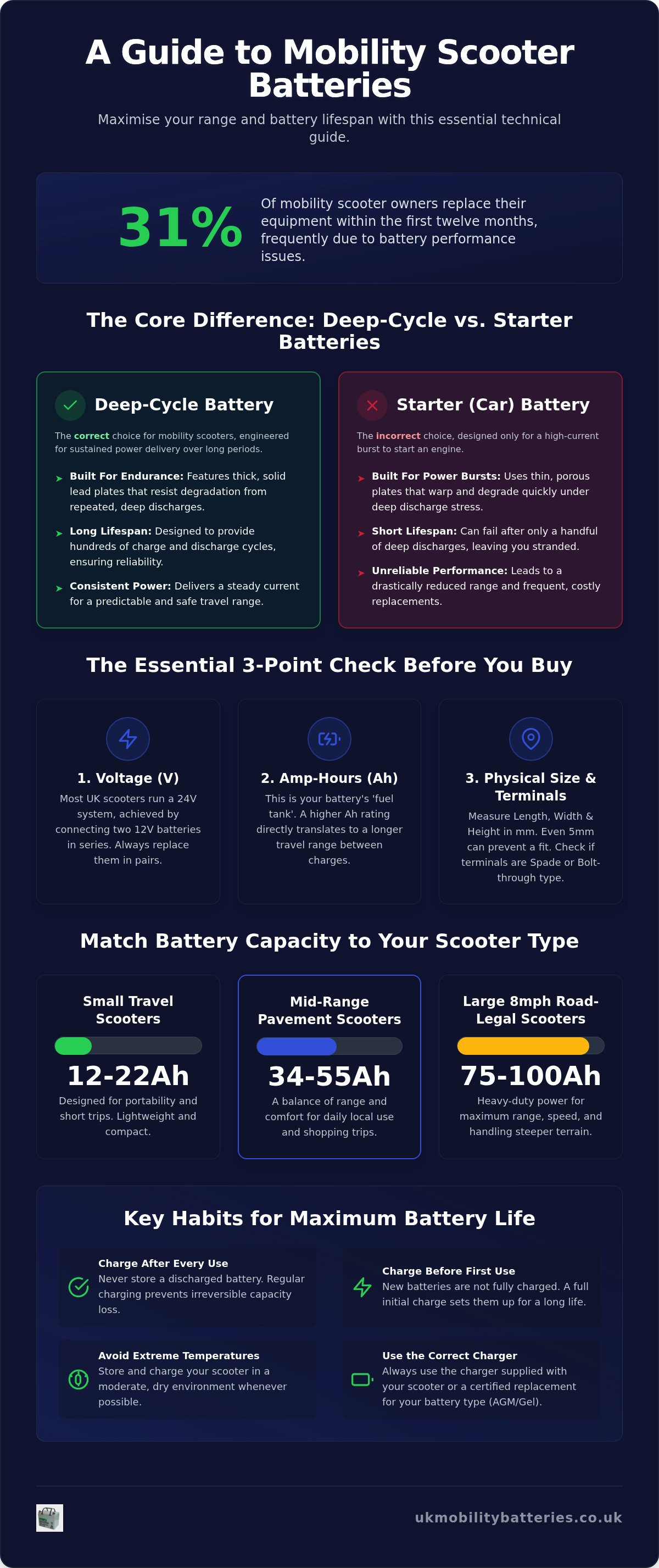
Over 31% of mobility scooter owners replace their equipment within the first twelve months, frequently because of battery performance and charging issues. It's a significant statistic that highlights why choosing the longest lasting mobility scooter batteries is a technical decision rather than a simple purchase. You've likely felt the anxiety of a reduced range on familiar routes or struggled to find clear facts amongst the conflicting advice regarding AGM and Gel chemistries.
Securing a reliable power source requires an understanding of technical data rather than lifestyle marketing. This guide details the exact specifications and maintenance protocols required to secure the longest possible lifespan for your mobility power solution. You'll learn how to identify a battery that offers maximum cycles for the price, whilst understanding the specific charging habits that preserve internal cell health. We also provide the data needed to select a trusted Lucas brand unit for fast UK delivery, ensuring your equipment remains a reliable tool for daily use.
Key Takeaways
- Learn the technical differences between standard starter batteries and true deep-cycle units to ensure you select the longest lasting mobility scooter batteries for sustained power delivery.
- Master the three-point specification check covering Voltage, Amp-hours, and physical dimensions to guarantee your replacement units fit and perform correctly.
- Evaluate the performance profiles of AGM and Gel technologies to determine which chemistry best suits your specific daily routes whilst meeting discharge requirements.
- Implement the "Charge Before Use" protocol and essential maintenance habits to protect your investment and prevent premature capacity loss.
- Identify why Lucas Sealed AGM technology is engineered for high-performance deep-cycle applications across the UK mobility market.
Understanding Mobility Scooters Batteries: The Science of Deep-Cycle Longevity
Long-lasting mobility batteries are specialised deep-cycle units engineered for sustained power delivery over hundreds of discharge cycles. Unlike automotive starter batteries, which provide a high-current burst to start an engine, mobility power solutions must provide a steady flow of energy over several hours. This fundamental difference in application requires a specific approach to deep-cycle battery technology. Most UK mobility scooters operate on a 24V system. This voltage is typically achieved by connecting a pair of 12V batteries in series. Modern units in the UK market, such as those in the Lucas mobility range, are predominantly Sealed Lead Acid (SLA) or Absorbed Glass Mat (AGM) designs. These are entirely maintenance-free, meaning they don't require water top-ups and are safe for transport due to their spill-proof construction.
The Role of Amp-Hours (Ah) in Your Daily Range
Amp-hours (Ah) represent the size of your battery's capacity, acting much like a fuel tank for your scooter. A higher Ah rating directly correlates to a longer travel distance between charges. Amp-hours are the measure of electrical charge a battery can deliver in one hour. Whilst a compact boot scooter might use a 12V 12Ah battery, a larger road-legal model might require a 12V 55Ah Sealed AGM Mobility Battery. Your actual range fluctuates based on variables like user weight, tyre pressure, and the inclines found amongst your local routes. Larger capacity units provide the necessary headroom to navigate steep hills without depleting the cells to a critical level.
Why Deep-Cycle Chemistry Matters
The secret to the longest lasting mobility scooter batteries lies in the physical thickness of the internal lead plates. Deep-cycle chemistry utilises heavy, solid lead plates rather than the thin, porous plates found in automotive batteries. These robust components are designed to withstand repeated discharge and recharge cycles without suffering from rapid internal degradation or shedding of active material. Standard starter batteries often fail after only a few deep discharges because their thin plates warp under the stress of low voltage. In contrast, deep-cycle designs manage these low-voltage states safely. There is a direct, inverse relationship between the depth of discharge (DoD) and the total life expectancy of the battery pack. Minimising the depth of each discharge cycle significantly extends the total number of cycles the battery can perform before reaching its end-of-life.
Selecting the Correct Battery Size: Specifications and Technical Dimensions
Selecting the correct replacement requires a rigorous three-point technical check. You must confirm the Voltage, Amp-hours (Ah), and physical dimensions of your existing units before purchasing. Most UK mobility scooters utilise two 12V batteries to create a 24V circuit. Whilst voltage is standard, Amp-hours and physical size vary significantly. Measuring the length, width, and height of your battery tray in millimetres is essential. A battery that is even 5mm too large will not fit into the moulded plastic battery boxes common on travel scooters. Securing the longest lasting mobility scooter batteries involves matching this increased capacity with the physical constraints of your specific model.
Terminal types also dictate compatibility. Smaller batteries typically use T1 (4.75mm) or T2 (6.35mm) fast-on spade connectors. Larger, high-capacity units often feature M5 or M6 bolt-through terminals. Ensuring your scooter's wiring loom matches the terminal style prevents the need for dangerous modifications. If you are unsure about the physical fitting process, consulting a guide on how to install replacement batteries provides a safe framework for the transition.
Standard Mobility Battery Size Categories
Mobility scooters in the UK generally fall into three distinct size categories based on their power requirements. Small travel scooters are designed for portability and typically utilise Lucas 12V 12Ah or 20Ah batteries. Mid-range pavement scooters, which offer more comfort and a higher weight capacity, are often fitted with 34Ah, 35Ah, or 50Ah units. These provide a balanced ratio of weight to range for daily local trips. Large 8mph road-legal scooters require heavy-duty power to meet legal requirements and handle longer distances, necessitating 55Ah, 75Ah, or 100Ah+ batteries. You can browse our full range of Lucas AGM mobility batteries to find the exact match for your scooter category.
Upgrading Your Capacity: What is Technically Possible?
It's often possible to upgrade your capacity for a longer range, provided the physical dimensions of the battery tray allow it. For instance, many scooters originally fitted with 42Ah batteries can safely accommodate 50Ah units. This upgrade increases the energy density of the scooter without damaging the electronic controller. However, you must consider the added weight. High-capacity lead-acid batteries are significantly heavier, which can alter the scooter's centre of gravity and handling. For a comprehensive selection framework, reference the Ultimate Guide to Mobility Scooter Batteries UK. Finding the longest lasting mobility scooter batteries requires this balance between maximum available Amp-hours and the structural limits of your battery box.
Comparing AGM and Gel Technologies for UK Mobility Devices
Both AGM (Absorbed Glass Mat) and Gel batteries represent a significant advancement over traditional flooded lead-acid units. They're entirely maintenance-free, eliminating the risk of acid leaks or the need for distilled water top-ups. For those searching for the longest lasting mobility scooter batteries, understanding these two chemistries is essential for making an informed purchase. Crucially, both types are classified as non-spillable by the IATA. This makes them compliant with airline safety regulations for air travel, allowing users to transport their scooters on international flights from the UK with minimal paperwork. The UK's varied climate and urban terrain make these maintenance-free options the only viable choice for modern equipment.
The AGM Advantage: Reliability and Value
AGM technology is the standard choice for the majority of UK mobility scooters. In an AGM battery, the electrolyte is absorbed into a fine glass mat between the lead plates. This construction provides high power density and exceptional vibration resistance. This is particularly relevant for navigating uneven UK pavements and frequent kerb climbs, which can physically stress internal components. Lucas AGM batteries are the preferred choice for domestic applications because they offer faster charging cycles than Gel units. This reduces downtime between journeys. They provide a cost-effective balance of durability and performance for pavement and travel scooters. Most users find that premium AGM units deliver the best return on investment for standard daily use.
When to Choose Gel Batteries
Gel batteries use a silica-based gel to immobilise the electrolyte. This chemistry is specifically engineered for high-use environments where the battery is discharged deeply every single day. While they typically cost more upfront, Gel units are more resilient to internal sulphation during long storage periods and perform better in warmer conditions. They're often ideal for heavy-duty electric wheelchair users who require maximum cycle life under extreme discharge conditions. If you're looking for specialised power for a wheelchair rather than a scooter, see our Best Batteries for Electric Wheelchairs guide. For standard mobility scooter use, however, the high-current efficiency of premium AGM remains the technical benchmark for securing the longest lasting mobility scooter batteries. The choice ultimately depends on your specific discharge patterns and the physical demands of your daily travel.
How to Install and Maintain Your Replacement Scooter Batteries
Installing the longest lasting mobility scooter batteries requires more than just physical fitting. Proper preparation is essential to avoid injury and equipment damage. Lead-acid units are heavy; always use correct lifting techniques or seek assistance whilst handling them. Before your very first trip, you must follow the "Charge Before Use" rule. New AGM batteries arrive partially charged, but they require a specialised "break-in" period of approximately 15 to 20 cycles to reach their full chemical capacity. Skipping the initial 12 to 24-hour charge can permanently limit the battery's potential range from the outset.
Step-by-Step Installation Guide
Disconnecting old batteries must be done with caution to ensure safety. Start by removing the terminal covers and noting the wiring polarity. It's helpful to take a photograph of the existing layout to ensure the correct series connection. Clean the terminals and cable connectors with a dry cloth to remove any oxidation. This ensures a secure metal-to-metal connection, which is vital to prevent arcing and power loss during use. Loose connections can generate heat that melts terminal covers. For a detailed walkthrough of the physical process, consult our How to Change Mobility Scooter Batteries guide.
Maximising Lifespan: The Golden Rules of Charging
Adhering to a strict 12-hour charging protocol is the most effective way to maintain internal cell health. Partial charges lead to premature battery failure because they don't allow the chemistry to equalise. You should never let your battery drop below 20% capacity. This prevents deep-cycle exhaustion, which is a leading cause of capacity loss in UK mobility devices. Temperature also plays a significant role in durability. During the winter months, chemical reactions within the battery slow down. This requires more frequent top-up charges, even if the scooter is inactive, to prevent permanent sulphation damage. If you're storing the scooter for several weeks, ensure the batteries are fully charged and disconnected if possible. You can address common myths regarding charging safety in our Can You Overcharge a Mobility Scooter Battery? technical article.
Maintaining a disciplined charging routine ensures you get the maximum value from your investment. If your current units are showing signs of reduced range or physical bulging, it's time to source a high-quality replacement. You can buy premium Lucas AGM batteries with fast UK delivery to restore your scooter's original performance and secure the longest lasting mobility scooter batteries for your specific model.
Premium Lucas Mobility Batteries: Reliable Power for Your Independence
Lucas is a heritage UK brand synonymous with electrical reliability and automotive excellence. For mobility users, this reputation is backed by technical superiority in Sealed AGM technology. These units are engineered specifically for deep-cycle applications, providing the necessary durability for sustained daily travel. Selecting Lucas often represents the most reliable route to securing the longest lasting mobility scooter batteries for your equipment. The brand's commitment to high-quality internal components ensures that each unit meets the rigorous demands of assistive power, offering peace of mind for those who depend on their scooters for independence.
Buying from a dedicated UK specialist ensures you receive fresh, high-quality stock rather than aged inventory. Lead-acid batteries have a finite shelf life and suffer from natural self-discharge whilst sitting in a warehouse. Aged batteries that have remained in storage for months can develop internal sulphation before they're even installed. We prioritise stock rotation to ensure your power solution arrives in peak chemical condition. This approach guarantees that you start your battery's life cycle with a unit that's capable of reaching its full performance potential from the first charge.
The Lucas Mobility Range
The Lucas range provides a solution for every equipment category, from compact travel models to heavy-duty road vehicles. The Lucas 12V 34Ah and 12V 50Ah Mobility Battery units are the recognised "workhorses" of the UK market. These are frequently found in mid-range pavement scooters and larger 8mph models. For users of small travel scooters, the Lucas 12V 9Ah Uprated Sealed AGM Battery offers a significant advantage. It provides extra capacity over standard 7Ah units within the same physical footprint, allowing for extended range on a single charge. If you're experiencing issues with your current power pack, you can review common signs of failure in our Mobility Scooter Battery Troubleshooting guide.
Why Order from UK Mobility Batteries?
We provide expert technical support to ensure you select the correct specification amongst our extensive range of Lucas products. Whether you require a Lucas 12V 7Ah Sealed AGM Battery for a boot scooter or a pair of Lucas 12V 55Ah units for a road-legal model, our team understands the precise technical requirements of each device. Our national delivery focus ensures your replacement units arrive quickly, reducing downtime and getting you back on the move without unnecessary delay. We're committed to providing maintenance-free, deep-cycle solutions that meet the highest standards of reliability for wheelchairs and scooters across the UK. By choosing a specialist supplier, you secure a power solution that's technically matched to your needs and engineered for the longest lasting mobility scooter batteries performance.
Securing Your Long-Term Mobility with Technical Precision
Maximising the lifespan of your power solution requires a disciplined approach to both selection and maintenance. Longevity depends on matching the correct Amp-hour capacity to your scooter's physical dimensions and adhering to a strict 12-hour charging protocol. Premium Lucas AGM technology provides the vibration resistance needed for UK pavements whilst ensuring maintenance-free operation for hundreds of deep-cycle discharges. By understanding the relationship between discharge depth and cell health, you can effectively secure the longest lasting mobility scooter batteries for your specific equipment.
Our team provides specialist technical support for UK customers to ensure every replacement unit meets the exact requirements of your mobility device. We prioritise fresh stock and offer national delivery on all orders to get you back on the move quickly. Investing in the correct technical specifications today prevents the anxiety of reduced range and premature failure tomorrow.
View our full range of premium Lucas mobility batteries and order online for fast UK delivery. You'll move forward with confidence knowing your scooter's powered by reliable, high-performance technology.
Frequently Asked Questions
How long do mobility scooter batteries typically last in the UK?
Mobility scooter batteries in the UK typically last between 12 and 18 months, which equates to roughly 300 to 500 charge cycles. Whilst premium lithium-ion options can reach 3 to 5 years, the majority of users rely on AGM or Gel chemistries. Your actual lifespan depends on charging frequency and the depth of discharge during daily travel. To secure the longest lasting mobility scooter batteries, you should avoid letting the capacity drop below 20%.
Can I replace my 34Ah batteries with 50Ah batteries for more range?
You can replace 34Ah batteries with 50Ah units if the physical battery tray has sufficient space. Upgrading to a higher Amp-hour rating increases your travel range without damaging the scooter's motor or controller. However, you must verify the length, width, and height of the new units, as 50Ah batteries are often larger. The added weight may also slightly affect the scooter's handling and braking distance on steep UK inclines.
Should I leave my mobility scooter on charge all the time?
You shouldn't leave your scooter on the charger indefinitely, but you must charge it after every journey. Most modern chargers feature an automatic cut-off, yet it's best practice to disconnect once the green "full" light has been active for a few hours. If you're storing the scooter, charge the batteries fully at least once a month to prevent internal sulphation. This habit is essential for maintaining the longest lasting mobility scooter batteries performance.
What are the signs that my mobility scooter batteries are failing?
The most common sign of failure is a noticeable reduction in range on familiar routes. You might also observe the scooter struggling to climb hills or feeling sluggish even on flat pavements. Physical indicators include bulging of the battery casing or a distinct "rotten egg" smell, which suggests internal overheating. If your battery indicator drops significantly as soon as you accelerate, the cells can no longer hold a sufficient surface charge.
Do I need to charge new mobility batteries before I use them?
Yes, new batteries require a full initial charge of 12 to 24 hours before their first use. They arrive from the factory in a partially charged state and need this initial cycle to equalise the internal chemistry. It takes approximately 15 to 20 charge cycles for the lead plates to reach their peak performance. Using them immediately without a full charge can lead to a permanent loss of capacity and reduced durability.
Are all mobility scooter batteries the same size?
No, mobility batteries are produced in various physical sizes that correlate to their Amp-hour (Ah) capacity. A 12V 7Ah battery used in a small boot scooter is significantly more compact than a 12V 55Ah unit found in a road-legal vehicle. You must measure your existing battery's length, width, and height in millimetres to ensure a correct fit. Terminal types also vary, including spade connectors or bolt-through configurations that are not interchangeable.
Can I use a standard car battery charger for my mobility scooter?
No, you must never use a standard car battery charger for a mobility scooter. Car chargers deliver high-amperage bursts designed to jump-start a starter battery, which can warp the thick lead plates in deep-cycle mobility units. Mobility chargers use a specific three-stage charging profile (bulk, absorption, and float) that safely manages the voltage. Using the wrong charger will cause internal gassing and drastically shorten the battery's lifespan through heat damage.
Is it better to have AGM or Gel batteries for my electric wheelchair?
Gel batteries are generally superior for electric wheelchair users who require deep discharges every single day. Their silica-gel electrolyte is highly resistant to sulphation and handles extreme discharge cycles better than standard AGM. However, for most pavement scooters, a premium Lucas AGM battery provides excellent vibration resistance and faster charging times at a more accessible price point. The choice depends on your daily mileage and the frequency of deep discharges.