
Best Electric Wheelchair Batteries UK: 2026 Expert Guide
What if the most expensive battery on the market actually shortens your wheelchair's operational life because its discharge curve is poorly matched to your motor? Finding the best batteries for electric wheelchairs uk is rarely about the highest price point; it's about matching technical specifications to your specific mobility needs. We understand the anxiety of being stranded by a sudden power failure or the confusion caused by incompatible terminal types and physical dimensions. With mobility impairment affecting nearly half of the 14.6 million disabled people in the UK, reliable power is a non-negotiable requirement for daily independence.
This 2026 expert guide provides the technical data needed to select, fit, and maintain deep-cycle power solutions. We'll explain how to identify the correct Ah rating for your travel distance and ensure 100% compatibility with your specific powerchair model. Our analysis covers the practical benefits of Lucas maintenance-free AGM technology, specifically the Lucas 12V 34Ah and 55Ah mobility battery specifications, alongside the eligibility criteria for UK VAT relief. This methodical approach ensures you find a high-performance solution that restores your mobility with confidence and speed.
Key Takeaways
- Identify the best batteries for electric wheelchairs uk by understanding the performance advantages of deep-cycle AGM technology over standard lead-acid alternatives.
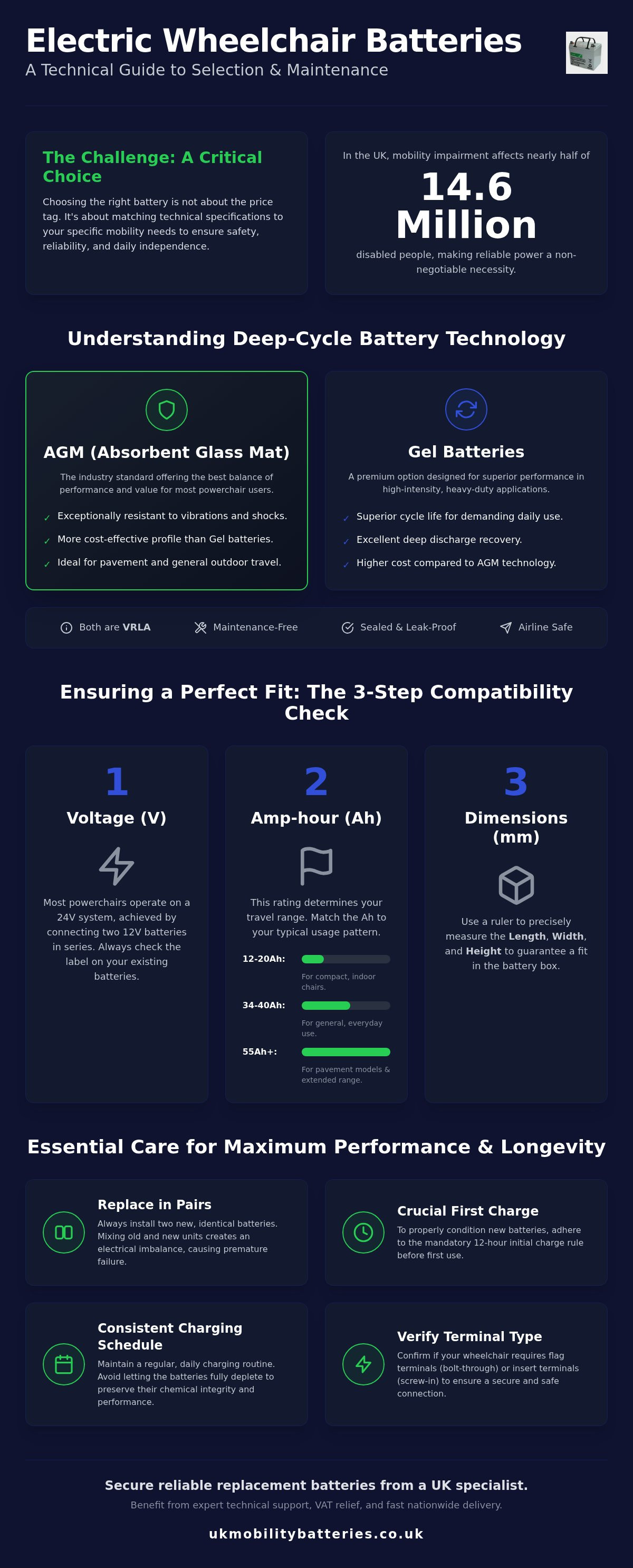
- Ensure 100% compatibility for your powerchair by verifying the three critical technical specifications: voltage, Amp-hour (Ah) rating, and precise physical dimensions.
- Match your power source to your specific usage pattern, ranging from compact 12Ah units for indoor chairs to high-capacity 55Ah Lucas batteries for pavement models.
- Maximise the operational lifespan of your equipment by adhering to the 12-hour "first charge" rule and maintaining a consistent daily charging schedule.
- Secure reliable replacement batteries through a UK specialist to benefit from expert technical support and fast nationwide delivery for minimal mobility disruption.
Understanding Electric Wheelchair Battery Technology: AGM vs Gel
Deep-cycle batteries are the primary power source for mobility equipment, designed specifically for endurance. Unlike automotive starter batteries that provide a short, high-current burst to ignite an engine, mobility batteries provide a steady flow of energy over several hours. When looking for the best batteries for electric wheelchairs uk, it's vital to choose a deep-cycle variant to avoid premature component failure. These units are built to handle the unique electrical demands of electric motors, ensuring that power remains consistent even as the charge level drops during a long journey.
The Science of Deep-Cycle Discharge
The internal architecture of a deep-cycle battery differs significantly from standard lead-acid units. These batteries feature thicker lead plates that can withstand repeated discharge cycles to 50-80% of their total capacity. This robust design prevents the plates from buckling under the stress of daily use. In 2026, battery efficiency is a key driver for users who require consistent range, making plate density a critical specification for longevity. Thinner plates found in car batteries would quickly degrade if subjected to the deep discharge patterns required by a powerchair.
Sealed Lead Acid (SLA) vs VRLA Terminology
Users often encounter technical jargon like SLA and VRLA. Both terms refer to Valve Regulated Lead Acid technology. These batteries are completely sealed and maintenance-free, meaning you'll never need to check or top up electrolyte levels. This "sealed" status is a mandatory safety feature for motorised wheelchair components used in domestic environments. It also ensures the batteries are leak-proof, which is a prerequisite for airline travel and safe storage within the home. All Lucas mobility batteries in our range utilise this sealed technology to ensure user safety and equipment protection.
The AGM Advantage and Lucas Reliability
Absorbent Glass Mat (AGM) technology uses a fine fibreglass mat to suspend the battery acid. This makes the battery exceptionally resistant to vibrations and shocks during outdoor travel. Lucas AGM batteries, such as the Lucas 12V 34Ah Sealed AGM Deep Cycle Battery, are the industry standard for UK users. They offer a more cost-effective profile than Gel batteries whilst providing the necessary durability for pavement use. While Gel batteries offer superior cycle life in high-intensity, heavy-duty applications, the Lucas AGM range provides the best balance of performance and rapid national delivery for the majority of powerchair models. Selecting a Lucas 12V 55Ah Sealed AGM Mobility Battery ensures your chair maintains its factory-specified range without the maintenance burden of older battery technologies.
How to Choose the Correct Battery Specification for Your Powerchair
Selecting the best batteries for electric wheelchairs uk requires a methodical approach to technical specifications. Mistakes in selection lead to physical incompatibility or electrical failure. To ensure a perfect fit, you must verify three primary attributes: voltage, Amp-hour (Ah) rating, and physical dimensions. Most electric wheelchairs operate on a 24V system, which uses two 12V batteries connected in series. You can find these details on the label of your current batteries. Always check both units; they should be identical in specification and age.
Replacing batteries in pairs is a technical necessity. An electrical imbalance occurs when a new battery is paired with a degraded one. The new unit discharges at a higher rate to compensate for the older battery's increased internal resistance. This process leads to premature chemical exhaustion in the new battery. Always install two identical units from the same production batch to maintain a balanced discharge curve and optimal range.
Measuring Dimensions and Identifying Terminals
Precise measurement is the only way to guarantee the battery fits your wheelchair's battery box. Measure accurately. Use a ruler to record the length, width, and height in millimetres. Even a 5mm difference can prevent the lid from closing securely. Pay close attention to the terminal type. Most Lucas mobility batteries use either flag terminals or screw-in (insert) terminals. Flag terminals require a bolt through a hole in a metal tab, while insert terminals use a threaded hole in the battery casing. Ensure there is sufficient cable clearance above the terminals to prevent wires from being pinched when the battery compartment is locked.
Amp Hour (Ah) Upgrades: Can You Increase Capacity?
The Amp-hour rating determines your maximum travel range. If your current range is insufficient, you might consider an upgrade. For instance, moving from a Lucas 12V 34Ah Sealed AGM Deep Cycle Battery to a Lucas 12V 50Ah Mobility Battery provides more capacity for longer journeys. High capacity batteries are heavy. They are also physically larger. You must measure the internal space of your battery tray before ordering. For detailed instructions on the installation process, you can read our guide on how to change mobility scooter batteries. If you're ready to restore your chair's performance, you can browse our full range of Lucas mobility batteries with confirmed dimensions.
Best Battery Options for Different Wheelchair Usage Patterns
Selecting the best batteries for electric wheelchairs uk is an exercise in matching capacity to environmental demands. A battery that excels in a flat, indoor shopping centre may fail to provide adequate torque on steep British pavements or rural paths. Lucas offers a tiered range of AGM batteries to address these specific use-case scenarios. Choosing a premium Lucas battery ensures consistent power delivery, as these units are engineered to maintain a stable discharge curve even as the remaining capacity diminishes.
For users of compact, transportable powerchairs, the Lucas 12V 12Ah and 20Ah Mobility Battery ranges provide the necessary power without adding excessive weight to the frame. These units are ideal for indoor environments where manoeuvrability is prioritised over long-range endurance. Mid-range pavement chairs typically require the Lucas 12V 34Ah Sealed AGM Deep Cycle Battery. This 34Ah unit is widely regarded for its versatility, offering a balance between physical size and a discharge capacity capable of supporting several hours of continuous daily use.
Lightweight and Travel-Friendly Solutions
Folding electric wheelchairs often utilise smaller cells to maintain portability. The Lucas 12V 7Ah Sealed AGM Batteries and the 9Ah uprated variants are designed for these lightweight frames. For a detailed breakdown of these smaller units, see our Lucas 12V 7Ah Battery Technical Overview. Crucially, these sealed AGM units are IATA compliant. This means they are safe for air travel, provided you obtain airline approval prior to flying. Their leak-proof construction ensures they meet the stringent safety standards required for cabin or hold storage during transit.
Maximum Range for Active Users
Heavy-duty and off-road powerchairs require high-capacity solutions like the Lucas 12V 50Ah and 55Ah Sealed AGM Mobility Batteries. The 55Ah model is the "workhorse" of the UK market because it maintains stable voltage levels even under significant electrical load. When navigating inclines or rough terrain, the motor draws higher current; lower capacity batteries may suffer from voltage sag, which reduces speed and overall performance. High-capacity Lucas batteries mitigate this, providing consistent torque throughout the discharge cycle. For further comparison of high-performance options, consult our Best Batteries for Electric Wheelchairs: 2026 UK Buyer’s Guide. These larger units are essential for active users who require a reliable 10-15 mile range on a single charge.
Maximising Performance: Care and Charging for Long-Life Batteries
Even the best batteries for electric wheelchairs uk will fail prematurely if they are not commissioned correctly. New Lucas AGM units require a mandatory 12-hour initial charge before their first operational use. This "priming" charge ensures the chemical plates are fully activated and balanced across both batteries in the 24V set. Beyond the initial setup, daily charging habits dictate the total cycle life of the equipment. You should never leave a deep-cycle battery in a discharged state. Doing so triggers sulphation, where lead sulphate crystals harden on the plates, permanently reducing the battery's ability to hold a charge.
Optimal Charging Cycles
Modern powerchairs typically utilise "smart" charger technology to manage the health of the cells. These chargers operate through three distinct stages: Bulk, Absorption, and Float. The Bulk stage delivers a high current to reach approximately 80% capacity quickly. The Absorption stage then tapers the current to safely fill the remaining 20% without overheating the internal components. Finally, the Float stage maintains the battery at a stable voltage to prevent self-discharge. For a detailed technical analysis of these stages, read our expert guide on whether you can overcharge a mobility scooter battery. It is critical to avoid using standard automotive chargers; these are designed for starter batteries and deliver a voltage spike that can damage the delicate glass mats inside a sealed AGM unit.
Winter Care and Capacity Loss
UK winters present a physical challenge to battery chemistry. In freezing temperatures, a deep-cycle battery can lose up to 30% of its effective capacity. This is a temporary reduction in range rather than permanent damage, but it requires careful management. To maintain optimal performance, charge your batteries in a room-temperature environment whilst the chair is stored. If you don't use your chair every day, follow a strict storage protocol. Perform a monthly "top-up" charge to prevent the voltage from dropping below the critical threshold where the battery chemistry becomes unrecoverable. Maintaining these protocols ensures your Lucas 12V 34Ah or 55Ah units reach their full service potential. If your current power source is struggling to hold a charge in cold weather, you can order replacement Lucas mobility batteries with fast national delivery to restore your equipment's reliability.
Sourcing Reliable Replacement Batteries with UK-Wide Delivery
Sourcing the best batteries for electric wheelchairs uk requires a supplier who understands the technical nuances of deep-cycle chemistry. Buying from a specialist ensures you receive verified stock specifically designed for mobility applications, rather than generic automotive or leisure batteries that lack the necessary plate thickness for daily discharge cycles. The Lucas brand remains the benchmark for reliability in the UK mobility sector. Their heritage in electrical engineering translates to batteries that maintain stable voltage under load, providing the dependability required by powerchair users for their daily independence.
Logistics are a critical factor when purchasing lead-acid batteries. These units are dense and heavy, making professional handling essential during transit. Our national UK delivery service manages these logistics, ensuring your batteries arrive safely and promptly at your door. This eliminates the physical burden of transporting high-capacity units like the Lucas 12V 55Ah from a physical shop. If you're unsure about the fitting process or the technical specifications of your specific chair, expert support is available to guide you through the installation.
The UK Mobility Batteries Advantage
We specialise exclusively in mobility power solutions. Our inventory is strictly limited to batteries rated for deep-cycle performance, such as the Lucas 12V 20Ah and 50Ah mobility ranges. By focusing on this niche, we ensure that every unit in our warehouse meets the high-stakes requirements of electric wheelchair users. For a broader look at how these power sources integrate with various mobility aids, you can consult The Ultimate Guide to Mobility Scooter Batteries UK. Our direct-to-door delivery model is designed to restore your mobility as quickly as possible with minimal disruption to your routine.
Ensuring Your Order is Correct
Before you complete your purchase, perform a final technical audit of your requirements. Use this checklist to prevent compatibility issues:
- Amp-hour (Ah) Rating: Confirm it matches or safely exceeds your original battery capacity.
- Physical Dimensions: Re-verify the length, width, and height in millimetres to ensure the battery box lid closes.
- Terminal Type: Ensure the terminals are the correct orientation and style (flag or insert) for your wiring loom.
If you have any doubts about these specifications, our technical team can provide a compatibility double-check before you order. This safety net ensures you receive the correct components the first time. When you're ready to upgrade or replace your current power source, you can browse our full range of Lucas Electric Wheelchair Batteries to find a high-performance, maintenance-free solution.
Restoring Your Mobility with Technical Precision
Securing the best batteries for electric wheelchairs uk involves more than just selecting the highest capacity; it requires a precise match between your equipment's motor requirements and the battery's discharge profile. By verifying your physical dimensions and terminal types, you'll eliminate the risk of incompatibility. Adhering to strict charging protocols, such as the initial 12-hour priming charge and avoiding deep discharge states, will significantly extend the service life of your investment. These technical steps ensure that your equipment remains dependable for daily travel.
As an authorised Lucas battery stockist, we provide verified deep-cycle solutions that maintain performance in demanding UK conditions. Our team offers expert UK technical support to ensure your selection is correct before you buy. With fast nationwide delivery on all orders, we'll help you restore your powerchair's range and reliability without unnecessary delay. Reliable power is the foundation of daily independence, and choosing a heritage brand like Lucas ensures your chair performs as the manufacturer intended. Take the next step in maintaining your independence by choosing a power solution engineered for endurance. Shop the Best Selection of Lucas Electric Wheelchair Batteries today and benefit from specialist knowledge and dependable technical specifications. Your mobility remains our primary focus.
Frequently Asked Questions
How long do electric wheelchair batteries typically last?
Typically, electric wheelchair batteries last between 12 and 18 months with regular daily use. If the equipment is used less frequently and maintained with a strict charging regime, this lifespan can extend to 3 years. Factors such as the depth of discharge, environmental temperatures, and the use of a correct smart charger significantly influence longevity. Chemical exhaustion is a natural process, but avoiding total discharge helps maximise the service life of your units.
Can I use a standard car battery in my electric wheelchair?
No, you cannot use a standard car battery in an electric wheelchair. Car batteries are designed for starting applications, providing a short burst of high current to ignite an engine. In contrast, powerchairs require deep-cycle batteries that provide a steady flow of energy over several hours. Using a starter battery will result in rapid plate degradation and premature failure, as it isn't engineered to handle the deep discharge cycles required for mobility equipment.
Do I need to replace both wheelchair batteries at the same time?
Yes, you must always replace both batteries simultaneously to ensure balanced performance. Electric wheelchairs operate on a 24V system using two 12V batteries connected in series. If you pair a new battery with an old one, the new unit will work harder to compensate for the higher internal resistance of the aged cell. This imbalance leads to the rapid failure of the new battery. To ensure the best batteries for electric wheelchairs uk perform correctly, always install an identical, fresh pair.
What is the difference between AGM and Gel wheelchair batteries?
The primary difference lies in how the electrolyte is stabilised within the casing. AGM batteries use a glass mat to soak up the acid, making them highly vibration-resistant and cost-effective for most UK users. Gel batteries use silica to turn the electrolyte into a thick paste, which offers superior performance in extreme heavy-duty scenarios or very deep discharge cycles. Whilst Gel units are often more expensive, Lucas AGM batteries provide the ideal balance of reliability and performance for pavement use.
How do I know if my electric wheelchair batteries are failing?
Common signs of failure include a significant reduction in travel range and a loss of power when navigating inclines or kerbs. You might also notice the battery indicator on your joystick dropping rapidly under load or the charger reaching the full stage much faster than usual. If your chair feels sluggish or requires more frequent charging than it did previously, the internal lead plates are likely reaching the end of their chemical service life.
Are these batteries safe for taking on an aeroplane?
Sealed AGM and Gel batteries are generally safe for air travel as they are classified as non-spillable. All Lucas mobility batteries are fully sealed and leak-proof, meeting the requirements for cabin or hold transit. However, you must obtain prior approval from your airline before arriving at the airport. You should also carry the technical data sheet for your specific battery model to confirm its IATA compliance and non-hazardous status to security staff during the boarding process.
How many miles will my wheelchair go on a full charge?
Range depends primarily on the Amp-hour (Ah) rating and the total weight of the user and equipment. For example, a Lucas 12V 34Ah battery set typically provides between 10 and 15 miles of travel on flat terrain. Higher capacity units, such as the Lucas 12V 55Ah, can extend this to over 20 miles. Environmental factors like steep hills, rough terrain, and cold temperatures will reduce these estimates, so it's vital to choose the correct capacity for your daily needs.
What is the best way to store wheelchair batteries if I am not using them?
If you aren't using your chair, fully charge the batteries before storage. Store the equipment in a cool, dry environment to slow the natural self-discharge process. It's essential to perform a top-up charge at least once every month. This prevents the voltage from dropping to a level where permanent sulphation occurs. Never leave batteries in a completely discharged state for any period, as this often leads to irreversible chemical failure and permanent capacity loss.