
AGM vs Gel Mobility Scooter Batteries: Which Technology Is Right for You?
The most expensive battery choice for your mobility scooter might actually be the one that leaves you stranded far from home. Reliability is vital when your independence depends on a single power source, yet the technical distinctions between different cell types often remain unclear. Understanding the performance gap in agm vs gel mobility scooter batteries is essential for maintaining consistent range and avoiding failure whilst navigating cold British weather.
We recognise that deciphering Amp Hour (Ah) ratings and deep-cycle specifications can be difficult, particularly when your priority is simply getting from A to B. This article delivers a practical breakdown of these two technologies to help you select a reliable and cost-effective power source for your specific model. We will evaluate technical factors such as discharge depth, cycle life, and maintenance requirements, showing why AGM often suits pavement use whilst Gel serves heavy-duty requirements. This comparison ensures you can choose a compatible replacement with confidence, allowing you to maximise the distance your scooter covers on a single charge.
Key Takeaways
- Identify the technical distinctions between agm vs gel mobility scooter batteries to select the most efficient power source for your specific equipment and travel requirements.
- Compare the cycle life and Depth of Discharge (DoD) characteristics of each technology to ensure your batteries can withstand frequent charging without premature capacity loss.
- Determine the best battery fit for your mobility device by assessing whether you operate a Class 2 pavement scooter or a high-performance Class 3 road model.
- Implement professional maintenance and storage techniques to prevent the "flat battery" trap and maximise the range of your equipment throughout the UK winter.
- Discover why Lucas deep-cycle AGM technology provides a reliable, maintenance-free solution with capacities ranging from 7Ah to 150Ah for all major scooter brands.
Understanding the Basics: What are AGM and Gel Batteries?
Both battery types are classified as a Valve-Regulated Lead-Acid (VRLA) battery. This technical designation means they're sealed units that utilise a pressure-relief valve to manage internal gases during the charging process. Because the electrolyte is immobilised within the casing, these units are entirely spill-proof and maintenance-free. They don't require the addition of distilled water, which was a mandatory requirement for older, "wet" lead-acid designs.
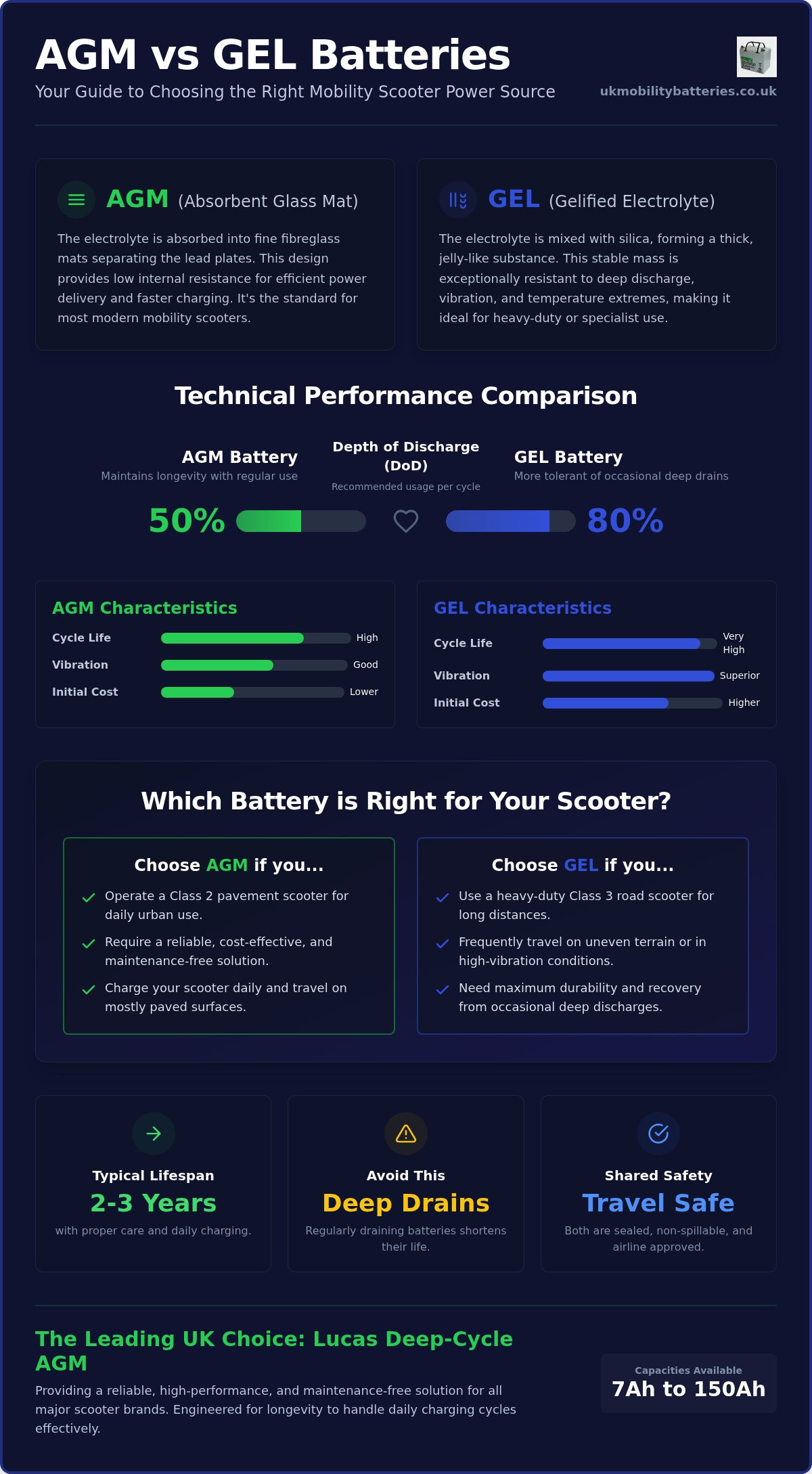
In an AGM battery, the electrolyte is absorbed into a fine fibreglass mat. This structure allows for lower internal resistance, which facilitates faster charging and efficient power delivery. In contrast, a Gel battery contains a silica-based electrolyte that has been turned into a thick, jelly-like mass. This gel-like substance is exceptionally stable and resistant to temperature fluctuations.
When comparing agm vs gel mobility scooter batteries, both technologies share essential safety characteristics. They're non-spillable and approved for air travel under standard ICAO and IATA regulations. This ensures they're safe for use on public transport and aircraft, provided the airline's specific notification requirements are met.
The Role of AGM Technology in Mobility
AGM technology is the primary choice for most Class 2 pavement scooters. It provides a reliable balance between weight, power output, and cost. Because the acid is held securely in glass mats, these batteries can withstand the minor bumps and kerbs encountered during daily urban use. They're particularly effective for users who charge their equipment daily and require a dependable, "maintenance-free" power source.
UK Mobility Batteries specialises in deep-cycle AGM solutions, including the Lucas 12V 7Ah and uprated 9Ah models. These units are designed for longevity and are ready for immediate installation without the need for initial acid filling. AGM is a high-performance, cost-effective solution for modern scooters.
The Gel Alternative for Specialist Use
Gel batteries are often categorised as a specialist choice for heavy-duty applications. Their unique silica structure allows them to recover more effectively from deep discharges. This means they're less likely to suffer permanent capacity loss if they're occasionally left in a low-charge state. The thick electrolyte acts as a physical cushion for the internal lead plates, providing superior durability in high-vibration environments.
You'll typically find Gel batteries in larger Class 3 road scooters that require consistent power for longer distances. Whilst they carry a higher initial purchase price, their ability to handle rigorous discharge cycles makes them a practical investment for road-legal equipment. They're particularly suited for users who travel on uneven terrain where physical shock to the battery is more frequent.
AGM vs Gel: A Technical Performance Comparison
The choice in agm vs gel mobility scooter batteries often comes down to two technical metrics: cycle life and Depth of Discharge (DoD). Cycle life refers to the total number of full charge and discharge cycles a battery can complete before its capacity drops below 80% of its original rating. Whilst Gel batteries are traditionally cited as having a longer cycle life, premium deep-cycle AGM units from Lucas have significantly narrowed this performance gap for the average user.
Depth of Discharge (DoD) represents the percentage of the battery capacity that has been used. Most AGM batteries are designed for a 50% DoD to maintain longevity. Gel batteries can often handle deeper discharges, up to 80%, without immediate damage. However, regularly draining any battery to these levels will shorten its overall service life regardless of the technology used. Understanding these limits is vital for maintaining your equipment's reliability.
Cycle Life and Longevity
For a typical UK mobility user, a well-maintained battery set should provide two to three years of service. Premium AGM models are engineered to handle daily charging cycles effectively. One of the primary advantages of AGM technology is its ability to deliver high bursts of power whilst maintaining a stable voltage. This makes them ideal for the stop-start nature of pavement travel.
A "partial state of charge" occurs when a battery is used and then not fully recharged. This is a common cause of premature failure in mobility equipment. Gel batteries are slightly more resilient to this behaviour, but both technologies require a full charge after every trip to prevent sulfation. If you require a replacement that matches your specific scooter's requirements, you can browse our range of Lucas mobility batteries to find a compatible match.
Temperature Resistance and Terrain
UK weather conditions play a significant role in battery efficiency. AGM batteries generally offer superior performance in cold temperatures. They maintain a higher current output, which is essential for moving a heavy scooter from a standstill on a frosty morning. Gel batteries can become sluggish in extreme cold as the electrolyte's jelly-like consistency increases internal resistance.
Terrain also dictates the discharge curve. Hilly areas require sustained high-current draws. AGM batteries handle these high-demand periods efficiently due to their low internal resistance. Whilst Gel is technically more resistant to internal heat generated by the motor during long climbs, this is rarely a limiting factor in the UK's temperate climate. For most pavement users, the cold-weather reliability of AGM provides a more practical daily benefit.
Self-discharge rates are another consideration for winter storage. Both types hold charge well; they typically lose only 1% to 3% of their capacity per month when idle. This makes them far superior to older battery designs for users who may not use their scooter every day during the colder months.
Which Battery Type Should You Choose for Your Scooter?
Selecting between agm vs gel mobility scooter batteries depends primarily on your equipment's classification and your typical travel environment. Class 2 scooters, limited to 4mph on pavements, have different power profiles than Class 3 road-legal models capable of 8mph. Before purchasing, check your existing battery's physical dimensions and terminal type. Even a small difference in millimetres can prevent the battery from fitting securely in the tray if it doesn't align with the manufacturer's original specifications.
Weight is another critical factor for users with portable equipment. Gel batteries are often slightly heavier than their AGM counterparts of the same capacity. For those who frequently dismantle their scooter for transport, this additional weight can make lifting the battery pack into a car boot significantly more difficult.
Best for Pavement and Folding Scooters
For portable and folding scooters, AGM technology is the industry standard. These devices require a high power-to-weight ratio to remain manageable when lifted. Using a Lucas 12V 20Ah AGM battery provides the necessary current for short urban trips without adding excessive bulk. These batteries are designed to deliver reliable bursts of energy for navigating kerbs and shop entrances.
From a cost-benefit perspective, AGM is highly efficient for users who cover moderate distances. If you typically replace your batteries every 24 months, the lower initial investment of AGM offers better value than Gel. These batteries provide consistent performance for daily shopping trips or visits to local town centres where the terrain is relatively flat and the journeys are predictable.
Best for Heavy-Duty and Long-Range Use
When evaluating agm vs gel mobility scooter batteries for road-legal models, the durability of the electrolyte becomes a primary factor. Gel batteries are the preferred choice for larger, Class 3 scooters designed for road use. If your journeys involve steep inclines or extended excursions exceeding 15 miles, the deep-discharge resilience of Gel is beneficial. These batteries are better suited for heavy-duty applications where the motor draws a sustained high current over several hours.
You should consider Gel if your charging habits are irregular. Whilst we recommend charging after every use, Gel cells are more forgiving if you occasionally forget to plug in immediately. Use this checklist to determine if you need the specialist performance of Gel:
- Does your scooter travel on public roads at speeds up to 8mph?
- Do you frequently navigate steep hills or rough park terrain?
- Is your scooter a larger model that uses 50Ah to 100Ah batteries?
- Do you prioritise the longest possible service life over the initial purchase cost?
If you answered yes to most of these points, Gel is likely the better investment for your specific needs. For all other standard pavement use, a high-quality deep-cycle AGM battery will provide the reliability and range you require for daily independence.
Care and Maintenance for Maximum Lifespan
The actual service life of your equipment depends more on your charging habits than the initial technology choice. Regardless of the outcome in the agm vs gel mobility scooter batteries debate, the "Golden Rule" remains the same: you must charge your batteries after every trip. Leaving cells in a discharged state leads to sulfation, a chemical process where lead sulphate crystals harden on the internal plates. This "flat battery trap" reduces capacity and is the primary cause of premature battery failure in the UK.
Terminal maintenance is another vital task for ensuring consistent power delivery. White powdery deposits can form on the connections, which increases electrical resistance and causes power loss. Cleaning these terminals with a wire brush and applying a thin layer of petroleum jelly creates a secure, conductive seal. You'll know your batteries are nearing the end of their functional life when the range drops significantly or the scooter loses speed on familiar inclines.
Charger Compatibility: A Crucial Warning
Charger compatibility is a technical factor that many users overlook when switching battery types. AGM and Gel technologies require different charging profiles to reach full capacity. A standard AGM charger typically operates at a lower finishing voltage than what a Gel battery requires. Using an AGM charger on a Gel unit often leads to persistent undercharging, which causes the electrolyte to stratify and shortens the battery's life. Some professional chargers feature switchable profiles to support both technologies. For a deeper understanding of these requirements, read our Expert guide to mobility scooter battery care.
Winter Storage and Health Checks
Maintaining battery health requires proactive management amongst the colder months. Low temperatures slow down the chemical reactions inside the cells, which can lead to a permanent loss of capacity if the voltage drops too low. If you don't intend to use your scooter during the winter, don't leave the batteries completely idle. Maintain a trickle charge by connecting the charger at least once every two weeks to keep the cells active.
Perform regular visual inspections to identify physical signs of distress. A "bulging" or distorted battery casing usually indicates that the unit has been overcharged or exposed to excessive heat. If you notice any leaks or unusual smells during the charging cycle, disconnect the power immediately. For a full list of physical warning signs, consult our guide on Troubleshooting battery failure signs.
If your current batteries no longer hold a sufficient charge for your daily needs, you can buy replacement Lucas mobility batteries for fast national delivery across the UK.
Why Lucas AGM Batteries are the Leading UK Choice
Lucas is a well-established and trusted brand in the UK mobility sector, known for engineering batteries that specifically address the needs of scooter users. Unlike generic power cells, Lucas AGM batteries are constructed with heavy-duty lead-calcium plates and reinforced casings to withstand the rigours of deep-cycle use. This specialised internal architecture ensures they handle repeated discharge patterns better than standard automotive units. When evaluating agm vs gel mobility scooter batteries, Lucas AGM offers a high-performance alternative that bridges the gap in reliability whilst maintaining a competitive cost of ownership. Their extensive range covers capacities from the Lucas 12V 7Ah up to 150Ah, providing a compatible solution for every scooter class available in the UK.
Uprated Capacity Options
Many portable travel scooters are supplied with 7Ah batteries as standard, which can limit your travel radius. Upgrading to a Lucas 12V 9Ah uprated battery provides approximately 28% more capacity within the same physical dimensions. This extra energy density allows for longer outings and provides a necessary safety margin during cold weather. For owners of mid-sized scooters, choosing between a Lucas 12V 34Ah and a 50Ah unit depends on your daily mileage and the physical space in your battery tray. A higher Amp Hour (Ah) rating directly increases your potential range without altering the scooter's speed. If you're preparing to install a new set, our Changing your batteries: a step-by-step guide provides technical instructions for a safe swap.
The Specialist Supplier Advantage
Purchasing your replacement power source from a dedicated specialist centre ensures you receive fresh stock that hasn't been sitting idle in a warehouse. Batteries are perishable items; their internal chemistry degrades if they aren't maintained at an optimal charge. UK Mobility Batteries provides fast national delivery across the UK, ensuring that every Lucas battery arrives in peak condition with full warranty protection. This direct supply chain guarantees that you're receiving genuine, deep-cycle technology rather than a generic equivalent. For eligible UK customers, VAT relief is available on batteries designed specifically for mobility equipment, ensuring that high-performance power remains accessible. Our technical support team is available to confirm compatibility, helping you choose between agm vs gel mobility scooter batteries based on your specific scooter model and usage patterns.
Securing Reliable Power for Your Independence
Selecting the correct technology in the agm vs gel mobility scooter batteries debate depends on your vehicle class and daily travel patterns. AGM technology provides a high-performance, cost-effective solution for Class 2 pavement scooters, whilst Gel remains the technical standard for heavy-duty Class 3 road models. Regardless of the cell type you choose, consistent charging after every trip and correct terminal maintenance are vital for maintaining the service life of your equipment.
As an authorised Lucas UK supplier, we specialise in providing deep-cycle solutions that meet the demanding requirements of the British mobility market. Our team offers expert technical advice to ensure you select a compatible replacement with the correct Amp Hour (Ah) rating for your specific model. You can browse our full range of premium Lucas AGM mobility batteries to benefit from fast national delivery across the UK and VAT relief available for eligible users. Making an informed decision today ensures your equipment remains reliable for years to come.
Frequently Asked Questions
Is a gel battery better than an AGM battery for a mobility scooter?
A Gel battery isn't necessarily better; it serves a different technical purpose. Gel technology is superior for heavy-duty road scooters and deep discharge cycles because the silica-based electrolyte is more resilient. However, for most pavement scooters, AGM provides a more cost-effective and reliable power source. AGM batteries also offer better performance in cold UK weather, making them the standard choice for daily urban use.
Can I swap my AGM batteries for Gel batteries using the same charger?
You shouldn't swap between technologies without verifying your charger's specific compatibility. AGM and Gel batteries require different charging profiles to reach their full capacity. Using a standard AGM charger on a Gel battery often results in persistent undercharging, which leads to electrolyte stratification and premature failure. Always check if your charger has a switchable setting or a specific "Gel" mode before changing your battery type to ensure longevity.
How long do AGM mobility scooter batteries typically last in the UK?
In the UK, a high-quality set of AGM mobility scooter batteries typically lasts between two and three years. This lifespan depends heavily on your charging habits and the average load carried by the device. Regular daily charging and avoiding the "flat battery" trap are essential for reaching this maximum service life. Cold winter temperatures can reduce temporary capacity, but they don't shorten the overall life if the battery is kept charged.
Are gel batteries safer for air travel than AGM batteries?
Both battery types are equally safe for air travel as they're both classified as non-spillable Valve-Regulated Lead-Acid (VRLA) batteries. Neither technology contains free-flowing liquid, making them leak-proof even if the casing is damaged. You can take both on aircraft provided they're IATA and ICAO approved. Most airlines require you to notify them 48 hours before travel, regardless of whether you use agm vs gel mobility scooter batteries.
Can I mix one AGM battery with one Gel battery in my scooter?
You must never mix different battery technologies or brands in the same mobility scooter. Mobility devices operate on a 24V system using two 12V batteries connected in series. Mixing an AGM battery with a Gel battery causes an electrical imbalance because they have different internal resistances and discharge rates. This imbalance leads to one battery overcharging whilst the other undercharges, which will quickly destroy both units and potentially damage your electronics.
Why are Gel batteries more expensive than AGM batteries?
Gel batteries are more expensive because the manufacturing process for the silica-based electrolyte is more complex than the glass mat construction used in AGM. The gel substance provides a physical cushion for the internal lead plates, which enhances durability in high-vibration environments and allows for a higher number of deep discharge cycles. Whilst the initial purchase price is higher, the specialist construction offers a longer lifespan for road-legal scooters.
Do I need to top up the liquid in a Gel or AGM battery?
No, you don't need to top up any liquids in these batteries. Both AGM and Gel units are completely sealed and maintenance-free. They use a recombinant gas system that turns oxygen and hydrogen back into water inside the battery casing. This design eliminates the need for distilled water, which was a requirement for older, "wet" lead-acid batteries. You should never attempt to open the casing, as this will ruin the internal pressure seal.
What happens if I use the wrong charger for my Gel battery?
Using an incorrect charger for a Gel battery usually results in a significantly shortened service life. Standard chargers designed for AGM often finish the charging cycle at a voltage that's too low for Gel cells. This causes lead sulphate to harden on the plates, a process known as sulfation, which permanently reduces the battery's capacity. Over time, your scooter's range will decrease until the batteries can no longer hold enough power for short journeys.