
What to Do If Your Mobility Scooter Battery Dies: A Complete Recovery Guide
Imagine you're halfway to the local shops when your battery indicator suddenly drops into the red and the motor cuts out. It's a stressful situation that leaves many users wondering exactly what to do if your mobility scooter battery dies whilst they're away from home. You likely rely on your equipment for daily independence; so a sudden loss of power feels like a significant technical failure rather than a simple inconvenience. It's common to feel frustrated by ambiguous indicator lights or uncertain about whether your cells are truly exhausted or just poorly connected.
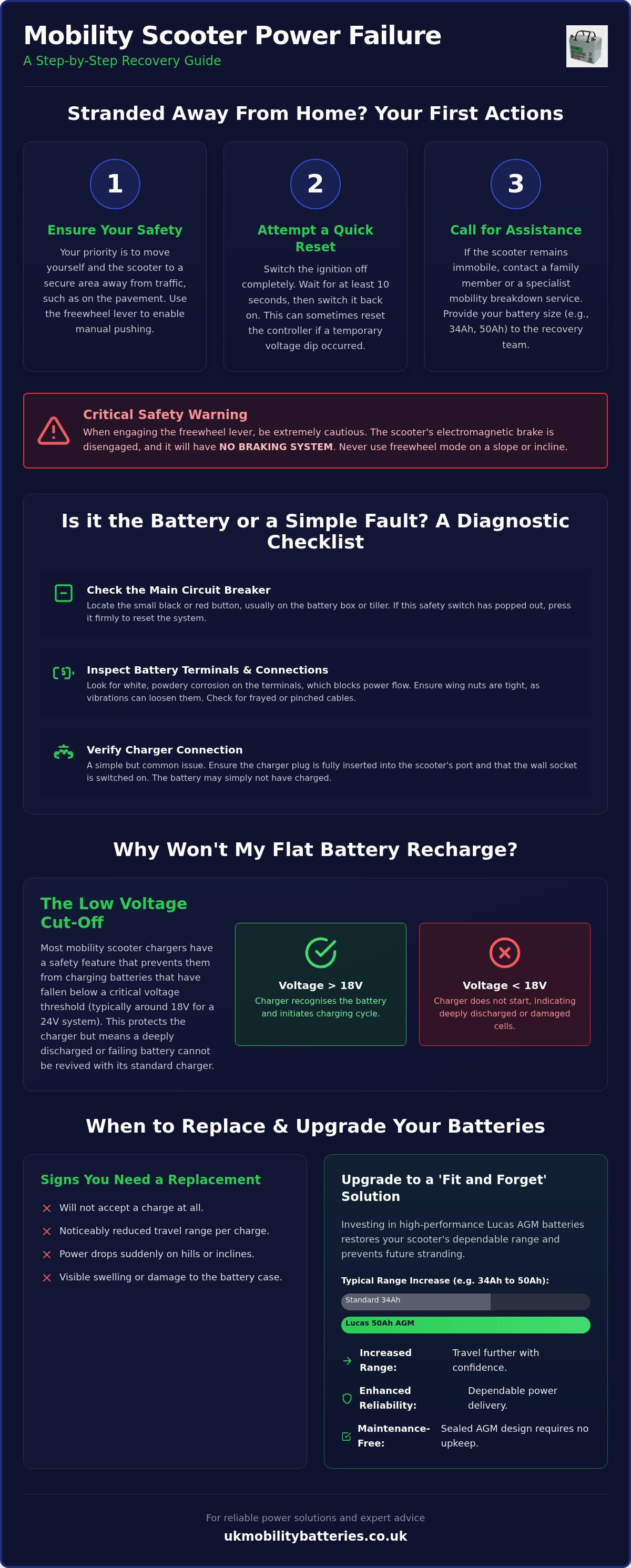
We understand that reliability is your primary concern when selecting 12V deep cycle power components. This guide provides a systematic, step-by-step approach to managing a power failure, prioritising your immediate safety and technical troubleshooting. You'll learn how to secure your position, verify terminal connections, and interpret voltage signals correctly. We also outline how to determine if your current lead-acid cells require a professional replacement. By following this recovery guide, you can identify if a high-performance Lucas AGM battery is the necessary "fit and forget" solution to restore your scooter's dependable range and prevent future stranding.
Key Takeaways
- Prioritise personal safety whilst stranded by using the freewheel lever to move your scooter to a secure area away from traffic.
- Follow a diagnostic triage to determine what to do if your mobility scooter battery dies, focusing on terminal corrosion, loose wing nuts, and tripped circuit breakers.
- Understand the technical limitations of standard chargers, including the low voltage cut-off threshold that prevents charging if batteries drop below 18V.
- Evaluate replacement options such as upgrading to 50Ah Lucas AGM batteries to increase range and ensure a maintenance-free, "fit and forget" power solution.
Immediate Actions: What to Do If You Are Stranded Away from Home
When your scooter stops unexpectedly in a public place, your first priority is removing yourself from potential hazards like road traffic or crowded thoroughfares. Knowing exactly what to do if mobility scooter battery dies whilst you're out helps prevent panic and ensures you remain safe until assistance arrives. The most immediate solution is to utilise the freewheel mechanism. This allows you to push the vehicle manually to a secure position on the pavement. Before assuming the battery is fully depleted, verify the position of the freewheel lever; if this has been accidentally knocked into the disengaged position, the motor won't engage, which often mimics a total power failure.
If the lever is correctly positioned and the console remains dark, try a hard reset. Switch the ignition off, wait ten seconds, and switch it back on. This can occasionally reset the controller if a temporary voltage dip occurred under heavy load. Unlike automotive systems, mobility scooters utilise VRLA (Valve-Regulated Lead-Acid) batteries, specifically AGM or Gel types. These cannot be jump-started with cables. Attempting to do so can cause irreparable damage to the sensitive electronic speed controller. Understanding what to do if mobility scooter battery dies from a technical perspective means recognising that these units require controlled charging rather than high-amperage bursts.
Engaging Freewheel Mode Safely
Locate the freewheel lever, which is typically a yellow or red handle situated near the rear motor assembly or transaxle. Pulling or pushing this lever disengages the electromagnetic brake, allowing the wheels to turn freely. You must use extreme caution; once in freewheel mode, the scooter has no braking system. Don't disengage the motor whilst on a slope or incline. Once you've reached a safe, level area, ensure the lever is clicked firmly back into the "drive" position before attempting any further diagnostics or waiting for recovery.
Who to Call for Assistance
Contact a family member or a specialist breakdown service if you cannot restart the vehicle. Many specialist insurance policies for mobility users include recovery as standard. When you call for help, provide the recovery team with your battery specifications, such as whether you use 34Ah or 50Ah cells, as this helps them determine the weight and equipment needed for transport. Never allow a standard car to tow your scooter using a rope. The high speeds and lack of controlled braking will likely destroy the internal transaxle and motor gears.
Diagnostic Triage: Is the Battery Truly Dead or Is It a Connection Fault?
Before you commit to a replacement, you must determine if the power loss is a permanent cell failure or a simple circuit interruption. Knowing what to do if mobility scooter battery dies involves a systematic check of the entire electrical path. A common cause of sudden failure is a tripped main circuit breaker. This safety component, typically a small black or red button located on the battery box or tiller, protects the electronics from high-current surges during steep climbs. If the button has popped out, press it firmly to reset the system. You should also verify that the charger plug is fully seated in the port. An incorrectly inserted plug or a switched-off wall socket often leads to a false diagnosis of a dead battery when the cells simply haven't received a charge.
If the scooter remains unresponsive, observe the battery gauge for specific signals. Many controllers use the display to communicate error states. A needle that "bounces" or LEDs that flash in a repeating sequence are not random; they are diagnostic tools. Identifying these patterns early can save significant time and prevent unnecessary expenditure on new parts if the fault lies within the wiring loom or the motor brushes rather than the power source itself.
Checking Battery Terminals and Connections
To perform a thorough inspection, remove the protective battery shroud to access the individual 12V units. Check the terminals for white powdery oxidisation. This corrosion increases electrical resistance and can prevent the motor from drawing the necessary current. You can clean the terminals using a stiff brush whilst wearing gloves to ensure a metal-to-metal contact. Ensure the wing nuts or bolts are tight; vibrations from regular use can loosen these connections over time. Inspect the cables for frayed insulation or wires pinched beneath the seat assembly. If you find that your terminals are beyond cleaning, consider browsing our Lucas AGM batteries for a clean, maintenance-free replacement.
Understanding Dash Fault Codes
Modern mobility scooters use "flash codes" to indicate specific electrical errors. If your battery gauge is blinking, count the number of flashes in each sequence. A "low voltage" warning typically indicates that the batteries have dropped below the functional cut-off limit of the controller. You should consult a specialised mobility scooter battery troubleshooting guide to translate these beep or flash patterns accurately. This diagnostic step is essential to confirm what to do if mobility scooter battery dies, as it helps distinguish between a battery that is merely flat and one that has reached the end of its chemical lifespan.
How to Revive a Flat Mobility Scooter Battery
If your equipment has been left in storage for several months, the internal voltage may have dropped below the threshold required for a standard charger to operate. Most intelligent mobility chargers feature a "low voltage cut-off" safety mechanism. For a standard 24V system, which consists of two 12V batteries in series, the charger often won't activate if the combined voltage is below 18V. In this state, the charger cannot "see" the batteries and will fail to initiate the charging cycle. Understanding what to do if mobility scooter battery dies after long-term storage is crucial; you might assume the charger is faulty when the batteries are simply too flat to be recognised. Once an AGM battery drops below 10.5V, permanent chemical damage is likely.
You should avoid using high-amperage "quick chargers" or automotive chargers intended for car batteries. These devices can cause rapid gas build-up and physical swelling within sealed AGM units, potentially rupturing the safety valves or causing the casing to split. A slow, controlled trickle charge is the only safe method for attempted recovery. This methodical approach ensures that the heat generated during the chemical reaction remains within safe limits for the sealed unit.
The 24-Hour Recovery Charge
To attempt a recovery, connect the charger lead to the scooter's port before plugging the unit into the mains to prevent electrical sparking. Leave the scooter in a well-ventilated area whilst charging for a full 24-hour period, even if the "charged" light appears sooner. This extended duration allows the internal chemistry to stabilise and reach a full state of charge. Monitor the charger indicator lights closely; a flashing red light or a persistent error signal usually indicates that the battery is non-recoverable and the internal resistance is too high for safe operation.
Why "Reviving" Often Fails
Even if a battery appears to take a charge after a deep discharge, its functional performance is often compromised. When lead-acid batteries remain in a discharged state, lead sulphate crystals harden on the plates. This process, known as sulphation, creates an insulating layer that permanently reduces the Ampere-hour (Ah) capacity. A battery that originally provided a 34Ah capacity may only deliver 15Ah after a deep discharge event, significantly reducing your travel range. For detailed advice on maintaining cell longevity, refer to our guide on can you overcharge a mobility scooter battery to prevent these issues from recurring.
Evaluating Replacement Options: When to Buy New Batteries
If your diagnostic triage confirms that your cells are exhausted, you must select a compatible replacement to restore your scooter's range. Knowing what to do if mobility scooter battery dies permanently involves more than just purchasing the first 12V unit you find. You must replace batteries in matched pairs. Installing a single new battery alongside an aged one creates an electrical imbalance; the older cell will have higher internal resistance, forcing the new battery to work harder and leading to the premature failure of both units. This "matched pair" approach ensures the voltage remains balanced during both the discharge and recharge cycles.
Selecting the correct technology is equally vital for long-term reliability. Most modern scooters utilise 12V AGM batteries, which are favoured for being maintenance-free and spill-proof. When you choose a replacement, verify the terminal type on your existing units. Most larger batteries use "insert" terminals (threaded holes), whilst smaller units may use "flag" or "spade" connectors. Using the wrong terminal style can lead to loose connections and heat build-up, which eventually damages the scooter's wiring loom.
AGM vs. Gel: Which is Right for You?
Sealed AGM batteries are the standard choice for everyday use. They are cost-effective and provide excellent deep-cycle performance for most pavement and road-going scooters. Gel batteries are a specialised alternative for heavy-duty, high-mileage users because they handle deep discharge cycles slightly better in extreme conditions. However, Gel batteries require a specific charging profile. If your current charger is not designed for Gel chemistry, stick with a high-quality AGM unit to avoid undercharging. For a detailed comparison of these technologies, consult the ultimate guide to mobility scooter batteries UK.
Sizing and Compatibility Checklist
Before ordering, you must verify the physical dimensions of your current battery box. Measure the length, width, and height of the units in millimetres to ensure a secure fit.
- Capacity (Ah): You can often upgrade your capacity for better range. For instance, replacing 42Ah with 50Ah batteries is a common upgrade if the physical dimensions are identical.
- Voltage: Confirm you are ordering 12V units. These are connected in series to provide the 24V required by the motor.
- Weight: Higher capacity batteries are heavier. Ensure you can still manage the weight if you frequently dismantle your scooter for car travel.
Securing Reliable Power with Premium Lucas AGM Batteries
When considering what to do if mobility scooter battery dies and troubleshooting fails to restore power, the quality of your replacement cells determines the long-term reliability of your equipment. Lucas AGM batteries are widely recognised as the UK industry standard for mobility applications. These units utilise Valve-Regulated Lead-Acid (VRLA) technology, specifically Absorbed Glass Mat (AGM) construction, which renders them completely maintenance-free. Unlike older battery types, these sealed units don't require water topping and are spill-proof, providing peace of mind for users who transport their scooters in vehicles or aeroplanes.
A critical factor often overlooked by general retailers is the age of the stock. Lead-acid batteries undergo natural self-discharge even when not in use. If a battery sits on a shelf for several months without a maintenance charge, permanent sulphation begins, reducing its usable lifespan before it's even installed. As a national specialist, we prioritise high stock turnover to ensure every Lucas battery delivered is fresh and holds its full factory-rated capacity. When your mobility is at stake, fast national delivery is essential to minimise downtime and restore your independence quickly.
Why Choose Lucas Mobility Batteries?
Lucas mobility batteries are engineered with deep cycle capability, meaning they're designed to handle repeated discharge and recharge cycles without significant performance degradation. This robust construction is essential for the varied UK weather conditions and the vibrations encountered on uneven pavements. The range covers all common specifications, from the compact 12V 7Ah battery for mobility scooter technical specifications fitting guide for boot scooters to larger 50Ah and 55Ah units for road-legal Class 3 vehicles. This versatility ensures that regardless of your scooter's power requirements, there's a Lucas "fit and forget" solution available.
Buying with Confidence from UK Mobility Batteries
Choosing the correct power source shouldn't be a matter of guesswork. Our technical support team assists users in identifying the exact terminal type and Ampere-hour rating required for their specific model. We offer competitive pricing on multi-pack bundles, encouraging the recommended practice of replacing batteries in pairs to ensure system balance. If you're still uncertain what to do if mobility scooter battery dies and you need a reliable replacement, browse our full range of Lucas mobility batteries for fast UK delivery. We provide the technical data and expert guidance needed to get your equipment back on the road with total confidence in your power supply.
Restore Your Independence with Reliable Power
Managing a power failure requires a methodical approach, from securing your position in public to performing a technical diagnostic triage. By verifying terminal connections and understanding why chargers fail to activate below specific voltage thresholds, you can determine exactly what to do if mobility scooter battery dies and whether a recovery is chemically possible. When the internal lead-acid plates have suffered permanent sulphation from deep discharge, a matched pair of high-performance cells is the only solution to guarantee consistent travel range and safety.
As an authorised Lucas battery distributor, we provide specialist technical advice for UK customers to ensure perfect compatibility. Our comprehensive range, spanning from 7Ah to 150Ah, features fresh stock that arrives ready for immediate installation. Choosing a premium, maintenance-free AGM unit eliminates the uncertainty of future failures, allowing you to focus on your journey rather than your battery gauge. Order your replacement Lucas mobility batteries today for rapid UK delivery. You can look forward to restored mobility and the peace of mind that comes with industry-standard power.
Frequently Asked Questions
Can I jump-start my mobility scooter battery using a car?
No, you must never attempt to jump-start a mobility scooter using a car battery. The high cold cranking amps (CCA) of a car battery can instantly destroy the sensitive electronic speed controller. Mobility scooters use specialised deep-cycle batteries designed for steady power delivery rather than short, high-amperage bursts. If you're unsure what to do if mobility scooter battery dies, prioritise a slow recharge using the manufacturer-approved 24V smart charger to avoid permanent component damage.
How long should a mobility scooter battery last before it needs replacing?
A high-quality Lucas AGM battery typically lasts between 12 and 18 months with regular daily use. If you only use your scooter occasionally and maintain a strict charging regime, you might achieve up to three years of service. Factors such as the depth of discharge, the weight of the user, and storage temperatures all influence longevity. Replacing your cells when the range begins to noticeably diminish prevents unexpected failures whilst you're away from home.
My charger light is green but the scooter won’t move, what should I do?
A green light on the charger signifies that the charging cycle is complete, but it doesn't always mean the batteries are healthy. This often indicates a "surface charge" where the voltage is high enough to trigger the light, but the internal plates lack the capacity to hold a load. If you're wondering what to do if mobility scooter battery dies despite a green light, verify the freewheel lever is engaged and check the main circuit breaker before testing the voltage.
Can I replace just one battery if only one has died?
You must always replace mobility batteries in matched pairs. If you install a single new cell alongside an older one, the aged battery's higher internal resistance will cause an electrical imbalance. This forces the new battery to overwork during discharge and undercharge during the replenishment cycle, leading to the premature failure of both units. To ensure long-term reliability and balanced 24V performance, we only recommend purchasing and installing fresh, identical pairs of Lucas batteries.
Is it safe to leave my mobility scooter on charge overnight?
It is safe and generally recommended to leave your scooter on charge overnight. Modern "smart" chargers are designed to switch to a maintenance or "float" mode once the batteries reach a 100% state of charge. This prevents overcharging whilst ensuring the cells are fully saturated. Frequent partial charging can lead to sulphation, so allowing the charger to complete its full cycle overnight is the most effective way to maintain your battery's Ampere-hour capacity.
What is the difference between an AGM and a Gel battery?
AGM (Absorbed Glass Mat) batteries use a fibreglass mat to soak up the electrolyte, making them maintenance-free and cost-effective for most users. Gel batteries use a silica additive to turn the electrolyte into a thick paste, offering superior resistance to extreme deep discharge and vibrations. Whilst Gel batteries are excellent for high-mileage users, they require a specific charging profile. Most UK scooters are factory-fitted with AGM units, which remain the industry standard for reliable daily performance.
Why does my battery die faster in cold winter weather?
Battery capacity decreases in cold weather because the internal chemical reactions occur more slowly. In temperatures near freezing, you may notice a 20% to 30% reduction in your usual travel range. To mitigate this, store your scooter or battery pack in a heated indoor area whilst charging. Charging in a warm environment ensures the chemistry is active and the cells reach their maximum potential capacity before you head out into the cold winter air.
Can I upgrade my scooter to a higher Ah battery for more range?
You can often upgrade to a higher Ampere-hour (Ah) rating to increase your travel range, provided the new units fit within the physical dimensions of your battery box. For example, many users successfully upgrade from 34Ah to 50Ah Lucas batteries to achieve more miles per charge. You must measure the length, width, and height of your current compartment and confirm that the terminal type is compatible before committing to a higher capacity power solution.