
UPS Batteries: Standby Power Technical Guide 2026
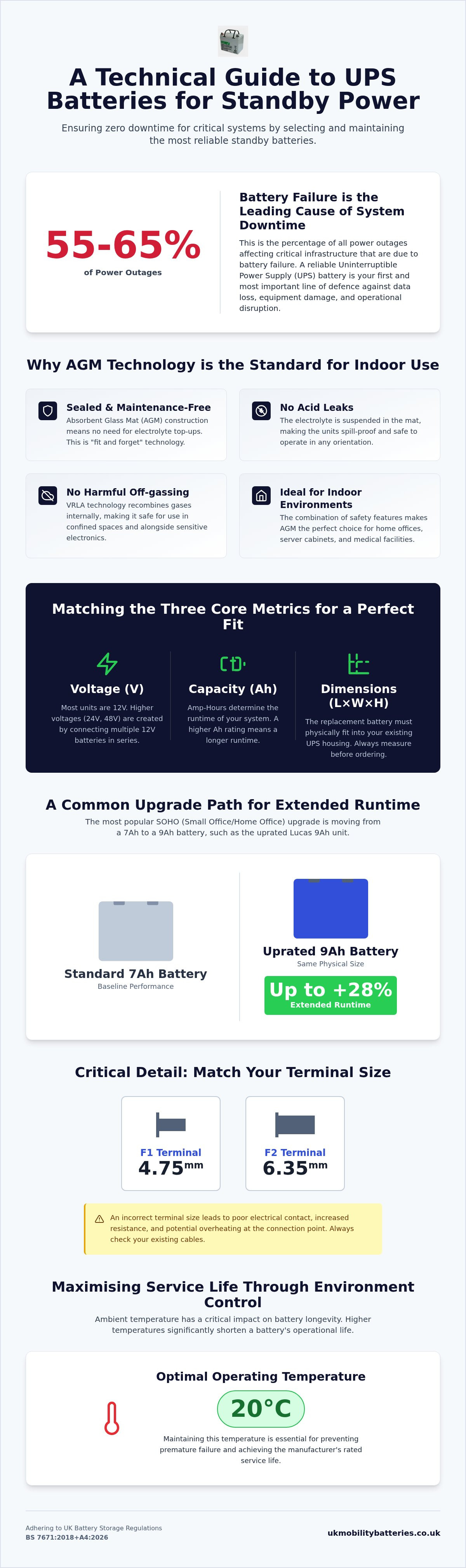
Battery failure is responsible for 55% to 65% of all power outages affecting critical infrastructure. It's a sobering statistic that highlights the vulnerability of many systems relying on ups batteries for standby power. You likely understand the frustration of a sudden power loss during a critical task, or the confusion that arises when trying to match Ah ratings with physical dimensions. Worrying about battery leaking or off-gassing in indoor environments is a valid concern for any site manager or home office user.
This technical guide ensures you can select and maintain the most reliable AGM units to achieve zero downtime. We'll help you identify the exact Lucas replacement battery for your specific unit, whilst adhering to the new UK battery storage regulations (BS 7671:2018+A4:2026) that became mandatory in October 2026. You'll learn how to prolong the life of your standby cells and how to secure quick UK delivery for urgent replacements. We'll move through technical specifications and maintenance protocols to keep your equipment protected and functional.
Key Takeaways
- Learn to distinguish between high-rate discharge units and standard deep-cycle batteries to ensure your system can handle immediate electrical loads during a failure.
- Identify the precise ups batteries for standby power by matching voltage, Amp-Hour ratings, and physical dimensions to your existing UPS housing.
- Discover why sealed AGM technology provides a safe, maintenance-free solution for indoor standby systems without the risk of leaking or off-gassing.
- Understand the critical impact of ambient temperature on battery longevity, specifically why maintaining a 20°C environment is essential for preventing premature failure.
- Explore how uprated Lucas 9Ah units can provide extended runtime as a direct physical replacement for standard 7Ah batteries in many standby configurations.
Understanding the Role of UPS Batteries in Standby Power Systems
An Uninterruptible Power Supply (UPS) relies on a battery specifically engineered for high-rate discharge. These units aren't designed for long, slow energy release; they're built for immediate, high-intensity activation. When the mains supply fails, the battery must deliver its stored energy instantly to the inverter. This ensures that connected devices don't experience even a microsecond of power loss. For anyone managing critical data or medical devices, this "instant-on" capability is the only metric that matters.
These batteries function as the heart of the protection circuit. They remain in a constant state of readiness, receiving a precise float charge to counteract self-discharge. Reliability in ups batteries for standby power comes from the internal chemistry's ability to handle high-current draws without a significant voltage drop. If the internal resistance is too high, the battery fails to support the load, leading to the exact system crash the UPS was installed to prevent. The system's rectifier converts incoming AC to DC to charge the battery string, whilst the inverter stands ready to reverse this process the moment the input voltage deviates from the standard 230V UK mains frequency.
Standby Power vs. Emergency Backup: What is the Difference?
A standby power system acts as a bridge. It fills the gap between the initial failure and the start-up of a secondary source, like a generator, or until the system can be safely shut down. It also serves as a critical filter. Standby batteries help smooth out brownouts and voltage surges that would otherwise degrade sensitive electronics. Emergency backup usually implies a longer-term solution, whereas standby power is about the integrity of the transition. The battery must be robust enough to handle the inrush current of the connected equipment, which can be significantly higher than its steady-state operating current. While we specialise in mobility solutions, certain high-capacity units like the Lucas 12V 34Ah Sealed AGM Deep Cycle Battery can bridge the gap between mobility and standby roles in specific low-draw applications where runtime is prioritised over high-rate bursts.
The Importance of Maintenance-Free Sealed Units
Safety is paramount in indoor environments. Modern ups batteries for standby power almost exclusively use Valve Regulated Lead Acid (VRLA) technology. These are sealed units, meaning they're maintenance-free and won't leak acid if tilted. They're ideal for home setups or remote server cabinets where regular inspection isn't practical. Using Lucas sealed AGM batteries eliminates the risk of harmful off-gassing, making them safe for use in confined spaces alongside sensitive medical or computing equipment. This "fit and forget" nature allows users to focus on their primary tasks without constant battery monitoring.
Key Technical Specifications: Voltage, Amp-Hours, and Dimensions
Selecting ups batteries for standby power requires precise technical matching across three core metrics: voltage, capacity, and physical footprint. Most small to medium-sized UPS units utilise a 12V architecture as their primary building block. Higher voltage systems, such as 24V or 48V strings, are simply configurations of these standard 12V units connected in series. Adhering to ITU best practices for infrastructure efficiency ensures that your battery string remains balanced and capable of delivering the required load without premature degradation.
Terminal identification is equally critical for a secure electrical connection. Standby batteries typically use spade-style connectors, classified as F1 or F2. F1 terminals are 4.75mm wide, whilst F2 terminals are 6.35mm wide. Using the wrong size leads to poor electrical contact, increased resistance, and potential overheating at the connection point. Always check your existing leads before ordering a replacement to ensure the terminal width matches your UPS cables.
The 7Ah vs. 9Ah Debate: Can You Upgrade Your UPS?
When selecting ups batteries for standby power, the most common upgrade path for SOHO (Small Office/Home Office) units involves moving from Lucas 12V 7Ah Sealed AGM Batteries to the Lucas 12V 9Ah Uprated Sealed AGM Battery. These two models share identical physical dimensions, but the 9Ah version offers approximately 28% more runtime. This uprated capacity provides a vital buffer during extended outages without requiring any modifications to the UPS housing. Most modern chargers can handle this slight increase in Amp-Hour capacity without issue, provided the voltage remains at 12V.
Standard Dimensions for SOHO UPS Units
Physical size is the non-negotiable factor in battery replacement. The industry-standard footprint for a typical 7Ah or 9Ah unit is 151mm x 65mm x 94mm. Even a variance of a few millimetres can prevent the battery compartment from closing or lead to dangerous pressure on the casing. Before you finalise your selection, measure your current battery's length, width, and height. If you're unsure about the correct fit, you can consult our technical support team for exact identification. Measurements should always include the terminal height to ensure the unit fits within the vertical clearance of the UPS chassis.
Selecting the Right Battery Chemistry: Why AGM is the Industry Standard
Absorbent Glass Mat (AGM) technology has become the benchmark for ups batteries for standby power due to its superior efficiency in high-current applications. Unlike traditional flooded lead-acid batteries, AGM units contain the electrolyte within a fine glass fibre mat. This design allows for a significantly lower internal resistance. In high-current draw scenarios, such as when a UPS must support a server rack or medical equipment during a power cut, this low resistance ensures the battery can discharge rapidly without a catastrophic voltage drop.
Adhering to technical benchmarks like the Department of Energy UPS standards ensures that these systems operate within safe efficiency parameters. Whilst Gel batteries are excellent for sustained deep-cycle mobility use, they're rarely the first choice for standard UPS units. This is because Gel chemistry typically has higher internal resistance, which limits its ability to deliver the massive bursts of power required for instant-on standby protection. AGM remains the industry standard for its balance of cost, safety, and high-rate performance.
VRLA and AGM: The Safety Advantage
These units are classified as Valve Regulated Lead Acid (VRLA). They use a recombinant lid design that captures oxygen and hydrogen gases generated during charging and recombines them back into water. This process prevents electrolyte loss and eliminates the need for topping up. Because the acid is absorbed into the glass mats, there's no liquid to spill. This allows for safe operation in any orientation, provided they aren't used continuously in an inverted position. These attributes mean Lucas AGM batteries are classed as non-hazardous for transport across the UK, ensuring reliable logistics for urgent replacements.
Discharge Rates and Standby Life Expectancy
Standby batteries are engineered with thinner, more numerous plates than standard deep-cycle batteries to provide a larger surface area for chemical reactions. This specific architecture allows for the high-wattage bursts typical of UPS operation. Most high-quality AGM units offer a 5-year design life in standby service, provided they remain in a temperature-controlled environment. Constant "float" charging keeps the internal chemistry active without overcharging. This ensures the battery string is always at 100% capacity when the mains fail, maintaining the integrity of the standby system over several years of service.
Maximising Service Life: Maintenance and Environment Control
Excessive heat acts as a silent killer for standby systems. Whilst AGM technology is robust, it's highly sensitive to its operating environment. Every 8°C rise in ambient temperature above the ideal 20°C baseline halves the operational life of your ups batteries for standby power. If your UPS unit is stored in a poorly ventilated cupboard or near a heat source, a battery with a five-year design life could fail in less than two years. Maintaining a cool, stable environment is the most effective way to protect your investment.
Physical maintenance is equally vital for reliability. You should ensure that all terminal connections are clean, dry, and tightened to the manufacturer's torque specifications. Loose or corroded terminals cause micro-arcing. This creates electrical noise and generates localised heat that can melt the battery casing or damage the UPS circuitry. Establish a regular self-test schedule through your UPS management software. Running a monthly discharge test for 30 seconds identifies weak cells before they fail during a genuine power cut.
Optimal Charging Profiles for Standby Use
Standby batteries require a precise float voltage to remain healthy. If the charger's voltage is too high, it leads to gassing and dry-out. In extreme cases, overcharging a mobility scooter battery or a UPS unit causes thermal runaway, where the battery heats up uncontrollably and swells. Inspect your batteries every six months for any signs of casing deformation or "swelling". A bloated battery case is a definitive sign of charger failure or high-temperature stress and requires immediate replacement to prevent fire risks.
Identifying Failure Before the Power Goes Out
You don't need specialised equipment to spot the early signs of battery failure. Pay attention to recharge times; if your UPS takes significantly longer than usual to reach 100% after a brief outage, the internal resistance is likely increasing. You can use a simple digital voltmeter to check the open-circuit voltage of each 12V unit. A healthy, fully charged battery should read between 12.8V and 13.0V. If a unit reads below 10.5V after charging, it has likely dropped a cell. Most industry experts recommend the "Age Rule": replace your battery string every 3 to 4 years regardless of apparent health to ensure maximum uptime. If your system is due for a refresh, browse our range of Lucas UPS batteries for a reliable replacement.
Reliable UPS Battery Solutions from UK Mobility Batteries
Lucas remains a benchmark for reliability in the British power sector. As an authorised retailer of Lucas premium batteries, we provide a specialised inventory designed to meet the high-rate discharge requirements of modern standby systems. Our logistics network specialises in the transport of heavy, specialised goods. This ensures that your ups batteries for standby power arrive safely and promptly across the UK. We offer a comprehensive range of capacities, from the standard 7Ah units found in desktop protectors to heavy-duty 150Ah batteries for industrial-scale backup strings.
Expert technical support is a core component of our service. Identifying the correct replacement for a complex UPS string can be challenging. Our team understands the technical nuances of lead-acid chemistry and can help you verify physical dimensions and terminal compatibility before you commit to a purchase. This precision prevents the downtime associated with ordering incorrect parts and ensures your critical infrastructure remains protected.
The Lucas AGM Range for Standby Power
There's a significant overlap between high-performance mobility cells and the requirements of standby systems. The mobility scooter batteries UK range we supply features the same robust AGM construction required for UPS applications. Lucas sealed batteries are particularly suited for home and office environments because they're entirely maintenance-free and leak-proof. They're designed as direct, drop-in replacements for original equipment in major UPS brands, including APC, Eaton, and CyberPower. Whether you need a single Lucas 12V 9Ah Uprated Sealed AGM Battery or a full string of Lucas 12V 34Ah Sealed AGM Deep Cycle Batteries, the build quality remains consistent.
Ordering Your Replacement Batteries Online
Matching your current battery data is the first step toward a successful replacement. You should use the technical specifications provided on our product pages to confirm that the voltage, Amp-Hour rating, and terminal type (F1 or F2) match your existing unit. For many mid-range UPS systems, batteries are configured in 24V or 48V strings. We strongly recommend buying in pairs or full sets to ensure that all cells in the string have identical internal resistance and age. This prevents the "weakest link" effect, where an old battery degrades the performance of a new one. Once you've identified your requirements, you can browse our full range of Lucas UPS and Standby Batteries to secure your backup power solution.
Securing Your Critical Infrastructure for 2026
Achieving zero downtime requires a methodical approach to battery selection and maintenance. You now understand that matching physical dimensions and terminal types is just as critical as selecting the correct Amp-Hour rating. By maintaining a stable 20°C environment and following a regular self-test schedule, you can protect your equipment from the common causes of premature failure. Investing in high-quality ups batteries for standby power ensures that your system remains a dependable bridge during mains fluctuations or total outages.
UK Mobility Batteries acts as an authorised Lucas battery specialist, providing the technical data you need to make an informed decision. We supply maintenance-free AGM technology as standard, ensuring safe indoor operation for home offices and server rooms alike. With fast UK-wide delivery on all standby power solutions, you can replace failing units before they compromise your setup. Don't wait for a power cut to test your system's integrity. Find your replacement Lucas UPS batteries today and ensure your critical tasks remain uninterrupted.
Frequently Asked Questions
Can I use a mobility scooter battery in my UPS system?
Yes, you can use certain mobility batteries in a UPS provided the voltage, capacity, and physical dimensions are identical. Many mobility batteries, such as the Lucas 12V 7Ah or 9Ah units, use the same AGM technology found in ups batteries for standby power. However, always check the discharge rate requirements of your specific UPS. Standby units often require high-rate discharge plates, whilst mobility batteries are designed for sustained deep-cycling.
How long do UPS batteries typically last for standby power?
Most high-quality AGM batteries have a design life of three to five years in standby applications. This lifespan is heavily dependent on the ambient temperature of your home or office. As established earlier, keeping the units at a stable 20°C is essential. If the environment is consistently warmer, the chemical degradation inside the cells accelerates. We recommend a proactive replacement every three to four years to avoid unexpected failure.
What is the difference between a 7Ah and a 9Ah UPS battery?
The primary difference is the runtime capacity. A 9Ah battery, such as the Lucas 12V 9Ah Uprated Sealed AGM Battery, provides approximately 28% more energy storage than a standard 7Ah unit. Both typically share the same physical footprint of 151mm x 65mm x 94mm. This makes the 9Ah version an ideal upgrade for users who need a longer buffer period during a power cut without changing their UPS hardware.
Is it safe to keep AGM batteries in a home office or bedroom?
Yes, it's safe to use sealed AGM batteries in residential environments. These are classified as Valve Regulated Lead Acid (VRLA) units, meaning they're designed to recombine gases internally during the charging process. Unlike older flooded batteries, they don't leak or emit harmful fumes under normal operating conditions. This makes them ideal for home offices, bedrooms, or confined server cupboards where ventilation might be limited and safety is a priority.
Why has my UPS battery started to swell or get very hot?
Swelling or excessive heat is usually a sign of thermal runaway. This occurs when the battery's internal chemistry breaks down, often due to a failing charger or high ambient temperatures. If your battery case looks bloated, it means the internal pressure has exceeded the safety valve's capacity. You should power down the UPS and replace the unit immediately, as a swollen battery is a significant fire risk and cannot be repaired.
Do I need to charge my new UPS batteries before fitting them?
You don't usually need to charge them separately. Lucas batteries are supplied in a charged state, but they may have lost a small percentage of their capacity during transit. Once you've installed the new ups batteries for standby power, simply leave the UPS plugged into the mains. The system's internal charger will automatically bring the cells to the correct float voltage within 24 hours to ensure they're ready for an outage.
Can I replace just one battery in a multi-battery UPS string?
It's best practice to replace the entire string at once. If you mix a new battery with older ones, the internal resistance won't match. The UPS charger will struggle to balance the string, often overcharging the new battery or undercharging the old ones. This leads to premature failure of the new unit. Replacing the full set ensures that all cells degrade at the same rate and maintain overall system stability.
How do I dispose of my old lead-acid UPS batteries in the UK?
Lead-acid batteries are 98% recyclable and must not be thrown in general waste. In the UK, you can take your old batteries to any local household waste recycling centre. Many retailers also provide collection points for lead-acid units. Because lead is a hazardous material, proper disposal is a legal requirement under UK environmental regulations. Recycling ensures the lead and plastic components are recovered for use in new battery manufacturing.