
The Essential Benefits of AGM Batteries for Mobility Scooters
With over 350,000 mobility scooter users across the UK, the demand for reliable power has never been higher, yet many owners remain uncertain about the specific benefits of AGM batteries for mobility scooters. It's common to feel overwhelmed by technical jargon or worry about being stranded by a sudden power failure. You likely want a power source that doesn't require constant topping up with distilled water or pose a risk of acid leaks in your home.
Absorbent Glass Mat technology is the industry standard for a reason. These sealed units are designed for deep-cycle use, meaning they handle repeated charging cycles without the performance degradation seen in standard automotive lead-acid batteries. This guide examines the technical advantages of the Lucas AGM range, explains why these non-spillable units are essential for air travel, and provides practical steps to maximise your battery lifespan. You'll gain the confidence to choose a battery that fits your specific usage patterns and technical requirements whilst ensuring long-term reliability for your equipment.
Key Takeaways
- Understand how the recombinant VRLA system makes Absorbent Glass Mat technology completely maintenance-free and safe from hazardous acid leaks.
- Identify the technical benefits of AGM batteries for mobility scooters, including low internal resistance for better performance on hills and high vibration resistance.
- Compare the cost-efficiency and durability of AGM against gel and lithium alternatives to find the most robust solution for your specific scooter type.
- Learn the essential charging and storage protocols required to prevent capacity degradation and maximise the service life of your Lucas mobility battery.
- Recognise why the Lucas range is the established UK benchmark for reliable, deep-cycle mobility power across all scooter classes and sizes.
What is an AGM Battery for Mobility Scooters?
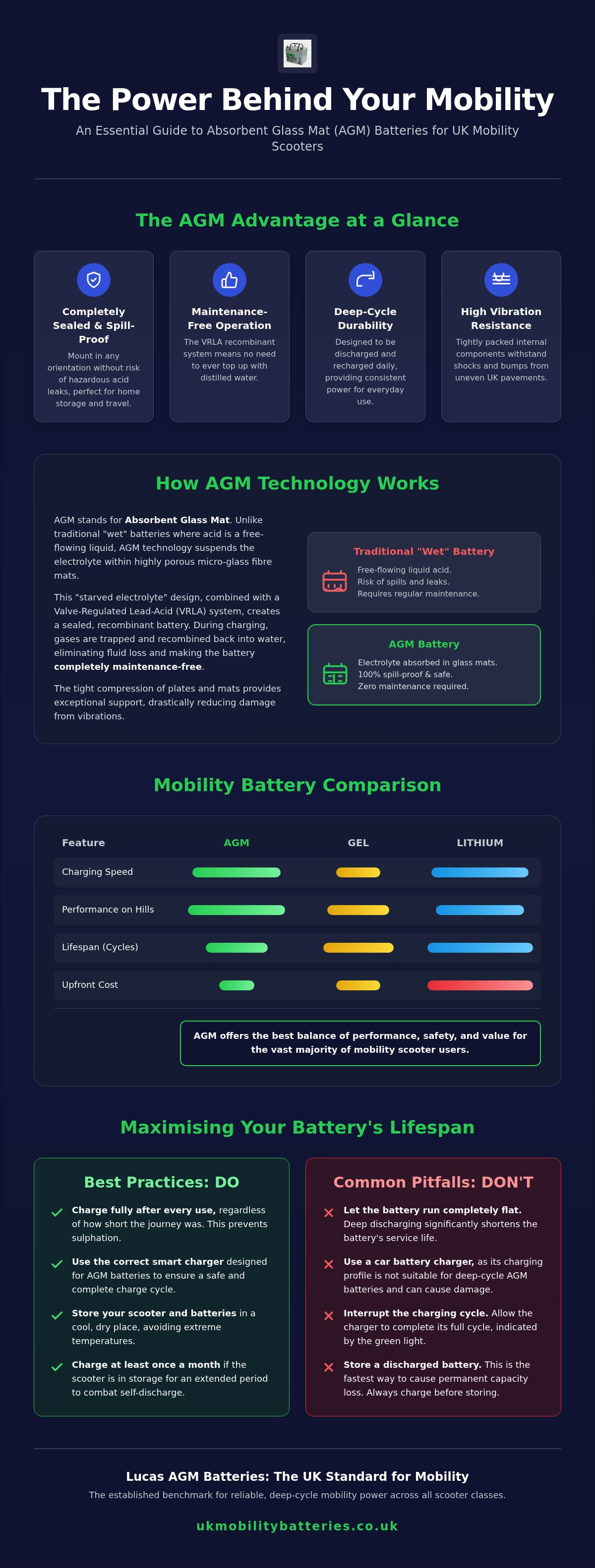
AGM technology represents a significant evolution in portable power for the mobility sector. It stands for Absorbent Glass Mat, a design where the battery's electrolyte is held entirely within porous glass fibre separators rather than sloshing around as a free-flowing liquid. This transition from traditional "wet" lead-acid batteries has transformed how users interact with their equipment. Whilst older battery types required regular inspections and upright storage to prevent leaks, modern AGM units offer a robust, spill-proof alternative that suits the active lifestyle of a scooter user.
The core of this technology is the Valve-Regulated Lead-Acid (VRLA) battery system. These batteries are "recombinant" in nature. During the charging process, oxygen produced at the positive plates travels through the glass mat to the negative plates, where it recombines with hydrogen to form water. This internal recycling process is why the units are termed "sealed." A one-way pressure relief valve is included as a safety feature to release gas only in extreme overcharge scenarios, ensuring the casing remains intact under normal operating conditions. One of the primary benefits of AGM batteries for mobility scooters is this inherent safety, making them ideal for use in homes and public spaces.
The Internal Construction of AGM Cells
The internal architecture of an AGM cell consists of high-purity lead plates compressed tightly against the glass fibre mats. This tight packing provides superior physical support to the plates, which significantly reduces the risk of damage from the vibrations and shocks encountered on uneven pavements. During discharge, a chemical reaction occurs as ions move through the saturated mat, providing a consistent electrical current. The "starved electrolyte" design is the defining characteristic of AGM technology, where the glass mats are filled with just enough acid to facilitate the reaction without any excess liquid remaining.
For compact equipment, such as travel scooters, a 12V 7Ah unit employs this construction to provide a lightweight yet dependable power source. The lack of free-flowing liquid allows these batteries to be mounted on their side if required by the scooter's chassis design, offering a level of versatility that traditional batteries cannot match.
Maintenance-Free Operation Explained
A major advantage of the AGM system is that it removes the need for user intervention. Traditional lead-acid batteries lose water through electrolysis and evaporation, requiring the user to top up the cells with distilled water periodically. Because AGM units are sealed and recombinant, they lose virtually no fluid over their entire lifespan. The maintenance-free nature remains one of the most cited benefits of AGM batteries for mobility scooters amongst UK users, particularly for those who cannot easily access the battery compartment.
Beyond this, the sealed design prevents the emission of corrosive acid fumes. In standard batteries, these fumes often lead to terminal corrosion, which creates high resistance and eventual power failure. AGM batteries keep the terminals clean and the battery box dry. This reliability ensures that the electrical connection remains secure, which is a critical factor for the long-term performance of mobility equipment across the UK.
Key Performance Benefits of AGM Technology
The Absorbent Glass Mat (AGM) design offers exceptionally low internal resistance. This technical attribute is crucial for mobility equipment because it allows the battery to deliver high power bursts when they're needed most. For example, when you're ascending a steep pavement ramp or navigating hilly terrain, the battery can supply the required current without a significant voltage drop. Standard lead-acid batteries often struggle under these high-load conditions, but AGM maintains steady performance.
Physical robustness is another area where this technology excels. The internal components are tightly packed, which provides superior resistance to vibration and shock. This is a vital feature for scooters used on uneven UK pavements. Additionally, these units charge significantly faster than traditional gel-cell alternatives. Their low self-discharge rate is equally impressive. An AGM battery typically loses only 1% to 3% of its charge per month whilst in storage, meaning your scooter is more likely to be ready for use after a period of inactivity.
Deep Cycle Durability for Daily Use
Mobility scooter batteries must be deep-cycle units. Unlike a car battery designed for a single high-power start, a deep-cycle battery is built to be discharged and recharged hundreds of times. One of the core benefits of AGM batteries for mobility scooters is their ability to handle these frequent cycles without losing capacity rapidly. The premium Lucas 12V range available at UK Mobility Batteries is specifically engineered for this purpose, providing the durability needed for daily independence.
Non-Spillable Design and Air Travel Safety
Safety is paramount for users who enjoy travelling. These units carry a "Non-Spillable" rating, which makes them fully compliant with International Air Transport Association (IATA) regulations for air travel. Because the acid is held within the glass mats, there's no liquid to leak even if the outer casing is cracked or damaged. This makes them the safest choice for transport by plane, coach, or car. You can travel with peace of mind, knowing that your power source won't cause hazardous spills or damage to other luggage. If you're planning a trip, selecting a reliable sealed mobility battery ensures you meet airline safety standards without hassle.
AGM vs. Gel vs. Lithium: Making the Right Choice
Selecting the correct battery chemistry involves balancing technical requirements against initial budget and long-term performance. Whilst Gel and Lithium technologies offer specific advantages, the benefits of AGM batteries for mobility scooters provide a versatile middle ground for the majority of UK users. AGM units are significantly more affordable upfront than Lithium alternatives. They also offer a more robust solution for occasional users or those with "boot scooters" who may not use their equipment every day. Because AGM has a low self-discharge rate, it maintains its charge effectively during short periods of inactivity without the need for complex battery management systems.
Charger compatibility is a major practical consideration. Most mobility scooters sold in the UK are supplied with chargers specifically calibrated for lead-acid profiles. AGM batteries are a direct "plug and play" replacement that works seamlessly with these existing chargers. In contrast, switching to Lithium requires a dedicated charger with a specific voltage cutoff to prevent cell damage. Weight is another factor. Although Lithium is lighter, the standard weight of an AGM battery often contributes to the stability and centre of gravity of the scooter, which manufacturers account for in their safety designs.
When to Choose AGM Over Gel
Gel batteries use a silica additive to turn the electrolyte into a jelly-like substance. They're often marketed for their high cycle life, but they have a distinct weakness in the UK climate. Gel cells are highly sensitive to cold temperatures, which can lead to a significant drop in available range during winter months. AGM batteries perform much better in lower temperatures, maintaining a higher discharge rate when the thermometer dips. For those searching for the Best Batteries for Electric Wheelchairs and scooters, AGM provides the most consistent year-round reliability without the premium price tag associated with Gel technology.
AGM vs Lithium: The Practical Reality
The price gap between AGM and Lithium remains substantial, often with Lithium units costing three to four times more. For many users, the "value-per-cycle" of a high-quality Lucas AGM battery is superior. Safety is also a critical differentiator. AGM batteries are exceptionally stable and don't carry the same thermal runaway risks associated with some Lithium-ion chemistries. This makes them easier to store and charge indoors. Furthermore, TSA travel regulations and UK CAA guidelines are very accommodating for non-spillable AGM batteries. They don't face the strict watt-hour (Wh) capacity limits that often prevent larger Lithium batteries from being taken on commercial flights, making AGM the most straightforward choice for international travel.
Maximising the Life of Your AGM Scooter Battery
The "Golden Rule" of AGM maintenance is to never leave the battery in a discharged state. When a battery sits flat, a chemical process called sulphation begins. Lead sulphate crystals harden on the internal plates, which creates permanent resistance and reduces the total capacity of the unit. To fully realise the benefits of AGM batteries for mobility scooters, you should recharge your equipment as soon as possible after every journey, regardless of how short the trip was. This habit keeps the chemistry active and prevents the premature failure often seen in neglected batteries.
Identifying the signs of an ageing battery can prevent you from being stranded. If your scooter feels sluggish when climbing familiar inclines or if the battery gauge drops rapidly under load, the internal resistance is likely increasing. Using a dedicated smart charger is the best way to combat this. Unlike basic chargers, smart units use multi-stage charging profiles-bulk, absorption, and float-to ensure the cells reach full saturation without overheating. If you require a dependable replacement, you can buy Lucas mobility batteries designed specifically for these deep-cycle requirements.
The Correct Charging Routine
Establishing a consistent routine is vital for long-term health. Always connect the charger to the scooter first before switching on the mains power. You must leave the charger connected until the "green light" stage is reached, indicating a full charge. Short "top-up" charges of 30 or 60 minutes are detrimental to AGM health because they don't allow the battery to reach the necessary saturation point. This partial charging can lead to a loss of capacity over time. For more technical details on charging safety, read our guide on Can You Overcharge a Mobility Scooter Battery?
Winter Care and Off-Season Storage
UK winter temperatures can significantly impact battery performance. Cold weather slows down the chemical reactions inside the cells, which temporarily reduces your travel range. Protecting your battery from frost is essential; if possible, store the scooter or the battery pack indoors in a cool, dry place. A fully charged AGM battery is much less likely to freeze than a flat one, as the acid concentration is higher in a charged state. If you aren't using your scooter for several weeks, apply a "trickle charge" once a month. This prevents the battery from falling into a deep discharge state from which it might not recover.
Why Lucas AGM Batteries are the UK Standard
Lucas is a name synonymous with UK automotive and electrical engineering excellence. This brand heritage spans decades, and their specialised mobility range is built upon those same standards of reliability and performance. Whilst many unbranded batteries are available on the market, they often lack the internal build quality required for deep-cycle applications. Lucas AGM units are engineered with high-purity lead and extra-thick internal plates. This construction is a primary factor in the long-term benefits of AGM batteries for mobility scooters, as it ensures the cells can withstand hundreds of discharge cycles without structural failure.
The variety within the Lucas range caters to every type of mobility equipment. For smaller, transportable boot scooters, the compact 12V 7Ah battery provides a lightweight and efficient power source. For larger, road-legal Class 3 scooters, Lucas offers heavy-duty units up to 150Ah. This breadth of choice allows users to find a precise match for their specific power requirements. Choosing a specialised brand over a generic alternative provides a level of quality assurance that is essential for equipment that supports your daily independence.
Selecting the Correct Lucas Battery for Your Scooter
Compatibility is determined by two main factors: capacity and physical size. You should always check the Ampere-hour (Ah) rating of your existing batteries before ordering a replacement. It's often possible to upgrade to a higher Ah rating for increased range, provided the battery box has sufficient space. For example, a 12V 7Ah battery can often be replaced by a 12V 9Ah unit if the dimensions are identical. You must measure the length, width, and height of your current battery to ensure a perfect fit. For a detailed walkthrough on selection, consult The Ultimate Guide to Mobility Scooter Batteries UK.
Expert Support and National Delivery
Buying from a specialised UK retailer ensures you receive the technical support necessary for high-stakes equipment. Our team understands the specific requirements of the UK mobility market and can advise on compatibility for all major scooter brands. We prioritise efficiency because we know that a dead battery can lead to a loss of mobility. Fast national delivery ensures your replacement units arrive quickly, allowing you to return to your normal routine without delay. The combined benefits of AGM batteries for mobility scooters and the technical superiority of the Lucas range make this the dependable choice for UK users. You can browse our full range of Lucas AGM Mobility Batteries to find the correct power solution for your needs today.
Securing Reliable Power for Your Mobility Journey
Selecting the correct power source is essential for maintaining independence and ensuring your equipment performs when needed. The diverse benefits of AGM batteries for mobility scooters, including their maintenance-free operation and superior vibration resistance, make them the practical choice for UK users. By choosing a high-quality Lucas unit, you're investing in a deep-cycle battery that handles frequent charging whilst remaining safe for indoor storage and air travel. Following a consistent charging routine will further protect this investment and extend the service life of your cells.
As an Authorised Lucas Battery Retailer, UK Mobility Batteries provides specialised technical support to help you match the correct capacity and dimensions to your specific scooter model. Our status as UK national delivery specialists ensures your equipment remains operational with minimal downtime. Shop Premium Lucas AGM Batteries with Fast UK Delivery today to restore the full range and performance of your mobility scooter. We're here to ensure you stay on the move with confidence.
Frequently Asked Questions
Are AGM batteries better than Gel for mobility scooters?
AGM batteries are generally superior for UK users who require reliable performance in varying temperatures. While Gel batteries offer a slightly higher cycle life in controlled conditions, they are highly sensitive to cold weather and overcharging. One of the primary benefits of AGM batteries for mobility scooters is their lower internal resistance, which provides better power delivery when climbing hills or ramps. AGM technology is also more cost-effective for the majority of daily mobility applications.
How long do AGM mobility scooter batteries typically last?
A high-quality Lucas AGM battery typically lasts between 18 and 24 months with regular use. This lifespan depends heavily on your charging habits and the depth of discharge. Batteries that are discharged to 50% and then immediately recharged will last significantly longer than those frequently run until they are flat. Consistent maintenance, such as avoiding storage in a discharged state, is the most effective way to reach the upper limit of the battery's service life.
Can I take my AGM battery on an aeroplane?
Yes, you can take AGM batteries on an aeroplane because they are classified as "non-spillable" and meet IATA safety standards. Unlike wet lead-acid batteries, the electrolyte is absorbed in glass mats, preventing leaks if the casing is damaged. You must notify your airline at least 48 hours before travel. They will require specific information, such as the battery type and capacity, and may ask you to disconnect the terminals before the scooter is loaded.
Do AGM batteries require any maintenance or topping up?
AGM batteries are completely maintenance-free and do not require any topping up with distilled water. The recombinant VRLA design ensures that the electrolyte remains sealed within the unit for its entire lifespan. You should never attempt to open the battery casing or remove the safety valves, as this will damage the internal chemistry and void the warranty. Maintenance is limited to keeping the terminals clean and ensuring the battery remains properly charged between journeys.
How often should I charge my AGM mobility scooter battery?
You should charge your AGM battery after every use, regardless of the distance travelled. Leaving a battery in a partially discharged state leads to sulphation, which permanently reduces the unit's capacity. The benefits of AGM batteries for mobility scooters are most apparent when a strict charging regime is followed. If you use your scooter daily, plug it in every evening and leave it until the charger indicates a full charge to ensure the cells reach saturation.
Can I use a car battery charger on my AGM mobility battery?
You must not use a standard car battery charger on a mobility scooter battery. Car chargers deliver a high initial current designed for starting batteries, which can overheat and damage the delicate internal glass mats of an AGM unit. Instead, use a dedicated smart charger with a specific AGM or VRLA charging profile. These chargers use multi-stage processes to safely saturate the battery and then switch to a "float" mode to maintain the charge.
Why is my AGM battery losing power more quickly in winter?
Cold temperatures slow down the chemical reactions inside the battery, which temporarily reduces the available capacity. During the UK winter, you might notice a 20% to 30% reduction in your total travel range compared to summer months. This is a physical limitation of lead-acid chemistry rather than a fault with the battery. Storing your scooter or battery pack indoors and ensuring it is fully charged before use will help mitigate these cold-weather performance drops.
What should I do with my old AGM scooter batteries?
Old AGM batteries must be disposed of at a licensed recycling centre or returned to a battery retailer. Lead-acid batteries are approximately 98% recyclable, and the lead and plastic can be reclaimed to manufacture new units. You should never dispose of batteries in household waste due to the environmental risk posed by lead and sulphuric acid. Most local authority recycling centres in the UK have dedicated bins for lead-acid batteries to ensure safe and legal processing.