
Sunrise Medical Wheelchair Batteries: 2026 UK Replacement Guide
Paying inflated equipment dealership markups isn't a prerequisite for restoring your powerchair's daily driving range and performance. When sourcing replacement Sunrise Medical wheelchair batteries, dependable operation depends entirely on matching exact tray dimensions, terminal polarity, and deep-cycle AGM chemistry, rather than paying an unnecessary premium for OEM branding.
If you feel confused by differing Ampere-hour ratings or worry that an incorrect casing won't seat properly into your chassis tray, you aren't alone. Facing diminished travel range or fearing an unexpected power loss outdoors creates genuine anxiety for powerchair users. Sourcing the right power pack shouldn't require technical guesswork, costly dealership consultations, or protracted ordering delays.
This guide demonstrates how to identify, select, and install the correct high-performance replacement batteries for your Sunrise Medical powerchair safely and cost-effectively. We cover critical physical measurements, terminal configurations, and robust maintenance-free sealed AGM options to ensure seamless compatibility and dependable daily mobility across the UK.
Key Takeaways
- Understand how 24-volt powerchair systems rely on paired 12-volt deep-cycle batteries engineered specifically for sustained cyclic discharges.
- Discover how to accurately identify compatible Sunrise Medical wheelchair batteries by verifying physical tray dimensions, terminal polarity, and Ampere-hour capacities.
- Learn why premium Lucas sealed AGM batteries deliver the identical cyclic performance and durability of OEM equipment without dealership markups.
- Review a practical pre-purchase checklist covering casing measurements, terminal orientations, and bolt configurations to prevent costly ordering mistakes.
- Find out how national UK mainland delivery and dedicated technical guidance simplify sourcing the exact replacement power pack for your chair.
Understanding Sunrise Medical Wheelchair Battery Requirements
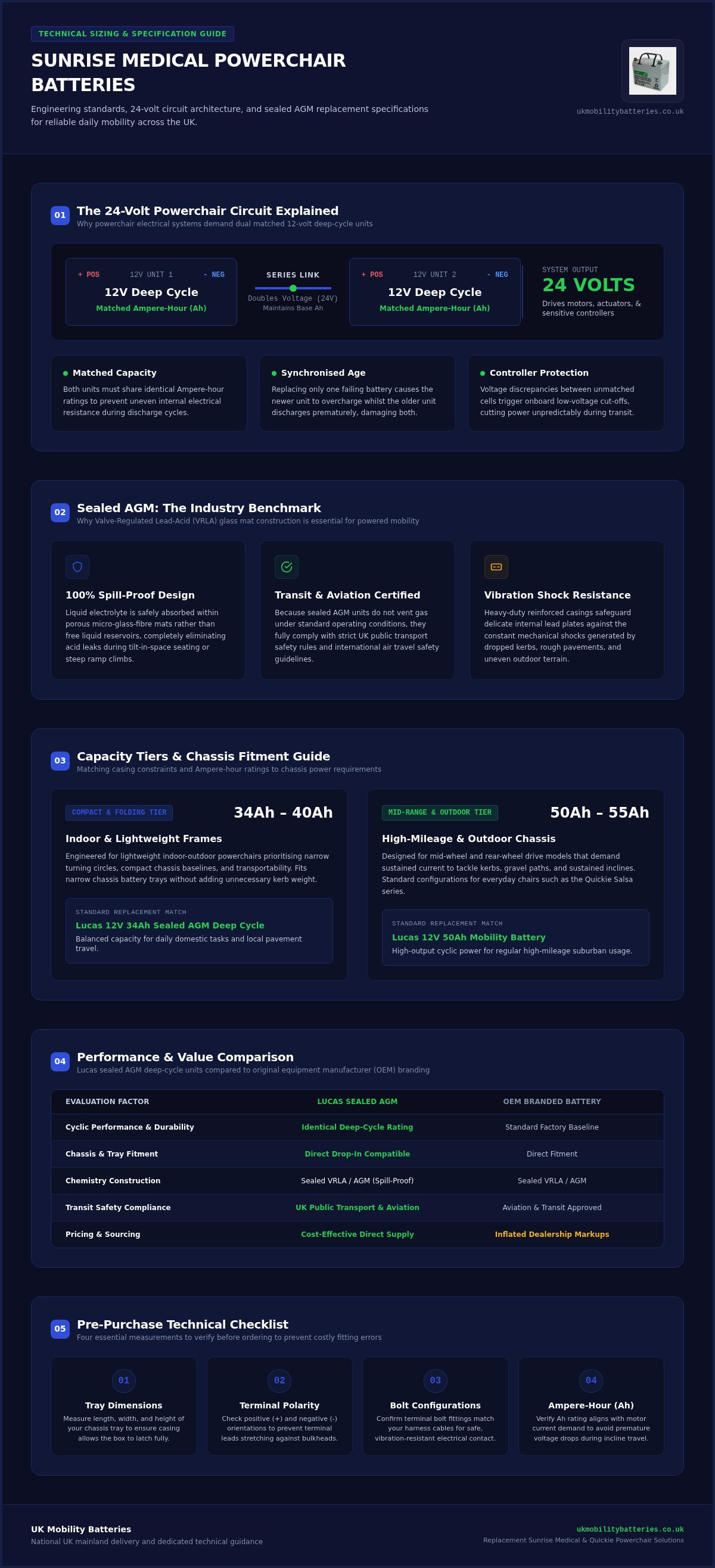
Sunrise Medical powerchairs rely on a dedicated 24-volt electrical system to drive high-torque motors, electronic actuators, and sensitive onboard controllers. This system doesn't run from a single 24V unit. Instead, it pairs two 12-volt deep-cycle batteries wired together in series. Unlike standard automotive starter units designed to provide short bursts of high cranking amps, wheelchair batteries must sustain consistent, low-to-moderate current draws over many hours of continuous operation.
Selecting appropriate Sunrise Medical wheelchair batteries requires matching the exact physical dimensions and Ampere-hour (Ah) ratings specified for your model's chassis. A battery's Ah rating directly determines your daily driving range and sustained motor responsiveness. Undersizing this capacity leads to premature voltage drop on inclines, while improper physical fit risks casing damage inside the battery tray.
The 24-Volt Powerchair Circuit Explained
Series wiring doubles the voltage while maintaining the base Ampere-hour capacity. Connecting the positive terminal of the first 12V battery to the negative terminal of the second creates the 24V supply that modern powerchairs require. Because current flows equally through both units, balance is critical:
- Matched capacity: Both units must share identical Ampere-hour ratings to prevent uneven electrical resistance.
- Synchronised age: Replacing only one failing battery causes the newer unit to overcharge whilst the older unit discharges prematurely.
- Controller protection: Voltage discrepancies between unmatched cells trigger low-voltage cut-offs, cutting power unpredictably during outdoor transit.
Why Sealed AGM Technology is the Industry Benchmark
Valve-Regulated Lead-Acid construction represents the standard for modern powered mobility. Modern deep-cycle cells use advanced AGM and Gel battery technology, embedding liquid electrolyte within porous micro-glass-fibre mats rather than allowing acid to sit loose in open reservoirs.
This construction yields significant operational benefits for daily users. The sealed design is completely spill-proof, preventing acid leaks when navigating steep ramps or operating tilt-in-space seating. Because AGM units do not vent gas under standard operating conditions, they satisfy strict UK public transport rules and international air travel safety guidelines. Heavy-duty reinforced casings also deliver excellent vibration resistance, safeguarding the delicate lead plates against the constant mechanical shocks generated by dropped kerbs, rough pavements, and uneven outdoor terrain.
Quickie and Sunrise Medical Battery Sizing Guide
Sunrise Medical manufactures a diverse portfolio of powerchairs, ranging from ultra-manoeuvrable indoor frames to high-performance outdoor chairs. Because each chassis configuration imposes specific physical constraints on the internal battery compartment, selecting replacement Sunrise Medical wheelchair batteries requires exact attention to casing measurements alongside Ampere-hour ratings. Sizing errors prevent the battery box from latching securely or cause terminal leads to stretch against internal bulkheads.
Most Sunrise Medical models accommodate batteries scaling across three primary capacity tiers. To compare duty cycles and operational thresholds across various configurations, read our detailed guide on best batteries for electric wheelchairs before finalising your replacement choice.
Compact and Folding Powerchairs: 34Ah to 40Ah Range
Lightweight indoor-outdoor chairs prioritise tight turning circles and transportability. These chassis styles feature narrow battery trays that house compact deep-cycle blocks. Standard drop-in options like the Lucas 12V 34Ah Sealed AGM Deep Cycle Battery provide the balance needed for everyday domestic tasks and local pavement travel without adding unnecessary kerb weight to the base.
Mid-Range and Outdoor Powerchairs: 50Ah to 55Ah Range
Mid-wheel and rear-wheel drive models designed for active outdoor use demand sustained current to tackle kerbs, gravel paths, and sustained inclines. Standard configurations for everyday chairs like the Quickie Salsa series rely on higher-output power packs:
- Lucas 12V 50Ah Mobility Battery: Supplies dependable cyclic power for regular high-mileage suburban transit.
- Lucas 12V 55Ah Sealed AGM Mobility Batteries: Maximises continuous travel range, delivering superior cold-weather resilience and prolonged run times between charging cycles.
Heavy-Duty and Bariatric Powerchairs: 60Ah to 75Ah+ Range
Chairs equipped with powered seating functions require substantial energy reserves. Operating power tilt, backrest recline, and elevating leg rests simultaneously alongside twin drive motors draws heavy current from the circuit. These complex models require heavy-duty battery enclosures capable of housing large-format 60Ah to 75Ah+ units. When refitting these high-load setups, double-check your tray depth and secure heavy-gauge bolted terminal connections firmly to prevent heat buildup during motor stall conditions.
If you're unsure which casing matches your specific chassis, review your model dimensions on ukmobilitybatteries.co.uk to select the correct specification with confidence.
Lucas AGM vs OEM Batteries: Performance and Value Analysis
Mobility equipment manufacturers do not operate chemical production plants to manufacture their own cells. Instead, Sunrise Medical sources valve-regulated lead-acid units from specialised industrial battery manufacturers, relabelling them under OEM branding. Sourcing replacement Sunrise Medical wheelchair batteries directly from established aftermarket brands like Lucas delivers identical electrical discharge rates and mechanical dependability without paying inflated equipment dealership markups.
Cell longevity is determined by chemical engineering, lead plate purity, and build quality, rather than the logo printed on the plastic casing. If your current set struggles to hold a charge or cuts out under load, consult our mobility scooter battery troubleshooting guide to detect early signs of internal cell failure before getting stranded outdoors.
Cyclic Durability and Daily Deep Discharge Rates
Daily powerchair usage demands robust deep-cycle chemistry capable of enduring regular 50% to 80% discharge cycles. Premium aftermarket solutions provide this continuous resilience through superior internal construction:
- High-density active material: Lucas deep-cycle mobility batteries use dense paste formulations on the positive plates, preventing voltage collapse during sudden acceleration bursts or steep ramp climbs.
- Lead-calcium tin alloy grids: Advanced alloy composition significantly reduces grid corrosion and internal water loss, extending overall service life under constant cyclic demands.
- Stable charge acceptance: High plate porosity ensures the cells recharge efficiently overnight without generating excessive heat that compromises the internal glass mats.
Terminal Styles, Resistance, and Energy Efficiency
A powerchair draws substantial amperage under heavy torque conditions. High electrical resistance at the battery posts wastes power as excess heat, reducing total range and starving the motor controller. Lucas sealed AGM designs feature low internal resistance to ensure smooth, unhindered current delivery to the drive motors.
Connection types must match your harness hardware. Most mid-to-large capacity mobility batteries utilise M5 or M6 threaded insert terminals (nut-and-bolt fittings). These recessed connections provide flat, high-contact surface areas that resist vibration loosening when traversing uneven pavements or dropped kerbs. Compact sizes may employ standard flag terminals or fast-on spade tabs. Always torque bolts securely to prevent arcing and terminal damage, but avoid over-tightening into the soft lead threads.
Pre-Purchase Checklist for Sunrise Medical Battery Replacements
Before purchasing replacement Sunrise Medical wheelchair batteries, running through a systematic physical and electrical inspection prevents costly compatibility errors. While battery group codes offer a general guideline, slight variances in case mouldings or terminal positioning between manufacturers can disrupt installation inside tightly packed chassis compartments.
Follow this practical three-point checklist to confirm that your replacement cells integrate seamlessly with your existing wiring harness and mounting trays.
Verifying Physical Enclosure Dimensions
Open the battery compartment and measure your existing cells directly using a millimetre rule. Record three specific values:
- Base footprint: Measure maximum casing length and width across the widest points of the base.
- Total height: Measure from the base to the top of the terminal posts, not just the plastic lid. Insufficient overhead clearance risks dead shorts against steel seat plates.
- Cavity margins: Ensure adequate room remains for internal safety fuses, thermal breakers, and heavy-gauge wiring looms without compressing the cables.
Checking Terminal Types and Wiring Loom Compatibility
Inspect how your current harness secures to the battery posts. Most Sunrise Medical mid-wheel and rear-wheel models use threaded insert terminals requiring metric M5 or M6 securing bolts. Flag terminals or slide-on spade connectors appear primarily on ultra-compact travel chairs. Check your wiring loom for signs of heat degradation, brittle insulation, or oxidised copper eyelets. Scrub ring terminals clean with a wire brush prior to reassembly. For comprehensive fitting instructions and safety steps, review our guide on changing mobility batteries.
The Matched Pair Replacement Rule
Always replace both 12-volt batteries at the exact same time. Installing a single new battery alongside an aged cell creates an immediate internal resistance imbalance within the 24-volt circuit. The older battery possesses higher internal resistance, forcing the new unit to shoulder disproportionate charging currents and driving loads. This imbalance shortens the operational lifespan of the new cell by several months and triggers unpredictable controller shutdowns on steep gradients.
When you're ready to refit your powerchair with high-grade cyclic power, order your Lucas mobility batteries directly for swift nationwide dispatch across the UK.
Ordering and Maintaining Your Wheelchair Batteries with UK Mobility Batteries
UK Mobility Batteries supplies premium Lucas sealed AGM batteries directly across the UK mainland. By bypassing dealership distribution networks, users obtain dependable power cells backed by dedicated technical support. Our specialists verify terminal styles, capacities, and compartment clearances so you receive the precise drop-in fit for your equipment without unnecessary stress or delay.
Selecting reliable Sunrise Medical wheelchair batteries comes down to pairing your chassis requirements with factory-fresh inventory. Stored inventory loses charge over time, which is why UK Mobility Batteries dispatches freshly manufactured units that deliver their full cyclic lifespan right out of the box.
Selecting the Right Lucas AGM Mobility Batteries
Our inventory covers the primary physical formats and electrical ratings utilised by modern powerchairs:
- Lucas 12V 34Ah Sealed AGM Deep Cycle Battery: Standard configuration for compact and folding indoor-outdoor powerchairs.
- Lucas 12V 50Ah Mobility Battery: Balanced capacity engineered for regular pavement travel and moderate outdoor duties.
- Lucas 12V 55Ah Sealed AGM Mobility Batteries: Heavy-duty cyclic capability for high-mileage users requiring maximum power reserves.
Initial Conditioning and Charging Protocol
Fresh AGM cells require proper initial conditioning to achieve full chemical activation. Connect your new pack to the powerchair charger and run an uninterrupted initial charge cycle of 12 to 14 hours before your first journey. New cells typically reach peak electrochemical capacity after roughly 15 to 20 complete charge and discharge cycles.
Routine charging habits protect your investment. Plug the charger in after every single day of operation, regardless of how short your trip was. Leaving cells in a partially depleted state accelerates internal plate sulphation, which permanently reduces overall capacity. To explore comprehensive maintenance regimens, consult our mobility scooter batteries guide for proven charging best practices.
Safe Disposal and Environmental Responsibility
Replacing worn Sunrise Medical wheelchair batteries requires responsible end-of-life disposal. Sealed AGM and lead-acid batteries are over 98% recyclable in the United Kingdom. Lead plates and polypropylene casings are recovered and processed into new industrial products, preventing toxic compounds from entering the environment.
Never discard depleted powerchair batteries in standard domestic household bins. Local council household waste recycling centres across the UK accept lead-acid mobility batteries free of charge. Most sites feature dedicated, acid-resistant disposal bunds specifically organised for heavy equipment cells.
Restore Dependable Power to Your Sunrise Medical Powerchair
Maintaining dependable daily mobility doesn't require technical guesswork or inflated dealership premiums. Sourcing reliable Sunrise Medical wheelchair batteries comes down to three non-negotiables: confirming precise physical tray measurements, replacing both 12-volt units simultaneously as a balanced pair, and choosing robust AGM chemistry engineered for deep cyclic demands. Getting these details right safeguards your motor controller whilst restoring peak travel range.
At UK Mobility Batteries, we stock dependable Lucas sealed AGM mobility batteries designed to withstand tough everyday duty cycles. With our reliable nationwide UK delivery service direct to your doorstep and dedicated technical customer support on hand to ensure precise model compatibility, refreshing your power system is straightforward. Find the correct Lucas replacement batteries for your Sunrise Medical wheelchair at UK Mobility Batteries and regain complete confidence on every journey.
Frequently Asked Questions
Can I use car batteries in my Sunrise Medical electric wheelchair?
No, you cannot use automotive starter batteries in an electric wheelchair. Car batteries deliver short, high-amp cranking bursts to start an engine and degrade rapidly under continuous discharge. Powered wheelchairs require deep-cycle AGM batteries designed to discharge steadily over several hours. Using automotive starter units risks rapid plate degradation, acid leaks from non-sealed caps, and premature electrical failure.
How do I know what size battery my Quickie wheelchair needs?
You can determine the required size by measuring the physical dimensions of your existing battery tray and checking the printed Ampere-hour (Ah) rating on current cells. Compatible Sunrise Medical wheelchair batteries generally scale from 34Ah in compact frames up to 55Ah in mid-range models. Measure casing length, width, and height in millimetres to ensure a secure, unhindered drop-in fit.
Is it necessary to replace both wheelchair batteries at the same time?
Yes, you must always replace both 12-volt batteries simultaneously. A 24-volt series circuit functions as an interconnected system, relying on equal internal resistance across both cells. Installing a single new battery forces it to overwork alongside the aged counterpart. This imbalance causes premature cell deterioration, uneven charging, and unexpected controller shut-offs on moderate inclines. Always fit them as a matched pair.
How long do replacement batteries last on a Sunrise Medical powerchair?
Quality deep-cycle replacement batteries typically deliver between two and four years of dependable service. Actual lifespan depends on daily travel distance, total user payload, terrain severity, and recharging habits. Recharging your powerchair immediately following daily use and avoiding long periods in a discharged state prevents plate sulphation, keeping your Sunrise Medical wheelchair batteries performing reliably for their full rated cyclic life.
Can I upgrade my powerchair to a higher Ampere-hour battery for more range?
You can upgrade to a higher Ampere-hour rating provided the physical casing dimensions fit securely inside your powerchair's existing tray. Higher capacity batteries offer longer travel range per charge, but they are often physically larger and heavier. Confirm that your chassis compartment, terminal harness, and factory charger support the increased capacity before stepping up from 34Ah to 50Ah or 55Ah units.
What should I do if my new wheelchair batteries seem to drain quickly at first?
This behaviour is entirely normal and doesn't indicate a defective battery pack. Brand-new deep-cycle AGM batteries require an initial conditioning phase to reach full capacity. You should conduct an initial continuous charge of 12 to 14 hours prior to first use. Expect maximum range and voltage stability to develop progressively after completing 15 to 20 normal discharge and recharge cycles.
Are Lucas sealed AGM batteries permitted on passenger aircraft?
Yes, Lucas sealed AGM mobility batteries comply with standard international air transport regulations for non-spillable batteries. Because the electrolyte is fully absorbed into internal fibreglass mats, they don't leak or vent during transit. However, you should notify your airline in advance, disconnect the wiring harness terminals, and insulate the posts against accidental short circuits prior to airport check-in.