
Replacement Wheelchair Batteries: 2026 Technical Guide
The most critical component of your electric wheelchair isn't the frame or the motor; it's the power system that determines whether you remain mobile or find yourself stranded. You likely recognise the frustration of a declining range or the persistent anxiety caused by a battery indicator that drops unexpectedly whilst you're away from home. Relying on expensive OEM parts isn't your only option, but finding the correct replacement wheelchair batteries requires precise technical knowledge to avoid compatibility errors.
This 2026 technical guide provides the exact data you need to master the selection, fitting, and maintenance of high-performance power cells. We focus on the practicalities of Amp-hour (Ah) ratings, physical casing dimensions, and terminal configurations to ensure a perfect fit for your specific model. You will learn how to identify maintenance-free AGM solutions that offer restored reliability and extended range without the premium price tags often found at dealerships. We cover everything from verifying UN38.3 certification for travel to the methodical process of replacing batteries in factory-matched pairs to maximise service life and ensure dependable performance.
Key Takeaways
- Recognise the primary signs of deep-cycle failure, such as sudden range reductions, to ensure you replace your power cells before total failure occurs.
- Match technical specifications including voltage and Amp-hour (Ah) ratings when sourcing replacement wheelchair batteries to maintain the manufacturer's intended performance.
- Identify the exact physical dimensions and terminal configurations required to ensure a secure fit within your wheelchair's battery housing.
- Follow a safe, step-by-step procedure for disconnecting and refitting batteries to prevent electrical shorts and protect your wheelchair's control system.
- Understand the advantages of sealed AGM technology, which offers a maintenance-free and reliable alternative to expensive original equipment manufacturer (OEM) components.
Recognising When Your Electric Wheelchair Needs New Batteries
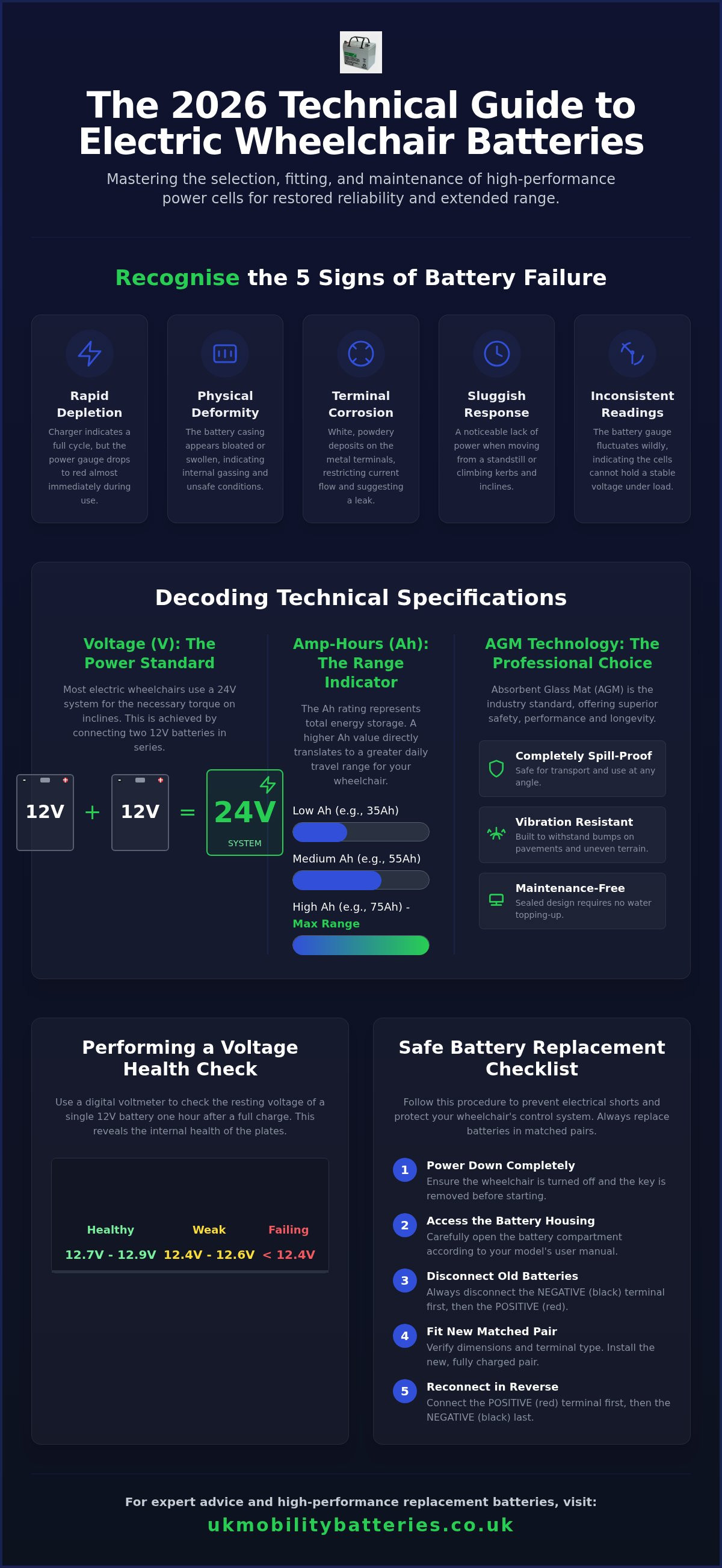
Identifying exactly when to invest in replacement wheelchair batteries is vital for maintaining your independence and avoiding the risk of being stranded. Deep-cycle AGM batteries do not typically fail instantly; instead, they undergo a gradual degradation process over several months. You will likely notice the wheelchair struggles on inclines or uneven terrain where it previously performed without issue. This sluggishness occurs because internal resistance increases as the battery ages, preventing it from delivering the high current required for torque. In the UK climate, cold winter temperatures can temporarily reduce capacity and accelerate permanent wear if the batteries are left in a discharged state. Most high-quality AGM units provide reliable service for 12 to 24 months, depending on your daily mileage and charging habits.
The 5 Signs of Mobility Battery Failure
The "memory effect" refers to a loss of capacity when a battery is recharged before being fully depleted, but this phenomenon rarely affects modern rechargeable battery technologies like the sealed AGM units used in wheelchairs. Instead, look for these specific indicators of failure:
- Rapid depletion: The charger indicates a full cycle quickly, but the wheelchair dashboard display drops to the red zone almost immediately during use.
- Physical deformity: Inspect the battery casing for bloating or a "swollen" appearance, which indicates internal gassing and signifies the unit is no longer safe to use.
- Terminal corrosion: Look for white, powdery deposits on the metal terminals, as these can restrict current flow and suggest a leak or poor connection.
- Sluggish response: A noticeable lack of power when moving from a standstill or climbing kerbs.
- Inconsistent readings: The battery gauge fluctuates wildly when you move the joystick, indicating the cells can no longer hold a stable voltage under load.
For a more detailed diagnostic process, you can consult our comprehensive guide on mobility scooter battery troubleshooting for specific failure signs and fixes.
Testing Your Current Battery Health
A standard digital voltmeter provides a useful baseline for assessing battery health. A fully charged 12V battery should show a resting voltage of approximately 12.7V to 12.9V after sitting idle for an hour. If your reading sits below 12.4V after a full charge, the internal plates are likely sulphated. However, resting voltage does not tell the full story. You must observe how the voltage behaves whilst the wheelchair is actually moving. Healthy replacement wheelchair batteries maintain a stable voltage under load, whereas failing units will see the voltage plummet the moment the motors engage. If your manual tests are inconclusive, it is best to seek professional technical support for a dedicated discharge test before the batteries fail completely.
Understanding Technical Specifications: Ah, Voltage, and AGM Technology
Almost every electric wheelchair operates on a 24V circuit. This voltage is achieved by connecting two 12V replacement wheelchair batteries in series. By linking the positive terminal of one battery to the negative terminal of the other, the voltage doubles whilst the capacity remains the same. This configuration is standard because it provides the necessary torque for motors to handle inclines and heavy loads. The capacity of these units is measured in Amp-hours (Ah). This figure represents the total energy storage. A higher Ah rating directly correlates to an increased electric wheelchair's battery charge and a greater total daily range.
The Advantage of Sealed AGM Batteries
Absorbent Glass Mat (AGM) technology has become the industry standard for mobility devices. In these units, the electrolyte is held in fine glass fibre mats sandwiched between the lead plates. This design makes the batteries completely spill-proof and exceptionally resistant to the vibrations encountered on pavements and uneven surfaces. Unlike older "wet" cell batteries, AGM units are entirely maintenance-free. You won't need to top up acid or water levels during the battery's lifespan. This sealed construction is also essential for compliance with IATA and FAA regulations for air travel, as it prevents the leakage of hazardous materials during transit.
Can You Upgrade Your Battery Capacity?
One of the most effective ways to improve a wheelchair's utility is to increase the Amp-hour rating during replacement. There's a direct relationship between Ah and mileage; higher capacity allows you to travel further between charges. In many instances, you can upgrade the capacity without modifying the wheelchair's physical structure. For example, wheelchairs designed for standard 7Ah footprints can often accommodate uprated Lucas 12V 9Ah batteries. This simple swap provides roughly 28% more capacity in the exact same physical space. If you're looking for a reliable boost in performance, choosing a Lucas mobility battery can provide the necessary technical edge. Always verify that your charger's output is sufficient for the higher capacity to ensure efficient recharge cycles.
Selecting the Correct Battery Size and Terminal Configuration
Precision is mandatory when purchasing replacement wheelchair batteries. Most powerchairs feature a custom-moulded battery box or tray with zero tolerance for oversized units. Even a 5mm deviation in length or width can prevent the housing from closing or locking correctly. This physical mismatch often leads to cable strain or excessive vibrations that can damage the internal lead plates over time. You must ensure the new units sit securely without moving whilst the chair is in motion.
How to Measure Your Existing Batteries
To ensure a successful fit, you must measure the physical casing of your current units rather than relying solely on the printed label. Labels can sometimes list nominal sizes that differ slightly from the actual footprint. Use a precise measuring tool to record the Length, Width, and Height of the battery case. It is vital to measure the total height including the terminals, as a lid that cannot close fully poses a significant safety risk.
- Measure the base dimensions first to ensure the unit sits flat in the tray.
- Account for any protruding handles or casing ridges.
- Identify the mobility scooter battery terminal types commonly found on Lucas units, such as F1/F2 spade connectors, bolt-through flag terminals, or threaded inserts.
Terminal configuration is just as critical as the external size. If the positive and negative terminals are reversed compared to your original setup, the existing wiring loom may not reach. Attempting to stretch cables or forcing a connection can cause a short circuit or permanent damage to the wheelchair’s electronic controller. Always verify the terminal layout matches your original batteries before proceeding with the installation.
Matching the Battery to Your Wheelchair Model
Always cross-reference your wheelchair's technical manual with the battery specifications. Manufacturers typically list the maximum Amp-hour capacity the tray can support. Whilst compact, lightweight chairs may use 7Ah or 12Ah units, heavy-duty outdoor models often require substantial 75Ah to 100Ah+ systems. It's essential to replace both units simultaneously. Mixing a new battery with an old one causes the stronger unit to overwork to compensate for the weaker cell. This imbalance leads to premature failure of both batteries, often within a few months of use. By selecting factory-matched pairs, you maintain the balanced performance required for a reliable 24V system.
How to Safely Change and Fit Your Replacement Batteries
Handling the installation of replacement wheelchair batteries requires a methodical approach to ensure both personal safety and the integrity of the wheelchair's electronics. Before you begin, ensure the wheelchair is switched off and, if possible, the main circuit breaker is tripped or the fuse removed. Short circuits occur easily if a metal tool bridges the positive and negative terminals simultaneously. This can lead to intense heat, sparks, and immediate damage to the control joystick or power module.
Step-by-Step Fitting Instructions
Start by removing the protective shroud or opening the battery box. If your batteries are connected via individual wires rather than a plug-and-play harness, always disconnect the negative (black) terminal first. This reduces the risk of a short circuit if your spanner accidentally touches the metal frame of the wheelchair whilst loosening the positive (red) terminal. Once the old units are removed, inspect the battery tray for any debris or signs of acid leakage from the previous set.
Clean the cable connectors with a wire brush to ensure a low-resistance electrical path. When installing the new Lucas units, apply a thin layer of terminal grease or petroleum jelly to the metal contact points. This prevents moisture ingress and future corrosion. Secure the batteries tightly using the original brackets or straps; a loose battery can shift during transit, potentially pulling on cables or causing internal plate damage from vibration. For more detail, see our article on how to change mobility scooter batteries.
Post-Installation Care and Maintenance
New AGM batteries are typically shipped at approximately 80% charge. You must perform a full, uninterrupted charge cycle of at least 12 hours before the first use. It is also a technical reality that deep-cycle batteries require a "break-in" period. You won't achieve the maximum advertised range until the batteries have been through roughly 15 to 20 charge and discharge cycles. During this time, avoid completely depleting the batteries.
Daily charging is the most effective way to maintain the health of your power system. Even if you have only used a small portion of the capacity, reconnect the charger at the end of the day. Modern smart chargers are designed to drop to a "float" mode once the batteries are full, preventing damage. Refer to our guide on how to avoid overcharging mobility batteries for longevity tips. If you require technical assistance or are ready to purchase, you can find our full range of Lucas replacement wheelchair batteries online for fast UK delivery.
Why Lucas AGM Batteries are the Professional Choice for Wheelchairs
Lucas is a trusted UK brand with a legacy of providing reliable power solutions across multiple industrial sectors. Unlike generic alternatives, Lucas mobility batteries are engineered specifically for deep-cycle applications. This means the internal lead plates are thicker and more robust, allowing them to withstand the repeated discharge and recharge cycles required by daily wheelchair use. UK Mobility Batteries specialises in the Lucas 12V series because these units provide a dependable alternative to expensive OEM parts without compromising on technical performance or safety standards.
The Lucas Quality Standard
The superior internal plate design of a Lucas battery ensures a high recovery rate from deep discharge states. This is a critical factor for users who rely on their wheelchair for long-distance travel where the replacement wheelchair batteries might be drawn down significantly. The range is extensive, including everything from the compact Lucas 12V 7Ah Sealed AGM Batteries to the heavy-duty Lucas 12V 55Ah Sealed AGM Mobility Batteries. Every unit in the mobility range features a maintenance-free, valve-regulated lead-acid (VRLA) design. This sealed construction is specifically tailored for the UK market, ensuring the batteries remain leak-proof and safe for use in both indoor environments and on public transport.
Ordering Your Replacements Online
Selecting replacement wheelchair batteries online is straightforward when you use our detailed technical data strings. We provide the exact physical dimensions and terminal configurations for every Lucas model, allowing you to verify compatibility before you buy. Our national distribution network ensures fast UK-wide delivery, which is essential for restoring your mobility as quickly as possible. For 2026, we maintain consistent stock levels of the most popular sizes, including the Lucas 12V 9Ah Uprated Sealed AGM Battery that fits standard 7Ah trays to provide extra mileage without requiring more space.
By focusing on technical data rather than lifestyle marketing, we ensure you receive a product that matches the electrical requirements of your specific wheelchair model. Our expert technical support is available to assist with compatibility queries, ensuring you have confidence in the reliability and performance of your power system. View our full range of best batteries for electric wheelchairs and order today to ensure your equipment remains reliable and efficient.
Restoring Your Wheelchair's Optimal Range
Selecting the correct replacement wheelchair batteries is a technical process that relies on precise measurements and matching Amp-hour ratings to your specific equipment requirements. By prioritising sealed AGM technology, you ensure a maintenance-free experience and full compliance with modern travel regulations. Replacing batteries in factory-matched pairs remains the most effective method for guaranteeing balanced performance and preventing the premature failure of your new power cells.
UK Mobility Batteries acts as your specialist partner, providing the technical data and expert support required to verify compatibility for any powerchair model. We supply premium Lucas AGM technology as a reliable, high-performance alternative to original equipment manufacturer components, backed by fast national delivery across the UK. Browse our full range of premium Lucas replacement wheelchair batteries to restore your equipment's range and reliability. You can move forward with confidence knowing your wheelchair is powered by industry-standard components designed for daily durability and long-term efficiency.
Frequently Asked Questions
How do I know which replacement battery fits my wheelchair?
You must identify the Voltage (V) and Amp-hour (Ah) rating printed on your current battery labels. Most electric wheelchairs use two 12V batteries to create a 24V system. Beyond electrical specs, you must measure the physical length, width, and height of the battery casing. Even a 5mm difference can prevent the battery box from closing. Finally, verify if your terminals are spade connectors, threaded inserts, or bolt-through flag types.
Can I upgrade my wheelchair batteries to a higher Ah rating?
You can upgrade to a higher Amp-hour rating if the new batteries fit within your existing battery tray. A higher Ah rating increases your total daily range without affecting the wheelchair's speed. For example, many wheelchairs using standard 7Ah footprints can accommodate uprated 9Ah batteries for roughly 28% more capacity. Always ensure your charger is compatible with the increased capacity to maintain efficient recharge times and battery health.
Do I need to replace both wheelchair batteries at the same time?
You must replace both batteries simultaneously as a factory-matched pair. If you mix a new battery with an old one, the newer unit will overwork to compensate for the higher internal resistance of the failing cell. This imbalance causes the new battery to degrade rapidly, often leading to total system failure within months. Installing two identical units ensures the 24V circuit remains balanced and reliable for daily use.
Are these replacement batteries safe for air travel?
Sealed AGM batteries are classified as non-spillable and are generally safe for air travel under IATA and FAA regulations. Because the electrolyte is absorbed into glass mats, there is no risk of leakage during flight. You should always notify your airline 48 hours before departure. Ensure the batteries remain installed in the wheelchair or are packed in protective cases with the terminals insulated to prevent accidental short circuits during transit.
How long should new wheelchair batteries last?
High-quality AGM batteries typically provide a service life of 12 to 24 months. This duration depends on your daily mileage, the terrain you navigate, and your charging consistency. Batteries that are regularly discharged deeply will fail sooner than those kept at a high state of charge. In the UK climate, extreme cold can temporarily reduce performance, but following a disciplined charging routine is the most effective way to maximise the lifespan of your units.
What is the difference between AGM and Gel wheelchair batteries?
AGM batteries use glass fibre mats to hold the electrolyte, whilst Gel batteries use a thickened silica paste. AGM units are generally more cost-effective and offer excellent recovery from deep discharge, making them the industry standard for most electric wheelchairs. Gel batteries are typically reserved for specialised applications requiring extremely frequent, deep cycling. Both types are sealed and maintenance-free, meaning they don't require water or acid top-ups during their lifespan.
How often should I charge my replacement wheelchair batteries?
You should charge your replacement wheelchair batteries after every use, regardless of the distance travelled. Deep-cycle batteries perform best when they are not left in a partially discharged state. Leaving batteries flat for extended periods leads to sulphation, which permanently reduces the capacity and range of the cells. If you don't use your wheelchair for several weeks, perform a full refresh charge at least once a month to maintain the internal chemistry.
Can I use a standard car battery charger for my wheelchair batteries?
You must never use a standard car battery charger for mobility batteries. Car chargers deliver a high-amperage "bulk" charge that can overheat and warp the internal plates of a deep-cycle AGM battery. Instead, use a dedicated multi-stage mobility charger. These smart devices are designed to deliver a specific voltage profile that safely recharges the cells and then switches to a low-voltage "float" mode once the batteries reach full capacity to prevent overcharging.