
Pride Mobility Scooter Battery Replacement: The Complete 2026 Technical Guide
A mobility scooter is only as dependable as the chemical energy stored within its battery casing. Many owners feel a justifiable sense of anxiety when their range begins to diminish or when the battery indicator flashes prematurely. You might worry about getting stranded far from home or feel confused by the conflicting advice surrounding AGM versus Gel technology. It is also common to feel hesitant about performing a Pride Mobility Scooter battery replacement yourself for fear of damaging the internal wiring or electronics.
This guide provides the exact technical data and methodical steps required to restore your equipment to its original factory range. You will learn how to select the correct Lucas deep-cycle power solution, whether your Pride Go-Go requires a 12Ah pack or your Colt series needs the higher capacity 50Ah units. We will cover the specific dimensions and terminal configurations necessary for a secure fitment. Additionally, we provide a clear overview of the 2026 airline regulations for non-spillable batteries and the correct procedures for hazardous waste disposal. By following these professional standards, you can ensure your mobility aid remains a reliable tool for independence rather than a source of technical frustration.
Key Takeaways
- Learn to identify the "false full" phenomenon and other technical indicators that signal the need for a pride mobility scooter battery replacement.
- Understand why Lucas AGM deep-cycle technology provides a maintenance-free and reliable alternative to standard OEM power units.
- Identify the specific Amp-hour requirements and physical dimensions for popular Pride models, including the Go-Go and Colt series.
- Master the safe installation process using standard tools to ensure secure terminal connections and the protection of scooter electronics.
- Discover the critical 12-14 hour initial charging protocol and daily habits that maximise the service life of your new Lucas batteries.
Signs Your Pride Mobility Scooter Battery Needs Replacement
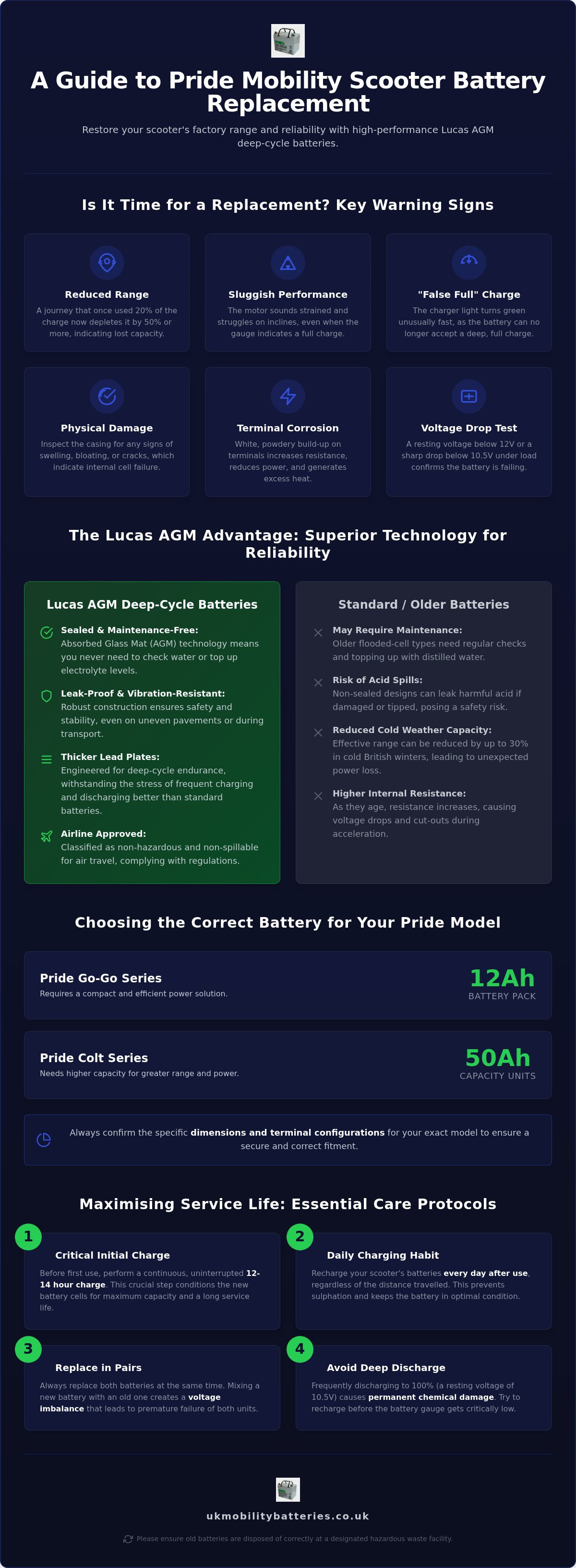
Identifying the precise moment for a pride mobility scooter battery replacement involves monitoring technical performance rather than waiting for total failure. A mobility scooter relies on deep-cycle batteries that degrade chemically over time. The most immediate indicator is a significant reduction in range. If a journey that previously consumed 20% of the charge now depletes the gauge by 50%, the cells are losing their capacity to hold energy. You'll also notice sluggish performance on inclines. The motor sounds strained despite a seemingly full charge because the battery cannot deliver the required current density.
The "false full" phenomenon occurs when a charger indicates a green "complete" light much faster than usual. This happens because the battery's internal chemistry can no longer accept a deep charge. It reaches its peak voltage quickly but lacks the capacity to sustain power under load. Physically, you should inspect the battery casing for swelling or bloating. These signs indicate overheating or gas buildup within the sealed unit. Check terminals for white, powdery corrosion, as this increases electrical resistance and generates unnecessary heat during operation.
Using a multimeter provides a factual assessment of cell health. A healthy 12V battery should show roughly 12.6V to 12.8V at rest. If the resting voltage sits below 12V, the battery is likely damaged. However, the true test is load voltage. If the voltage drops sharply, for example below 10.5V, the moment you engage the throttle, the battery is failing and requires immediate attention to prevent being stranded.
Understanding Battery Voltage and Discharge Curves
Voltage is not a linear representation of capacity. For a standard AGM battery, a reading of 10.5V indicates a 100% depth of discharge. Discharging to this level frequently causes permanent chemical damage. Modern Lucas AGM batteries don't suffer from the "memory effect" found in older nickel-cadmium cells, but they are sensitive to temperature. Cold British winters can reduce effective capacity by up to 30% in older cells. This makes a pride mobility scooter battery replacement essential before the temperature drops significantly.
Internal Resistance and Performance Loss
As batteries age, internal resistance increases. This resistance acts as a bottleneck for electrical current. You'll feel this when the scooter cuts out during sudden acceleration or when navigating kerbs. The power demand spikes, the internal resistance causes a massive voltage drop, and the controller shuts down to protect the electronics. Always replace batteries in pairs. Mixing a new Lucas battery with an old one creates a voltage imbalance. The older, weaker cell forces the new one to work harder, which leads to premature failure of both units.
Technical Specifications: Why Lucas AGM Batteries are the Preferred Choice
Lucas batteries utilise Absorbed Glass Mat (AGM) technology, a sophisticated subset of Sealed Lead Acid (SLA) design. Unlike standard flooded batteries, AGM units are completely sealed and maintenance-free. You never need to top up electrolyte levels or check water. This is a critical advantage for a pride mobility scooter battery replacement, as it eliminates the risk of acid spills and reduces the user's maintenance burden. These units are classified as non-hazardous for air travel, provided they are securely packaged and the terminals are protected.
The construction of these cells is engineered specifically for the rigours of daily mobility use. They feature a leak-proof and vibration-resistant chassis. This ensures the battery remains stable when navigating uneven pavements or whilst being transported in car boots. Industry organisations like the Battery Council International highlight the ongoing innovations in AGM technology that enhance energy density and safety. Lucas deep-cycle batteries handle frequent discharge cycles far better than standard cells because they are built for endurance rather than short bursts of power.
The Anatomy of a Lucas Deep-Cycle Battery
Lucas deep-cycle units incorporate thicker lead plates compared to generic alternatives. These robust plates withstand the chemical stress of repeated charging and discharging. The glass mat separator sits between the plates, holding the electrolyte in suspension like a sponge. This prevents spills even if the case is damaged. Recombination technology ensures that gases generated during normal charging are turned back into water within the cell. This process prevents gas emission and water loss, making the battery safe for use in enclosed indoor environments.
Sizing and Capacity: Ah Ratings Explained
Capacity is measured in Ampere Hours (Ah). This figure represents the total amount of energy the battery can store. A higher Ah rating typically translates to a longer daily range. When planning a pride mobility scooter battery replacement for a Go-Go model, you might find a Lucas 12V 7Ah battery as the standard fitment. However, you can often upgrade to a Lucas 12V 9Ah uprated battery for more runtime without changing the physical footprint. It's important to match the Ah rating to your motor's requirements to avoid sluggish performance.
To identify your requirements, check the label on your existing batteries. It will state the voltage (usually 12V) and the Ah rating. If you're unsure about the correct fitment or need to confirm your dimensions, you can view our full range of Lucas mobility batteries to match your specific model requirements. Replacing your batteries with the correct Ah rating ensures your scooter maintains its original speed and climbing capability.
Matching Lucas Batteries to Your Pride Mobility Model
Technical compatibility is the primary factor in a successful pride mobility scooter battery replacement. You must match the voltage, Ampere-hour (Ah) rating, and physical dimensions of your existing power pack. Pride Mobility designs their battery boxes to tight tolerances. Selecting a battery with incorrect dimensions will prevent the casing from closing securely or may cause internal components to rattle during transit.
Terminal type is another critical variable. Most compact models use F2 spade connectors which are 6.35mm wide. Larger mid-range and heavy-duty scooters often utilise M5 or M6 nut and bolt terminals to ensure a high-current connection. Ensuring your Lucas replacement has the correct terminal configuration prevents the need for dangerous wiring modifications or uncertified adaptors.
The Go-Go Series: Compact Power Solutions
The Pride Go-Go series, including the Elite Traveller and Ultra X, typically relies on a pair of 12V batteries housed in a removable plastic box. The standard factory fitment is often a Lucas 12V 12Ah Mobility Battery. For users requiring a longer daily range, these battery boxes can frequently accommodate a Lucas 12V 20Ah Mobility Battery. These uprated options provide a significant increase in energy density whilst maintaining a compatible footprint for many Go-Go models. If you are unsure of the physical process of accessing the battery box, refer to our technical guide on how to change mobility scooter batteries for professional assistance.
The Colt and Apex Ranges: Mid-to-Large Capacity
Mid-range scooters like the Pride Colt Deluxe and Apex Finesse require higher current draws to support their larger motors and full suspension systems. These models typically use a pair of Lucas 12V 34Ah Sealed AGM Deep Cycle Batteries. For the larger Colt Pursuit or Victory models, a Lucas 12V 50Ah Mobility Battery or a Lucas 12V 55Ah Sealed AGM Mobility Battery is necessary. These larger cells are significantly heavier and require secure mounting to withstand the vibrations of outdoor use on uneven pavements.
Bariatric and all-terrain models demand the highest capacity available to manage increased weight and terrain resistance. Using a battery with an insufficient Ah rating in these models will lead to rapid voltage drop and may damage the motor controller. Always verify that your chosen Lucas battery matches the specific Ah and physical dimensions listed in your Pride owner's manual. Replacing your batteries with the correct Lucas deep-cycle units restores the climbing torque and reliability required for challenging environments.
Step-by-Step: How to Replace Your Pride Scooter Batteries
Performing a pride mobility scooter battery replacement is a straightforward technical task that requires basic hand tools and adherence to specific safety protocols. Before you begin, ensure the scooter is switched off and the key is removed from the ignition. This isolates the electrical system and prevents accidental short circuits during the procedure. You will typically need a cross-head screwdriver for smaller Go-Go models or a 10mm spanner for the nut-and-bolt terminals found on larger Pride Colt units. If you are experiencing electrical issues prior to replacement, consult our guide on mobility scooter battery troubleshooting to rule out potential controller or charger faults.
Removing the Battery Pack or Shroud
Accessing the batteries depends on your specific Pride model. On travel scooters like the Go-Go Elite Traveller, the batteries are housed in a self-contained plastic box. Rotate the battery box release lever or unscrew the large thumb screws to free the casing. For larger road-legal models, you may need to lift the seat and remove a plastic shroud to reveal the battery tray. Always disconnect the main loom plug, which is the heavy-duty plastic connector linking the batteries to the scooter's motor, before attempting to lift the cells. This prevents unnecessary strain on the internal wiring harness.
Wiring the New Lucas Cells
Once the casing is open, you will see two 12V batteries connected in series to create a 24V system. Take a photograph of the wiring configuration before disconnecting anything. Follow the "black to black, red to red" rule strictly; the red wire must always connect to the positive (+) terminal and the black wire to the negative (-) terminal. Use a wire brush to clean the terminal connectors, as this ensures a low-resistance path for the current. When installing your new Lucas batteries, apply a thin layer of terminal grease or petroleum jelly to the metal surfaces. This prevents future oxidation and maintains electrical conductivity in damp British weather conditions. Secure the harness tightly, as loose connections cause heat buildup and intermittent power loss.
Old lead-acid batteries are classified as hazardous waste and must not be placed in household bins. Most local authority recycling centres in the UK provide dedicated skips for lead-acid batteries. Many retailers also offer take-back schemes for used cells. Disposing of your old batteries correctly ensures that the lead and plastic components are recycled responsibly. To get started with your upgrade, you can order your replacement Lucas battery set today for fast national delivery.
Maximising the Life of Your New Replacement Batteries
Once you've completed your pride mobility scooter battery replacement, the focus shifts to technical preservation. The service life of an AGM battery is measured in charge cycles, and poor maintenance habits can halve the usable lifespan of your new Lucas power solution. The most critical step occurs immediately after installation. You must perform an initial charge of 12 to 14 hours. Even if the charger light turns green sooner, this extended period is necessary to ensure the lead plates reach full chemical equilibrium. This initial soak charge prepares the cells for the rigours of daily discharge.
Daily charging is the standard recommendation for active users. Unlike older technologies, modern Lucas AGM batteries don't benefit from being "run down" to empty. Deep discharges put immense strain on the internal chemistry and lead to premature failure. You should aim to charge the scooter after every significant use, rather than waiting for the battery indicator to drop into the red zone. Modern smart chargers are designed to prevent the "overcharging" trap by switching to a float mode once the cells reach capacity, which keeps the battery healthy without overheating the electrolyte.
Charging Cycles and Best Practice
Maintaining a healthy state of charge is vital for longevity. You should never let your batteries drop below 20% capacity. Regularly hitting the low-voltage cutoff point causes sulphation, where lead sulphate crystals harden on the plates and permanently reduce capacity. Ambient temperature also plays a role in performance. Charging in a very cold garage is less efficient than charging at room temperature, as the chemical reactions occur more slowly in the cold. For a deeper look at electrical safety and charger behaviour, read our guide on can you overcharge a mobility scooter battery?
Long-Term Storage and Maintenance
If you don't intend to use your scooter for over a month, specific winter storage strategies are required. Batteries naturally lose charge over time, even whilst idle. This is known as self-discharge. You should disconnect the battery pack from the main loom to prevent any parasitic draw from the scooter's electronics. Perform a "top-up" charge at least once every four weeks to keep the cells healthy during the off-season. Neglecting this leads to a deeply discharged battery that may not recover when spring arrives. For comprehensive advice on selecting and caring for your equipment, consult the ultimate guide to mobility scooter batteries UK. Following these methodical steps ensures your Pride scooter remains ready for use whenever you need it.
Restoring Reliable Performance to Your Pride Mobility Scooter
Executing a successful pride mobility scooter battery replacement requires technical precision and the selection of high-grade components. By matching the exact Ah requirements of your specific Pride model and following a methodical installation process, you eliminate the risk of electrical failure. Adhering to the critical 12-14 hour initial charge protocol ensures your new cells reach their full chemical potential. These steps are essential for maintaining the torque and range you expect from your equipment.
UK Mobility Batteries acts as your specialist partner in maintaining equipment longevity. We provide premium Lucas deep-cycle technology featuring maintenance-free AGM construction for maximum reliability in all conditions. Our inventory is available for fast national UK delivery, so you aren't left waiting for essential power solutions. Browse our range of Lucas Pride Mobility replacement batteries today to restore your scooter's original performance. You can move forward with confidence knowing your mobility is supported by industry-standard power technology.
Frequently Asked Questions
How long do Pride mobility scooter batteries typically last?
Pride mobility scooter batteries generally last between 12 and 24 months, depending on usage frequency and charging habits. Whilst some well-maintained cells can reach 36 months, the chemical capacity inevitably degrades over time. Factors such as deep discharging below 20% or storing the scooter in a cold garage without regular top-up charges will significantly shorten this lifespan. Regular daily charging is the most effective way to ensure your batteries reach their maximum service potential.
Can I use car batteries as a replacement for my Pride scooter?
You cannot use car batteries as a pride mobility scooter battery replacement because they are designed for different electrical tasks. Car batteries provide a high-current burst to start an engine but aren't built for deep discharging. Mobility scooters require deep-cycle AGM batteries, like the Lucas range, which provide sustained power over several hours. Using a car battery will likely damage the scooter's motor controller and the battery itself will fail within weeks.
Do I need to replace both batteries at the same time?
You must always replace both batteries at the same time to maintain electrical balance. Mobility scooters use a 24V system created by two 12V batteries connected in series. If you mix a new Lucas battery with an old one, the older cell's higher internal resistance will force the new battery to work harder. This imbalance leads to the premature failure of the new unit and reduces the overall range of your scooter.
Are Lucas batteries compatible with my original Pride charger?
Lucas AGM batteries are fully compatible with the original off-board chargers supplied with Pride equipment. Most modern Pride chargers are "smart" units that use a multi-stage charging profile suitable for sealed lead-acid and AGM technology. These chargers automatically switch to a float mode once the Lucas cells reach full capacity. This prevents overheating and ensures the recombination process within the battery functions correctly, maintaining the maintenance-free benefits of the AGM design.
How do I know if my Pride scooter uses 12Ah or 18Ah batteries?
The most reliable method is to check the printed label on your current batteries. A standard Pride Go-Go Elite Traveller often uses 12V 12Ah batteries, whilst the larger Go-Go Sport models may use 18Ah or 20Ah units. You can also identify them by physical size; a 12Ah battery is typically 151mm long, whereas an 18Ah or 20Ah unit is larger at 181mm. Always measure the internal battery box before ordering an upgrade.
What is the difference between AGM and Gel batteries for Pride scooters?
AGM (Absorbed Glass Mat) batteries use a fibreglass mat to hold the electrolyte, whilst Gel batteries use a thickened silica paste. AGM batteries, such as the Lucas deep-cycle range, are the industry standard for Pride scooters because they offer excellent vibration resistance and higher burst power for inclines. They are also generally more cost-effective for the average user. Gel batteries are typically reserved for specialised heavy-duty applications where the scooter is discharged to extreme levels daily.
Is it difficult to change the batteries in a Pride Go-Go myself?
Changing the batteries in a Pride Go-Go is a straightforward task that most owners can complete in under fifteen minutes. The process involves removing the battery box from the scooter, unscrewing the lid, and swapping the leads between the old cells and the new Lucas replacements. You only need a standard cross-head screwdriver. It's helpful to take a photograph of the wiring harness before disconnecting the terminals to ensure the "red to positive" rule is followed.
Can I upgrade to a higher Ah battery for more range?
You can often upgrade to a higher Ampere-hour (Ah) rating to increase your travel distance between charges. For example, many scooters that take a 7Ah battery can accommodate a Lucas 12V 9Ah uprated battery. Similarly, 17Ah or 18Ah systems can often be upgraded to a Lucas 12V 20Ah mobility battery. The primary constraint is the physical size of the battery tray; as long as the dimensions match, the higher capacity will provide a longer range.