
Pride Mobility Scooter Batteries: A Technical Guide to Replacement and Performance
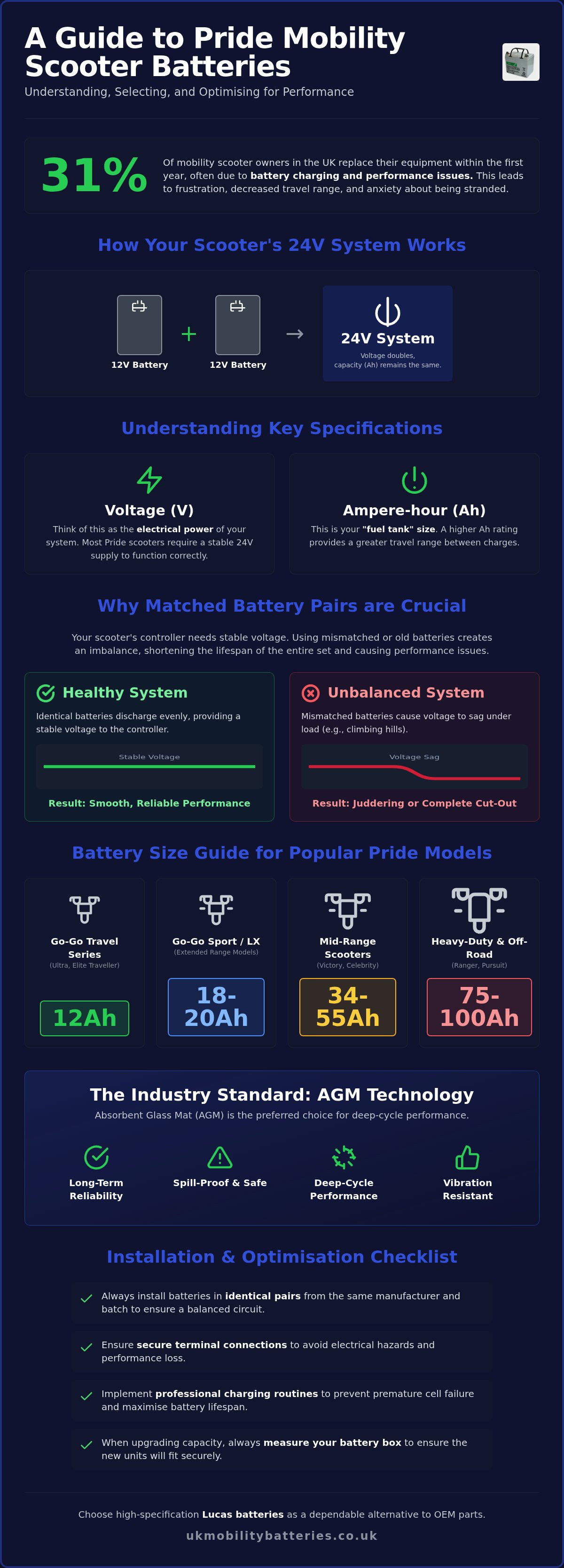
Did you know that over 31% of mobility scooter owners in the UK replace their equipment within the first year, often citing battery charging and performance issues as a primary reason for their dissatisfaction? It's a common frustration to find your travel range decreasing or to feel a persistent anxiety about being stranded due to unexpected power loss. You need a dependable machine, but the technical specifications surrounding voltage, amp-hours, and AGM technology often make finding the right replacement feel like a complex guessing game.
By mastering the technical specifications and maintenance requirements for pride mobility scooter batteries, you can ensure your equipment remains reliable and high-performing. This guide provides the exact data you need to identify compatible Lucas AGM alternatives whilst understanding deep-cycle capacity and the specific charging routines required to prevent premature cell failure. We'll examine the technical match-making process between your scooter's controller requirements and your battery's discharge profile to keep you moving with confidence.
Key Takeaways
- Learn how the standard 24V system operates and how selecting the correct Ampere-hour rating directly influences the daily range of your equipment.
- Identify the specific requirements for your model, from compact 12Ah units for the Go-Go series to heavy-duty 55Ah configurations for the Victory and Celebrity lines.
- Master the technical installation process for pride mobility scooter batteries to ensure secure terminal connections and avoid electrical hazards during replacement.
- Discover why maintenance-free AGM technology is the preferred industry standard for deep-cycle performance and long-term reliability in the UK.
- Optimise your scooter's lifespan by implementing professional charging routines and choosing high-specification Lucas batteries as a dependable alternative to OEM parts.
Understanding Pride Mobility Battery Specifications
Pride Mobility scooters rely on a standardised electrical architecture to balance weight and power output. Most models operate on a 24V DC system. This isn't achieved by a single massive battery, but through the series connection of two identical 12V units. Selecting the correct pride mobility scooter batteries requires understanding how these components interact with your scooter's electric motor and speed controller.
Voltage and Ampere-hour (Ah) Basics
When you connect two 12V batteries in series, the voltage doubles to 24V whilst the capacity remains the same. The Ampere-hour (Ah) rating represents the total charge a battery can deliver at a specific rate. Think of Ah as the size of your fuel tank. A higher Ah rating, such as moving from a 12Ah to a 14Ah unit, generally provides a greater travel range between charges. You must ensure the physical dimensions remain compatible with the battery shroud or tray, as even a few millimetres of difference can prevent the casing from locking securely.
A Deep-cycle battery is engineered to provide sustained power over long periods. This technology allows the battery to be discharged and recharged hundreds of times without significant degradation to the internal lead plates. Using standard car batteries will lead to rapid failure because they aren't built for the constant, deep discharge cycles inherent in mobility use.
Why Pride Scooter Controllers Require Stable Voltage
The controller acts as the brain of your scooter, regulating the flow of electricity from the batteries to the motor based on your throttle input. It requires a consistent, stable voltage to operate efficiently. If you use low-quality cells or mismatched pairs, the voltage can sag under load, particularly when climbing hills or traversing uneven terrain. This often results in a juddering sensation or the controller cutting out entirely as a safety precaution.
It's technically necessary to install pride mobility scooter batteries in identical pairs from the same manufacturer and batch. If one battery is older or has a different internal resistance, it will discharge at a different rate than its partner. This imbalance puts undue stress on the weaker battery, significantly shortening the lifespan of the entire set. Matching the specifications exactly ensures a balanced discharge and keeps the 24V circuit healthy and dependable.
Identifying the Correct Battery Size for Your Pride Model
Selecting the right pride mobility scooter batteries requires more than just checking the model name. Pride often offers different battery box configurations for the same scooter line. If your labels have faded over time, you'll need to verify the capacity and physical dimensions manually to ensure a safe fit and reliable performance.
Batteries for the Go-Go Travel Series
The compact Go-Go range, including the Ultra and Elite Traveller, typically uses a pair of 12V 12Ah batteries. These are designed for portability and fit into a detachable battery pack. For those using the Go-Go Sport or LX models, the requirement usually increases to 18Ah or 20Ah to support the larger motor and provide extended range. If you own one of the ultra-compact boot scooters, you might find our guide on the 12V 7Ah Battery for Mobility Scooter: Technical Specifications & Fitting Guide useful for identifying smaller cell requirements.
Mid-Range and Heavy-Duty Pride Scooter Battery Requirements
Mid-range scooters like the Pride Victory and Celebrity lines transition to larger 34Ah or 50Ah capacities. These road-legal 8mph models consume more power and require deeper discharge capabilities. Specialist models such as the Pride Ranger or Pursuit often demand 75Ah to 100Ah batteries to handle off-road terrain and higher speeds. When upgrading your capacity, always measure the internal dimensions of the battery box. Even if the Ah rating is higher, the battery must not interfere with the terminal leads or prevent the lid from closing securely. It's also vital to follow official guidance on managing fire risk for premises when charging these high-capacity units.
Power chairs in the Jazzy range generally follow similar patterns, frequently requiring 34Ah to 50Ah units depending on the specific model's weight capacity and motor size. If the labels on your current batteries are unreadable, use a tape measure to record the length, width, and height in millimetres. Matching these physical dimensions is the most reliable way to verify compatibility when the original technical data is missing. You can then browse our range of Lucas mobility batteries to find the exact technical match for your Pride equipment.
Comparing Battery Technologies: AGM, Gel, and Lithium
Selecting the appropriate chemistry for pride mobility scooter batteries involves a technical trade-off between initial expenditure, cycle life, and weight. In the UK market, Sealed Lead Acid (SLA) batteries remain the dominant choice due to their proven safety record and total compatibility with standard Pride charging systems. Whilst newer technologies are emerging, the majority of Pride equipment is factory-calibrated for the discharge curves of lead-based cells.
The Advantages of Sealed AGM Technology
Absorbent Glass Mat (AGM) technology is the standard for most Pride equipment. Lucas AGM batteries utilise a fine glass fibre mat to hold the electrolyte between the lead plates. This construction makes them entirely leak-proof and spill-proof, which is essential for users who frequently transport their scooters in car boots or on aeroplanes. Because the electrolyte is absorbed, these batteries are classified as non-hazardous for travel when handled correctly.
These batteries offer several technical benefits for daily users:
- Low Self-Discharge: Lucas cells retain their charge for longer periods whilst the scooter is stationary, preventing capacity loss during storage.
- Maintenance-Free: The sealed design eliminates the need to top up water levels or check acid gravity, providing a "fit and forget" solution.
- Vibration Resistance: The tight internal construction protects the lead plates from damage when driving over uneven pavements or gravel.
For the majority of applications, Lucas AGM batteries provide the most efficient balance of performance and price. They offer dependable deep-cycle capabilities without the premium cost associated with niche chemistries.
When to Consider Gel or Lithium Upgrades
Whilst AGM is versatile, certain use cases may warrant an upgrade to Gel or Lithium. Gel batteries use a silica-based gel to immobilise the electrolyte. This makes them more resilient to "deep discharge" events where the battery is regularly drained below 50% of its capacity. High-frequency users who cover significant distances daily may find that Gel batteries offer a longer overall service life.
Technical data regarding Batteries for Electric Vehicles shows that lithium-ion options provide the highest energy density and the lowest weight. For specific Pride models like the Go-Go Endurance Li, lithium can reduce the battery pack's weight by up to 70%. However, you must verify that your Pride charger is specifically lithium-ready. Using a standard lead-acid charger on a lithium battery is dangerous and can lead to thermal runaway.
For those operating Jazzy power chairs, choosing the right technology is even more critical due to the increased power demands of dual motors and complex seating systems. You can find more specific data in our Best Batteries for Electric Wheelchairs: 2026 UK Buyer’s Guide. Regardless of the chemistry you select, always replace both batteries in the pair to ensure the 24V circuit remains balanced and reliable.
Step-by-Step Installation and Performance Optimisation
Before you begin the physical exchange of your pride mobility scooter batteries, ensure the scooter is on a level surface with the power turned off and the key removed. This simple step prevents accidental engagement of the drive motor whilst you are handling electrical components. If your Pride model uses a separate battery box, detach it from the chassis and place it on a stable workbench for easier access to the internal wiring harness.
Safety Procedures for Changing Pride Batteries
When opening the battery casing, identify the positive (red) and negative (black) terminals correctly. You should always disconnect the negative terminal first and reconnect it last to minimise the risk of accidental sparking if a tool touches the metal frame. Ensure all terminal bolts are tightened securely. Loose connections increase electrical resistance, which generates heat and can melt plastic terminal protectors or cause the Pride controller to report a false "low battery" error. For a detailed walkthrough of the physical assembly, refer to our How to Change Mobility Scooter Batteries: A Step-by-Step Technical Guide.
You must replace both batteries simultaneously. Mixing a new battery with an old one creates an immediate voltage imbalance. The stronger battery will attempt to charge the weaker one, leading to excessive heat and a significantly reduced lifespan for your new investment. This imbalance is a primary cause of premature failure in Pride equipment.
Extending Service Life Through Correct Charging
New batteries require a "break-in" period to reach their full chemical capacity. For the first five to ten cycles, avoid discharging the batteries beyond 50% and ensure they receive a full 12-hour charge. Following this period, adopt a routine of charging your scooter after every trip, regardless of the distance travelled. Pride controllers are sensitive to voltage drops; keeping the batteries at a high state of charge prevents the electronics from underperforming. You can learn more about managing these cycles in our Can You Overcharge a Mobility Scooter Battery? Expert Guide to Battery Care.
Environmental factors play a significant role in performance. The British winter can reduce battery capacity by up to 30% due to slowed chemical reactions in cold temperatures. If you don't plan to use your scooter during the winter months, store the batteries in a cool, dry place and top them up at least once every four weeks to prevent permanent sulphation. For immediate replacements, you can order high-performance Lucas batteries with fast UK delivery to restore your scooter's range today.
Reliable Replacement Batteries for Pride Scooters in the UK
Finding a dependable source for pride mobility scooter batteries is the final step in ensuring your equipment remains operational. Lucas batteries serve as a technically superior alternative to standard OEM parts. They offer the deep-cycle capacity and stable voltage delivery required by Pride controllers without the inflated costs often associated with branded replacements. By selecting high-specification cells, you maintain the reliability of your scooter whilst ensuring long-term performance.
Why Lucas Batteries are the Professional Choice
Lucas batteries are the preferred option for UK mobility engineers due to their robust build quality. Their internal lead plates are engineered for high vibration resistance, which is essential for scooters used on uneven outdoor pavements or gravel paths. The standardised sizing of the Lucas range ensures that whether you require a 12V 12Ah unit for a Go-Go or a 12V 55Ah Sealed AGM Mobility Battery for a larger Pride model, the fit will be precise. This eliminates the risk of batteries moving within the shroud, which can lead to terminal damage or intermittent power loss.
These batteries are designed specifically for the mobility market. They provide a consistent discharge rate that protects the sensitive electronics within your scooter's speed controller. Using these professional-grade units ensures that your Pride machine operates within its intended electrical parameters, reducing the likelihood of unexpected cut-outs or motor strain.
Fast UK Delivery and Technical Support
When your batteries fail, fast replacement is a priority to maintain your independence. UK Mobility Batteries provides efficient, national delivery to ensure you aren't without your scooter for longer than necessary. Our UK-based technical support team is available to help you identify the correct battery size or provide advice on uprating your capacity from a standard 12Ah to a 14Ah unit for extended range. If you are currently experiencing power issues, you should consult our guide on Mobility Scooter Battery Troubleshooting: A Practical Guide to Failure Signs and Fixes to confirm if your cells require replacement.
It's also vital to consider the financial benefits available for mobility purchases. Under UK tax regulations, eligible disabled customers can purchase pride mobility scooter batteries with VAT relief. This exemption applies to batteries used specifically for mobility equipment. When you order online, you can complete a simple self-declaration to ensure you don't pay unnecessary tax on your essential maintenance parts. This makes high-quality Lucas AGM technology an affordable and practical solution for every Pride owner.
Restoring Long-Term Reliability to Your Pride Equipment
Maintaining the performance of your scooter depends on precise technical matching and disciplined charging routines. By selecting batteries that align with your Pride model's specific Ampere-hour requirements and physical tray dimensions, you prevent controller instability and ensure a consistent travel range. Maintenance-free AGM technology remains the most practical solution for UK users, offering a leak-proof design that is safe for both car transport and air travel.
Investing in premium pride mobility scooter batteries is the most effective way to eliminate range anxiety and avoid the risk of unexpected power failure. Our team provides expert technical advice to help you identify the exact Lucas battery configuration for your equipment, ensuring a perfect fit every time. With fast UK-wide delivery and specialist support, you can restore your scooter to its original factory performance without delay.
Take the first step towards a more reliable machine. Browse our full range of Lucas Pride Mobility Scooter Batteries to find your technical match. You'll soon be back on the move with total confidence in your equipment's power system.
Frequently Asked Questions
How long do Pride mobility scooter batteries typically last?
Pride mobility scooter batteries generally last between 12 and 18 months with regular daily use. If the scooter is used less frequently and maintained with proper charging routines, the service life can extend to 3 years. Factors such as user weight, local terrain, and storage temperatures significantly impact longevity. Once you notice a significant drop in travel distance or sluggish performance on hills, the internal lead plates have likely reached the end of their useful life.
Can I upgrade my Pride Go-Go batteries from 12Ah to 18Ah?
Upgrading from 12Ah to 18Ah is possible for many Pride Go-Go models, provided the battery box has the physical space to accommodate the larger units. An 18Ah battery is typically taller than a 12Ah version. This upgrade provides a higher Ampere-hour capacity, which directly increases the distance you can travel between charges. Always verify the internal dimensions of your battery shroud before purchasing to ensure the lid closes securely and the terminals remain protected.
How do I know if my Pride scooter batteries need replacing?
You can identify the need for replacement by monitoring the battery gauge whilst the scooter is in motion. If the needle or LED display drops into the red zone during acceleration or hill climbing, the batteries are failing to hold a stable voltage under load. Other indicators include a noticeable reduction in total travel range and the charger reaching its full state much quicker than usual, which suggests a permanent loss of chemical capacity.
Are Pride mobility scooter batteries covered by VAT relief?
Yes, pride mobility scooter batteries are eligible for VAT relief in the UK for customers with chronic illnesses or disabilities. This exemption allows you to purchase essential replacement parts without paying the standard 20% tax rate. When ordering through UK Mobility Batteries, you simply complete a self-declaration form at the checkout. This process ensures that high-quality technical solutions remain accessible and affordable for users who rely on their equipment for daily independence.
How long should I charge my new Pride batteries for the first time?
You should charge your new batteries for a minimum of 12 to 14 hours before their first use. This initial overnight charge is critical for conditioning the cells and ensuring they reach their maximum chemical potential. During the first ten charging cycles, avoid discharging the batteries deeply. This break-in period allows the internal plates to stabilise, which ultimately contributes to a longer overall service life and more dependable performance for your scooter.
Can I use a car battery charger on my Pride mobility scooter batteries?
You must never use a standard car battery charger on your mobility scooter. Car chargers are designed for high-current bursts to start engines and can easily overheat or rupture the seals on AGM or Gel batteries. Mobility scooters require a dedicated 24V smart charger that delivers a controlled, multi-stage charging profile. This ensures the batteries are charged safely and efficiently without the risk of thermal runaway or permanent damage to the sensitive internal plates.
What happens if I only replace one battery in my Pride scooter?
Replacing only one battery causes an immediate electrical imbalance in the 24V circuit. The older battery will have a higher internal resistance and lower capacity than the new unit. This forces the new battery to work harder and can cause the old battery to draw excessive current, leading to overheating. To maintain the reliability of your Pride equipment, you should always replace batteries in identical pairs from the same manufacturer and production batch.
Is it safe to leave my Pride scooter batteries on charge overnight?
It is safe to leave your batteries on charge overnight if you are using the original Pride smart charger or a high-quality technical equivalent. Modern chargers include an automatic cut-off feature that transitions to a float mode once the batteries reach 100% capacity. This prevents overcharging whilst keeping the cells topped up. However, you should avoid leaving the charger connected for more than 24 hours at a time to prevent unnecessary heat buildup.