
Mobility Scooter Battery: UK Technical Selection Guide 2026
Selecting the wrong battery for wheelchair scooter models isn't just a minor technical oversight; it's the primary cause of roadside strandings for the 350,000 mobility users across the UK. You rely on your device for daily independence, yet the technical jargon surrounding Ampere-hour (Ah) ratings and terminal configurations often makes finding a replacement feel like guesswork. It's common to worry about whether a new unit will fit your chassis or if it provides enough range to get you home without failing.
This technical guide provides the exact specifications and selection criteria you need to identify a high-quality, maintenance-free Lucas AGM battery that guarantees reliability. You'll master how to decode capacity ratings, verify terminal compatibility, and determine if an uprated capacity is a viable option for your specific device. We've organised this data to help you make an informed decision and secure fast UK delivery for your essential equipment. By matching the correct electrical profile to your mobility needs, you can ensure your device remains dependable for every journey.
Key Takeaways
- Learn how to configure 12V deep-cycle units into a standard 24V system and why these differ technically from standard automotive batteries.
- Identify the most suitable AGM or Gel battery for wheelchair scooter use by matching the internal chemistry to your specific terrain and frequency of travel.
- Master the relationship between Ampere-hour (Ah) ratings and mileage to determine if your device can support a capacity upgrade for extended range.
- Maximise the service life of your equipment by adhering to the essential charging rule of never leaving a battery in a discharged state.
- Ensure reliable performance by selecting fresh, maintenance-free Lucas AGM stock that meets precise physical dimensions and electrical specifications.
Understanding Mobility Scooter and Wheelchair Battery Technology
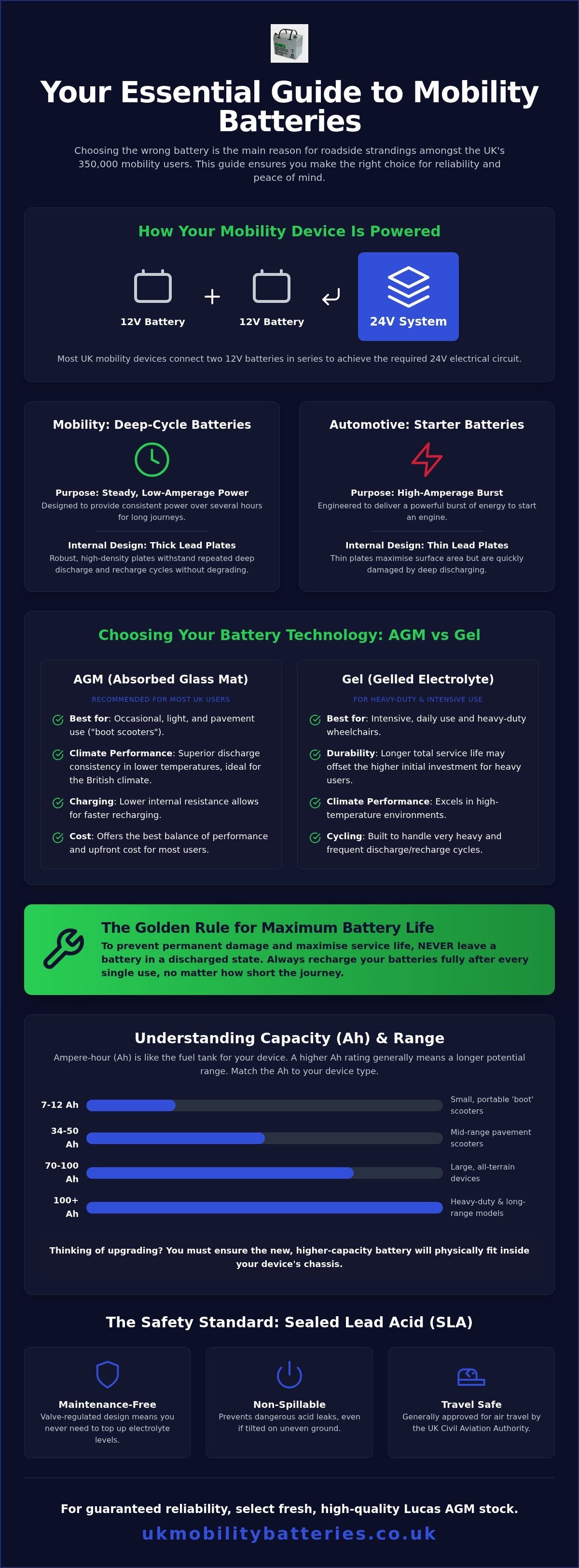
Most UK mobility devices operate on a 24V electrical circuit. This power requirement is met by connecting two 12V units in a series configuration. Whilst a standard automotive battery provides a high-amperage burst to start an internal combustion engine, a battery for wheelchair scooter use must provide a steady, low-amperage discharge over several hours. This fundamental difference in power delivery necessitates specific internal architecture. The Lucas range, spanning from 7Ah to 150Ah, provides the necessary deep-cycle durability required for this specific discharge profile.
What is a Deep Cycle Battery?
Deep-cycle battery technology involves lead-acid cells with thick plates designed to withstand consistent discharge and recharge cycles without structural degradation. Unlike starter batteries that use thin lead plates for maximum surface area, deep-cycle units feature thick, high-density plates. These robust components withstand the chemical stress of deep discharging without buckling or shedding active material. Deep-cycle battery technology ensures that your device maintains consistent voltage levels throughout its journey. Lucas batteries, such as the Lucas 12V 34Ah Sealed AGM Deep Cycle Battery, represent the industry benchmark for this performance profile. They are engineered to sustain hundreds of cycles whilst maintaining their rated capacity.
The Importance of Sealed Lead Acid (SLA) Construction
Modern mobility devices almost exclusively use Sealed Lead Acid (SLA) technology. These units are valve-regulated and non-spillable, which eliminates the need for users to top up electrolyte levels with distilled water. This maintenance-free design is a critical safety feature for wheelchair users. It prevents acid leaks during transit or if the device is tilted on uneven terrain. Because these batteries are sealed, they are generally classified as safe for air travel by the UK Civil Aviation Authority, provided they are correctly labelled. Using a high-quality battery for wheelchair scooter applications like the Lucas 12V 50Ah Mobility Battery ensures your equipment remains clean and safe for indoor use. These units require no active monitoring of acid levels, making them the most practical choice for daily mobility.
AGM vs Gel: Selecting the Right Battery for Your Mobility Needs
Choosing the correct electrolyte chemistry is vital for maintaining the operational efficiency of your device. Most users selecting a battery for wheelchair scooter use will decide between Absorbed Glass Mat (AGM) and Gel technology. Whilst both are classified as Sealed Lead Acid (SLA) and are maintenance-free, their internal construction dictates how they handle discharge cycles and environmental stress. AGM batteries use a fine fibreglass mat to soak up the sulphuric acid, making them spill-proof and highly resistant to cold weather. In contrast, Gel batteries feature a thickened, paste-like electrolyte that excels in high-temperature environments and heavy-duty cycling applications.
The British climate often favours AGM technology due to its superior performance in lower temperatures. These units maintain a higher discharge consistency when the mercury drops, which is a common occurrence for UK users. However, for those who use their equipment intensively every single day, the initial higher investment in Gel technology may be offset by a longer total service life. Proper management of these units is essential; adhering to UK government fire safety guidance ensures that your charging area remains safe and your batteries are stored correctly to prevent premature degradation.
The AGM Advantage for Occasional and Light Use
AGM batteries are the most common choice for "boot scooters" and pavement-based wheelchairs. They offer a lower internal resistance, which facilitates faster recharging and efficient power delivery. This technology is particularly effective for users who take shorter trips or those who transport their scooters in a car. The Lucas 12V 7Ah Sealed AGM Batteries and the Lucas 12V 12Ah Mobility Battery are standard specifications for these portable models. They provide a reliable power source that doesn't require the complex charging regimes sometimes associated with Gel units. For most pavement users, AGM offers the best balance between upfront cost and dependable daily performance.
When to Choose Gel for Heavy-Duty Wheelchairs
Gel batteries are designed for intensive, high-mileage users. If you frequently travel on uneven terrain or hills, the superior vibration resistance of a Gel unit provides an added layer of durability. These batteries can be discharged more deeply than AGM units without causing permanent damage to the lead plates. This makes them ideal for Class 3 road scooters that require consistent power over long distances. Whilst they require a specific charger setting and a longer "cool down" period after use, their ability to withstand thousands of micro-cycles makes them a robust choice for permanent wheelchair users. If you need help determining the best chemistry for your specific model, you can view our full technical range to compare specifications.
Matching Capacity and Dimensions: The Ampere-Hour (Ah) Guide
Identifying the correct electrical capacity is the first step in sourcing a replacement battery for wheelchair scooter equipment. The Ampere-hour (Ah) rating, clearly printed on the battery casing label, indicates the total volume of electrical charge the unit can store. A higher Ah rating generally translates to an increased travel range between charges. However, physical dimensions are equally critical. Most mobility scooter battery trays are designed with fixed tolerances; a battery with a higher capacity often requires a larger physical footprint. You must measure the length, width, and height of your existing units to ensure the replacement fits securely within the chassis.
Terminal configuration is another technical detail that determines compatibility. Common types include Spade (push-on connectors), Insert (threaded holes for bolts), and Flag (upright terminals with a bolt hole). Using the incorrect terminal type can lead to poor electrical contact or prevent the wiring loom from reaching the battery. Always verify that your new Lucas batteries match the terminal style of your original equipment to maintain a secure, vibration-resistant connection.
Can I Upgrade My Battery Capacity?
A frequent technical query involves upgrading from a standard 42Ah battery to a 50Ah unit to gain extra mileage. In many cases, these two capacities share identical physical dimensions (approximately 197mm x 165mm x 170mm), making the swap straightforward. However, you must verify that your battery tray has the necessary clearance and that your existing charger can support the higher capacity. A charger designed for small 7Ah units will struggle to fully saturate a 50Ah battery, potentially leading to sulphation and premature failure. Do not significantly over-size a battery for a small, lightweight motor, as the added weight can strain the drivetrain and decrease overall efficiency.
Common Size Categories in the UK Market
Standardising your search around established size categories helps narrow down the correct Lucas replacement. Most UK devices fall into three primary brackets:
- Small Travel Scooters: These typically utilise 7Ah, 12Ah, or the Lucas 12V 20Ah Mobility Battery. These units are designed for portability and frequent dismantling.
- Mid-Range Pavement Scooters: These models generally require 34Ah to 50Ah units. They offer a balance of range and moderate physical size for indoor and outdoor use.
- Heavy-Duty Road Scooters: Class 3 vehicles often require 55Ah, 75Ah, or even 100Ah+ batteries to handle road speeds and longer distances.
Always replace batteries in pairs. Mixing a new unit with an old one, or mixing different Ah ratings in the same 24V system, causes an electrical imbalance. This leads to the weaker battery being over-discharged whilst the stronger one is under-charged, ultimately shortening the lifespan of both.
Maximising Lifespan: Care and Safe Installation
The "Golden Rule" for any battery for wheelchair scooter applications is to never leave the unit in a discharged state. Lead-acid batteries, including the Lucas AGM range, suffer from permanent chemical damage called sulphation if left flat for even short periods. This process hardens lead sulphate crystals on the plates, which reduces the battery's ability to hold a charge. To prevent this, you should connect your device to a charger as soon as possible after every trip. Replacing a battery for wheelchair scooter models is a technical task that requires attention to the wiring loom and terminal integrity. Before fitting new units, inspect the cables for fraying or corrosion. Clean the terminals with a wire brush if you notice any oxidation, as poor contact increases electrical resistance and generates heat.
The Correct Charging Protocol
Modern mobility chargers are intelligent devices that use a multi-stage profile to safely replenish the cells. You should charge your batteries after every use, regardless of the distance travelled. Unlike older nickel-cadmium technology, AGM batteries don't have a "memory effect" and don't need to be fully depleted before recharging. In fact, keeping the depth of discharge shallow significantly extends the total cycle life. Avoid using chargers not specifically rated for your battery's Ah capacity, as this can lead to under-charging. For a visual walkthrough of the physical installation process, consult our technical guide on how to change mobility scooter batteries correctly.
Storage and Off-Season Maintenance
British winters present a challenge for battery health. Cold temperatures slow down the chemical reactions inside the cells, effectively reducing the available capacity during the winter months. If you don't intend to use your scooter for several weeks, don't simply leave it in a cold shed. Remove the batteries and store them in a cool, dry environment. You must provide a "top-up" charge at least every 30 days whilst the batteries are in storage. This counteracts the natural self-discharge rate and keeps the chemistry active. If you notice the scooter is losing power faster than usual or the charger is reaching the "full" stage too quickly, refer to our guide on mobility scooter battery troubleshooting to identify potential cell failure.
When fitting your new Lucas batteries, always install them as a matched pair. Replacing only one unit in a 24V system causes the new battery to work harder to compensate for the older, higher-resistance unit. This imbalance leads to rapid failure of both batteries. If you are ready to restore your device's range and reliability, you can order your replacement Lucas mobility batteries for immediate national delivery.
Why Source Your Lucas Batteries from UK Mobility Batteries?
Sourcing a replacement battery for wheelchair scooter equipment from a generalist retailer often results in receiving older stock that has sat in a warehouse for months. Lead-acid batteries begin to degrade the moment they're manufactured if they aren't kept on a maintenance charging programme. At UK Mobility Batteries, we specialise exclusively in the Lucas mobility range, ensuring that every unit delivered is fresh and technically sound. Our national delivery infrastructure is designed to minimise downtime; we understand that a failed battery isn't just a technical fault, it's a loss of independence. By focusing on the full spectrum of Lucas sizes from 7Ah to 150Ah, we provide exact matches for every class of device on UK roads.
Our national delivery network covers the entire UK, providing a dependable link between our specialised warehouse and your doorstep. We prioritise speed because we know how critical a battery for wheelchair scooter reliability is for your daily routine. Every order is handled by staff who understand the nuances of AGM technology and can advise on specific model compatibility. Whether you're looking for the Lucas 12V 34Ah Sealed AGM Deep Cycle Battery or a smaller 7Ah unit for a travel scooter, we ensure the electrical profile matches your device's requirements perfectly.
Understanding VAT Relief on Mobility Batteries
HMRC rules in 2026 continue to provide VAT relief for individuals purchasing batteries for mobility aids. This exemption applies when the equipment is used by a person with a chronic illness or disability for their personal use. As a UK-based specialist, we've integrated a simple self-declaration process into our checkout system. This allows eligible users to claim relief instantly without the need for complex paperwork. It's essential to buy from a provider who understands these specific regulations to ensure you're only paying the correct, tax-exempt amount for your essential equipment.
The Lucas Quality Assurance
Lucas is a favoured brand amongst UK healthcare professionals and mobility engineers due to its consistent build quality and deep-cycle performance. These units are engineered with high-density lead plates that withstand the rigours of daily discharge better than budget alternatives. You can compare technical specifications across the market in our guide to the best batteries for electric wheelchairs. Our team provides expert technical support to help you verify capacity upgrades or terminal compatibility before you commit to a purchase. We don't just supply parts; we provide the technical data required to keep your mobility device running at peak efficiency.
Secure Your Mobility Independence with Precision Power
Maintaining the reliability of your device requires a precise match between its electrical requirements and the battery chemistry. By following the technical criteria for Ampere-hour ratings and physical dimensions, you can avoid the common pitfalls of incorrect fitting or insufficient range. Adhering to a strict charging protocol ensures that your new equipment delivers its maximum cycle life; this provides dependable performance throughout the British winter. Finding the right battery for wheelchair scooter models is a straightforward process when you have access to accurate technical data and a specialist delivery network.
As an authorised Lucas retailer, we provide the specialist technical support necessary to verify your selection and ensure compatibility. We focus on supplying fresh, high-performance stock that meets the rigorous demands of daily use. Eligible users can also access VAT relief during the checkout process to ensure their essential equipment remains cost-effective. You can now restore your device to peak performance with confidence.
Browse the full range of Lucas Mobility Batteries with fast UK delivery
Frequently Asked Questions
How long should a battery for a wheelchair or scooter last?
A standard deep-cycle battery for wheelchair scooter applications typically lasts between 12 and 18 months with daily intensive use. Light users who adhere to a strict charging protocol may see a service life extending to three years. Lifespan is measured in charge cycles; discharging the unit below 50 per cent regularly will shorten its total duration. Environmental factors and storage conditions also play a significant role in maintaining the internal chemical health.
Can I replace just one battery if only one has failed?
You should always replace mobility batteries in matched pairs rather than individually. Connecting a new battery to an old, degraded unit creates an electrical imbalance within the 24V system. The older battery has a higher internal resistance, which forces the new unit to overwork and discharge more rapidly. This mismatch leads to the premature failure of both batteries, ultimately increasing your long-term maintenance costs and reducing the reliability of your mobility equipment.
What is the difference between 12V 7Ah and 12V 9Ah batteries?
The primary difference is the electrical capacity, where the Lucas 12V 9Ah Uprated Sealed AGM Battery provides approximately 28 per cent more runtime than the 7Ah version. Both units typically share identical physical dimensions, making the 9Ah a direct uprated replacement for travel scooters. Choosing the higher Ampere-hour rating allows for an extended travel range without requiring modifications to the battery tray or wiring. This upgrade is ideal for users seeking more independence.
Are these batteries safe for air travel from the UK?
Sealed AGM and Gel batteries are generally classified as non-spillable and are safe for air travel according to UK Civil Aviation Authority guidelines. These units don't contain free-flowing acid, which allows them to be transported in the hold of an aircraft. It's essential to check with your specific airline before travelling, as they may require you to disconnect the battery terminals or provide a technical data sheet to confirm the battery's sealed construction.
Do I need a special charger for AGM or Gel batteries?
You must use an intelligent, multi-stage charger that is compatible with your battery's chemistry and Ah rating. AGM batteries can typically be charged with standard mobility chargers, but Gel batteries require a specific charging profile with a lower peak voltage. Using an incorrect charger can lead to permanent damage through over-charging or under-charging. Always verify that your charger's output amperage is between 10 per cent and 20 per cent of the battery's total capacity.
How do I know if my mobility scooter battery is failing?
Common signs of failure include a noticeable decrease in travel range and a loss of power when navigating inclines. You may also observe that your charger reaches the 'full' indicator much faster than usual, which suggests the internal plates can no longer hold a substantial charge. If your device feels sluggish or the battery meter drops significantly under load, it's likely time to source a replacement battery for wheelchair scooter use to avoid being stranded.
Can I use a standard car battery charger on my mobility scooter?
You should never use a standard automotive battery charger on a mobility scooter. Car chargers are designed for high-amperage bursts and lack the delicate multi-stage sensors required for deep-cycle AGM or Gel units. Using a car charger can cause the electrolyte to boil, leading to case swelling or internal short-circuits. Always utilise a dedicated mobility charger that provides a controlled, low-amperage finish to safely saturate the lead-acid cells without causing thermal stress.
Why does my scooter range decrease in the winter?
Battery range decreases in the winter because cold temperatures slow down the chemical reactions inside the cells. It's an effect that reduces the power the battery can deliver, often resulting in a 20 per cent to 30 per cent reduction in mileage. To mitigate this, store your scooter in a temperate environment and ensure the batteries are fully charged before every journey. Cold weather also increases the rolling resistance of tyres.