
Mobility Scooter Batteries: Complete Technical Guide 2026
A mobility scooter is only as dependable as the chemical energy stored within its cells, yet the technical specifications of disabled scooter batteries are often misunderstood. It's frustrating to face high showroom markups or feel overwhelmed by the technical jargon of deep-cycle chemistry. You shouldn't have to worry about being stranded because of a mismatched component or an incorrect charging cycle. You want a solution that offers consistent power across all terrains and the confidence that your equipment will perform every time you leave your home.
This technical guide provides the data you need to master battery selection and maintenance. You'll learn how to identify the correct Lucas battery for your specific requirements and how to implement a care routine that extends operational life. We'll examine the performance characteristics of sealed AGM technology, decode capacity ratings from 7Ah to 55Ah, and outline the exact steps required to ensure maximum range and reliability for 2026. By understanding these technical requirements, you can avoid unnecessary replacement costs and maintain your independence with certainty.
Key Takeaways
- Understand why specialised deep-cycle AGM technology is essential for safety and performance, and why standard automotive batteries are unsuitable for mobility applications.
- Learn to decode technical specifications like Amp Hours (Ah) and voltage to ensure your disabled scooter batteries provide the necessary range for your specific daily requirements.
- Master the "charge after every trip" rule to prevent permanent plate damage from deep discharge and significantly extend the service life of your Lucas battery.
- Discover how to correctly identify and install matched pairs of replacement batteries by verifying the label specifications on your existing unit.
- Gain the ability to calculate realistic range expectations based on variables such as user weight, terrain, and environmental conditions rather than relying solely on manufacturer estimates.
Understanding Disabled Scooter Batteries: Technology and Safety
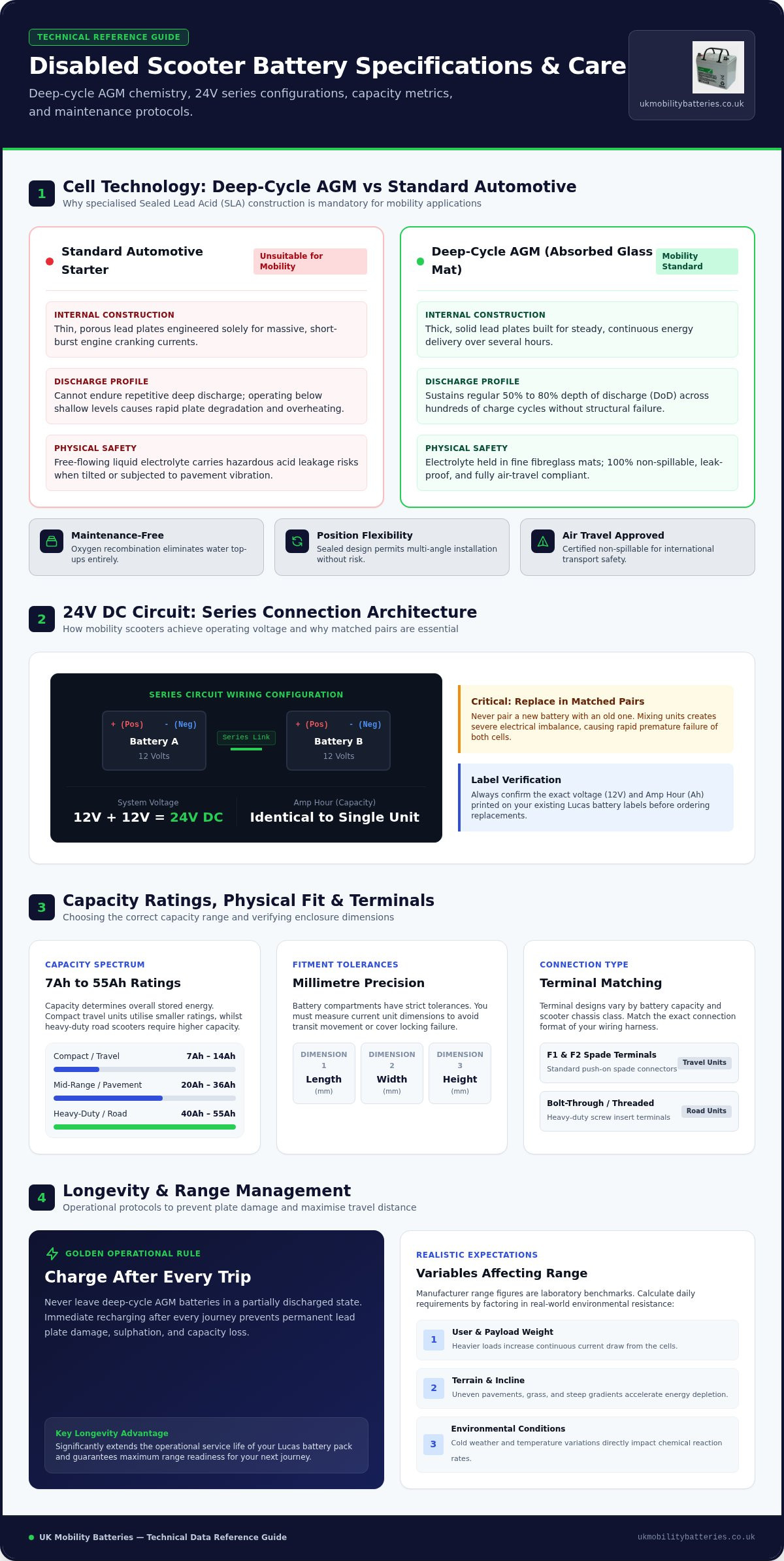
Disabled scooter batteries are precision-engineered power storage units designed specifically for deep-cycle applications. They differ fundamentally from standard automotive batteries in both their internal construction and their discharge profiles. Whilst a car battery is built to provide a massive high-current burst to start a cold engine, mobility batteries must provide a consistent, lower-intensity flow of energy over several hours of continuous operation. Using an automotive battery in a mobility device is not only inefficient but potentially dangerous. It can lead to rapid plate degradation, overheating, and potential equipment failure because standard designs cannot survive the repeated 50-80% depth of discharge common in daily mobility use.
Safety is a primary consideration for mobility equipment, especially when used in confined spaces or public areas. Modern units rely on Sealed Lead Acid (SLA) technology to ensure that the battery remains leak-proof even if tilted or subjected to heavy vibrations. This sealed design is critical for users who store their scooters inside their homes or transport them in the boot of a car. By eliminating the risk of acid leaks, these batteries provide a dependable power source that meets the rigorous demands of daily life without requiring the hazardous maintenance associated with older battery types.
The Role of Deep-Cycle Technology
The internal architecture of a deep-cycle battery is built to withstand the physical stress of being emptied and refilled with energy. Unlike cranking batteries that use thin, porous plates to maximise surface area for a quick burst of power, deep-cycle units feature thicker, solid lead plates. These robust plates allow for a sustained chemical reaction that delivers energy steadily until the battery is depleted. The quality of these internal components directly dictates the battery's lifespan. High-density plates can endure hundreds of charge cycles, ensuring that your equipment maintains its performance levels over several years of regular use.
Why AGM is the Industry Standard
Absorbed Glass Mat (AGM) construction is the current benchmark for reliability in the mobility sector. In an AGM battery, the electrolyte is held in a fine fibreglass mat rather than sitting as a free-flowing liquid. This technical advancement makes the battery completely non-spillable and exceptionally resistant to vibration. This level of durability is essential for mobility scooter technology and specifications, as it ensures the battery remains functional when navigating uneven pavements or kerbs.
AGM batteries offer several specific advantages for the user:
- Maintenance-Free: The oxygen recombination cycle ensures that the battery never needs to be topped up with water.
- Position Flexibility: The sealed nature allows the battery to be installed in various orientations without the risk of leakage.
- Travel Compliance: These units are classified as non-spillable, making them suitable for air travel and compliant with international safety regulations.
Selecting high-quality disabled scooter batteries ensures that your mobility aid remains a reliable tool for independence. By choosing AGM technology, you benefit from a power source that is safe for indoor use, easy to maintain, and robust enough for varied UK terrains.
Technical Specifications: Amp Hours, Voltage, and Dimensions
Most mobility scooters operate on a 24V DC electrical system. This voltage is achieved by connecting two 12V disabled scooter batteries in series. In this configuration, the positive terminal of one battery connects to the negative terminal of the second. This doubles the voltage whilst the capacity (Ah) remains identical to a single unit. You should always replace both units at the same time. Installing a single new battery alongside an old one causes an electrical imbalance that leads to premature failure of both components.
Physical dimensions are the most common cause of incorrect orders. Battery trays and compartments are manufactured with precise tolerances. You must measure the length, width, and height of your current unit in millimetres before purchasing a replacement. Even a small discrepancy can prevent the battery cover from locking or cause the unit to shift during transit. Similarly, terminal types must match. Small travel scooters typically use F1 or F2 spade terminals, whilst larger 34Ah to 55Ah models require nut and bolt connections for a secure electrical path.
Decoding Amp Hour (Ah) Ratings
Amp Hour (Ah) is the measure of electric charge a battery can deliver over time. This rating indicates the total energy capacity of the unit. Small travel scooters often utilise 7Ah or 12Ah batteries for short-range trips. In contrast, heavy-duty road scooters require 55Ah or larger units to manage higher motor demands and longer distances.
It's often possible to uprate your capacity without changing the battery box. For example, a Lucas 12V 9Ah Uprated Sealed AGM Battery fits in the same space as a standard 7Ah unit. This upgrade provides approximately 28% more range without increasing the physical size of the battery. If you're unsure of your current capacity, you can check our inventory of Lucas 12V mobility batteries to find a compatible match for your scooter model.
Standard Sizes and Fitment Guidance
The UK market relies on several standard battery group sizes. When comparing options, pay close attention to the weight of the unit. A heavier battery usually signifies a higher lead content and thicker internal plates. This density is a primary indicator of quality and cycle life. Higher lead density allows the battery to withstand the chemical stress of repeated deep discharges more effectively than lighter, budget alternatives.
For more detailed insights on matching performance to your specific lifestyle needs, read The Ultimate Guide to Mobility Scooter Batteries UK. Choosing the correct specification ensures your scooter remains reliable across varied terrains whilst protecting the longevity of your electrical system.
Maximising Performance: Range, Terrain, and Environmental Factors
Manufacturer range estimates are theoretical benchmarks. These figures are typically calculated using a 75kg user on a flat, smooth surface in a controlled 20°C environment. Real-world conditions in the UK rarely match these laboratory parameters. When you navigate steep inclines or carry additional equipment such as oxygen cylinders or heavy shopping bags, the motor draws significantly more current from your disabled scooter batteries. This increased amperage reduces the total distance you can travel on a single charge.
Terrain profile is another critical variable. Moving across soft grass or loose gravel creates higher rolling resistance than cruising on tarmac. This resistance forces the motor to work harder, accelerating battery depletion. Similarly, stop-start driving in busy shopping centres consumes more energy than steady cruising. Overcoming inertia from a complete standstill requires a high-current burst, which is more taxing on the cells than maintaining a constant speed whilst in motion.
Real-World Range Expectations
Your scooter's classification dictates its baseline performance. Compact travel scooters using 7Ah to 12Ah batteries are designed for short, local trips on level ground. In contrast, 8mph road scooters equipped with 55Ah Lucas batteries are built for longer commutes and more demanding motor loads. If you notice your battery indicator dropping rapidly during a climb or struggling to maintain speed on familiar routes, it's often a sign that the internal resistance of the cells has increased due to age. Performance will naturally degrade over time, but knowing your scooter's limits helps prevent being stranded.
Environmental Impact on Capacity
Ambient temperature directly affects the chemical reaction speed inside the battery. In cold winter weather, the movement of ions within the electrolyte slows down, which can reduce effective capacity by up to 25%. This isn't a permanent loss of power, but it means you'll achieve fewer miles during the colder months. To mitigate this, store and charge your scooter in a temperate indoor environment. Charging a battery in freezing conditions is inefficient and can lead to incomplete charge cycles. For more detailed help on identifying performance drops, consult our guide on Mobility Scooter Battery Troubleshooting.
Battery Care and Maintenance for Long-Term Reliability
Proper maintenance is essential for extending the service life of disabled scooter batteries. The most critical rule is to charge the unit after every use, regardless of the distance travelled. Unlike older battery technologies that suffered from "memory effect," modern AGM and GEL deep-cycle batteries perform best when kept at a high state of charge. Allowing a battery to sit in a partially discharged state initiates a chemical process called sulphation. This occurs when lead sulphate crystals harden on the internal plates, reducing capacity and eventually leading to total failure.
Deep discharge happens when the battery voltage drops below its recommended threshold, typically around 10.5V for a 12V unit. If this occurs frequently, the internal lead plates suffer permanent structural damage. This is why "charging only when empty" is incorrect advice for mobility users. Consistent, shallow discharge cycles followed by immediate recharging will double or even triple the operational life compared to irregular charging habits. Ensure terminals are kept clean and connections remain tight to prevent power loss through resistance.
The Correct Charging Cycle
Modern smart chargers utilise a multi-stage process to protect your equipment. The Bulk stage delivers a high current to reach approximately 80% capacity. The Absorption stage then slows the current to safely top up the remaining 20%. Finally, the Float stage maintains the battery at full charge without overheating the cells. You should always match your charger's Amp output to your battery's capacity. For instance, a 2-5 Amp charger is suitable for smaller 7Ah to 20Ah units, whilst larger 55Ah batteries require an 8-10 Amp charger. For more technical details, read our guide: Can You Overcharge a Mobility Scooter Battery?.
Winter Storage and Maintenance
The UK's damp climate presents specific challenges for battery health. If you don't intend to use your scooter for several weeks, do not leave it in a discharged state. Batteries lose charge naturally through a process called self-discharge. To prevent the voltage from dropping to dangerous levels, perform a "top-up" charge at least once a month during periods of inactivity. Always store batteries in a dry, frost-free environment. Freezing temperatures can cause the plastic casing to crack or the electrolyte to expand, which causes internal shorts. If your current set is struggling to hold a charge after a period of storage, it may be time to invest in replacement Lucas mobility batteries to ensure your independence is not compromised.
Choosing and Installing Your Replacement Mobility Batteries
Selecting the correct replacement disabled scooter batteries requires verification of the technical data printed on your existing units. Most manufacturers include a label specifying the voltage (V) and Amp-hour (Ah) rating. For instance, you might see "12V 34Ah" or "12V 50Ah". You should also verify the physical dimensions, as higher capacity batteries often require larger compartments. Choosing a heritage brand like Lucas ensures that the internal lead plates meet the high-density standards required for deep-cycle performance. These units are maintenance-free and leak-proof, making them a safe choice for indoor storage and public transport.
The transition from identifying your needs to physical installation is a high-stakes process. Using the wrong tools or failing to secure connections can lead to electrical arcing or intermittent power loss. By following a methodical approach, you can ensure that your equipment remains reliable and that you get the full value from your investment in new power cells.
The Importance of Matched Pairs
You must always replace your batteries as a matched pair. Mixing a new battery with an old one creates an electrical imbalance that significantly reduces the lifespan of the new component. An older battery has higher internal resistance. During a charging cycle, the charger cannot distinguish between the two units and may provide a voltage that is too high for the new battery or insufficient for the old one. This "dragging down" effect leads to poor range and premature failure. Always ensure both batteries are the same brand, age, and Ah rating to maintain balanced discharging and charging cycles across the 24V system.
Installation Best Practices
Before beginning the replacement process, ensure the scooter's ignition is turned off and the charger is disconnected. You'll typically need a basic set of spanners or a screwdriver, depending on whether your terminals use nut-and-bolt or spade connections. A critical step is documenting the wiring layout. Take a photograph of the existing connections before removing any cables to ensure you don't reverse the polarity during reassembly. Reversing the positive and negative leads can cause catastrophic damage to the scooter's controller.
Once the old units are removed, clean the battery tray of any debris or corrosion. Position the new Lucas batteries securely and reconnect the cables, ensuring that all terminals are tightened firmly. For a detailed walkthrough of this process, see our guide on How to Change Mobility Scooter Batteries. Following these technical steps guarantees that your new power system operates at peak efficiency from the first trip.
Securing Long-Term Reliability for Your Mobility
Maintaining your independence depends on a deep understanding of the technical requirements governing your power system. By precisely matching the Amp-hour ratings and physical dimensions of your equipment, you ensure your disabled scooter batteries provide the necessary range across varied UK terrains. Adhering to the matched pair rule and a disciplined charging cycle are the most effective strategies to prevent premature failure and avoid the frustration of being stranded. Reliability is a technical choice.
Technical precision in battery selection eliminates the uncertainty often found in local showrooms. As an authorised Lucas battery specialist, we supply high-performance AGM solutions ranging from 7Ah to 55Ah to suit every scooter classification. Browse our full range of premium Lucas mobility batteries with fast UK delivery and access our expert technical support for capacity uprating. With the correct components and a proactive care routine, you'll enjoy reliable performance and the freedom to travel with absolute confidence throughout 2026.
Frequently Asked Questions
How long do disabled scooter batteries usually last?
Disabled scooter batteries typically last between 12 and 18 months depending on usage patterns and maintenance routines. High-quality Lucas units often exceed this timeframe when charged correctly. Factors such as the depth of discharge and total cycle count influence longevity. To maximise life, you should avoid letting the charge drop below 20%. Regular charging after every use is the most effective way to protect the internal lead plates from degradation.
Can I use a car battery for my mobility scooter?
No, you cannot use a car battery for a mobility scooter. Automotive batteries are designed to provide a high-current burst to start an engine, whereas mobility devices require a steady, low-intensity flow of energy over several hours. Using a car battery will lead to rapid internal damage because it isn't built for deep-cycle discharge. This mismatch can also damage the scooter's delicate electronic speed controller and wiring.
Should I charge my scooter batteries every night?
Yes, you should charge your batteries every night after use, regardless of how far you've travelled. Modern AGM batteries don't have a memory effect, so frequent charging is beneficial. Keeping the cells fully charged prevents the accumulation of lead sulphate crystals on the plates. This process, known as sulphation, is the leading cause of premature battery failure. A full overnight charge ensures your scooter is always ready for the next day's journey.
What is the difference between AGM and Gel mobility batteries?
AGM batteries use a fibreglass mat to absorb the electrolyte, whilst Gel batteries use a silica-based paste to create a thick jelly. Both are sealed and maintenance-free. AGM technology is generally the preferred industry standard because it handles high-current motor demands more efficiently and offers excellent vibration resistance. Gel batteries are sometimes used for very deep-cycle applications, but AGM provides the most reliable performance for the majority of modern UK mobility scooters.
Why does my scooter range decrease in the winter?
Chemical reactions inside the battery slow down as temperatures drop, which reduces the available capacity. In freezing UK winter conditions, you might notice a range reduction of up to 25%. This isn't a permanent fault, but it means the battery can't release its stored energy as quickly. You can mitigate this by storing and charging your scooter in a temperate indoor area. Always ensure the batteries are fully charged before heading out in the cold.
Can I upgrade my battery to a higher Amp-hour (Ah) rating?
You can often upgrade to a higher Amp-hour rating if the physical dimensions of the battery compartment allow it. For instance, a Lucas 12V 9Ah Uprated Sealed AGM Battery frequently fits the same space as a standard 7Ah unit. This upgrade increases your energy capacity, effectively giving you a larger fuel tank for longer journeys. Always verify the length, width, and height of the uprated battery to ensure a secure fit before purchasing.
Do I need to replace both batteries at the same time?
You must always replace disabled scooter batteries in matched pairs to ensure electrical balance across the 24V system. If you install a new battery alongside an old one, the higher internal resistance of the older unit will force the new battery to overwork. This imbalance leads to uneven charging and will cause the new battery to fail prematurely. Replacing both units simultaneously is the only way to guarantee consistent performance and protect your investment.
How should I store my mobility scooter batteries if I am not using them?
Store your batteries in a cool, dry, and frost-free environment to prevent internal damage or casing cracks. Before storage, ensure the batteries are fully charged. Because all lead-acid batteries suffer from natural self-discharge, you must provide a top-up charge at least once every month during periods of inactivity. Never leave a battery in a fully discharged state for any length of time. This prevents permanent sulphation and ensures the cells remain healthy for future use.