
Lucas Mobility Battery Compatibility Guide: Finding the Perfect Fit
Did you know that selecting a battery with the wrong terminal type can render even the most powerful deep-cycle unit completely useless for your mobility scooter? It's a common frustration for many of the estimated 350,000 scooter users in the UK who find themselves stuck between technical specifications and physical constraints. This lucas mobility battery compatibility guide provides the expert technical framework you need to accurately match Lucas deep-cycle batteries to your mobility scooter or electric wheelchair. We address the common anxiety of whether a 12V 34Ah or 50Ah unit will fit your battery box, ensuring you never purchase a component that's too large for your equipment.
You likely want the peace of mind that comes with a maintenance-free, non-spillable battery that's safe for indoor storage and air travel. We'll clarify the confusion between standard 12V 7Ah and uprated 9Ah options, explaining how these upgrades can provide more range without changing the physical footprint. This guide examines physical dimensions, terminal configurations, and the specific advantages of AGM technology. By the end of this article, you'll be able to confirm the exact Lucas part number required and feel confident that your power source is both reliable and performance-driven.
Key Takeaways
- Learn why Lucas Sealed AGM technology is the industry standard for maintenance-free operation and safe indoor use.
- Use this lucas mobility battery compatibility guide to accurately identify the correct Ah rating for your specific travel, pavement, or road-legal scooter.
- Understand how to achieve a superior value proposition by upgrading to uprated 9Ah units for increased range within the same physical footprint.
- Identify critical compatibility factors including terminal types and layout positions to ensure your cables reach the battery connectors securely.
- Follow a methodical measurement framework to verify that your new deep-cycle batteries fit perfectly within the dimensions of your existing battery box.
Understanding Lucas Battery Specifications for Mobility Devices
A mobility scooter relies on a constant, steady flow of electricity rather than a short burst of high current. This is the primary function of a deep-cycle battery. In this lucas mobility battery compatibility guide, we focus on the technical attributes that make Lucas units suitable for this demanding application. These batteries are engineered to discharge slowly over several hours, providing the stamina required for daily travel. They're built to survive deep discharges, meaning you can use a high percentage of the battery's capacity before needing a recharge. This performance is essential for maintaining consistent speed and torque throughout your journey.
Lucas Sealed AGM (Absorbent Glass Mat) technology has become the industry standard amongst UK users because it eliminates the need for electrolyte topping. The "Maintenance-Free" label specifically refers to the battery being hermetically sealed. This design prevents the release of gases during normal charging, making these units safe for indoor use and overnight charging in domestic environments. Every Lucas mobility battery operates at a consistent 12V nominal voltage. This ensures that whether you're using a 12V 7Ah unit or a 12V 55Ah unit, the electrical output remains compatible with your scooter's motor controller. Choosing the right capacity is vital, but the underlying 12V chemistry remains the same across the range.
The AGM Advantage for Mobility Scooters
AGM technology utilises a fine glass mat separator that absorbs sulphuric acid to keep the electrolyte in suspension. This construction makes the battery entirely leak-proof, even if the case is tilted or stored on its side. It's a critical feature for users who transport equipment in car boots or travel by air. Most airlines and courier services classify these non-spillable batteries as safe for carriage because they don't pose a corrosive risk. Additionally, the internal components are tightly packed, providing superior vibration resistance against uneven pavements and kerbs.
Deep Cycle vs Starter Batteries
Car batteries are designed for high-intensity bursts to start engines, followed by immediate recharging from an alternator. If used in a scooter, they'll fail prematurely because their thin plates warp under sustained load. Lucas mobility batteries feature significantly thicker lead plates designed specifically for repeated deep discharge cycles. This design allows the battery to be drained and recharged hundreds of times without losing total capacity. For more technical detail on battery longevity, you can consult our ultimate guide to mobility scooter batteries UK.
Lucas Mobility Range: Capacity and Dimension Comparison
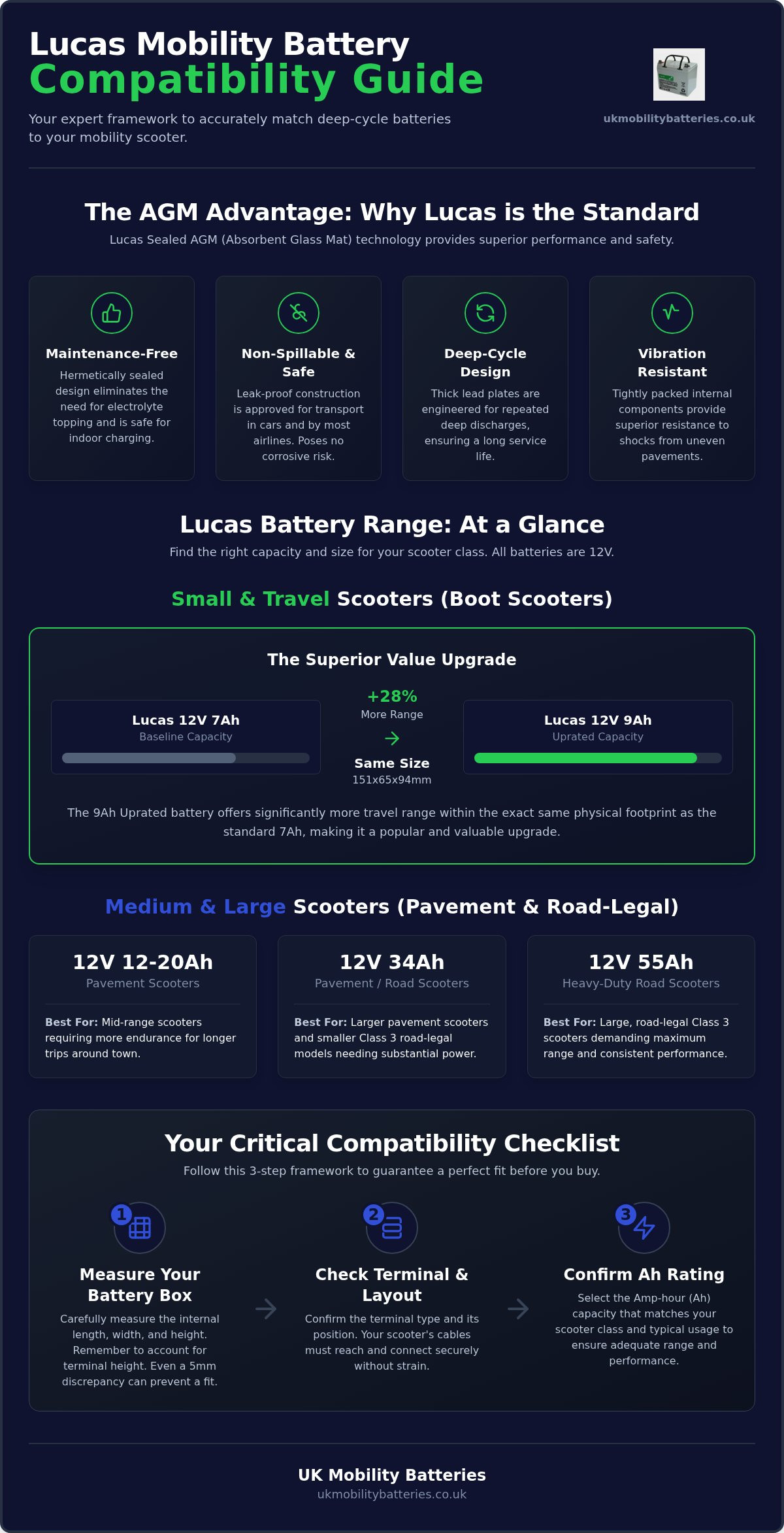
Most UK mobility scooters operate on a 24V system, necessitating two 12V batteries wired in series. While these are sold as individual units, they should always be replaced as a matched pair to ensure balanced charging and discharge rates. This lucas mobility battery compatibility guide organises the range into three primary classes: Small/Travel, Medium/Pavement, and Large/Road-Legal. Measuring the internal dimensions of your battery box, including the height of the terminals, is a mandatory step. Even a 5mm discrepancy can lead to housing interference or cable strain, potentially damaging the connectors during use.
Small to Mid-Range Lucas Batteries (7Ah to 20Ah)
The 7Ah to 20Ah category serves the "boot scooter" and "pavement scooter" markets where portability is the priority. The Lucas 12V 7Ah is the baseline for many lightweight models, but many users now opt for the Lucas 12V 9Ah Uprated Sealed AGM Battery. This uprated version offers approximately 28% more capacity within the exact same physical footprint of 151mm x 65mm x 94mm. It's a superior value proposition for those seeking extra range without modifying their equipment. For slightly larger mid-range models, the Lucas 12V 12Ah and 20Ah units provide the necessary endurance for longer trips. Whilst these AGM units are non-spillable and maintenance-free, those looking at alternative chemistries should review the NFPA lithium-ion battery safety guidelines for comprehensive safety data.
Heavy-Duty Lucas Batteries (34Ah to 55Ah)
Road-legal Class 3 scooters require the high-current delivery of the Lucas 12V 34Ah, 50Ah, or 55Ah batteries. These units are designed for heavy-duty cycles and significant daily mileage on varied terrain. The Lucas 12V 55Ah Sealed AGM Mobility Batteries are particularly popular for electric wheelchairs where reliability is non-negotiable. These batteries are heavy, with a 55Ah unit typically weighing around 17kg. This mass contributes to the vehicle's centre of gravity and must be considered during installation. For users seeking the best batteries for electric wheelchairs, the 50Ah and 55Ah Lucas range offers the ideal balance of cycle life and physical durability. If you need to verify a specific fitment, you can browse our Lucas mobility range to check precise measurements for each model.
Compatibility Factors: Terminals, Connectors, and Uprating
Electrical compatibility extends beyond voltage and physical size. This lucas mobility battery compatibility guide identifies the specific connection points required to interface with your scooter's wiring loom. Standard small-capacity batteries typically use spade terminals, also known as fast-on connectors. F1 terminals measure 4.75mm in width, whilst F2 terminals are wider at 6.35mm. Larger batteries, such as the 34Ah to 55Ah models, utilise bolt-through terminals (M5 or M6) to handle higher current draws. Selecting the incorrect terminal type can result in a loose connection, causing heat build-up and potential melting of the plastic casing.
Terminal layout is equally critical for a successful installation. Layout 0 usually places the positive terminal on the right-hand side, whereas Layout 1 places it on the left. Because mobility scooter battery cables are often cut to a precise length, choosing a battery with the opposite layout will prevent the cables from reaching the connectors. Never attempt to stretch these cables. Whilst Lucas AGM batteries are lead-acid, following general MHRA safety recommendations for mobility devices ensures your equipment remains compliant and safe during daily operation.
Identifying Terminal and Connector Types
Most travel scooters use plastic battery shrouds that house the wiring loom. When replacing your units, you'll need to disconnect the existing spade or bolt connectors and move them to the new Lucas batteries. If your current connectors are corroded or loose, they should be replaced to maintain electrical integrity. For a visual walkthrough of these components, refer to our technical guide on identifying mobility scooter battery terminal types. Reusing your existing looms is straightforward as long as the terminal types on the new Lucas units match your previous set.
The Logic of Uprating Battery Capacity
Uprating is a technical strategy used to increase a vehicle's range without modifying the battery box. This lucas mobility battery compatibility guide highlights the Lucas 12V 9Ah Uprated Sealed AGM Battery as the primary choice for users currently using 7Ah units. Because the external case dimensions are identical, the 9Ah battery fits perfectly into the 7Ah slot. This upgrade provides significantly more miles per charge and improves performance when navigating steep inclines or carrying heavier loads. It's a high-efficiency solution for users who find their current travel range insufficient for their daily requirements. Always replace both batteries in the pair to avoid capacity imbalances that can lead to premature cell failure.
How to Match Lucas Batteries to Your Scooter Model
Matching the correct power source to your specific scooter model is a methodical process that prioritises technical accuracy over guesswork. Unlike automotive applications where a registration search is common, mobility devices require manual verification of the existing components. This lucas mobility battery compatibility guide outlines five essential steps to ensure a perfect fitment. First, locate the label on your existing battery to confirm the voltage and the Amp-hour (Ah) rating. Next, measure the physical dimensions of the unit. You must record the length, width, and height, ensuring you include the terminal height in your total measurement to avoid housing interference.
The third step involves verifying the terminal type to guarantee your existing wiring loom connects securely without modification. Once these technical data points are established, you can decide between a direct capacity replacement or an uprated option for enhanced travel range. Finally, verify your charger's compatibility. Most intelligent AGM chargers found in the UK are designed to work across the Lucas range, provided the nominal voltage matches. If you've confirmed your specifications, you can buy Lucas mobility batteries directly from our specialist inventory for fast national delivery.
Measuring Your Battery Box Correctly
When measuring the internal clearance of a battery tray or plastic shroud, always account for the wiring harness and any protective padding. Cables require a small amount of "slack" to prevent tension on the terminals, which can lead to intermittent power loss or terminal breakage during transit. You should measure the available space in millimetres for maximum accuracy. If your battery box is tight, avoid choosing an uprated unit that exceeds the original case dimensions, though Lucas 9Ah units are specifically engineered to match standard 7Ah footprints exactly.
Cross-Referencing with Manufacturer Data
If your battery label is unreadable due to age or corrosion, your scooter's user manual is the most reliable source for the original manufacturer's specifications. It will list the recommended Ah rating and class for your specific vehicle. In instances where the manual is unavailable, measuring the battery box remains the primary method for identification. If your scooter fails to operate correctly even after a successful installation, consult our mobility scooter battery troubleshooting guide to identify other potential electrical faults such as blown fuses or motor controller issues.
Selecting Your Replacement Lucas Batteries from UK Mobility Batteries
Finding the correct replacement requires technical precision, but sourcing that unit from a specialist ensures the data in this lucas mobility battery compatibility guide results in a perfect fit. UK Mobility Batteries operates as a dedicated retailer for the full Lucas range, from compact 12V 7Ah units for travel scooters to heavy-duty 12V 55Ah batteries for road-legal vehicles. This focus ensures that our stock is fresh and our technical knowledge is current, providing a level of service that generalist marketplaces cannot match. We understand your equipment's reliability is non-negotiable for your daily independence.
Buying from a specialist means you receive a product that is specifically designed for deep-cycle applications. Many retailers sell generic lead-acid batteries that aren't optimised for the constant discharge and recharge cycles required by mobility devices. Lucas AGM technology is the preferred choice for UK users because it combines maintenance-free operation with a high cycle life. This ensures your scooter remains dependable for hundreds of journeys across varied terrain. We maintain a steady supply of these premium units to ensure you aren't left waiting when a replacement is needed.
Why Choose Lucas AGM Technology?
Lucas AGM batteries are built to survive the demanding conditions of the British climate. Whether navigating damp autumn pavements or operating in the height of summer, these sealed units maintain their structural integrity and electrical performance. Most of these deep-cycle batteries come with a 12-month warranty, providing security for your investment. Proper maintenance is still required to reach the maximum lifespan of the unit. We suggest consulting our expert guide on overcharging a mobility scooter battery to learn how to manage your charging cycles effectively and avoid heat-related damage to the AGM separators.
Expert Technical Support and Fast Delivery
If you remain uncertain about terminal layouts or whether an uprated 9Ah unit will fit your specific battery box, our technical support team can provide a personalised compatibility check. We use our internal database to cross-reference your scooter model with known Lucas fitments. This lucas mobility battery compatibility guide serves as a foundation, but we're here to confirm the fine details. Once your order is confirmed, we utilise rapid national dispatch and secure packaging to ensure your batteries arrive in perfect condition. We prioritise efficiency to minimise your downtime. You can Browse our full range of Lucas Mobility Batteries today and select the power solution that meets your exact needs.
Securing Long-Term Performance for Your Mobility Device
Correct fitment depends on matching physical dimensions with precise terminal configurations. This lucas mobility battery compatibility guide has highlighted the importance of verifying voltage consistency and the potential for uprating capacity with 9Ah units to extend your travel range. Choosing genuine Lucas deep-cycle technology ensures your equipment operates at peak efficiency whilst maintaining safety for indoor charging and storage. By following a methodical measurement and identification process, you eliminate the risk of purchasing incompatible components that could strain your vehicle's electrical system.
UK Mobility Batteries provides the specialist technical advice needed to confirm these specifications before you commit to a purchase. With fast national UK delivery, you can restore your vehicle's reliability without unnecessary delays. Our inventory is strictly focused on high-performance AGM units that meet the rigorous demands of daily use on British pavements and roads. Find your compatible Lucas Mobility Battery here and ensure your scooter or wheelchair is powered by the industry standard. You can now proceed with confidence, knowing your new power source is a perfect technical match for your equipment.
Frequently Asked Questions
Can I replace my 12Ah batteries with 14Ah Lucas batteries?
You can upgrade to a higher Amp-hour rating as long as the physical dimensions and voltage are identical. This process, often referred to as uprating, allows for a longer travel range per charge. Whilst we stock the Lucas 12V 12Ah Mobility Battery, many users find that uprated units fit into the same battery box. Always measure the internal clearance of your tray before purchasing to ensure the larger capacity cells don't cause housing interference.
Are Lucas mobility batteries supplied fully charged?
Lucas batteries are typically dispatched with a high state of charge, usually around 80% to 90%, but they require a full charge before their first deployment. This initial charging cycle is essential to synchronise the pair and ensure the cells reach their maximum capacity. We recommend connecting your scooter to its dedicated charger for at least 12 hours upon delivery. This practice ensures the deep-cycle chemistry is properly activated for long-term performance and reliability.
Do I need to replace both batteries in my scooter at the same time?
You must always replace both batteries simultaneously to maintain electrical balance within the 24V system. If you mix an old battery with a new one, the older unit will have higher internal resistance, causing the new battery to overwork and fail prematurely. Replacing them as a matched pair ensures even charging and discharge rates. This lucas mobility battery compatibility guide stresses that balanced pairs are the only way to guarantee the manufacturer's stated cycle life.
How do I know if my mobility scooter uses AGM or Gel batteries?
Check the technical label on your existing battery or the specifications printed on your charger. Most modern scooters in the UK utilise Sealed Lead Acid (SLA) or Absorbed Glass Mat (AGM) technology due to its maintenance-free nature. Lucas mobility batteries are exclusively AGM, making them a direct replacement for most original equipment. If your charger is specifically labelled "Gel Only", you must verify compatibility, as AGM batteries require a slightly different charging profile for optimal longevity.
Will a Lucas battery fit my specific brand of mobility scooter?
Lucas batteries are designed to be universal replacements that fit almost every major brand of mobility scooter sold in the UK. Compatibility is determined by technical specifications rather than the scooter's brand name. If the voltage, Amp-hour rating, and physical dimensions match your original units, a Lucas battery will function correctly. This lucas mobility battery compatibility guide helps you verify these data points to ensure the terminals and case size align with your specific vehicle's requirements.
What is the life expectancy of a Lucas AGM mobility battery?
The typical life expectancy for a Lucas AGM battery is between 12 and 18 months when used daily, though this can extend significantly with proper maintenance. Factors such as the depth of discharge, storage temperature, and charging frequency all influence the total cycle life. To maximise longevity, you should avoid leaving the batteries in a discharged state. Regular charging after every use, even on short journeys, helps prevent sulphation and maintains the health of the lead plates.
Can I use a standard car battery charger on my Lucas mobility batteries?
You should never use a standard automotive car charger on deep-cycle mobility batteries. Car chargers deliver a high-amperage burst designed for starter batteries, which can overheat and damage the delicate glass mat separators in an AGM unit. You must use a dedicated 24V intelligent charger designed for mobility devices. These chargers use a multi-stage process that tapers the current as the battery reaches full capacity, ensuring a safe and thorough charge without risking internal cell damage.
What should I do if the terminals on my new Lucas battery look different?
If the terminals appear different, first verify if you have transitioned from a spade connector to a bolt-through type. Some uprated Lucas batteries use wider F2 terminals (6.35mm) instead of the narrower F1 type (4.75mm). In most cases, you can easily adapt your existing wiring loom or swap the connectors to fit. If the terminal positions are reversed, check the layout configuration. Never force or stretch cables to reach; instead, contact our technical support team for advice on compatible adapters.