
Lucas Mobility Batteries: The Complete UK Guide to Selection and Maintenance
Imagine you are halfway through a trip to the local shops when your scooter's power indicator suddenly drops into the red. It's a common concern for many of the UK's 350,000 mobility scooter users when an ageing power source begins to lose capacity. To maintain independence, you need the reliability of Lucas mobility batteries to ensure you aren't left stranded during essential journeys. Finding a direct replacement that provides consistent voltage and deep-cycle durability is the only way to restore your device's original performance.
This guide explains why Lucas is a leading technical choice for mobility power and provides the exact specifications needed to select the correct AGM battery for your scooter or powerchair. We'll clarify the differences between AGM and traditional lead-acid technology, explain 24-volt series configurations, and outline the maintenance protocols required to maximise your battery's service life. By following these industry-standard practices, you can improve your device's travel range and operate your equipment with greater confidence.
Key Takeaways
- Understand the technical advantages of Lucas mobility batteries, specifically how their deep-cycle AGM design provides a maintenance-free and leak-proof power source for daily use.
- Learn to identify the correct Amp-hour rating for your equipment, including when to utilise uprated 9Ah batteries to increase your travel distance between charges.
- Implement professional charging routines and maintenance practices to protect your investment and avoid the risk of being stranded due to premature battery failure.
- Gain clarity on UK regulatory standards and VAT relief eligibility to ensure you select the most cost-effective and safe replacement batteries for your mobility device.
Why Choose Lucas Mobility Batteries for Your Scooter or Wheelchair?
Reliability is the primary requirement for any power source used in mobility scooters or electric wheelchairs. For many users, the battery is the most critical component of their device, determining both the travel range and the overall dependability of their transport. Lucas mobility batteries have established a dominant position in the UK market by providing high-performance deep-cycle solutions that meet the rigorous demands of daily mobility use. This brand is frequently the first choice for both individual owners and original equipment manufacturers (OEMs) due to its consistent electrical output and physical durability.
The Reputation of Lucas in the UK
Lucas is a name deeply embedded in the British electrical engineering and automotive landscape. With a history spanning over a century, the brand has evolved from a general automotive supplier into a specialist in advanced battery technology. In the UK mobility sector, the distinctive green branding of Lucas batteries is recognised as a hallmark of quality. This reputation is built on strict manufacturing standards and rigorous quality control processes that ensure every unit meets its rated capacity.
Consistency is vital for mobility applications because most scooters operate on a 24-volt system requiring two 12-volt batteries to work in perfect synchronisation. Lucas ensures that their manufacturing tolerances are exceptionally tight. This precision prevents one battery from underperforming and prematurely exhausting the other. For UK users, this level of engineering provides peace of mind that Lucas mobility batteries will perform as expected, journey after journey.
Key Advantages for Mobility Users
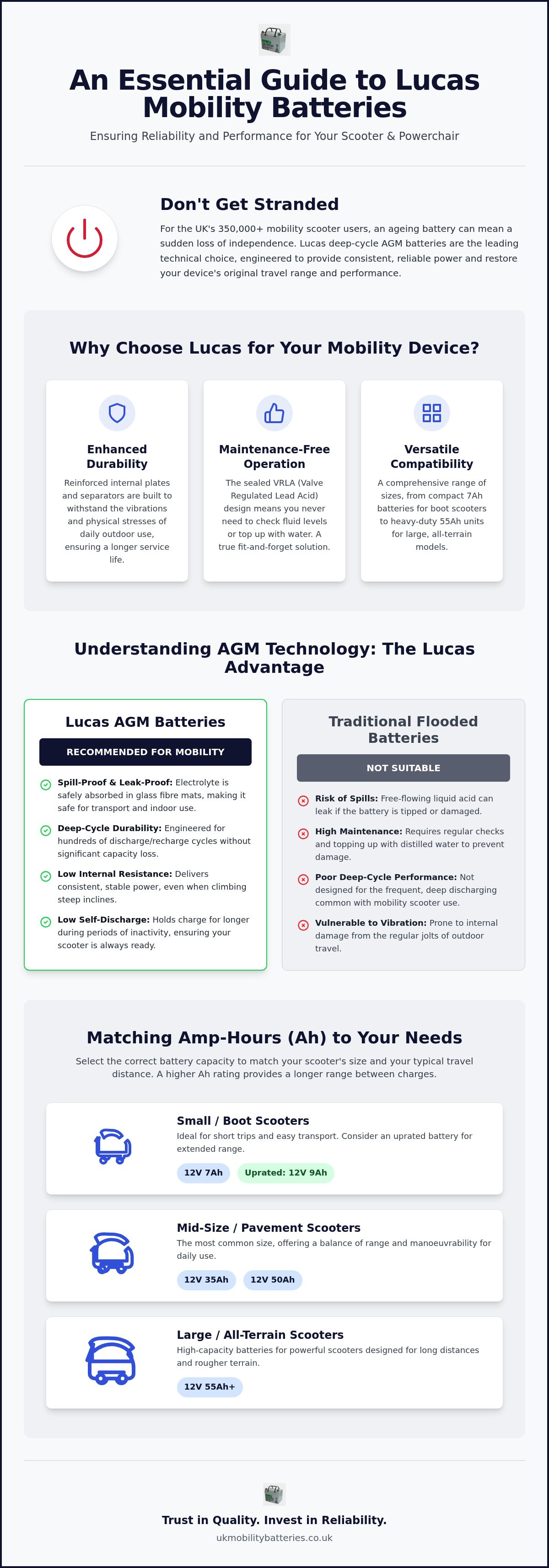
The primary technical advantage of choosing Lucas is the superior cycle life of their deep-cycle AGM range. Unlike standard starter batteries designed for a quick burst of power, these units are engineered to be discharged and recharged hundreds of times without significant degradation. This robust construction is essential for users who rely on their scooters for daily errands or long-distance travel. Specific benefits include:
- Enhanced Durability: The internal plates and separators are reinforced to withstand the vibrations and physical stresses of outdoor use.
- Maintenance-Free Operation: The sealed VRLA design means there is no need to top up electrolyte levels, making them safe for indoor storage and air travel.
- Versatile Compatibility: Lucas produces a comprehensive range of sizes, from the compact Lucas 12V 7Ah Sealed AGM Batteries used in boot scooters to the heavy-duty Lucas 12V 55Ah Sealed AGM Mobility Batteries found in large, all-terrain models.
By prioritising technical performance over lifestyle marketing, Lucas provides a fit-and-forget solution. This focus on functional excellence ensures that users achieve the maximum possible range from their specific scooter model whilst maintaining the highest safety standards required for medical devices.
Understanding Lucas AGM Technology: Performance and Safety Features
Lucas mobility batteries utilise Absorbed Glass Mat (AGM) technology, a sophisticated design where the electrolyte is suspended in fine glass fibre separators. This construction differs significantly from traditional flooded lead-acid batteries where liquid acid moves freely. In an AGM system, the plates are tightly packed with these mats, creating a robust internal structure that facilitates efficient chemical reactions. This configuration allows for a higher power density and better performance under the deep-cycle conditions typical of mobility scooter use, where the battery is frequently discharged to a low level before being recharged.
A key technical advantage of this technology is its low internal resistance. This allows Lucas batteries to deliver consistent current even when under heavy load, such as when a powerchair climbs a steep incline. Because the acid is absorbed, these batteries also exhibit a much lower self-discharge rate compared to standard alternatives. This means your device remains ready for use even after short periods of inactivity without losing significant charge.
Maintenance-Free Operation
The sealed Valve Regulated Lead Acid (VRLA) design of Lucas batteries ensures that the gases produced during the charging cycle are recombined internally into water. This oxygen recombination cycle removes the need for the periodic maintenance required by older battery types. You don't need to check fluid levels or top up cells with distilled water. This fit-and-forget characteristic is essential for users who want a reliable power source without the technical burden of manual upkeep. To understand more about these benefits, read our detailed guide on Maintenance free mobility batteries: The AGM advantage.
Safety and Transport Regulations
Safety is a critical factor for equipment used within the home. Lucas mobility batteries are classified as non-spillable and non-hazardous, making them safe for indoor charging and storage. There is no risk of acid leakage if the battery is tilted or if the scooter is transported in a vehicle boot. This spill-proof nature also means they meet the stringent safety requirements for air travel set by the UK Civil Aviation Authority (CAA), provided the airline is notified in advance.
The tightly packed internal construction also provides superior vibration resistance. This is particularly important when navigating uneven UK pavements or gravel paths, as it prevents the internal plates from shifting or cracking. If you require a replacement for a mid-sized scooter, consider the Lucas 12V 34Ah Sealed AGM Deep Cycle Battery for a balance of safety and capacity.
The Lucas Range: Matching Amp-Hours to Your Mobility Needs
Selecting the correct capacity for Lucas mobility batteries is essential for maintaining the intended travel range of your equipment. Amp-hours (Ah) represent the total energy storage capacity, similar to the size of a fuel tank. Most UK mobility devices operate on a 24-volt circuit, which requires two 12-volt batteries connected in series. It's critical to replace both units at the same time to ensure balanced performance and prevent charging issues that occur when mixing new and old cells.
Small to Medium Scooter Batteries
For lightweight boot scooters designed for transport in a car, the Lucas 12V 7Ah Sealed AGM Batteries are the standard fitment. These compact units provide sufficient power for short trips on flat surfaces. However, many users choose the Lucas 12V 9Ah Uprated Sealed AGM Battery as a direct replacement. Because the physical dimensions are identical to the 7Ah version, you can gain approximately 28% more capacity without modifying the battery box. This simple upgrade provides a noticeable increase in mileage and handles inclines more effectively.
Mid-sized travel scooters often utilise the Lucas 12V 12Ah Mobility Battery or the Lucas 12V 20Ah Mobility Battery. These units offer a balance between weight and endurance, supporting users who require a portable device with a more substantial range. For a detailed breakdown of measurements and compatibility for smaller units, see our guide on 12V 7Ah Battery for Mobility Scooter: Technical Specifications.
Heavy-Duty and Long-Range Batteries
Larger pavement scooters and electric wheelchairs require higher capacity to support heavier chassis and more powerful motors. The Lucas 12V 34Ah Sealed AGM Deep Cycle Battery is a common specification for Class 2 scooters intended for pavement use. For Class 3 road-legal models, the Lucas 12V 50Ah Mobility Battery or the Lucas 12V 55Ah Sealed AGM Mobility Batteries are typically required to meet the demands of longer journeys and higher speeds. These larger units are designed to provide sustained current over several hours of operation.
Before purchasing, you must verify the physical dimensions (length, width, and height) of your existing batteries. Even small variations can prevent the battery from fitting securely in the tray. Additionally, check the terminal type; smaller batteries usually feature spade connectors (F1 or F2), whilst larger 34Ah+ units often use bolt-through terminals for a more secure high-current connection. Using the correct terminal ensures a low-resistance path and prevents the connection from overheating during use.
Maintenance and Charging: Maximising the Life of Your Lucas Batteries
Proper care is the single most important factor in determining how many years of service you receive from Lucas mobility batteries. Whilst the AGM technology is inherently robust, these deep-cycle units require a disciplined charging routine to prevent internal sulphation. Sulphation occurs when a battery is left in a discharged state for an extended period, leading to a permanent loss of capacity that cannot be reversed by standard charging. Maintaining a full state of charge is the most effective way to protect your investment.
Charging Best Practices
The "Golden Rule" for mobility battery maintenance is to recharge the batteries fully after every journey, regardless of the distance travelled. Even if you only use your scooter for a ten-minute trip to the shops, you should still connect it to the charger overnight. For a brand-new set of Lucas batteries, an initial, uninterrupted charge of 24 hours is recommended before the first use. This ensures the cells are properly balanced and calibrated from the outset.
Modern smart chargers are designed to switch to a "float" or "trickle" mode once the battery reaches 100% capacity. This prevents the electrolyte from overheating and protects the internal mats. However, users often ask, Can you overcharge a mobility scooter battery? Understanding the specific limits of your charging equipment is vital for safety and longevity. During the winter months, extreme cold can temporarily reduce battery capacity. If you don't intend to use your scooter for several weeks, ensure the batteries are fully charged before storage and provide a top-up charge at least once a month to counteract natural self-discharge.
Troubleshooting and Health Checks
Identifying the early signs of degradation allows you to plan a replacement before the device fails completely and leaves you stranded. Common indicators that your Lucas mobility batteries are reaching the end of their service life include:
- The battery gauge dropping rapidly into the red when climbing small kerbs or inclines.
- A significant reduction in the total mileage achieved on a single full charge.
- The charger reaching the "complete" stage much faster than it did when the batteries were new.
If you notice these symptoms, consult our Mobility scooter battery troubleshooting guide to confirm if the issue lies with the cells or the charger. When replacement becomes necessary, you must always replace the batteries in pairs. Most scooters operate on a 24-volt system, and installing a single new battery alongside an old one will cause the newer unit to overwork, leading to rapid failure of both components.
To ensure you have a reliable power source for your next journey, you can buy Lucas mobility batteries in matching pairs with fast UK delivery.
Where to Buy Lucas Mobility Batteries with Fast UK Delivery
Procuring high-quality power cells from a specialist retailer is essential for ensuring the longevity of your mobility equipment. Whilst many general retailers stock various battery types, a dedicated specialist understands the specific deep-cycle requirements of mobility scooters and electric wheelchairs. Sourcing your Lucas mobility batteries from a professional UK supplier ensures you receive technical guidance tailored to your specific device, reducing the risk of compatibility errors or fitting issues.
One of the most critical factors in battery performance is the freshness of the stock. Lead-acid and AGM batteries begin a natural chemical degradation process from the moment they are manufactured. Dedicated specialists maintain a high turnover of inventory, meaning the units you receive have the latest manufacturing dates and haven't been sitting on a shelf for months. This ensures you start with the maximum possible service life and capacity.
The UK Mobility Batteries Advantage
Choosing a specialist provider like UK Mobility Batteries offers several practical benefits beyond simple procurement. We specialise in the full Lucas 12V AGM range, providing expert advice to help you decide whether the Lucas 12V 34Ah Sealed AGM Deep Cycle Battery or a higher capacity 55Ah unit is the correct choice for your chassis. Our technical support team can assist with specific queries regarding terminal types or wiring configurations, ensuring a safe and efficient installation.
Logistics are handled with specific care for heavy AGM units. Batteries are dispatched using a national delivery service with secure, reinforced packaging to prevent transit damage. Furthermore, as these items are designed for mobility assistance, eligible customers can benefit from 0% VAT relief. This statutory entitlement applies to those with chronic illnesses or disabilities, making the replacement of essential power sources more cost-effective. You'll be required to complete a simple self-declaration form during the checkout process to confirm your eligibility.
Ordering Your Replacement Batteries
To ensure a direct replacement, first identify the Amp-hour (Ah) rating and physical dimensions of your existing units. If you're looking to improve your travel range, remember that you can often swap a standard 7Ah unit for a Lucas 12V 9Ah Uprated Sealed AGM Battery if the battery box allows for the same footprint. It's always advisable to buy batteries in matching pairs to maintain the balance of your 24-volt system. We provide multi-pack bundles specifically for this purpose, ensuring both batteries are from the same production batch for optimal performance.
The ordering process is designed for efficiency. Once you have confirmed your dimensions and terminal requirements, you can place your order for fast UK-wide delivery. Most orders are processed and dispatched with purposeful speed to ensure your mobility is restored as quickly as possible. Browse the full range of Lucas mobility batteries here to find the exact match for your scooter or powerchair.
Securing Your Independence with Reliable Mobility Power
Selecting high-quality Lucas mobility batteries is a technical decision that directly impacts your daily independence and safety. By matching the correct Amp-hour rating to your chassis and adhering to a disciplined "charge after every use" routine, you ensure your equipment operates at peak efficiency. These sealed AGM units provide a maintenance-free solution that meets all UK safety standards for indoor storage and transport.
When replacement becomes necessary, choosing a dedicated specialist ensures you receive fresh inventory with the latest manufacturing dates. We provide genuine Lucas deep-cycle stock with fast national UK delivery and expert technical support to assist with fitting and compatibility questions. You can confidently restore your device's travel range and reliability by following the professional maintenance standards outlined in this guide. This methodical approach to battery care protects your investment and ensures your scooter or powerchair is ready for use when you need it most.
Shop the full Lucas mobility battery range at UK Mobility Batteries and enjoy dependable power for every journey.
Frequently Asked Questions
Are Lucas mobility batteries suitable for all scooter brands?
Lucas mobility batteries are compatible with almost all major scooter brands sold in the UK. You simply need to match the physical dimensions and the Amp-hour (Ah) rating of your existing units to ensure a proper fit. These batteries use standard terminal types, such as F1 or F2 spade connectors for smaller units and bolt-through terminals for larger 34Ah+ models found in Class 3 road-legal scooters.
How long do Lucas AGM batteries typically last before needing replacement?
A typical set of Lucas AGM batteries will last between 12 and 18 months under regular daily use. If you follow the professional charging advice of recharging after every journey and avoid deep discharges below 50% capacity, you can extend this lifespan to over 24 months. Total failure usually occurs when the internal plates become sulphated due to the cells being left in a discharged state for too long.
Can I replace my 7Ah batteries with Lucas 9Ah uprated versions?
You can replace standard 7Ah batteries with the Lucas 12V 9Ah Uprated Sealed AGM Battery if the physical dimensions are identical. Most 7Ah and 9Ah units share the same footprint, meaning the uprated version fits into the same battery box without modifications. This upgrade provides approximately 28% more capacity, allowing for longer travel distances and better performance on inclines compared to the standard version.
Do Lucas mobility batteries come fully charged and ready to use?
These units are shipped with a partial factory charge but must be fully charged before their first use. It's recommended to give your new Lucas mobility batteries an uninterrupted 24-hour charge before you take your first journey. This initial cycle ensures the cells are properly balanced and calibrated, which is essential for achieving the maximum possible service life and range from the outset.
How often should I charge my Lucas batteries if I am not using the scooter?
You should charge your batteries at least once every month if the scooter is not being used for an extended period. Natural self-discharge occurs even when the device is switched off. If the voltage drops too low during storage, permanent internal damage can occur. A full overnight charge every 30 days keeps the chemistry active and prevents the cells from becoming unrecoverable during the winter months.
What is the difference between Lucas AGM and Gel mobility batteries?
AGM batteries use glass fibre mats to absorb the electrolyte, whilst Gel batteries use a silica additive to turn the acid into a thick paste. AGM units are generally more cost-effective and provide excellent performance for typical daily use. Gel batteries are often preferred for extremely heavy, high-mileage users who discharge their batteries very deeply every day, though they require a specific charger profile and are usually more expensive.
Can I use a standard car battery charger for my Lucas mobility batteries?
You must never use a standard car battery charger for your mobility scooter batteries. Most car chargers are designed for 12V automotive systems and deliver a high-amperage burst that can damage the internal mats of an AGM battery. Mobility scooters operate on a 24V system and require a specific smart charger that manages the charging stages safely to prevent overheating, gassing, and case swelling.
Is it necessary to replace both batteries in my scooter at the same time?
It is essential to replace both batteries at the same time to ensure the 24V system remains balanced. If you mix a new battery with an old one, the older unit will have higher internal resistance and lower capacity. This causes the new battery to overwork and the old one to overcharge, leading to the premature failure of both units within a matter of months.