
Lucas 12V 20Ah Mobility Battery: Technical Specifications and Fitting Guide
Is your mobility scooter losing its "get up and go" just when you need it most? It's a common frustration for many of the 350,000 scooter users across the UK who find their travel range decreasing as their original equipment ages. You likely rely on your vehicle for essential independence, so the anxiety of a potential breakdown or a battery that won't hold a charge is a significant concern. The Lucas 12V 20Ah Mobility Battery offers a professional-grade solution to these issues, providing the deep-cycle performance needed for consistent daily use.
We understand that identifying the correct technical data can be confusing, especially when you need a fast replacement to get back on the move. This guide details the specific technical advantages, compatibility requirements, and maintenance protocols for the Lucas 12V 20Ah mobility battery to ensure your scooter remains reliable. We'll provide exact physical dimensions to ensure a perfect fit, explain why cyclic AGM technology is superior to standard standby cells, and offer a step-by-step fitting guide to help you restore your scooter’s original performance with confidence.
Key Takeaways
- Understand the technical specifications of the Lucas 12V 20Ah Mobility Battery, including its deep-cycle AGM construction designed for extended travel range.
- Verify physical compatibility using precise dimensions and terminal configurations to ensure a secure fit within your mobility scooter's battery compartment.
- Learn the critical "first charge" protocols and daily maintenance routines required to maximise the service life and reliability of your power cells.
- Discover how Lucas AGM technology provides superior vibration resistance and enhanced cycle life compared to standard lead-acid alternatives on UK pavements.
- Gain confidence in your purchase by understanding the benefits of sourcing genuine Lucas products from an authorised specialist UK retailer.
Understanding the Lucas 12V 20Ah Mobility Battery Specifications
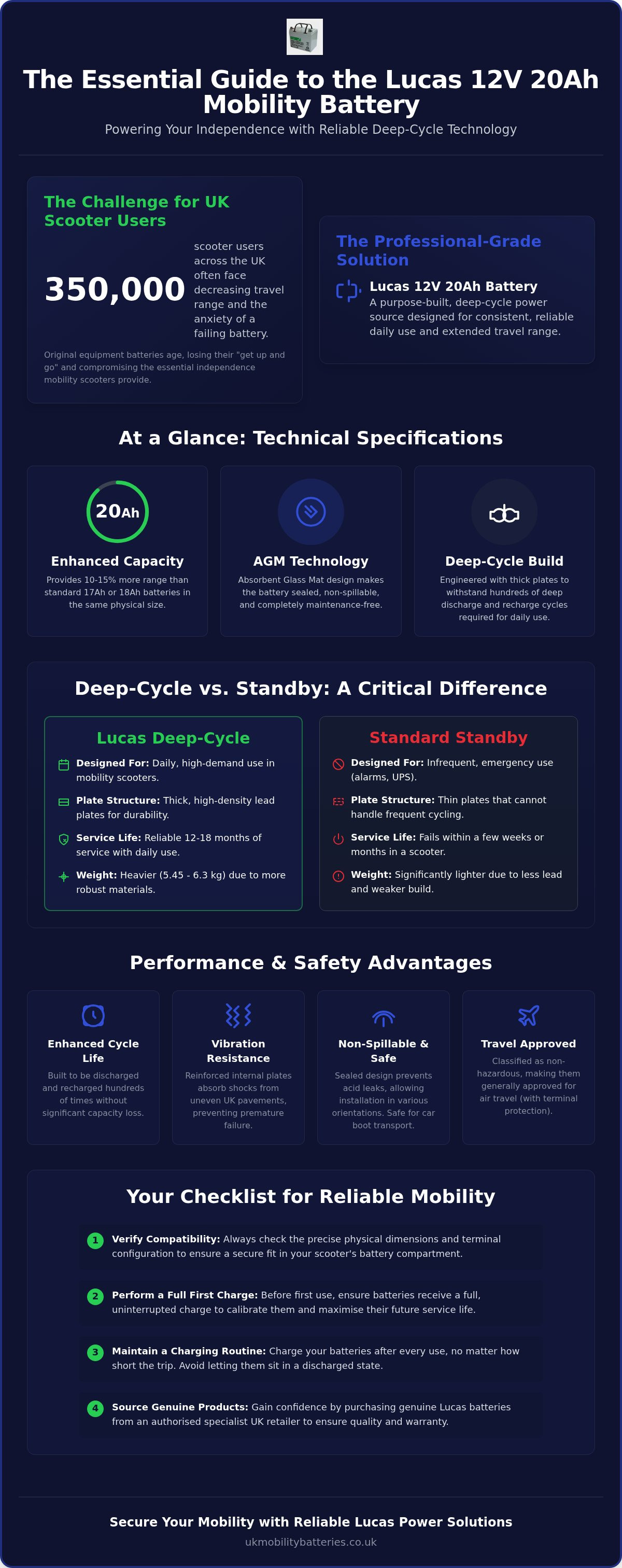
The Lucas 12V 20Ah Mobility Battery serves as a high-performance upgrade for travel scooters that typically rely on 17Ah or 18Ah alternatives. This deep-cycle unit is purpose-built to withstand deep discharges, making it fundamentally different from standby batteries found in alarm systems or UPS units. Standard standby batteries often fail within weeks if used in a scooter because they cannot handle the high current draws and frequent cycling required for daily transport. UK mobility specialists prefer the Lucas brand because it provides a reliable balance of energy density and physical durability, ensuring the vehicle remains operational across varied terrains.
Technical Data and Electrical Ratings
The 12-volt nominal rating is the standard for most UK mobility systems. These systems usually operate on a 24V circuit by connecting two batteries in series. With a 20 Ampere-hour rating, this battery provides roughly 10% to 15% more capacity than standard 18Ah units within the same physical footprint, effectively extending the travel range. The C20 rate defines the battery's capacity when discharged over a 20-hour period, serving as the industry standard for measuring usable energy in mobility applications. Low internal resistance ensures that the Lucas 12V 20Ah Mobility Battery can deliver peak power when the scooter negotiates steep ramps or uneven UK pavements. The discharge curve remains stable throughout the cycle, which prevents a significant drop in speed as the battery level depletes.
Sealed AGM Technology Explained
Absorbent Glass Mat (AGM) technology uses a fine fibreglass mat to soak up the sulphuric acid, making the electrolyte immobile. This design classifies the unit within the category of Valve-Regulated Lead-Acid (VRLA) batteries, which are completely sealed and maintenance-free. You don't need to check water levels or top up the cells, which simplifies the ownership experience for users who may have limited manual dexterity. The internal pressure is managed by a one-way valve, preventing the escape of gases under normal operating conditions.
This non-spillable construction is a critical safety feature for modern mobility. It allows the battery to be installed in various orientations and prevents acid leaks if the scooter is tilted or accidentally tipped. For users who frequently dismantle their travel scooters for car boot storage, these sealed units are essential. They are also generally approved for air travel because they are classified as non-hazardous, provided they are securely packed and the terminals are protected. This makes the Lucas 20Ah unit a versatile choice for both local errands and longer trips involving public transport or flights.
The Performance Benefits of Choosing Lucas Power
Lucas batteries are engineered specifically for high-demand cyclic applications. Unlike standard lead-acid units found in general automotive use, they offer an enhanced cycle life. This means they can be discharged and recharged hundreds of times without significant capacity loss. On UK pavements, constant vibration is a primary cause of battery failure. The internal construction of the Lucas 12V 20Ah Mobility Battery includes reinforced plate structures and tightly compressed AGM separators. These features effectively absorb mechanical shocks, preventing the internal fractures and active material shedding that lead to premature failure in lesser brands.
Deep Cycle vs Standby Batteries
It's a common mistake to fit "standby" batteries, often used in UPS systems or burglar alarms, into mobility scooters. Standby batteries have thin lead plates designed for rare emergency use. In contrast, the Lucas 12V 20Ah Mobility Battery uses thicker, high-density plates. These are engineered for repeated heavy discharge. You can often identify a genuine deep-cycle battery by its weight. A high-quality 20Ah unit typically weighs between 5.45 kg and 6.3 kg. This extra mass comes from the additional lead required for cyclic durability. Using a standby unit will likely result in failure within a few months. A proper deep-cycle battery provides between 12 and 18 months of service with daily use.
Reliability in British Weather Conditions
UK winters present a specific challenge for lead-acid chemistry. Cold temperatures increase internal resistance, which can temporarily reduce available capacity. Lucas batteries are designed with a high-purity lead alloy that maintains better conductivity in lower temperatures. To prevent performance drops, it's vital to keep terminals clean and protected against moisture. Corrosion on the terminals can lead to voltage drops, making the scooter feel sluggish during damp weather. For more detailed advice on maintaining performance throughout the year, see our guide on extending mobility scooter battery life.
Consistent power delivery is another hallmark of Lucas engineering. The voltage remains stable throughout the discharge cycle. This ensures your scooter doesn't lose significant speed or torque when the battery reaches 50% capacity. These units also feature low self-discharge rates. If you only use your scooter occasionally, the batteries will retain their charge for longer periods whilst in storage. This stability makes them a dependable choice for users who don't require their scooter every day but need it to be ready at a moment's notice.
If you need a dependable replacement, you can browse our selection of Lucas products to ensure your vehicle remains reliable.
Compatibility Check: Does the 12V 20Ah Fit Your Scooter?
The Lucas 12V 20Ah Mobility Battery is a standard fitment for many mid-sized travel scooters across the UK. It's frequently used as a direct performance upgrade for vehicles originally supplied with 17Ah or 18Ah batteries. Because the external casing dimensions are identical, you can often gain roughly 10% more capacity without needing to modify your battery box. Common models that utilise this specific battery pair include the Pride Go-Go Elite Traveller, Shoprider Whisper, and the Sunrise Medical Sterling Little Gem. If your scooter currently uses 17Ah or 18Ah cells, this 20Ah unit is the logical choice for restoring and extending your travel range.
Physical Dimensions and Battery Box Clearance
Standard dimensions for the Lucas 20Ah unit are 181mm in length, 76mm in width, and 167mm in height. Whilst these measurements are industry-standard, you should always verify the internal clearance of your specific battery box. Some compact models have very tight tolerances, particularly regarding total height once the cables are attached. If your scooter uses a plastic shroud or "clamshell" case, ensure there's enough room for the wiring loom to sit comfortably on top of the terminals without being pinched or strained. This prevents wire fatigue and potential short circuits during transit.
You must always replace mobility batteries in pairs. Even if only one battery appears to have failed, the remaining older unit will have a different internal resistance and state of health. This imbalance causes the new Lucas 12V 20Ah Mobility Battery to work harder to compensate, which leads to premature failure. Fitting a matched pair ensures the 24V system remains balanced, providing the most efficient power delivery to the motor controller.
Terminal Types and Connector Compatibility
Terminals on the Lucas 20Ah model typically come in two variations: Faston (spade) tabs or threaded inserts. Most small travel scooters in the UK use Faston 6.3mm blade connectors. These allow the wiring loom to push directly onto the terminal for a secure fit. Larger or more modern scooters might utilise M5 or M6 threaded inserts where a bolt secures the cable lug directly to the battery post.
Before ordering, inspect your existing batteries to confirm the terminal type. If your scooter uses a proprietary plug-and-play connector, you'll need to unscrew the internal cables from your old batteries and move them to the new Lucas units. For a visual guide on identifying these connections, refer to our technical resource on mobility scooter battery terminal types. Ensuring a clean, tight connection is vital to prevent heat buildup or intermittent power loss whilst driving.
Maximising the Lifespan of Your Lucas 20Ah Batteries
When you receive your new Lucas 12V 20Ah Mobility Battery pair, they require a specific initiation. Although they leave the factory with a partial charge, you must charge them for at least 12 hours before your first journey. This initial deep saturation ensures the chemical plates are fully activated, setting the foundation for a healthy service life. Proper commissioning is the first step in ensuring your scooter remains reliable for the long term.
The Ideal Charging Cycle
Charge your scooter after every trip, regardless of the distance travelled. Lead-acid batteries prefer to remain at a high state of charge. If you leave them in a discharged state, a process called sulphation begins. Lead sulphate crystals form on the plates and harden, which permanently reduces the battery's ability to hold energy. Most modern chargers are intelligent and will switch to a "float" mode once the cycle is complete. For more information on how these systems work, read our guide on can you overcharge a mobility scooter battery. Consistent daily charging is the most effective way to prevent premature capacity loss.
Environmental Factors and Storage
Temperature significantly influences the chemical reactions inside the casing. In the UK, seasonal changes can impact performance. Excessive heat during summer can accelerate internal corrosion, whilst winter cold temporarily reduces the capacity. If you don't plan to use your scooter for several weeks, store it in a cool, dry area. Ensure the batteries are fully charged before storage and top them up once a month to counteract natural self-discharge. This maintenance routine prevents the battery from falling into a "deep discharge" state from which it might not recover. If a battery is left flat in freezing temperatures, the electrolyte can freeze and crack the internal plates or the outer casing, rendering the unit useless.
Recognising the early signs of capacity loss prevents total failure during an essential trip. You might observe "voltage sag," where the battery gauge drops significantly during acceleration but recovers when stationary. This behaviour indicates that the internal plates can no longer sustain a high current draw. If your charger reaches the "complete" stage much faster than usual, it often suggests the battery has lost its ability to store a full charge. These indicators suggest it's time to replace your cells before they leave you stranded.
To restore your vehicle's reliability, order your Lucas 12V 20Ah Mobility Battery today for rapid national dispatch.
Secure Your Mobility with Reliable Lucas Power Solutions
Selecting the Lucas 12V 20Ah Mobility Battery is a technical decision that prioritises long-term vehicle availability over short-term savings. This battery represents the gold standard for UK travel scooters, balancing a compact physical footprint with the high energy density required for extended daily use. By choosing a brand with a proven cyclic performance record, you reduce the risk of being stranded and ensure your equipment operates within its designed electrical parameters. Reliability in mobility is not just about the first journey; it's about the hundreds of charge cycles that follow.
Why Order from UK Mobility Batteries?
UK Mobility Batteries operates as a specialist retailer with a singular focus on deep-cycle power solutions. Unlike general automotive factors or high-street shops, we understand the specific discharge characteristics required by mobility motor controllers. This expertise ensures you receive the correct technical advice for your specific scooter model. Our operational model prioritises several key benefits for the end user:
- Authorised Lucas Retailer: We supply genuine Lucas products, ensuring you receive the full benefit of the manufacturer's engineering and warranty support.
- Fresh Stock Rotation: Lead-acid batteries naturally self-discharge whilst on the shelf. Our high stock turnover ensures that your batteries arrive in peak chemical health with maximum capacity available.
- VAT Relief Eligibility: Most mobility scooter users in the UK qualify for VAT relief on replacement batteries. We provide a transparent process to ensure you only pay the net price if you are eligible due to a chronic condition or disability.
- Expert Technical Support: Our team can assist with terminal identification and compatibility queries, preventing the frustration of ordering the wrong fitment.
Next Steps for a Reliable Scooter
Restoring your scooter’s original range is a straightforward process. Once you have confirmed that your battery box can accommodate the 181mm x 76mm x 167mm dimensions, you can place your order through our secure online centre. We provide fast national delivery across the UK to ensure your downtime is kept to a minimum. Before your new batteries arrive, we recommend inspecting your existing charger. Ensure it is a 24V "smart" charger capable of delivering the correct multi-stage profile required for AGM chemistry. A faulty or outdated charger can damage new cells, so verifying this component is an essential part of your maintenance routine.
Consistent mobility starts with a dependable power source. To secure your independence and restore your vehicle's performance, you can view the Lucas 12V 20Ah Mobility Battery at UK Mobility Batteries and complete your purchase for rapid dispatch.
Restore Your Independence with Reliable Power
Upgrading to a professional-grade power source is the most effective way to ensure your travel scooter remains dependable for daily tasks. By choosing the Lucas 12V 20Ah Mobility Battery, you benefit from specialised AGM deep-cycle technology designed to handle repeated discharge cycles better than standard standby cells. The standard 181mm x 76mm x 167mm dimensions allow for a direct fit in most mid-sized models, providing a valuable capacity boost over standard 17Ah or 18Ah alternatives. Maintaining these units with a consistent charging routine will protect your investment and preserve your vehicle's travel distance.
As an authorised Lucas battery specialist, UK Mobility Batteries provides the expert technical support and fresh stock required to keep your vehicle in peak condition. Our UK-based team ensures you receive the correct advice on terminal types and charging protocols, backed by years of industry experience. Buy your Lucas 12V 20Ah Mobility Batteries today for fast UK delivery and regain the confidence to travel further without the worry of battery failure. It's time to get back on the move with a power solution that prioritises your independence and safety.
Frequently Asked Questions
How long does a Lucas 12V 20Ah mobility battery last on a single charge?
A single charge typically provides between 10 and 15 miles of travel range depending on the vehicle's load and the local terrain. Factors like steep inclines, uneven pavements, and the total weight of the user will reduce this distance. For the best results, ensure the tyres are correctly inflated to minimise rolling resistance and avoid unnecessary stops on hills.
Can I use a 20Ah battery to replace an 18Ah mobility battery?
Yes, you can use this unit as a direct replacement for an 18Ah battery if the physical dimensions match. The Lucas 12V 20Ah Mobility Battery shares the same footprint as most 17Ah and 18Ah models, measuring 181mm x 76mm x 167mm. This upgrade provides roughly 10% more capacity, allowing you to travel further between charges without modifying the battery box or your existing wiring loom.
How many years of service should I expect from Lucas AGM batteries?
You should expect between 12 and 18 months of reliable service if the batteries are used and charged daily. With lighter usage and strict adherence to charging protocols, some users report a lifespan of up to three years. Capacity naturally declines over time, so you may notice a gradual reduction in range as the batteries approach the end of their functional life.
Do I need a special charger for Lucas 12V 20Ah AGM batteries?
You must use a 24V automatic smart charger that is compatible with Absorbent Glass Mat (AGM) technology. These chargers use a multi-stage profile to prevent overcharging and gassing. Using an old-fashioned manual charger or one designed only for wet-cell automotive batteries will cause internal damage and significantly shorten the lifespan of your new power cells by boiling the electrolyte.
What is the weight of a single Lucas 12V 20Ah battery?
A single unit weighs approximately 5.45 kg to 6.3 kg. This weight is a result of the high-density lead plates required for deep-cycle performance. When replacing a pair, the total weight added to the battery box will be around 11 kg to 12.6 kg. Ensure the battery tray and carry handle are in good condition to support this mass safely during installation.
Is the Lucas 12V 20Ah battery safe for air travel?
Yes, these batteries are classified as non-spillable and are generally accepted for air travel under IATA regulations. Because they are Lucas 12V 20Ah Mobility Battery units, they meet the safety standards for sealed lead-acid transport. You should always notify your airline in advance and provide the technical data sheet to confirm their specific carriage requirements before arriving at the airport.
What should I do if my mobility scooter batteries are getting hot while charging?
Disconnect the charger from the mains supply immediately if the batteries feel excessively hot to the touch. Whilst slight warmth is normal during the bulk charging phase, high heat often indicates an internal short circuit or a charger malfunction. Continuing to charge a hot battery can lead to casing deformation or a safety hazard, so professional testing is recommended before further use.
Can I mix a new Lucas battery with an old one of a different brand?
No, you should never mix batteries of different ages, brands, or capacities. Batteries must be replaced as a matched pair to ensure the 24V system remains balanced. An old battery will have higher internal resistance, which forces the new unit to overwork and leads to premature failure of both components, potentially damaging the scooter's motor controller over time.