
Heavy-Duty Mobility Batteries: A Technical Guide to High-Performance Power (2026)
Why do some batteries fail on a modest incline whilst others maintain consistent torque throughout a full day of use? The difference isn't just a marketing label; it's a matter of internal lead density and plate thickness. You likely understand the frustration of range anxiety during longer trips or the disappointment when budget cells struggle on uneven pavement. Relying on your equipment means requiring a power source that doesn't degrade after only a few months of service. This technical guide explains how to select, install, and maintain heavy-duty mobility batteries to ensure maximum range and reliability for your specific device.
We'll provide the exact data needed to compare high-capacity options, such as the Lucas 12V 34Ah and 55Ah AGM units, against standard alternatives. You will learn the specific mechanical advantages of Absorbent Glass Mat technology and how to verify technical compatibility for your scooter or powerchair. By following these maintenance protocols and installation standards, you can achieve better hill-climbing performance and a significantly longer overall battery life. We will cover everything from initial charging requirements to the latest 2026 international transport regulations for high-performance power cells.
Key Takeaways
- Identify the technical differences between standard standby cells and true traction-grade units designed for high-discharge cycles.
- Learn how to select the correct heavy-duty mobility batteries for your equipment, focusing on capacities like 34Ah, 50Ah, and 55Ah for enhanced torque.
- Follow a precise two-step process to verify if larger, high-capacity batteries will physically fit within your existing battery tray or box.
- Understand why a full 8-12 hour charge cycle is essential for maintaining chemical stability and extending the service life of AGM batteries.
- Discover how lead purity and plate thickness directly influence internal resistance and your device's ability to handle steep inclines.
What Defines a Heavy-Duty Mobility Battery?
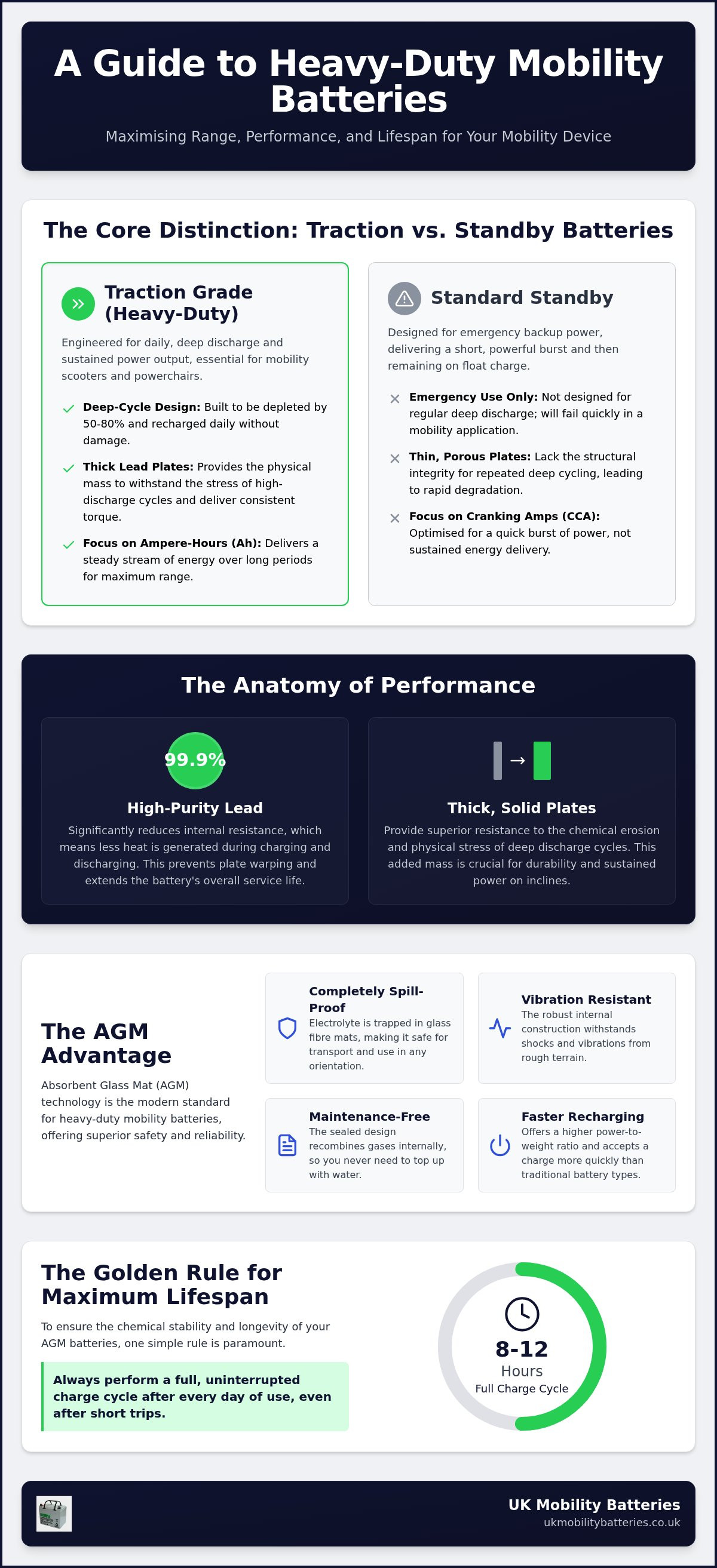
A heavy-duty mobility battery is a deep-cycle power unit engineered specifically for high-discharge cycles and superior durability. Whilst standard standby batteries are designed to remain fully charged until an emergency power cut occurs, heavy-duty mobility batteries are built to be depleted and recharged daily. This distinction is critical for Class 3 road-legal scooters. These vehicles operate at higher speeds and carry heavier chassis weights; they require traction-grade power that doesn't falter under sustained load or during long-distance travel on public highways.
Modern high-performance units utilise Absorbent Glass Mat (AGM) technology to provide maintenance-free reliability. This design traps the electrolyte in glass fibre mats between the lead plates, making the battery spill-proof and vibration-resistant. It's a vital safety requirement for equipment used in domestic settings or transported in vehicles. Because the gas is recombined internally, you don't need to top up water levels, ensuring the battery remains dependable throughout its entire service life.
The Purpose of Deep-Cycle Engineering
Deep-cycle behaviour involves discharging a battery to 50-80% capacity repeatedly without causing internal damage. Automotive starter batteries focus on Cold Cranking Amps (CCA) for a short burst of energy to turn an engine. In contrast, Deep-cycle battery technology focuses on Ampere-hours (Ah), providing a steady stream of energy over many hours. Deep-cycle batteries are units built for sustained power over long periods. Using thin-plate starter batteries in a mobility context causes rapid failure because they aren't designed for the physical stress of deep discharge.
When to Consider a Heavy-Duty Upgrade
Environmental factors often dictate the need for a high-performance upgrade. If your equipment cuts out on steep gradients or the range drops significantly when crossing rough terrain, your current setup is likely under-specified. User weight also plays a major role; a higher total load increases the current draw, which generates more internal heat. Upgrading to a Lucas 12V 50Ah or 55Ah unit provides the headroom needed for these high-stress scenarios. This is also a primary consideration for those seeking the best batteries for electric wheelchairs, where reliability during long days of active use is essential. Investing in high-quality heavy-duty mobility batteries ensures your equipment remains operational in challenging conditions.
Technical Specifications: Plate Construction and Lead Purity
The performance of heavy-duty mobility batteries is determined by the physical density of their internal components. Unlike standard batteries that use thin, porous plates for surface area, high-performance units feature thicker, solid lead plates. This added mass allows the battery to withstand the chemical erosion that occurs during deep discharge cycles. Lucas mobility batteries are engineered specifically for the UK market, ensuring they meet the high-torque demands of local terrain and the weight specifications of popular British scooter brands. Their sealed construction provides leak-proof operation, which is essential if a scooter is tilted during kerb climbing or vehicle loading.
Lead purity is equally vital for electrical efficiency. High-grade units utilise lead with a purity level of 99.9%, which significantly reduces internal resistance. Lower resistance means the battery generates less heat during the charging and discharging process. Excess heat is the primary cause of plate warping and electrolyte evaporation, both of which lead to premature capacity loss. Following expert battery care and maintenance tips regarding temperature management can further protect these high-purity components. If you require a dependable power source, you can browse our range of Lucas AGM batteries to find the exact technical match for your device.
AGM vs Gel: Choosing the Right Heavy-Duty Tech
Absorbent Glass Mat (AGM) technology uses a fine fibreglass mat to soak up the sulphuric acid, making the battery exceptionally resistant to vibration and impact. This design is generally preferred for modern UK mobility devices because it offers a higher power-to-weight ratio and faster recharge times than traditional Gel alternatives. Whilst Gel batteries excel in very high-temperature environments, AGM provides the consistent, high-current delivery needed for the stop-start nature of pavement and road use in the UK climate.
Voltage and Series Connections
The vast majority of mobility scooters and powerchairs operate on a 24V system. This voltage is achieved by connecting two 12V heavy-duty mobility batteries in series. When one battery begins to fail, it places an immense electrical strain on its partner, often causing it to overcharge or overheat. For this reason, you must always replace both batteries simultaneously to ensure balanced performance and longevity. Mixing old and new batteries leads to premature failure because the charger cannot balance the voltage across cells with different internal resistances. This imbalance typically results in the newer battery being undercharged whilst the older unit is damaged by excessive voltage.
Selecting the Correct Ampere-Hour (Ah) for Heavy Loads
Ampere-hours (Ah) measure the total energy storage capacity available to your motor over time. If a battery is rated at 50Ah, it can theoretically deliver 1 Amp for 50 hours or 5 Amps for 10 hours. For heavy-duty mobility batteries, selecting the correct Ah rating is a balance between your daily travel requirements and the physical constraints of your equipment. Common capacities for high-performance upgrades include 34Ah, 50Ah, 55Ah, and 75Ah units. Generally, larger Class 3 scooters require at least 50Ah to maintain road-legal speeds whilst navigating gradients.
To calculate your required capacity, consider your longest typical journey and add a 20% safety margin. If your scooter typically uses 15Ah for a return trip, a 34Ah pair provides ample headroom. However, if you frequently travel 10 miles or more, upgrading to 55Ah units ensures the battery isn't being discharged too deeply. This preserves the internal chemistry. The total weight of the scooter and occupant directly influences this current draw; heavier loads require more energy to overcome inertia and maintain velocity.
Range Expectations and Real-World Variables
Manufacturer range estimates are often based on ideal laboratory conditions. In the UK, real-world factors like cold winter temperatures can reduce effective capacity by up to 30%. Low tyre pressure also increases rolling resistance, forcing the motor to draw more current. This extra demand depletes the cells faster than expected on flat, warm pavement. For a detailed breakdown of these variables, consult our ultimate guide to mobility scooter batteries UK for performance benchmarks.
Weight vs Performance Trade-offs
High-capacity heavy-duty mobility batteries are physically heavier because they contain more lead. A single 55Ah battery typically weighs approximately 17kg to 18kg, compared to roughly 10kg for a 34Ah unit. This weight increase improves traction on loose surfaces but can make portable "boot" scooters significantly harder to disassemble and lift. You must ensure your scooter's battery box is rated for the additional mass of larger batteries. Balancing the desire for maximum range with the practicalities of daily handling is essential for maintaining the usability of your mobility aid.
Fitment and Upgrading: Can You Install Larger Batteries?
Upgrading to heavy-duty mobility batteries requires a methodical approach to physical fitment. You must first measure the internal dimensions of your existing battery tray or box using a standard millimetre tape measure. Don't rely on the external dimensions of the scooter chassis, as the internal housing often contains specific mounting points or foam spacers. Compare these measurements with the technical specifications of your intended upgrade. For instance, moving from a 34Ah unit to a 50Ah or 55Ah unit typically involves a significant increase in the battery's width and height. You must also verify the terminal type; most high-capacity units utilise M5 or M6 threaded inserts rather than the spade connectors found on smaller cells. Finally, check your charger's output rating. A standard 2-amp charger will struggle to replenish a 55Ah pair within a reasonable timeframe, often requiring an upgrade to a 5-amp or 8-amp charger to maintain chemical health.
If you are ready to improve your equipment's performance, you can view our full range of Lucas upgrade kits to find the correct dimensions for your scooter. Ensuring a precise fit prevents internal movement which can damage the terminals during transit.
The 34Ah to 50Ah Upgrade Path
The transition from 34Ah to 50Ah is the most frequent upgrade for mid-range scooters. This jump provides a substantial boost in range and hill-climbing torque without requiring a complete overhaul of the vehicle. Before purchasing, verify that your scooter's motor controller can handle the sustained current output of a larger battery. Most modern controllers are flexible, but older models may have thermal limits that could be exceeded during long climbs. Avoid forcing batteries into tight spaces. If the cells press tightly against the casing, vibration during travel can cause the plastic to crack or the terminals to loosen over time. A gap of at least 5mm around the battery is recommended for heat dissipation.
Terminal and Connector Safety
Identifying the correct terminal type is essential for a secure electrical circuit. Heavy-duty mobility batteries typically feature threaded inserts, whereas smaller cells often use flag or spade terminals. High-current draw generates significant heat; any loose connection will increase resistance and potentially melt the wiring loom or the battery casing. Ensure all connections are tightened to the manufacturer's torque specification and are free from corrosion or oxidation. For a detailed walkthrough on the physical installation process, refer to our technical guide on how to change mobility scooter batteries. This ensures your high-performance upgrade remains safe and efficient throughout its entire service life.
Maximising Lifespan: Care for High-Capacity Batteries
Maintaining heavy-duty mobility batteries requires a commitment to specific charging rhythms. Because these high-capacity units contain denser lead plates, the chemical transition from lead sulphate back to lead dioxide takes longer than in smaller cells. A full 8-12 hour charge cycle is essential for maintaining chemical stability. Pulling a battery off the charger as soon as the light turns green often leaves the plates partially sulphated, which reduces the total available Ampere-hours over time. You should ignore the "memory effect" myth; modern AGM batteries don't need to be fully depleted before charging. In fact, discharging them below 50% capacity frequently will cause permanent plate damage.
Storage temperature also dictates how long your batteries will last. In the UK, many users store scooters in unheated sheds or garages. When temperatures drop below 10°C, the chemical reaction slows down, and the battery's internal resistance increases. If you leave a battery in a discharged state during a frost, the electrolyte can freeze and crack the internal separators. You can identify early signs of capacity loss by monitoring how the scooter behaves under load. If the battery gauge dips significantly when you start moving or if the motor feels sluggish on familiar inclines, it indicates that the internal plates can no longer provide the required current.
Correct Charging Protocols
To preserve high-performance cells, you must use a 3-stage smart charger specifically designed for AGM technology. These chargers move from a bulk stage to an absorption stage and finally a float stage, which maintains the battery at 100% without overheating the electrolyte. You should never use a standard automotive car charger on mobility units. Car chargers are designed for starter batteries and often deliver a high-voltage jolt that can boil the gel or mat in a sealed mobility battery, leading to case bulging and total failure. To understand the risks of leaving your equipment plugged in too long, read our expert advice on can you overcharge a mobility scooter battery to avoid plate damage.
Routine Maintenance and Inspection
Physical inspections should be performed every month. Keep the terminals clean and free from the white, powdery lead sulphate that can build up over time. Applying a thin layer of petroleum jelly to the terminals after tightening will prevent oxidation and ensure a low-resistance connection. Check the battery cases for any signs of bulging or distortion. If the batteries feel excessively hot to the touch during the final stages of charging, it may indicate an internal short circuit or a failing charger. You can troubleshoot these and other common issues with our mobility scooter battery troubleshooting guide. Consistent monitoring ensures your heavy-duty mobility batteries provide reliable power for the full duration of their expected service life.
Securing Long-Term Reliability for Your Mobility Equipment
Selecting high-performance power units is a technical decision that directly impacts your daily independence. You now understand that heavy-duty mobility batteries provide superior torque and longevity through denser plate construction and high-purity lead. By verifying physical fitment and adhering to a disciplined 8-12 hour charging schedule, you can eliminate range anxiety and reduce the frequency of expensive replacements. Don't settle for under-specified cells when high-performance alternatives are available for your equipment.
As an authorised Lucas battery specialist, we provide the technical data and verified components needed for a successful upgrade. We offer next-day delivery across the UK and provide expert technical support for any fitment queries you may have. Browse our range of Lucas Heavy-Duty Mobility Batteries for fast UK delivery and regain confidence in your equipment's performance. You can look forward to more reliable journeys and consistent performance on every terrain.
Frequently Asked Questions
Can I replace my 34Ah batteries with 50Ah heavy-duty ones?
You can upgrade to 50Ah units if the physical dimensions of your battery box allow for the larger footprint. A standard 50Ah battery measures approximately 197mm in length, which is significantly larger than a 34Ah unit. You must also verify that your scooter's charging system and wiring loom can accommodate the increased capacity and weight. Ensuring a secure fit prevents internal movement that could damage terminals during transit.
How long do heavy-duty mobility batteries typically last?
Heavy-duty batteries typically provide 18 to 24 months of reliable service under normal daily conditions. This lifespan is heavily dependent on your charging behaviour and the depth of discharge during each trip. Heavy-duty mobility batteries feature thicker lead plates designed to withstand more recharge cycles than standard standby cells, provided they aren't regularly depleted below 50% capacity. Consistent charging is the most significant factor in longevity.
Do I need a new charger if I upgrade to higher capacity batteries?
You may require a higher-output charger to maintain the health of larger batteries. If you upgrade from 34Ah to 50Ah or 55Ah, a standard 2-Amp charger will take too long to reach a full state of charge, potentially leading to sulphation. An upgrade to a 5-Amp or 8-Amp smart charger is recommended to ensure the chemical reaction completes within a standard 8 to 12 hour window.
Are heavy-duty batteries leak-proof for use on public transport?
Yes, Lucas AGM batteries are completely leak-proof and classified as non-spillable for transport purposes. Because the electrolyte is absorbed into glass fibre mats, there is no liquid acid to leak, even if the battery is tilted or inverted. This makes them safe and legal for use on UK public transport, including buses, trains, and domestic flights, provided they are secured within the vehicle.
Why are Lucas batteries recommended for heavy-duty mobility use?
Lucas batteries are engineered with high-purity lead and robust internal connectors to handle the high current draw of mobility motors. Unlike budget alternatives designed for alarm systems, these traction-grade units are built for the daily stress of stop-start travel and hill climbing. They offer a maintenance-free solution that remains dependable in the varied UK climate, providing consistent torque when navigating uneven pavement or steep gradients.
What happens if I only replace one battery in my 24V system?
Replacing only one battery in a 24V system will cause the new battery to fail prematurely. The older battery has higher internal resistance, which confuses the charger and leads to an unbalanced voltage across the pair. This imbalance typically results in the new battery being overcharged whilst the old one remains undercharged. This process destroys the chemical stability of both units and negates the benefits of the new purchase.
Can I use heavy-duty batteries in a portable boot scooter?
Heavy-duty batteries can be used in boot scooters only if they match the original manufacturer's size specifications. Most portable scooters use 12Ah or 20Ah batteries to keep the weight manageable for lifting into a vehicle. Whilst 34Ah heavy-duty mobility batteries offer more range, they are significantly heavier and may not physically fit into the compact, detachable battery boxes found on these lightweight models.
How do I know if my batteries are truly deep-cycle or just standard AGM?
True deep-cycle batteries are identified by their cycle-life rating and physical weight. A genuine traction battery will be heavier than a standby unit of the same Ah rating because it contains more lead mass in its plates. Standby AGM batteries are designed for occasional power cuts and will degrade rapidly if used for the daily discharge cycles required by a mobility scooter or powerchair.