
Heavy-Duty Bariatric Scooter Batteries: 2026 UK Guide
A standard battery upgrade won't solve the performance issues of a bariatric mobility scooter if it lacks the specific discharge characteristics required for high-torque motors. You've likely experienced your scooter losing momentum on steep inclines. Perhaps the battery indicator drops faster than expected during routine trips. Selecting the correct heavy duty batteries for bariatric mobility scooters is essential for maintaining consistent power delivery and protecting your motor's longevity.
This guide explains how to identify high-capacity, deep-cycle batteries that ensure your equipment delivers maximum range. We focus on Lucas AGM technology; these cells provide the voltage stability needed to handle heavier loads without premature exhaustion. We'll examine technical specifications such as Amp Hour (Ah) compatibility and the practical implications of 2026 UK battery regulations. By matching your battery's discharge rate to your specific mobility requirements, you can travel with confidence. You'll gain a clear understanding of how to keep your scooter performing under pressure through correct component selection and maintenance-free power solutions.
Key Takeaways
- Understand how user weight impacts the Depth of Discharge and why high-torque bariatric motors require specific battery discharge characteristics.
- Learn how to select heavy duty batteries for bariatric mobility scooters by choosing the correct Amp Hour rating for your specific travel requirements.
- Identify the capacity differences between standard 50Ah units and the high-capacity 85Ah batteries used in road-legal Class 3 scooters.
- Discover why charging after every trip is the golden rule for maintaining battery longevity and preventing heat-related damage under heavy loads.
- Recognise the performance benefits of Lucas AGM technology for ensuring consistent power delivery and maintenance-free operation.
Understanding the Power Demands of Bariatric Mobility Scooters
A mobility scooter designed for bariatric use handles significantly higher electrical stress than standard portable models. While manufacturers reinforce the chassis and seating, the internal electrical system bears the weight of the increased mass. Bariatric motors are typically high-torque units. These motors pull a much higher current from the battery cells during initial acceleration and whilst maintaining speed on uneven surfaces. If the battery cannot provide a sustained discharge, the scooter's performance will degrade rapidly.
Heavy duty batteries for bariatric mobility scooters are those specifically engineered for deep-cycle recovery while sustaining high current output without significant voltage drops. Standard batteries often fail prematurely in these scenarios because they aren't built to handle the heat generated by constant high-amp draws. When a battery is pushed beyond its design limits, the internal plates can warp. This leads to a permanent loss of capacity and shortened service life.
Weight Capacity and Electrical Strain
The relationship between user weight and battery depletion is linear and unforgiving. A user weighing 30 stone (approximately 190kg) requires the motor to work significantly harder than a 15-stone user to achieve the same velocity. This increased workload directly impacts the Depth of Discharge (DoD). If a standard battery is drained to a high DoD on every trip, its total lifespan will be measured in months rather than years. High-load battery sets must have a larger total capacity to ensure the DoD remains within a healthy range.
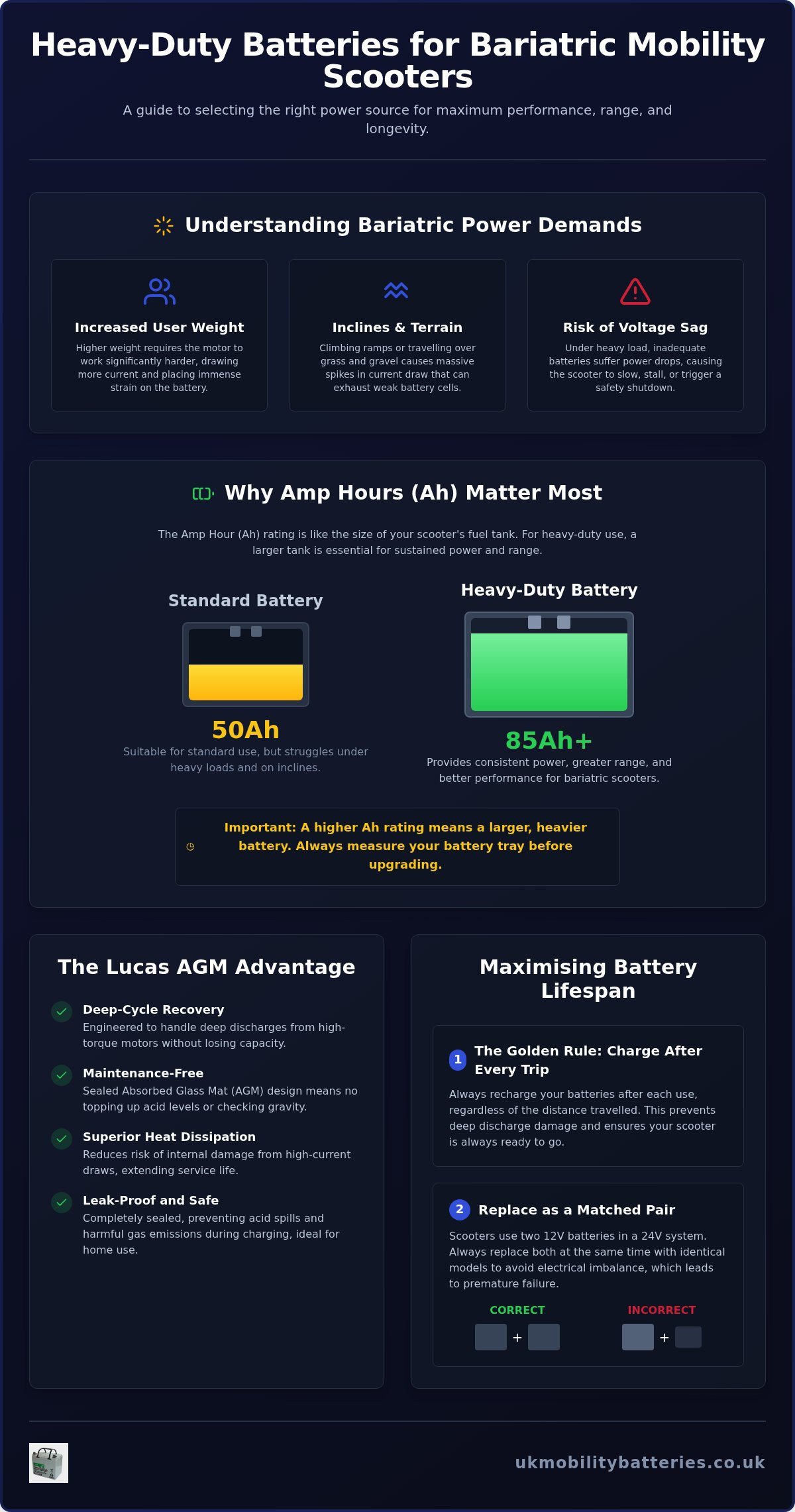
- Incline Performance: Climbing a standard pavement ramp or a 10-degree hill with a bariatric load causes a massive spike in current draw that can exhaust weak cells.
- Terrain Resistance: Travelling over grass or gravel increases rolling resistance, forcing the battery to deliver more power to maintain momentum.
- Voltage Stability: High-quality cells prevent "voltage sag," which occurs when power drops so low that the scooter's safety controller shuts the motor off entirely.
The Role of Deep-Cycle AGM Technology
Absorbed Glass Mat (AGM) technology is the industry standard for heavy-duty applications. In an AGM battery, the electrolyte is held in glass fibre separators rather than sloshing around as a liquid. This design allows for more efficient chemical reactions and better heat dissipation during high-torque usage. Lucas AGM batteries are particularly effective here because they offer the durability needed for bariatric motors whilst remaining completely maintenance-free.
Owners don't need to top up acid levels or check specific gravity. These batteries are also sealed and leak-proof. This safety feature is vital amongst household environments, as there is no risk of acid spills or harmful gas emissions during the charging cycle. Choosing a specialist AGM battery ensures the power source is as robust as the scooter it drives.
Key Technical Specifications: Why Amp Hours (Ah) Matter Most
The Amp Hour rating serves as the primary indicator of a battery's total energy capacity. It's helpful to view this metric as the size of your scooter's fuel tank. For heavy duty batteries for bariatric mobility scooters, a higher Ah rating is essential because it dictates how long the motor can draw high current before the voltage drops below the operational threshold. When a bariatric motor encounters an incline, it pulls significant amperage. A battery with a low Ah rating will suffer from "voltage sag" under this pressure, causing the scooter to slow down or stall prematurely.
There's a direct trade-off between energy capacity and physical dimensions. Increasing the Ah rating requires more lead plates and a larger internal volume to house the electrolyte. This makes the battery heavier and larger. You must measure your existing battery tray dimensions in millimetres before attempting an upgrade. A 55Ah battery is physically larger than a 34Ah unit; if the battery doesn't sit flush in the tray, the vibrations during travel can damage the internal plates or loosen the connections.
Mobility scooters operate on a 24V system, which is achieved by connecting two 12V batteries in series. These must always be replaced as a matched pair. Mixing an old battery with a new one, or using different brands and capacities, creates an electrical imbalance. The charger cannot effectively balance the cells, leading to one battery being chronically undercharged whilst the other is overcharged. This imbalance quickly destroys the chemistry of both units.
Calculating Your Range Requirements
Range isn't just about the distance you travel; it's about the energy required to move a specific mass. A user weighing 30 stone will achieve fewer miles per Ah than a 15-stone user on the same terrain. To preserve the health of your heavy duty batteries for bariatric mobility scooters, you should avoid discharging them below 50% of their capacity. Consistently draining cells to a zero state causes irreversible sulphation. For detailed measurements and a full dimension chart, consult our ultimate guide to mobility scooter batteries UK.
Terminal and Connector Compatibility
Heavy-duty batteries typically use flag terminals or M5/M6 bolt-hole inserts. Using the wrong connector type leads to poor electrical contact. Under the high loads required by bariatric motors, loose or incorrect connections can cause arcing. This generates intense heat that can melt plastic casings and presents a significant safety hazard. Adhering to UK government fire risk guidance is vital for safe home charging. For visual help with identification, refer to our guide on identifying mobility scooter battery terminal types. If you need to confirm which capacity fits your chassis, you can view our Lucas mobility battery specifications for precise data.
Comparing Heavy Duty Battery Capacities: From 50Ah to 100Ah+
Selecting the correct capacity involves balancing the scooter's physical tray size against the energy density required for the user's weight. Heavy duty batteries for bariatric mobility scooters typically start at the 50Ah mark. Choosing a capacity that exceeds your minimum daily requirement is often the most cost-effective long-term strategy. This approach reduces the electrical strain on each individual cell during high-torque manoeuvres and ensures the motor receives a consistent current even as the charge level drops.
50Ah to 55Ah: The Versatile Heavy Duty Choice
Mid-sized bariatric scooters with reinforced frames usually require a capacity between 50Ah and 55Ah. These units provide a balance between weight and energy storage. They're suitable for pavement use where terrain is mostly flat. A user weighing 25 stone can typically expect a reliable range of 15 to 20 miles on a full charge, provided the terrain remains consistent. The Lucas 12V 50Ah Mobility Battery and the Lucas 12V 55Ah Sealed AGM Mobility Batteries serve as reliable benchmarks in this category. These models offer the necessary deep-cycle recovery for daily use without the excessive weight of larger cells.
75Ah and Beyond: For Road-Legal Bariatric Power
Class 3 scooters capable of 8mph speeds demand a higher sustained output. These road-legal vehicles often carry users over longer distances and through more varied terrain. For these applications, 75Ah to 85Ah batteries are the standard. Over-speccing the capacity in this context is a strategic choice rather than a luxury. Larger capacities allow for more charging cycles by reducing stress on the lead plates. By using a higher capacity battery for a trip that only requires a portion of its energy, the Depth of Discharge remains low. This prevents chemical degradation and extends the overall service life of the battery set.
Extreme range requirements or users with very high weight specifications may necessitate 100Ah or 150Ah batteries. These are physically massive units. Before purchasing, verify the internal dimensions of your battery tray. An upgrade is only possible if the chassis can accommodate the increased footprint and height of the larger casings. If the batteries are too large for the enclosure, the seat or bodywork may not lock into place correctly. This creates a mechanical hazard. When sourcing heavy duty batteries for bariatric mobility scooters at these higher capacities, always prioritise a secure fit over a marginal increase in Amp Hours.
Maximising the Lifespan of High-Load Mobility Batteries
Maintaining heavy duty batteries for bariatric mobility scooters requires a stricter maintenance routine than standard mobility equipment. High-torque motors draw significant current, which increases the internal temperature of the battery cells during operation. This thermal stress can accelerate the degradation of lead plates if the battery is left in a discharged state. The most effective way to preserve capacity is to follow the golden rule of mobility care: charge the battery set after every single trip. Even short journeys consume energy that must be replenished immediately to prevent sulphation, a process where lead sulphate crystals harden on the plates and permanently reduce the battery's ability to hold a charge.
Environmental conditions in the UK also influence battery health. Colder British climates slow down the chemical reactions within AGM cells, effectively reducing the available capacity during winter months. If a scooter is stored in an unheated garage or shed, the batteries will lose their charge more rapidly through self-discharge. You must ensure the batteries are 100% charged before any period of inactivity. If the scooter remains unused for several weeks, perform a refresh charge once a month. This prevents the voltage from dropping to a level where the cells become chemically inactive or "frozen."
Charging Protocols for Heavy Users
High-capacity Lucas batteries require a compatible smart charger to manage the final stages of the charging cycle. These chargers use a multi-stage profile that ensures the cells reach full saturation without overheating. You should avoid short "top-up" charges of only one or two hours. A battery requires a continuous 8 to 12-hour cycle to complete the desulphation process and balance the voltage across both 12V units. Stopping the charge early prevents the battery from reaching its peak energy density. To understand the risks of improper charging, read our guide on how to avoid overcharging your mobility scooter battery.
Troubleshooting Performance Drops
Heavy duty batteries for bariatric mobility scooters often show signs of fatigue under load before they fail entirely. If your scooter feels sluggish on familiar inclines or the battery indicator fluctuates wildly when you pull the throttle, the internal resistance of the cells has likely increased. You can assess health with a simple voltage check using a multimeter. A healthy, fully charged 24V system should read approximately 25.4V to 25.8V after resting. If the voltage drops sharply below 23V the moment the motor engages, the batteries can no longer sustain the high current required for bariatric use. For more details on identifying failure signs, see our mobility scooter battery troubleshooting guide. If your current set is struggling to maintain torque, you can order replacement Lucas AGM batteries to restore your scooter's reliability and travel range.
Selecting the Right Lucas Batteries for Your Heavy Duty Scooter
Lucas is an established name amongst UK mobility specialists due to its long history of manufacturing reliable lead-acid cells. For users of bariatric equipment, the brand represents a dependable choice for high-torque motors that demand consistent current delivery. Sourcing heavy duty batteries for bariatric mobility scooters from a dedicated UK-based retailer ensures you receive technical support tailored to the specific electrical requirements of your chassis. Unlike generic battery suppliers, a specialist understands the nuances of capacity upgrades and terminal compatibility for heavy-duty frames.
The Lucas 12V 50Ah Mobility Battery and the Lucas 12V 55Ah Sealed AGM Mobility Batteries are the primary solutions for bariatric pavement scooters. These models are engineered to provide the sustained energy required to move larger masses without experiencing the rapid voltage drop common in lesser brands. By choosing a specialised brand, you ensure the internal construction of the battery can withstand the rigorous demands of daily travel on British pavements.
Why Choose Lucas AGM Batteries?
Bariatric scooters generate significant vibration due to their reinforced frames and the weight they carry. Lucas AGM batteries feature high vibration resistance, which protects the internal lead plates from mechanical damage whilst travelling over uneven surfaces. This durability is coupled with excellent recovery characteristics from deep discharge cycles. Even after a long trip that taxes the energy reserves, these cells are designed to return to full capacity through a standard charging cycle. The maintenance-free design is a practical advantage for users with limited mobility. There's no requirement to check electrolyte levels or top up fluid, as the sealed casing prevents any acid leakage or gas emission.
Ordering and Delivery Across the UK
Precision is vital when ordering high-capacity replacements. You must verify whether your scooter uses bolt-hole or flag terminals to ensure a secure electrical connection. UK Mobility Batteries provides national delivery to ensure your equipment is back in service with minimal delay. We provide expert technical support to help you identify the correct dimensions for your battery tray before purchase. It's a technical requirement to replace both 12V units simultaneously. This ensures the 24V system remains balanced and prevents the premature failure of a single new battery. Browse our full range of Lucas heavy duty mobility batteries to find the exact specification for your bariatric scooter.
Securing Your Future Mobility with Reliable Power
Maintaining the performance of a bariatric scooter depends on matching the electrical capacity to the mechanical load. You've learned that selecting heavy duty batteries for bariatric mobility scooters requires careful attention to Amp Hour ratings and physical tray dimensions. By prioritising Lucas AGM technology, you ensure that your high-torque motor receives the steady current it needs for inclines and varied terrain. Consistent charging after every journey remains the most effective way to protect your investment and prevent premature cell failure.
Our team provides expert UK technical support to help you identify the correct 12V pairs for your specific chassis. We offer premium Lucas deep-cycle AGM technology designed for maintenance-free use and durability. With fast national delivery, you can restore your equipment's range and torque without unnecessary delays. Shop our range of Lucas Heavy Duty Mobility Batteries today to secure your independence for the years ahead. Reliable power ensures you can travel with confidence across any landscape.
Frequently Asked Questions
What is the best battery capacity for a 30-stone mobility scooter user?
A 30-stone user requires a battery capacity of at least 75Ah to 100Ah for road-legal Class 3 scooters to ensure reliable range and motor performance. For pavement-based bariatric models, 50Ah or 55Ah units are the standard minimum requirement. These higher capacities provide the necessary current for high-torque motors without causing excessive voltage sag. Always verify the battery tray dimensions before upgrading to ensure the larger casings fit your specific chassis securely.
Can I upgrade my 50Ah batteries to 75Ah for more range?
You can upgrade from 50Ah to 75Ah provided the physical dimensions of the battery tray can accommodate the larger units. Increasing the Amp Hour rating acts like installing a larger fuel tank, extending your travel distance between charges. However, 75Ah batteries are significantly larger and heavier than 50Ah models. It is essential to measure the internal length, width, and height of your battery compartment before purchasing to ensure the seat and bodywork still fit correctly.
How long should heavy-duty batteries last in a bariatric scooter?
Heavy duty batteries for bariatric mobility scooters typically last between 12 and 24 months, depending on usage frequency and charging habits. Because bariatric motors place higher electrical strain on the cells, the chemical components degrade faster than in standard applications. You can maximise this lifespan by avoiding deep discharges below 50% and charging the set after every journey. Consistent maintenance and using a high-quality smart charger are vital for reaching the upper end of this estimate.
Do bariatric scooters need a special type of battery charger?
Bariatric scooters require a smart charger that is specifically matched to the Amp Hour rating and AGM chemistry of the batteries. A charger designed for smaller 12Ah batteries won't have the output necessary to effectively charge 55Ah or 75Ah units. Using an undersized charger leads to chronic undercharging and sulphation. Always use a multi-stage charger that can provide a full saturation charge to maintain the health of high-capacity lead plates and ensure peak energy density.
Why does my scooter slow down on hills even with new batteries?
Slowing down on inclines is often caused by voltage sag, where the motor draws more current than the batteries can instantly provide. Even with new cells, if the Amp Hour rating is too low for the user's weight or the hill's gradient, the voltage will drop temporarily. This triggers the scooter's controller to limit power to protect the internal electronics. Ensure your heavy duty batteries for bariatric mobility scooters are fully charged and correctly specced for high-torque demands.
Is it safe to use AGM batteries in an electric wheelchair for a bariatric user?
AGM technology is entirely safe and highly recommended for bariatric electric wheelchairs. These sealed, non-spillable batteries are designed for deep-cycle use and can handle the frequent, high-current draws required by powerchair motors. Because they are maintenance-free and don't emit gases during charging, they are ideal for indoor use. Ensure the selected Lucas batteries match the original manufacturer’s specifications for voltage and capacity to maintain the wheelchair's safety certifications and overall performance levels.
How do I know if my heavy-duty batteries need replacing?
The most common sign of failure is a significant reduction in travel range or the scooter feeling sluggish on minor inclines. You might notice the battery indicator needle dropping into the red zone during acceleration, even after a full charge. If the batteries no longer hold a charge for more than a few miles, the internal resistance has likely increased. A voltage test showing less than 24V after a full charging cycle indicates that the cells are exhausted.
Can I mix different brands or capacities of mobility batteries?
You must never mix different brands, ages, or capacities of batteries in a 24V mobility system. Replacing only one battery or using mismatched units causes an electrical imbalance where one cell is chronically overcharged whilst the other remains undercharged. This imbalance leads to rapid chemical failure in both batteries, often within weeks. Always install a matched pair of identical Lucas AGM batteries to ensure the charging system can balance the voltage correctly across the entire set.