
Flying with Sealed Lead Acid Batteries: UK Technical Guide
Could a single missing technical label on your mobility battery be the reason you're refused boarding at the departure gate? Many UK travellers find the conflicting terminology between IATA safety manuals and airline-specific policies difficult to navigate. It's a common concern that technical confusion or a lack of specific documentation might lead to delays or, worse, damage to your equipment during transit.
By following this technical guide, you'll master the necessary protocols for flying with sealed lead acid batteries and ensure your equipment meets all safety standards for air travel. We've simplified the complex regulatory landscape to provide the technical clarity needed for a seamless journey. This article provides a definitive "yes/no" on battery types, a comprehensive list of required transit documents, and the exact preparation steps needed to protect your Lucas AGM battery whilst it's in the aircraft hold. You'll gain the confidence to verify your mobility aid is flight-ready before you even reach the airport.
Key Takeaways
- Understand why SLA and AGM batteries are classified as "non-spillable" power sources, making them the most straightforward option for air travel compliance.
- Stay compliant with 2026 IATA and CAA regulations by learning the specific technical criteria required for mobility aid transport from UK airports.
- Master the essential preparation protocols for flying with sealed lead acid batteries, including how to properly insulate terminals to prevent accidental short-circuits.
- Learn the "48-hour rule" for notifying airlines and exactly which technical specifications, such as battery weight and type, you must provide in advance.
- Recognise why Lucas AGM batteries are the preferred choice for frequent flyers due to their durable, leak-proof, and maintenance-free design.
Are Sealed Lead Acid Batteries Allowed on Aeroplanes?
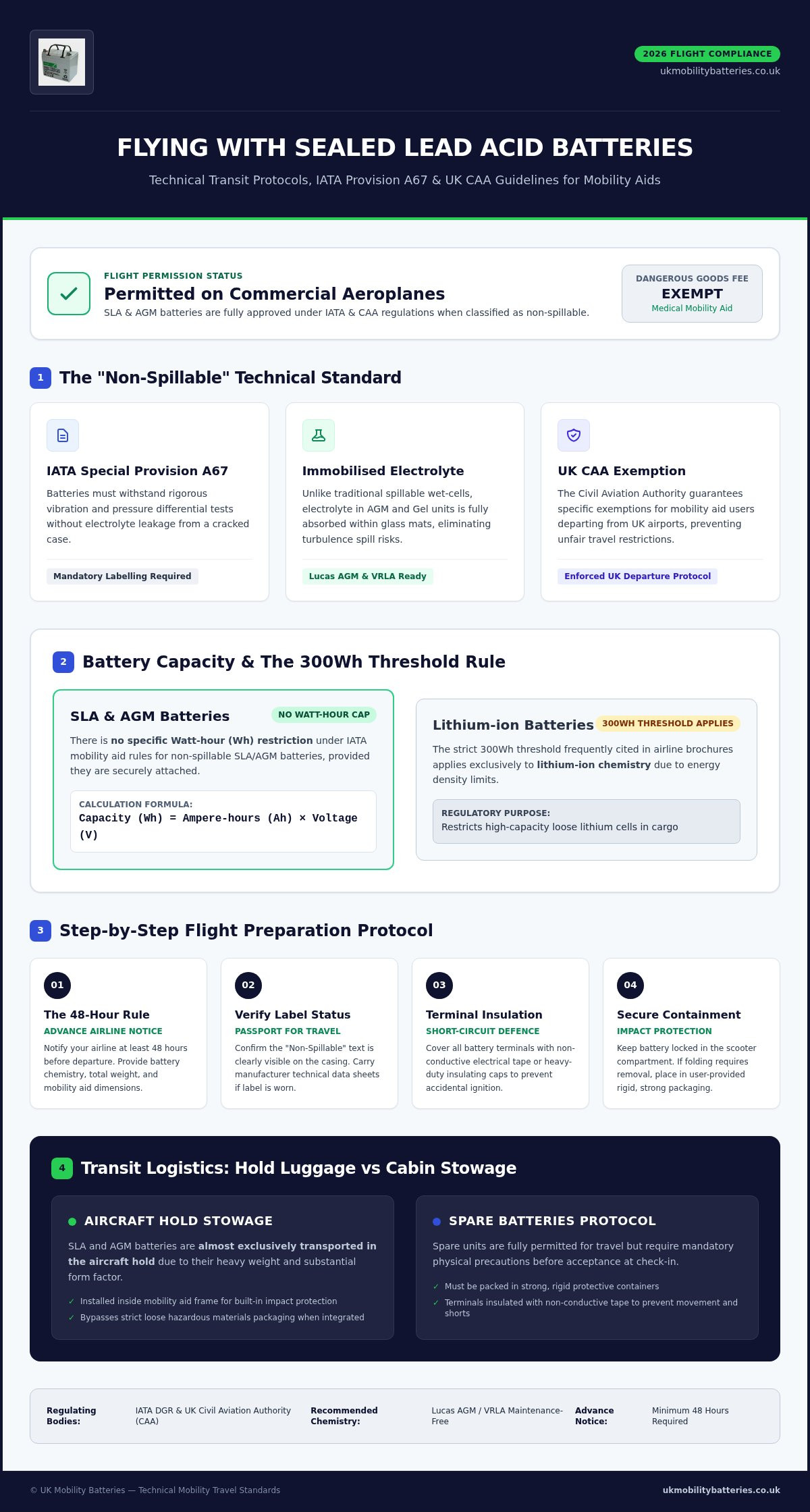
Yes, you can take these batteries on a flight, but specific safety criteria must be met. The International Air Transport Association (IATA) and the UK Civil Aviation Authority (CAA) classify Sealed Lead Acid (SLA) and AGM batteries as "non-spillable" power sources. This classification is vital. Unlike traditional "wet" or "spillable" lead-acid batteries, which contain free-flowing liquid acid that can leak if the unit is tilted, non-spillable units are designed to contain the electrolyte within a glass mat or gel. Because they don't pose a leakage risk during turbulence or handling, they are significantly less restricted than their spillable counterparts.
The primary condition for flying with sealed lead acid batteries is that the unit must be securely attached to the mobility aid. Airlines require the battery to be protected from damage and short circuits, which is most easily achieved by keeping it housed within the scooter's original battery compartment. If the battery is integrated into the device, it generally bypasses the more stringent packaging requirements reserved for loose hazardous materials.
The "Non-Spillable" Classification
Your battery's label acts as its passport for air travel. Ground staff look for specific terminology to confirm the unit is safe for the aircraft hold whilst you are checking in. Most modern mobility scooter batteries UK users own are actually valve-regulated lead-acid (VRLA) batteries, which include both AGM and Gel types. According to IATA Special Provision A67, a battery is officially non-spillable if it can withstand specific vibration and pressure differential tests without any electrolyte leakage from a cracked case. If your battery lacks this specific "non-spillable" marking, you may need to provide a technical data sheet from the manufacturer to prove compliance during the boarding process.
Hold Luggage vs Cabin Carry-on
Unlike small lithium-ion power banks, SLA batteries are almost always transported in the aircraft hold. Their weight and size make them unsuitable for cabin storage. When flying with sealed lead acid batteries, the safest method is to keep the battery installed within the mobility aid's frame. This provides physical protection against impact. If the battery must be removed to fold the scooter, it must be placed in strong, rigid packaging provided by the user. Spare batteries are permitted, but they must be protected from short circuits by insulating the terminals with non-conductive tape and packed securely to prevent movement. Always check if your airline requires spares to be checked in or if they have specific weight limits for individual units.
Understanding IATA and CAA Regulations for 2026
The International Air Transport Association (IATA) updates its Dangerous Goods Regulations (DGR) annually to reflect the latest safety data. For 2026, the protocols for mobility aids remain focused on battery chemistry and containment. In the United Kingdom, the Civil Aviation Authority (CAA) enforces these standards for all departing flights. While UK government airport luggage restrictions generally prohibit spillable wet-cell batteries for standard passengers, mobility aid users are granted specific exemptions. The CAA ensures that safety protocols don't unfairly restrict passengers with disabilities, provided the equipment is compliant.
A common point of confusion is the distinction between "leak-proof" and "non-spillable" terminology. In regulatory terms, "non-spillable" is the specific IATA classification for batteries where the electrolyte is fully immobilized, such as in AGM or Gel units. This status is vital for flying with sealed lead acid batteries. Because these batteries are classified as essential medical equipment and meet high safety standards, they are usually exempt from the complex "Dangerous Goods" handling fees that commercial shippers must pay. You won't typically face extra surcharges for your battery, but you must prove its non-spillable status during check-in.
The 300Wh Threshold and SLA Batteries
Many travellers worry about the 300 Watt-hour (Wh) limit often mentioned in airline brochures. This threshold is designed specifically for lithium-ion batteries due to their higher energy density. For SLA and AGM units, there's no specific Watt-hour cap under IATA mobility aid rules, provided the battery is non-spillable and securely attached. To calculate your capacity for peace of mind, multiply the Ampere-hours (Ah) by the Voltage (V). For example, high-capacity 12V 55Ah wheelchair batteries reach 660Wh. Despite being well over the 300Wh lithium limit, these AGM units remain flight-safe and are permitted in the hold because their chemistry is inherently stable during atmospheric pressure changes.
Safety Data Sheets (SDS)
A Safety Data Sheet (SDS) is a technical document provided by the manufacturer that details the chemical composition and transport safety of the battery. Carrying a printed copy of the SDS for your Lucas batteries can prevent significant delays. Section 14 of this document is the most relevant, as it explicitly states that the battery is "exempt from Dangerous Goods Regulations" according to Special Provision A67. While a clear "Non-Spillable" stamp on the battery casing is often sufficient for ground crew, having the technical paperwork provides an extra layer of authority if a gate agent questions your equipment. You can check your current battery's technical specifications to ensure you have the correct documentation before you reach the airport.
Step-by-Step: Preparing Your Mobility Battery for Flight
Ensuring your mobility aid is ready for the aircraft hold requires more than just confirming its non-spillable status. The most critical safety requirement for flying with sealed lead acid batteries is the prevention of accidental short-circuits. If the battery terminals come into contact with metal objects or other battery connectors during transit, they can generate intense heat or sparks. This poses a significant fire risk in the cargo hold, which is why ground staff are trained to inspect terminal insulation rigorously. You must ensure that every electrical connection is either recessed or physically shielded from contact before the scooter is handed over to the ground crew.
The battery must be housed in a rigid case or securely bolted to the chassis to prevent any movement. If your mobility aid is designed so the battery can be easily removed, you may be asked to disconnect it. However, if the battery is housed in a protective compartment that is part of the scooter's frame, it's often safer to leave it connected but electrically isolated. Always check your specific scooter manual to see if there is a "flight mode" switch or a specific plug that should be removed to disable the motor whilst in transit.
Terminal Protection Techniques
To achieve proper safety standards, you should use heavy-duty electrical tape or manufacturer-approved plastic terminal caps to cover all exposed metal connectors. It's not enough to simply unplug the device; the terminals themselves must be individually wrapped to remain protected throughout the journey. A battery is considered effectively insulated when the terminals are covered by non-conductive material that cannot be easily displaced by vibration or impact. According to the FAA PackSafe guidelines for mobility devices, which align with UK safety standards, batteries must be protected against short circuits and securely attached to the mobility aid. Unauthorised movement of a battery within its compartment can lead to cable strain or terminal exposure, so ensuring the unit cannot shift is a mandatory safety step.
Final Physical Checks
Perform a thorough visual inspection of the battery casing before you depart for the airport. Look for any signs of swelling, hairline cracks, or white powdery residue around the terminals, as these indicate internal failure or chemical leakage. If you are using a compact 12V 7Ah battery for mobility scooter models, verify that it is seated firmly within its housing and that any mounting brackets are tight. If you notice any performance issues, such as the scooter losing power unexpectedly, consult a guide on mobility scooter battery troubleshooting to resolve the issue. Airlines will refuse any battery that shows visible signs of physical damage, even if it is a high-quality sealed AGM unit.
Communicating with Your Airline: Essential Tips
Coordination with your carrier is as vital as the physical preparation of your equipment. Most UK airlines require at least 48 hours' notice if you intend to travel with a mobility aid. This notification period allows the airline to verify the aircraft's hold capacity and ensure the ground crew is briefed on handling your specific battery type. When flying with sealed lead acid batteries, you must explicitly state that the unit is "non-spillable" to avoid being categorised under more restrictive hazardous goods protocols. Failure to provide this advance notice can result in the airline refusing to carry the device at the gate.
The Pre-Flight Call Checklist
When you contact the airline's special assistance team, have your equipment's technical data ready for the agent. You should provide the make and model of your mobility device along with the specific battery chemistry, confirming it uses Sealed Lead Acid AGM technology. It's also necessary to provide the total weight of the device and the individual battery units. Ask the agent where the device will be loaded; whilst most airlines prefer you to ride the scooter to the aircraft door, some may require it to be checked in at the oversized baggage desk. Request that a "Special Equipment" tag is prepared for your arrival to streamline the check-in process.
At the Airport: Terminal Procedures
Arrive at the airport at least three hours before your departure to allow for manual battery inspections. Security staff may be more familiar with lithium-ion restrictions and might require clarification on SLA rules. If questioned, point to the "Non-Spillable" label on your battery casing to confirm compliance. You must also be prepared to demonstrate how the drive system is disengaged, typically via a freewheel lever, so the crew can move the device manually without damaging the transmission. Always pack your battery charger in your cabin bag to protect it from the physical impacts and temperature fluctuations in the hold. If you need to refresh your setup before travelling, you can browse our range of flight-ready mobility batteries to ensure your equipment is in peak condition.
Choosing Travel-Ready Batteries from UK Mobility Batteries
Selecting the right power source is the final step in ensuring your equipment is fully compliant with aviation standards. Lucas AGM batteries are the preferred choice for frequent flyers because they are specifically engineered to meet the "non-spillable" criteria discussed throughout this guide. These units use Absorbent Glass Mat technology to immobilise the electrolyte, making them inherently leak-proof even if the casing is compromised. This design is vital for flying with sealed lead acid batteries, as it provides the safety assurance required by ground crew and loadmasters who are responsible for aircraft hold safety.
Technical labelling is another area where Lucas batteries excel. Each unit features clear, factory-stamped markings that identify the battery as a sealed, non-spillable VRLA unit. This visibility is essential for passing through security and customs without the need for lengthy manual inspections. UK Mobility Batteries supports your travel by providing access to the necessary technical data sheets, ensuring you have the documentation required to satisfy airline protocols. By choosing a high-quality, travel-ready battery, you reduce the risk of technical delays at the airport.
The Lucas Advantage for Travellers
The aircraft hold is a demanding environment characterised by constant vibration and temperature fluctuations. Lucas batteries feature a robust, high-impact casing designed to withstand these physical stresses during transit. Beyond safety, these units utilise high-performance deep cycle technology, which provides the sustained power needed for long days of sightseeing in unfamiliar locations. Many users find that refreshing their batteries before a holiday is a sensible precaution. It's significantly more efficient to install a new set of reliable batteries at home than it is to manage battery failure signs whilst you're abroad. New batteries provide the capacity and reliability needed for a stress-free trip.
Fast UK Delivery Before Your Departure
We understand that travel preparations often happen on a tight schedule. We offer reliable national shipping across the UK to ensure your replacement batteries arrive with plenty of time for installation and testing before your flight. Our technical support team is available to help you confirm compatibility with your mobility aid, ensuring your new power cells fit perfectly into your scooter's battery compartment. Getting the right fit is essential for maintaining the "securely attached" status required by the CAA. To ensure your mobility aid is ready for the runway, you can browse our range of flight-safe Lucas AGM batteries and select the specific model required for your device.
Preparing for a Seamless International Journey
Success at the airport depends on technical preparation and clear communication. By mastering the "non-spillable" classification and adhering to strict terminal insulation protocols, you eliminate the primary reasons for boarding refusals. Coordinating with your airline at least 48 hours in advance ensures that ground staff understand your equipment's specific requirements before you arrive at the terminal. Understanding these safety standards makes flying with sealed lead acid batteries a predictable part of your travel routine rather than a source of stress.
As an official Lucas battery stockist, UK Mobility Batteries provides specialised technical support for mobility users to ensure every unit meets current IATA and CAA standards. We offer rapid UK-wide delivery to ensure your new power cells arrive well before your departure date. Upgrade to flight-safe Lucas AGM batteries today to ensure your mobility aid is fully compliant and ready for the aircraft hold. With the right equipment and documentation in place, you can focus on enjoying your trip with total confidence in your scooter's performance.
Frequently Asked Questions
Do I need a Safety Data Sheet to fly with an SLA battery?
Carrying a Safety Data Sheet (SDS) isn't legally mandatory for passengers, but it's the most effective way to prevent boarding delays. This document provides technical proof that your battery meets IATA Special Provision A67 safety standards. Ground staff use this data to confirm the unit is exempt from certain hazardous goods restrictions. You can usually obtain these documents from the manufacturer or a specialist retailer like UK Mobility Batteries before you travel.
Can I take my mobility scooter battery in the cabin?
Sealed lead acid batteries must be transported in the aircraft hold rather than the cabin. Due to their weight and physical dimensions, they are almost always kept installed within the mobility aid frame. If the battery is removed, it must be packed in a strong, rigid container and declared at the check-in desk. Unlike small lithium-ion power banks, SLA units are too heavy for overhead lockers and pose a physical risk if they aren't secured.
What happens if my battery is over 300Wh?
The 300Wh limit applies specifically to lithium-ion batteries and doesn't affect those flying with sealed lead acid batteries. As long as your battery is classified as non-spillable and is part of a mobility aid, there's no specific Watt-hour cap under current IATA regulations. High-capacity units, such as 12V 55Ah batteries, are permitted in the hold because their chemistry is stable and they don't share the thermal runaway risks associated with lithium power sources.
Is there a limit to how many spare SLA batteries I can take?
Most airlines allow you to carry up to two spare non-spillable batteries for your mobility aid. These must be protected from short circuits by insulating the terminals and packed in strong, rigid packaging that prevents movement. It's essential to confirm the specific limit with your carrier at least 48 hours before your departure. Each airline has the final discretion on how many spare units they can safely accommodate based on the aircraft's cargo capacity.
What should I do if the airline refuses my sealed battery?
If an airline refuses your battery, immediately request to speak with a supervisor or the dangerous goods coordinator. Present your Safety Data Sheet and point to the "Non-Spillable" label on the casing. Reference IATA Special Provision A67, which states that compliant AGM batteries are exempt from standard hazardous goods packaging. If the refusal persists, ask for a written explanation citing the specific safety regulation they believe your battery has failed to meet for your records.
How do I prove my battery is non-spillable to airport security?
You can prove your battery's status by showing the embossed or printed "Non-Spillable" label on the unit's casing. Most security staff are trained to look for this specific term. If the label is obscured, provide the manufacturer's technical data sheet or the mobility aid's user manual. These documents confirm that the electrolyte is immobilised, which is the primary requirement for flying with sealed lead acid batteries from any UK airport.
Should I disconnect my battery before handing the scooter to ground staff?
You should disconnect the battery if your mobility aid doesn't have a dedicated "flight mode" or master isolation switch. This prevents the scooter from being accidentally activated during the flight. If the battery is housed in a secure compartment, simply removing the key or using a battery isolator is often enough. Always ensure the terminals are protected with non-conductive tape even if the battery remains connected to the scooter's wiring loom whilst in transit.
Are AGM batteries treated differently to standard lead acid batteries?
AGM batteries are treated much more leniently than standard "wet" lead acid batteries because they are non-spillable. Standard lead acid batteries contain free liquid acid and are classified as fully regulated dangerous goods, which are often prohibited or require complex packaging. AGM technology uses a glass mat to absorb the acid, making it safe for aircraft holds. This distinction is why specialist Lucas AGM units are the preferred choice for travellers using mobility aids.