
Connecting Two 12V Batteries for 24V: Technical Guide
Wiring your mobility scooter incorrectly doesn't just result in a non-starting motor; it can lead to immediate controller failure or permanent damage to your new Lucas AGM cells. Understanding how to connect two 12v batteries to make 24v is essential because most UK mobility devices require this specific voltage to operate correctly. The fear of causing sparks or damaging expensive electronic components often leads to confusion, especially when users are forced to distinguish between series and parallel configurations under the weight of heavy lead-acid units.
We understand that the prospect of handling heavy batteries whilst managing wiring can be daunting. This technical guide provides the exact, step-by-step procedure to ensure your system is wired correctly from the start. You will learn the precise terminal connections required to create a functional series circuit, the specific torque requirements for M5 or M6 bolts, and the safety protocols necessary to protect your scooter's internal circuitry. By following these professional standards, you can ensure a secure installation that maximises battery life and provides the dependable performance you expect from your equipment.
Key Takeaways
- Understand the fundamental electrical logic of series circuits to safely double your voltage output while maintaining the same ampere-hour capacity.
- Learn the specific technical steps for how to connect two 12v batteries to make 24v by using a high-quality jumper wire to link opposite terminals.
- Implement critical safety protocols, including the removal of metal jewellery and the use of insulated tools to prevent accidental bridging and electrical shorts.
- Discover why replacing batteries in perfectly matched pairs is essential for maintaining balanced voltage and preventing premature failure of your Lucas AGM cells.
- Optimise your installation by correctly orienting terminals to minimise cable stretch and ensuring all M5 or M6 bolts are tightened to the correct torque.
Connecting Two 12V Batteries for a 24V System: The Basics
Most UK mobility scooters and electric wheelchairs rely on a 24V DC power supply to drive their motors effectively. Whilst 12V batteries are the industry standard for individual units, they must be configured correctly to provide the necessary electrical potential for these larger machines. Attempting to run a 24V motor on a single 12V battery, or two batteries wired incorrectly, will result in poor performance or a complete system failure that can leave you stranded.
To reach the required output, you must use a series circuit. This configuration involves connecting the batteries in a specific sequence to combine their individual voltages. Understanding the fundamentals of series and parallel circuits is vital for any user performing their own maintenance. When you determine how to connect two 12v batteries to make 24v, the primary rule is the "opposite poles" connection. You link the positive terminal of one battery to the negative terminal of the next, creating a bridge that stacks the electrical pressure.
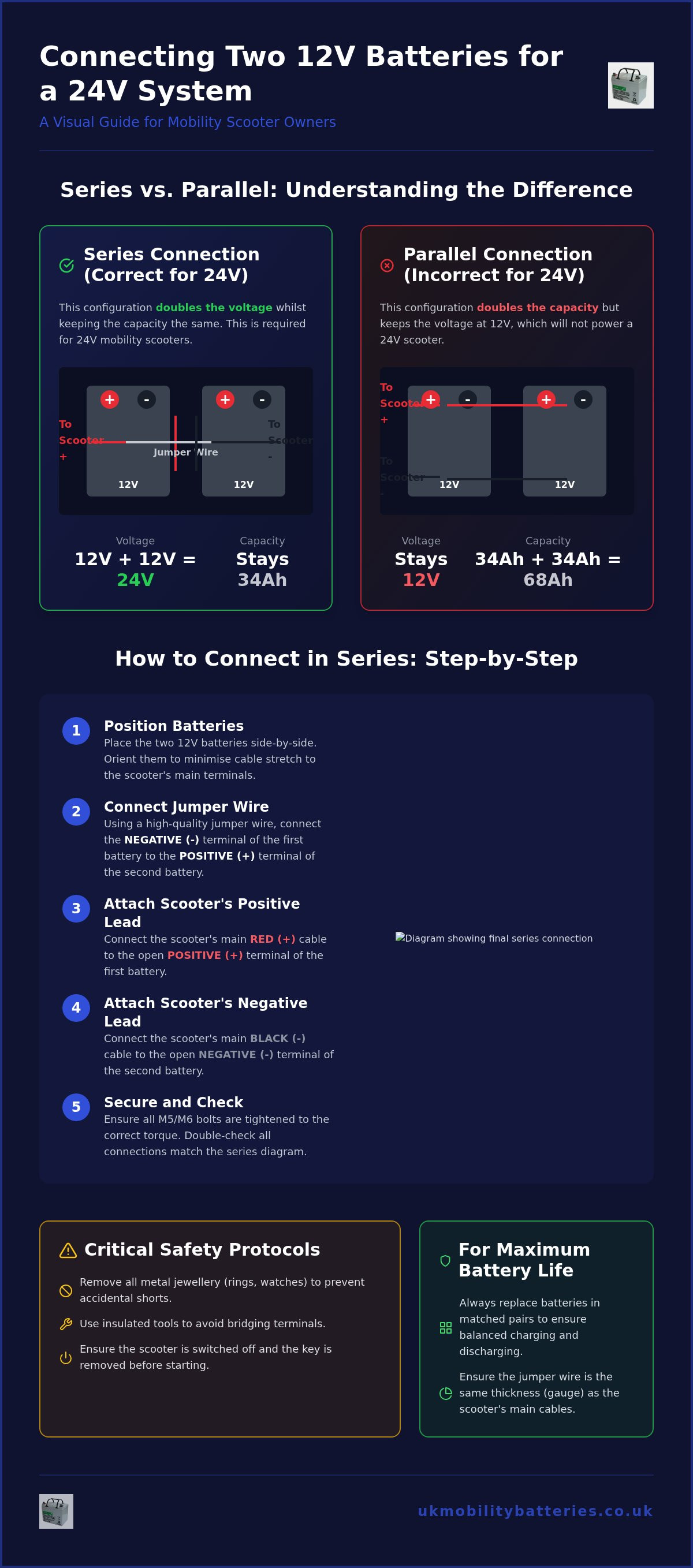
If you're wondering how to connect two 12v batteries to make 24v, the most common error is wiring them in parallel. Parallel wiring connects positive to positive and negative to negative; this maintains a 12V output whilst doubling the capacity. This configuration won't power a 24V mobility controller and might even trigger a low-voltage error on your dashboard. Correct series wiring is the only way to ensure your scooter receives the 24V it needs to function safely and efficiently.
Why 24V is the Standard for Mobility Devices
Higher voltage systems are significantly more efficient for electric propulsion. By operating at 24V, the scooter's controller and motor draw less current to achieve the same power output compared to a 12V setup. This reduction in amperage minimises heat buildup in the internal wiring, which protects sensitive electronics from thermal damage. Standard off-board chargers in the UK also require a 24V series configuration to deliver a charge across both batteries simultaneously.
The Difference Between Voltage and Capacity (Ah)
Voltage represents the pressure of the electrical flow, whereas Amp-hours (Ah) measure the total energy storage, similar to the size of a fuel tank. In a series configuration, the voltage of the two units is added together, but the capacity stays the same. For instance, two 12V 34Ah batteries in series result in 24V 34Ah. You've doubled the pressure required to move the vehicle, but the total runtime remains equivalent to the rating of a single battery in the string.
Understanding Series vs Parallel Connections
Visualising the flow of electricity helps clarify why a series connection is necessary for mobility equipment. In a 24V system, current must pass through both batteries in a single, continuous loop. This path creates the combined electrical pressure required by the scooter's motor controller. The most critical component in this loop is the jumper wire, which acts as the bridge between the two independent units. Without this bridge, the circuit remains open and the motor will not receive power.
When you determine how to connect two 12v batteries to make 24v, you are essentially creating a main positive and a main negative lead that the scooter sees as a single 24V source. The jumper wire links the internal terminals, whilst the remaining two terminals provide the final connection to the vehicle's wiring loom. Accidental parallel wiring, where you connect positive to positive, is a common pitfall. This mistake results in a 12V output that is insufficient to engage the solenoid or drive the motor; it simply keeps the system in a low-voltage fault state.
The Series Wiring Logic
The wiring follows a specific sequence to ensure the electrical potential stacks correctly. First, the scooter's red positive cable attaches to the positive terminal of the first battery. A jumper wire then connects the negative terminal of the first battery to the positive terminal of the second unit. Finally, the scooter's black negative cable attaches to the negative terminal of the second battery. This configuration ensures the voltage is additive. It is vital that the jumper wire gauge matches the thickness of the main cables to prevent resistance and heat buildup. The circuit only completes when the scooter is switched on, allowing electrons to flow through the entire string. For consistent performance, using a matched pair of Lucas mobility batteries ensures that both units discharge at the same rate.
Common Wiring Mistakes and How to Avoid Them
Short circuits are the most dangerous mistake during installation. This occurs if a tool or wire bridges the positive and negative terminals of the same battery. Such an event causes immediate sparking and can melt lead terminals or damage the battery casing. Always work on one terminal at a time and keep terminal covers in place where possible. Loose connections are another frequent issue; they cause intermittent power loss or "stuttering" during acceleration. Ensure every nut is tightened securely to prevent vibration from loosening the contact points. Cross-wiring, or accidentally creating a parallel circuit, will not damage the batteries immediately but will prevent the charger from working and the scooter from moving.
Safety Precautions and Essential Tools for Wiring
Safe battery installation begins with personal protection. The most critical safety requirement is the "No Jewellery" rule. Metal rings, watch straps, and bracelets are highly conductive; if they accidentally bridge the positive and negative terminals, the resulting short circuit can cause severe burns or weld the metal to the battery. Always remove all jewellery before starting the process. Additionally, you should use insulated spanners or screwdrivers. If you don't have specialist insulated tools, wrapping the handle of a standard metal spanner in electrical tape provides a basic layer of protection against accidental bridging.
Identifying your terminal type is essential for a secure fit. In the UK market, mobility batteries typically feature three terminal configurations: flag terminals (common on smaller 7Ah to 12Ah units), T-Bar terminals (found on mid-range scooters), or threaded inserts. Threaded inserts usually require M5 or M6 bolts, which are standard on larger Lucas 34Ah to 55Ah deep cycle batteries. Before you learn how to connect two 12v batteries to make 24v, inspect the terminals for oxidation. Use a wire brush or fine sandpaper to clean the contact points until the lead is bright. This ensures a low-resistance electrical connection that prevents power loss.
PPE and Environment Preparation
Work in a dry, well-ventilated area. Lead-acid and AGM batteries can emit small amounts of hydrogen gas during heavy discharge or charging; proper airflow prevents gas accumulation. Never smoke or use naked flames whilst handling these units. Organising your workspace is also vital. Use a small tray to hold the terminal bolts, washers, and nuts. This prevents small components from falling into the scooter's chassis, where they could cause a short circuit or become difficult to retrieve.
The Tool Kit for Battery Replacement
Most UK mobility batteries require a 10mm or 13mm spanner or socket set. Ensure you have the correct size to avoid rounding off the bolt heads. Once the connections are tight, apply a thin layer of petroleum jelly or a dedicated terminal protector spray to the terminals. This creates a moisture barrier that prevents the white, powdery corrosion often seen on older lead-acid systems. Finally, keep a simple multimeter on hand. This tool allows you to verify the total voltage across the main positive and main negative leads. A reading of approximately 25V to 27V confirms you have successfully mastered how to connect two 12v batteries to make 24v before you close the battery box and resume use.
Step-by-Step Instructions: How to Connect 12V Batteries in Series
Before handling the batteries, ensure the mobility scooter is switched off and the charger is physically disconnected from both the wall socket and the vehicle's charging port. This prevents accidental surges or shorts whilst you work within the chassis. Mobility battery bags and plastic cases offer very little clearance, so positioning is the first technical hurdle. Place your batteries side-by-side or end-to-end exactly as they were previously configured. Orient the terminals so the jumper wire can reach both posts without being pulled taut. Tension on battery cables can lead to terminal fractures or intermittent power loss during transit.
The bridge wire is the most important component when learning how to connect two 12v batteries to make 24v. This short cable links the two independent 12V units into a single 24V string. Once the bridge is secure, you can connect the main loom. If you notice any corrosion on the existing wiring, clean it thoroughly before assembly to ensure maximum conductivity and to prevent heat buildup at the contact points.
The Wiring Sequence
- Step 1: Align the batteries in their tray or bag. Ensure they are stable and cannot slide, which could strain the connections.
- Step 2: Connect the jumper wire from the Positive (+) terminal of Battery A to the Negative (-) terminal of Battery B. This creates the series connection.
- Step 3: Attach the scooter’s main red positive cable to the remaining Positive (+) terminal on Battery B.
- Step 4: Attach the scooter’s main black negative cable to the remaining Negative (-) terminal on Battery A.
After completing these steps, use a multimeter to measure the voltage across the final red and black cables. A healthy 24V system should read between 25.2V and 27.6V depending on the current charge state of the cells. If the reading is 12V, you have likely wired the units in parallel by mistake.
Securing the Connections
Tighten all terminal bolts by hand first to avoid cross-threading the lead inserts. Once seated, use a spanner for a final quarter-turn to ensure they are vibration-proof. Over-tightening can strip the threads on Lucas M5 or M6 inserts, whilst loose bolts cause sparking and melted terminals. Slide the rubber terminal boots or plastic covers over the connections to provide a physical barrier against the scooter's metal frame. Organise the cables so they sit flat within the compartment. Avoid pinching wires when you lower the battery case lid. For more detailed instructions on specific scooter models, you can read our guide on how to change mobility scooter batteries. If your current jumper wires are frayed or corroded, you should replace them alongside a new pair of Lucas AGM batteries to ensure a reliable electrical path.
Ensuring Longevity: Selecting the Right Replacement Batteries
Achieving a functional 24V system depends as much on battery selection as it does on the physical wiring. The golden rule for any mobility device is to always replace batteries in matched pairs. When you understand how to connect two 12v batteries to make 24v, you realise that the two units act as a single electrical reservoir. Mixing different brands, varying capacities, or pairing a new battery with an old one creates an immediate imbalance. This discrepancy in internal resistance will shorten the lifespan of both units and can lead to erratic scooter performance.
Identifying the correct battery involves checking the physical dimensions of your battery tray and the Amp-hour (Ah) rating of the original equipment. Lucas mobility batteries are available in various sizes, from compact 7Ah units to high-capacity 55Ah deep-cycle cells. Ensure the replacement matches the original Ah rating to maintain the intended range and to ensure the batteries fit securely within the compartment without straining the terminals.
The Danger of Unbalanced Battery Strings
In a 24V series setup, an old battery will "drag down" a new one. The older unit typically has a higher internal resistance; this causes the charger to misread the total voltage of the string. Consequently, the charger may overcharge the new, stronger battery whilst the weaker one remains undercharged. This cycle leads to rapid degradation. If you're looking to improve performance, "uprating" from a Lucas 12V 7Ah to a 9Ah battery is a viable option, provided both batteries are changed at the same time to ensure they remain balanced throughout their service life.
Why Lucas AGM Batteries are the Preferred Choice
Lucas Sealed AGM (Absorbent Glass Mat) technology is specifically engineered for the rigours of mobility use. These units are entirely maintenance-free, meaning there's no requirement to top up electrolytes or check fluid levels. The internal construction offers superior vibration resistance, which is essential for scooters used on uneven pavements or roads. This durability prevents internal plate damage and ensures consistent power delivery. For a deeper look at technical specifications and performance data, consult The Ultimate Guide to Mobility Scooter Batteries UK.
Final Maintenance Tips for 24V Systems
After you have mastered how to connect two 12v batteries to make 24v and completed the installation, you must perform a full initial charge. Allow the batteries to charge for 8 to 12 hours before the first use to ensure the cells are fully balanced. On a bi-annual basis, you should inspect the terminal bolts for tightness. Vibration from daily use can loosen M5 or M6 bolts, leading to heat buildup and potential terminal melting. If you encounter issues with power delivery or charging after installation, refer to our guide on mobility scooter battery troubleshooting for practical fixes and failure signs.
Optimising Your 24V Mobility System
Correct series wiring is the technical foundation of a reliable 24V power supply. By connecting the opposite poles of two identical units, you provide the precise electrical pressure your motor controller requires for efficient operation. Maintaining safety through the use of insulated tools and the removal of conductive jewellery prevents accidental shorts during the installation process. Mastering how to connect two 12v batteries to make 24v ensures your equipment remains dependable and safe for daily use whilst protecting your vehicle's sensitive electronic components.
As an official Lucas battery stockist, we provide matched pairs to guarantee perfectly balanced voltage and capacity across your entire system. You can browse our range of matched Lucas 12V battery pairs for your 24V system to ensure maximum service life. We offer next-day UK delivery on all deep-cycle solutions and provide expert technical support for mobility equipment users. With the correct configuration and high-quality AGM cells, you can enjoy extended battery range and consistent performance on every journey.
Frequently Asked Questions
Can I connect a 12V and a 6V battery to make 18V?
Technically this is possible, but it is highly discouraged for mobility scooters. Most controllers require exactly 24V to engage the solenoid and operate correctly. Mixing voltages like 12V and 6V causes an immediate imbalance during the charge and discharge cycles. The 6V unit will likely overcharge whilst the 12V unit remains undercharged. This leads to premature failure and potentially dangerous heat levels within the battery compartment.
What happens if I connect two 12V batteries in parallel instead of series?
Connecting in parallel keeps the voltage at 12V but doubles the available Amp-hours. Because your mobility scooter is designed for a 24V DC system, it won't function at half the required pressure. The dashboard might light up, but the motor controller will detect a critical undervoltage fault. This prevents the drive system from engaging to protect the electronics. You must use series wiring to achieve the correct 24V output.
Do I need a special charger for two 12V batteries connected in series?
You must use a dedicated 24V charger for batteries wired in series. A standard 12V charger doesn't have the electrical pressure required to push current into a 24V string. Most UK mobility scooters include a three-pin XLR off-board charger designed specifically for this configuration. Ensure your charger's output matches the battery chemistry, such as AGM or Gel, to prevent gassing or plate damage during the final stages of the charging cycle.
Why is my scooter still not working after connecting the batteries to make 24V?
Failure after installation usually stems from a loose connection or a blown main fuse. Verify that every terminal bolt is tightened to the correct torque and that the jumper wire is secure. If you've followed the steps for how to connect two 12v batteries to make 24v, use a multimeter to test the voltage at the final connector. A reading below 24V suggests a dead cell or a wiring error that requires immediate correction.
Can I use batteries with different Amp-hour (Ah) ratings together in series?
You should never mix batteries with different Amp-hour (Ah) ratings in a series circuit. The battery with the lower capacity will discharge more rapidly than its partner. Once the smaller battery is depleted, the larger battery continues to push current through it, which can cause permanent cell reversal and internal damage. To maintain a healthy 24V system, always use two identical Lucas batteries with the same capacity and age.
How do I know if my batteries are connected in series or parallel?
Identification depends on the terminal links. In a series connection, you will see a single jumper wire running from the positive terminal of the first battery to the negative terminal of the second. Parallel connections feature two wires: one linking both positives and another linking both negatives. If your multimeter shows 24V across the main red and black leads, the batteries are correctly configured in series for your mobility equipment.
Should I charge the batteries individually or together once connected?
You should charge the batteries together as a single 24V pack through the scooter’s charging port. This allows the 24V charger to manage the entire string as one unit. Whilst individual charging is possible for bench testing, it is impractical for daily maintenance. Charging together ensures that the batteries remain at a similar state of charge, which is essential for the longevity and balanced performance of your series-connected Lucas AGM cells.
Is it safe to connect two different brands of 12V batteries to get 24V?
It is not recommended to mix battery brands. Even if both units are 12V AGM, different manufacturers use proprietary lead alloys and internal plate structures. These differences result in varying internal resistances. During the charging process, the battery with higher resistance will heat up more, leading to an unbalanced charge. For the best performance, always install a matched pair of batteries from a single specialist supplier like UK Mobility Batteries.