
Alternatives to Buying Batteries from Scooter Dealers: A Cost-Saving Guide
Most mobility scooter manufacturers don't actually manufacture their own batteries; they purchase them from specialist producers and apply a substantial brand markup before they reach the showroom floor. If you feel overcharged by dealership prices, you aren't alone. It's common to feel a sense of anxiety about technical specifications or the logistics of fitting a replacement yourself. However, you can bypass these high costs by sourcing your power cells directly from specialist retailers.
This guide identifies the best alternatives to buying batteries from scooter dealer networks, providing you with the technical confidence to choose the right components. We'll explain how to match voltage and Ah ratings, verify physical dimensions, and ensure your new stock is fresh and reliable. You'll learn exactly how to identify high-quality Lucas AGM or deep-cycle batteries that meet or exceed original equipment standards. By the end of this article, you'll have a clear plan to restore your scooter's range and performance at a fraction of the dealer's price.
Key Takeaways
- Identify why showroom prices are inflated by high markups and learn how to bypass these costs by sourcing high-quality replacements directly.
- Master the "Big Three" technical specifications—Voltage, Amp-Hours, and physical dimensions—to guarantee 100% compatibility with your mobility equipment.
- Discover reliable alternatives to buying batteries from scooter dealer networks that offer fresher stock and dedicated technical support for DIY installation.
- Understand the critical difference between standard automotive units and the deep-cycle AGM technology required for consistent mobility performance.
- Learn how to safely fit your own batteries using simple household tools, eliminating the need for expensive professional labour fees.
The Dealer Markup: Why Mobility Batteries Cost More at the Showroom
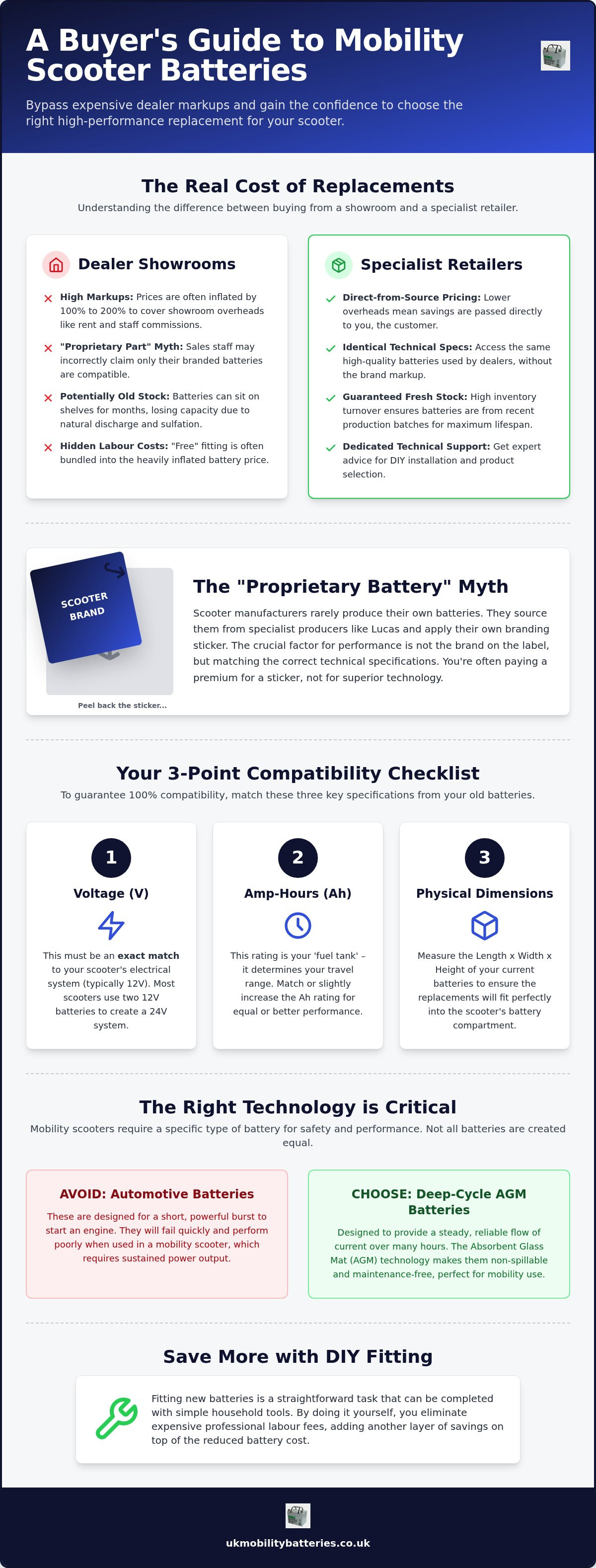
When you receive a quote for replacement batteries from a mobility showroom, the figure often includes a significant markup. In the UK market, it's common for dealers to apply 100% to 200% on top of the base cost of the units. This price increase isn't necessarily a reflection of superior product quality. Instead, it covers the dealer's physical overheads, including showroom rent, staff commission, and the logistics of maintaining a local storefront. These businesses frequently recommend specific brands because of established commercial partnerships rather than technical superiority.
Sales staff sometimes rely on the "proprietary part" myth to discourage customers from seeking alternatives to buying batteries from scooter dealer networks. They might suggest that only their branded batteries are compatible with your specific model. In reality, mobility scooters use standardised power cells manufactured by third-party specialists. These manufacturers supply both the dealers and independent retailers with identical technical specifications. You aren't paying for better performance; you're paying for a dealer's sticker.
Understanding the Convenience Tax
Showrooms often bundle logistics and labour into their pricing under the guise of "free" fitting. Whilst this appears convenient, the actual cost of these services is heavily subsidised by the inflated battery price. Paying for "peace of mind" in a high street retail environment typically results in a much higher final bill compared to specialist e-commerce sites. By separating the purchase from the installation, you can access the same technical reliability at a transparent, lower price point. Online specialists operate with lower overheads and pass those savings directly to the user.
The Problem with Showroom Stock Freshness
Battery health begins to decline from the moment of manufacture if the units aren't maintained with regular charging. Showroom stock may sit on a shelf for months, leading to internal sulfation and reduced capacity. Most mobility scooters rely on Valve-Regulated Lead-Acid (VRLA) batteries, specifically the AGM (Absorbent Glass Mat) variety. These require fresh stock to ensure maximum cycle life and reliable discharge rates during daily use.
Specialist retailers move inventory quickly. This high turnover ensures the units you receive are from a recent production batch. You can often verify this by checking the alphanumeric batch code stamped into the plastic casing or the "born-on" date. Choosing fresh stock from an independent expert is one of the most effective alternatives to buying batteries from scooter dealer outlets. It ensures you don't pay a premium for a battery that has already lost a portion of its service life whilst sitting in a display window.
Technical Alternatives: Understanding AGM and Brand Myths
Mobility scooters require a specific type of power delivery known as deep-cycle discharge. Unlike a car battery designed for a short burst of energy to start an engine, a mobility battery must provide a steady flow of current over several hours. Most modern scooters use Sealed Lead Acid (SLA) technology, specifically Absorbent Glass Mat (AGM) units. In an AGM battery, the electrolyte is held in glass fibre mats between the lead plates. This design makes them non-spillable and maintenance-free, which is essential for equipment that may be tilted during transport or used indoors.
When looking for alternatives to buying batteries from scooter dealer showrooms, it's vital to understand that the logo on the battery case is rarely the company that manufactured it. Scooter brands don't own battery factories. Instead, they source standardised units from established electrical specialists. By choosing a recognised name like Lucas, you're buying directly from the source of the technology rather than paying a markup for a scooter brand's sticker.
The Truth About Proprietary Batteries
Scooter manufacturers often imply that their machines require "genuine" parts to function correctly. This is a common industry myth. If you peel back a dealer sticker, you'll typically find the original manufacturer's label underneath. The performance of your scooter depends on matching the electrical specifications: Voltage (V) and Amp-Hours (Ah). For instance, a Lucas 12V 34Ah Sealed AGM Deep Cycle Battery provides identical power characteristics to a "branded" 34Ah unit sold by a dealer, but at a significantly lower cost. Identifying alternatives to buying batteries from scooter dealer networks is simply a matter of reading the technical label rather than the brand logo.
Why AGM Technology is the Industry Favourite
AGM technology has become the industry standard because it handles the physical demands of mobility better than traditional flooded cells. The glass mat construction provides superior resistance to vibration, which is a frequent factor when travelling over uneven pavements. Safety is another critical consideration. Regulatory bodies are increasingly focusing on battery reliability, with some regions proposing mandatory federal safety standards for micromobility products to ensure consistent manufacturing quality across the sector.
Choosing a premium AGM unit like a Lucas battery ensures your scooter benefits from high-purity lead plates and robust casing. These features result in more charge-discharge cycles compared to generic, unbranded alternatives that may use recycled materials. For reliable performance, you can browse a wide selection of replacement Lucas mobility batteries designed for long-term durability and consistent range.
Specialist Online Retailers vs. High Street Dealers
High street showrooms often justify their pricing by highlighting the convenience of local access and in-person fitting. However, the price disparity between these outlets and online specialists is often substantial. For popular capacities such as 12V 34Ah or 12V 55Ah batteries, the cost difference can reach hundreds of pounds across a pair. Identifying reliable alternatives to buying batteries from scooter dealer networks allows you to access trade-level pricing without sacrificing quality.
A common concern amongst users is the "Warranty Scare". Sales staff may suggest that fitting your own batteries will void the scooter's overall warranty. This is rarely the case. Batteries are considered consumable items, similar to tyres. As long as the replacement matches the original technical specifications, your warranty remains intact. National delivery services have evolved to bridge the gap, offering fast transit that rivals the speed of visiting a local store.
Evaluating Technical Support and Expertise
General mobility retailers often lack specific technical training regarding battery chemistry. A specialist distributor understands the nuances of discharge rates and how they impact the range of specific scooter classes. Before committing to a purchase, it is useful to consult a mobility scooter battery troubleshooting guide. This helps determine whether your current issues stem from a faulty charger or the batteries themselves, ensuring you only spend money when necessary. Getting an honest assessment from a specialist prevents the common showroom tactic of recommending a replacement before it's actually required.
Delivery and Logistics for Heavy Items
Shipping heavy lead-acid units requires specialised logistics to prevent casing damage. Online specialists prioritise safe transit through reinforced packaging and reliable couriers. This methodical approach ensures your equipment arrives in a ready-to-fit state. Sourcing from a specialist also ensures compliance with safety benchmarks, such as the CPSC safety standards for micromobility batteries. Fresh, high-turnover stock from a specialist warehouse will almost always outperform a battery that has sat on a showroom floor for several months. Most reputable retailers provide a clear returns policy and tracking information, giving you peace of mind throughout the delivery process.
How to Safely Identify and Source Your Own Replacement
Sourcing your own batteries requires a methodical approach to technical identification. The most reliable data source is the specification label affixed to your current units. By removing the battery cover or case, you can access the essential technical data needed to find alternatives to buying batteries from scooter dealer networks. You must document the "Big Three" specifications: Voltage (V), Amp-Hours (Ah), and physical dimensions in millimetres (mm). Most mobility scooters operate on a 24V system, which is achieved by connecting two 12V batteries in series.
Terminal configuration is another critical factor. Small travel scooters typically use "spade" connectors, whilst larger road-legal models often utilise "bolt-through" M5 or M6 terminals. To ensure a correct match, you can cross-reference your findings with a mobility scooter batteries UK guide. This allows you to verify that the replacement unit meets the exact electrical requirements of your specific model without relying on a dealer's recommendation.
Measuring for a Perfect Fit
Physical dimensions are arguably the most critical factor in battery selection. Even if the electrical specs match, a battery that is 5mm too wide will not fit into the moulded battery tray or plastic carry case. You should measure the length, width, and height of the casing accurately using a tape measure or calliper. When measuring height, always include the terminals in your calculation. Check for any additional clearance in the battery box, as some manufacturers leave extra room for padding or wiring looms. Precision here prevents the logistical hassle of returning heavy items due to fitment issues.
The Amp-Hour (Ah) Decision
The Amp-Hour rating determines the total energy capacity and, consequently, your travel range. In many cases, it's possible to uprate your capacity to improve performance. For example, replacing a Lucas 12V 7Ah Sealed AGM Battery with a Lucas 12V 9Ah Uprated Sealed AGM Battery provides a longer runtime within the same physical footprint. Similarly, some users upgrade from 34Ah to 50Ah if the battery tray allows for the larger size.
However, you must ensure your existing charger is compatible with an uprated capacity. A charger designed for small 12Ah batteries may struggle to fully charge a 50Ah set within a standard eight-hour window. These upgrades are effective alternatives to buying batteries from scooter dealer showrooms, as they allow you to customise your scooter's range to suit your specific lifestyle needs. If you're ready to secure high-quality power for your equipment, you can buy premium Lucas mobility batteries online for fast UK delivery.
Fitting Your Own Batteries: A Straightforward Alternative
Many local showrooms suggest that battery replacement is a complex procedure requiring specialist workshop tools. In reality, most mobility scooters are designed for user-led maintenance. Swapping your power cells is a straightforward task that typically requires nothing more than a standard cross-head screwdriver or a 10mm spanner. By choosing alternatives to buying batteries from scooter dealer services, you eliminate the high labour costs and fitting fees often bundled into showroom quotes.
Safety is the primary consideration during the swap. Mobility batteries are heavy, often weighing between 5kg and 25kg depending on the Ah rating. You must use correct lifting techniques to avoid strain. Additionally, you should avoid touching both terminals simultaneously with a metal tool, as this can cause a short circuit. Working on one battery at a time is an effective way to ensure the wiring loom remains correctly organised and the polarity is maintained.
Step-by-Step Technical Guidance
Before starting the replacement, ensure the scooter is switched off and the charger is disconnected. It's helpful to take a photograph of the existing wiring for reference before removing any leads. You should follow a detailed how to change mobility scooter batteries guide to ensure every safety protocol is met. The fundamental rule is "Red to Red, Black to Black". Connecting the positive (red) lead to the positive terminal and the negative (black) lead to the negative terminal is essential for the electrical circuit. Ensure every connection is tight and secure. Loose terminals can lead to arcing or intermittent power loss whilst the scooter is in motion. Applying a small amount of petroleum jelly to the terminals can help prevent future corrosion.
Disposing of Your Old Batteries Correctly
Lead-acid batteries contain hazardous materials that require specialist handling. It's illegal and environmentally damaging to dispose of old mobility batteries in your household waste. These units are highly recyclable, with over 90% of the lead and plastic casing being reusable in new manufacturing processes. Most local authority recycling centres have dedicated sections for lead-acid batteries. Alternatively, many local scrap metal merchants will accept them, and some may even offer a small payment based on the lead weight. Correct disposal is the final step in successfully managing your own alternatives to buying batteries from scooter dealer networks, ensuring your maintenance is both cost-effective and environmentally responsible.
Restoring Your Scooter's Range at a Fair Price
Bypassing the high street showroom allows you to access identical technical performance without the significant markups typically applied by local dealers. By focusing on the electrical specifications and physical dimensions of your units, you can confidently select high-quality AGM replacements that meet the exact requirements of your mobility equipment. Most users find that the installation process is a simple task requiring basic household tools; this makes direct sourcing one of the most effective alternatives to buying batteries from scooter dealer networks. You no longer need to rely on proprietary myths to maintain your equipment's reliability.
As an authorised Lucas battery retailer, we provide access to fresh, premium stock that ensures maximum cycle life and consistent range for your scooter. We support every purchase with fast national UK delivery and expert technical support via phone or email to assist with any specific compatibility questions. You can browse our range of Lucas mobility batteries and save on dealer prices today. Restoring your independence and scooter performance is a straightforward process when you have the correct technical data and a reliable supply partner.
Frequently Asked Questions
Will buying batteries from an alternative source void my scooter warranty?
No, purchasing batteries from an independent source generally won't void your scooter's mechanical warranty. Batteries are classified as consumable items, similar to tyres or brake pads. As long as the replacement units match the original voltage and physical dimensions, the machine's overall warranty remains intact. If you're looking for alternatives to buying batteries from scooter dealer showrooms, ensure you keep your purchase receipt to prove the technical specifications meet the manufacturer's requirements.
How do I know if a battery is a "deep-cycle" type suitable for my scooter?
You can identify a deep-cycle battery by checking the label for specific terminology like "Deep Cycle," "Mobility," or "AGM." Unlike automotive starter batteries that provide a high burst of current, deep-cycle units are designed to discharge slowly over several hours. Most mobility scooters require Sealed Lead Acid (SLA) or Absorbent Glass Mat (AGM) technology. If the label mentions "Cold Cranking Amps" (CCA), it's likely a car battery and unsuitable for mobility use.
Can I replace just one battery if only one has failed?
You shouldn't replace just one battery; always replace them in pairs. Mobility scooters use two 12V batteries connected in series to create a 24V system. If you mix a new battery with an old one, the older unit will drag down the performance of the new one. This leads to uneven charging and premature failure of both units. Replacing both ensures balanced voltage and maximum service life for your new power set.
Are Lucas batteries as good as the ones supplied by my scooter manufacturer?
Yes, Lucas batteries are often identical or superior to the units provided by scooter manufacturers. Brands like Pride or TGA don't produce their own power cells; they rebrand units from electrical specialists. Lucas is a premium manufacturer that provides high-purity lead plates and robust AGM construction. Choosing Lucas as one of your alternatives to buying batteries from scooter dealer networks ensures you receive trade-level reliability without the added cost of a dealer's logo.
How much can I realistically save by buying online instead of from a dealer?
You can realistically save a significant amount by purchasing from a specialist online retailer. UK mobility dealers often apply markups of 100% to 200% to cover showroom overheads and staff commission. By sourcing the units yourself and performing a simple DIY fitting, you bypass these hidden costs. The savings are particularly noticeable on larger sizes like 12V 34Ah or 12V 55Ah batteries, where the price gap between online specialists and high street dealers is most substantial.
Do I need a new charger if I buy batteries from a different supplier?
You don't need a new charger as long as your current one is in good working order and matches the battery chemistry. Most standard mobility chargers are designed for 24V AGM or Gel systems. If you've upgraded your capacity significantly, for example from 12Ah to 20Ah, your current charger will still work but it'll take longer to reach a full charge. Always check that the charger's output connector matches your scooter's charging port.
How do I identify the terminal type on my existing batteries?
Identify the terminal type by inspecting the top of your current battery. Small travel scooters typically use "spade" or F2 terminals, which are flat metal tabs that slide into a connector. Larger, road-legal scooters usually feature "bolt-through" terminals, often labelled as M5 or M6, where a screw secures the wiring loom to the battery. It's essential to match this terminal type exactly to ensure a secure, vibration-resistant connection during operation.
What should I do if the new batteries have a slightly higher Ah rating?
If your new batteries have a higher Ah rating, you'll simply benefit from an increased travel range. As long as the physical dimensions fit within your battery tray and the voltage remains 12V per unit, a higher Amp-Hour rating is a beneficial upgrade. For instance, moving from a 7Ah to a 9Ah battery provides more energy capacity. Just ensure that the battery box has enough clearance for the terminals and that your charger can handle the increased capacity.