
Signs You Need a New Mobility Scooter Battery: 2026 Guide
Does your mobility scooter battery gauge show a full charge at home, only to drop into the red the moment you encounter a slight incline? It is a common frustration that leaves many users feeling stranded or anxious about their next trip. You likely suspect your power cells are failing, but the confusion over erratic readings often leads to the high cost of an unnecessary or premature replacement. Understanding the specific signs you need a new mobility scooter battery is essential for maintaining your independence without overspending on maintenance.
This 2026 guide provides the exact technical markers and performance indicators that signal a battery has reached its end of life. You will learn how to distinguish between a simple charging issue and genuine cell degradation whilst gaining a clear, methodical framework for testing your Lucas AGM batteries at home. This data-driven approach ensures you have the confidence to identify exactly when a new set is required to maintain your equipment's reliability and performance.
Key Takeaways
- Identify why your equipment loses torque on inclines or fails to achieve its rated travel distance despite a full charge.
- Recognise the critical signs you need a new mobility scooter battery by interpreting erratic gauge behaviour and voltage fluctuations.
- Distinguish between genuine battery failure and simple electrical faults like terminal corrosion or loose loom connectors.
- Execute a precise static voltage test at home using a digital multimeter to verify the health of your AGM power cells.
- Ensure a correct fit by matching physical dimensions and learn how to safely upgrade Amp-hour ratings for increased range.
Recognising the Primary Signs of Mobility Scooter Battery Failure
Since Mobility scooters are usually battery powered, their overall reliability depends entirely on the health of their internal power cells. Identifying the signs you need a new mobility scooter battery requires a methodical observation of how the machine behaves under different load conditions. Most users first notice a decline when the scooter fails to complete familiar journeys that were previously effortless. This gradual degradation is often more telling than a total sudden failure.
Decreased Mileage and Range Capacity
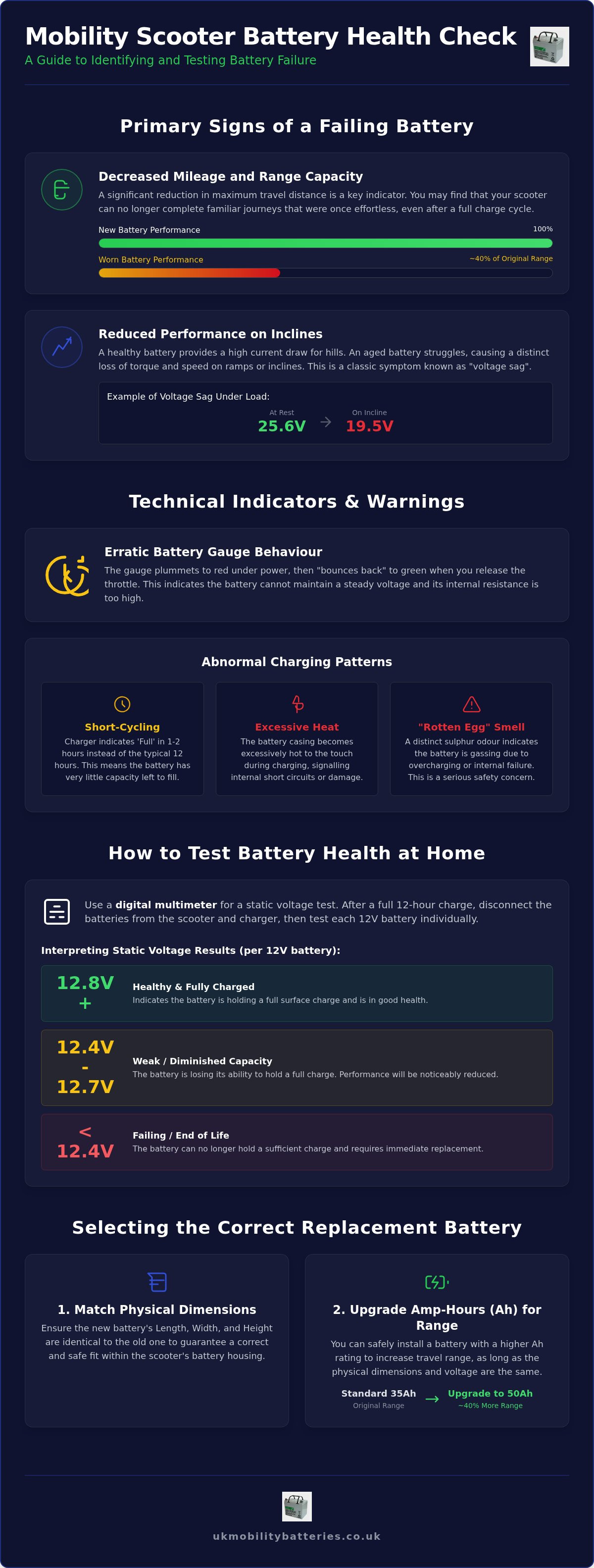
A significant reduction in maximum travel range is a hallmark of an exhausted battery. You might find that your "point of return" is getting closer to home each month. This occurs because deep-cycle batteries have a finite number of discharge cycles before their capacity diminishes. It's a technical reality that a battery showing a full charge on the dashboard can still be defective. Whilst the voltage might read correctly at rest, the actual capacity, measured in Amp-hours, has shrunk. This means the stored energy is insufficient to sustain long-term operation, leading to a scooter that feels "sluggish" or heavy even on flat, paved surfaces.
Reduced Performance on Inclines and Terrain
Navigating small kerbs or gentle inclines requires a high current draw from the batteries. Healthy Lucas AGM cells are designed to provide this burst of power, but aged cells struggle to maintain the necessary voltage. You may notice a distinct loss of torque when attempting to climb a ramp that the scooter previously handled with ease. It's vital to distinguish this from motor strain; if the scooter slows down significantly on an incline but returns to normal speed on the flat, the batteries are likely the culprit.
Environmental factors also play a role. Cold British winters significantly impact battery chemistry, often revealing weaknesses that were less apparent during warmer months. If your battery indicator drops to the red zone almost immediately upon acceleration, this is a phenomenon known as voltage sag. It indicates that the internal resistance has reached a point where the battery can no longer support the motor's electrical demand. Monitoring these patterns allows you to plan a replacement before a total breakdown occurs.
Technical Indicators: How Your Scooter Communicates Battery Health
Your scooter's control panel acts as a primary diagnostic tool. It offers immediate feedback on the state of the electrical circuit. Monitoring the specific reactions of the battery indicator during use is one of the most effective signs you need a new mobility scooter battery. These visual cues often appear weeks before a complete power failure, providing a window of opportunity to arrange a replacement.
Erratic Battery Gauge and Voltmeter Behaviour
A common symptom of a failing battery is the "bounce back" effect on the voltmeter or LED display. You may notice the needle plummeting towards the red zone whilst you are driving, only for it to spring back to the green sector the moment you release the throttle. This indicates that the batteries can no longer maintain a steady voltage under load. Voltage sag is the temporary drop in voltage caused by the internal resistance of a degrading battery. When this resistance becomes too high, the motor cannot draw the sufficient current it requires to maintain consistent speed.
In most 24V systems, which utilise two 12V batteries in series, it is common for one battery to fail whilst the other remains relatively healthy. This electrical imbalance causes the gauge to fluctuate wildly. If your display flickers or resets during a journey, it often suggests that the voltage has dropped below the controller's minimum operating threshold. If you experience these symptoms, you can consult technical specifications for Lucas mobility batteries to ensure your next set meets the precise discharge criteria of your specific model.
Abnormal Charging Patterns and Heat
The behaviour of your battery charger provides critical data regarding the health of the internal lead plates. A standard 12-hour charge cycle is typical for deep-cycle AGM batteries. If your charger indicates a full charge, usually via a green light, after only an hour or two, this is a major red flag known as short-cycling. This occurs because the battery has lost its active plate material, meaning it has a very small capacity left to fill. It reaches its peak voltage quickly but will deplete just as fast once you begin driving.
Physical changes are equally important technical markers. If the battery casing feels excessively hot to the touch during charging, or if you detect a "rotten egg" smell, the battery is likely gassing due to internal short circuits. This chemical reaction can lead to swelling or casing distortion. In such cases, the battery is no longer safe to operate. Identifying these indicators early prevents damage to the scooter's onboard electronics and ensures you aren't left without a reliable means of transport.
Troubleshooting: Is it the Battery or an Electrical Fault?
Does the battery indicator show a failure, or is the current simply blocked? Before purchasing replacements, you must eliminate mechanical and electrical interference. Some apparent signs you need a new mobility scooter battery are actually symptoms of high resistance in the wiring or terminal points. Identifying the signs you need a new mobility scooter battery requires ruling out these external factors first. A systematic approach prevents the high cost of replacing batteries that still have functional life. Conduct a thorough visual inspection of the entire power loom before concluding the cells are dead.
Inspecting Terminals and Connections
Furring, a white or blueish powdery corrosion, often forms on lead terminals. This oxidation creates a barrier that restricts electricity flow. You can safely clean these points using a wire brush or a specialised terminal cleaning spray. Amongst transportable "boot" scooters, frequent battery pack removal increases the risk of loose T-bar connectors. Check for frayed insulation or wires pinched in the battery box during assembly. Ensure every loom plug is seated firmly to avoid mimicking battery failure.
Verifying Charger Integrity
Inspect the 3-pin XLR connector for bent or recessed pins that prevent a full circuit. Cheap, unbranded chargers often lack the sophisticated profiles required for Lucas AGM batteries, leading to plate sulphation. If your charger stays green but the scooter won't move, the charger may be failing to provide the initial bulk charge. Our guide on mobility scooter battery troubleshooting provides further technical steps for diagnosing these external faults.
Operational load and environmental factors also dictate battery performance. A scooter will feel less capable whilst navigating soft terrain or carrying heavy loads. These conditions force the motor to draw significantly more Amps, depleting the capacity faster than standard pavement use. Additionally, check for mechanical drag, such as a binding brake or low tyre pressure, which increases the electrical demand on the battery. If the range has dropped but the battery passes a voltage test, it's likely the issue is mechanical rather than chemical.
How to Test Your Mobility Battery Health at Home
Confirming the physical state of your power cells requires more than just looking at the dashboard. Whilst the previous sections highlighted behavioural indicators, a technical test provides definitive proof. This process helps you verify the signs you need a new mobility scooter battery before committing to a purchase. To ensure accuracy, you must prepare the batteries correctly. Charge the scooter for a full 12 hours, then disconnect the charger and let the batteries rest for at least 2 hours. This rest period allows the surface charge to dissipate, revealing the true chemical state of the lead plates.
Using a Multimeter for Precision Checks
A digital multimeter is the most reliable tool for a static voltage test. Set the dial to the DC voltage setting, typically the 20V or 200V range. You must test each 12V battery individually rather than testing the 24V output at the charging port, as one failing battery can hide behind a healthier one. A fully charged, healthy Lucas AGM battery should show a reading of approximately 12.7V to 12.8V. If a battery reads 10.5V or lower, it has likely suffered a permanent cell failure and cannot be recovered. A resting voltage of 12.0V actually represents a nearly discharged battery, not a half-full one. If your batteries sit at this level after a full charge cycle, they are no longer holding sufficient capacity for reliable use.
The Practical Drive Test
A static test only tells part of the story. A battery might show 12.7V at rest but fail instantly under load. To perform a practical drive test, monitor your dash gauge whilst applying full throttle, ideally whilst navigating a slight incline or ramp. A healthy system will show a minor, steady dip. However, if the gauge crashes into the red zone immediately, you have identified a "dead cell" drop. This occurs when the internal resistance is too high to support the motor's current draw. If your home tests are inconclusive but the scooter remains unreliable, you may need a professional discharge test from a specialist using a load bank. If your readings confirm failure, you can view our range of Lucas mobility batteries to find a compatible replacement for your specific scooter model.
Selecting the Correct Replacement Batteries
Once you have confirmed the signs you need a new mobility scooter battery through the testing methods described earlier, selecting the correct replacement is vital for restoring performance. Precision in selection prevents mechanical fitment issues and electrical imbalances. You must match the physical dimensions (length, width, and height) to ensure the units fit securely in the battery tray. Even a few millimetres of difference can prevent the battery cover from closing or cause internal movement whilst driving. It is also a technical requirement to replace batteries in pairs. Mixing an old cell with a new one causes the healthier battery to overwork, leading to the premature failure of both units.
Amp-hour (Ah) ratings determine the total energy capacity of the cell. Whilst you must maintain the 12V voltage specification, you can often upgrade the Ah rating for increased travel distance. For example, replacing a standard Lucas 12V 7Ah Sealed AGM Battery with a Lucas 12V 9Ah Uprated Sealed AGM Battery provides approximately 28% more capacity within the same physical footprint. This is a practical solution for users who find their current range insufficient for their daily requirements. Ensure you check the internal dimensions of your battery box before opting for a higher Ah rating to confirm the larger plates will fit.
Choosing Between AGM and Gel Technology
Maintenance-free AGM (Absorbent Glass Mat) is the preferred choice for the majority of UK scooters. These units are completely sealed, making them leak-proof and safe for air travel or public transport. They offer superior vibration resistance, which is essential for transportable "boot" scooters that are frequently dismantled and loaded into vehicles. For a comprehensive breakdown of brand comparisons and chemical compositions, see The Ultimate Guide to Mobility Scooter Batteries UK.
The Lucas Advantage for Mobility Users
Lucas is a specialist in deep-cycle technology, providing the reliability required for daily independence. Their mobility range is engineered to handle the repetitive deep-discharge cycles that standard starter batteries cannot survive. Whether your scooter requires the compact Lucas 12V 12Ah Mobility Battery or the high-capacity Lucas 12V 55Ah Sealed AGM Mobility Batteries, selecting the correct Lucas model ensures your equipment operates within its intended electrical parameters. Reliable power cells are the foundation of a dependable mobility solution. To restore your scooter's torque and range, browse our full range of Lucas mobility batteries for fast UK delivery.
Restoring Your Scooter's Reliability and Range
Proactive maintenance ensures you are never left stranded due to an avoidable power failure. By monitoring for erratic gauge behaviour and performing periodic static voltage tests, you can accurately identify the signs you need a new mobility scooter battery before it reaches a critical state. Remember that replacing batteries in pairs and matching the physical dimensions are essential technical steps for a successful installation. Whether you require a standard replacement or an uprated capacity for longer journeys, using high-quality AGM cells is the most effective way to maintain your equipment's performance.
UK Mobility Batteries acts as an Authorised Lucas Battery Specialist, providing the exact technical specifications required for UK scooter models. We offer Fast National UK Delivery and Technical Support from UK Experts to help you make an informed decision. Don't let a failing battery limit your independence. Find your replacement Lucas mobility batteries here and enjoy the confidence of a fully restored travel range.
Frequently Asked Questions
How many years should mobility scooter batteries last?
Mobility batteries typically last between 12 and 24 months depending on usage patterns and charging frequency. Daily users who frequently discharge their batteries deeply may see a lifespan closer to one year, whilst occasional users might reach the two-year mark. Factors such as storage temperature and the quality of the charger significantly impact longevity. Leaving batteries in a discharged state for extended periods is the primary cause of premature failure in the UK.
Can I replace just one battery if the other is still working?
No, you must always replace mobility batteries in pairs to ensure balanced electrical performance. In a 24V system, the two 12V batteries operate in series. If you pair an old battery with a new one, the internal resistance mismatch causes the new battery to overcharge and the old one to undercharge. This electrical imbalance leads to the rapid degradation of the new unit, quickly negating any initial cost-saving attempt.
Why does my battery gauge show full but then drop to empty quickly?
This behaviour is a classic indicator of high internal resistance and lost capacity. Whilst the battery can reach its peak voltage quickly during charging, the lead plates can no longer store a significant amount of energy. This is one of the most reliable signs you need a new mobility scooter battery. The gauge reflects the resting voltage, but once the motor draws current, the voltage drops immediately into the red zone.
Is it normal for mobility batteries to lose range in the winter?
Yes, lead-acid and AGM battery capacity naturally decreases as temperatures drop. In cold British winters, you may experience a 20% to 30% reduction in travel range compared to summer performance. This occurs because the chemical reactions within the cells slow down in cold conditions. Whilst this is normal for healthy batteries, an older battery that is already struggling will often fail completely when the temperature drops below freezing.
Can I use a car battery charger on my mobility scooter?
No, you should never use a standard car battery charger on sealed AGM or Gel mobility batteries. Car chargers are designed for starter batteries and often deliver a high-amperage bulk charge that can overheat and damage the delicate plates in a deep-cycle battery. Mobility scooters require a specialised multi-stage charger that communicates with the battery to prevent overcharging and ensure the cells are properly balanced at the end of the cycle.
What is the difference between a 34Ah and a 50Ah battery?
The primary difference is the energy capacity, which directly dictates your travel range. A 50Ah battery stores more electricity than a 34Ah unit, allowing for longer journeys between charges. However, 50Ah batteries are physically larger and heavier. You can only upgrade to a higher Ah rating if your scooter's battery tray and loom connectors are compatible with the increased dimensions of the larger casing, such as the Lucas 12V 50Ah Mobility Battery.
How do I dispose of my old mobility scooter batteries in the UK?
You must recycle old lead-acid batteries at a licenced waste facility or a local household recycling centre. Under UK law, lead-acid batteries are classified as hazardous waste and cannot be disposed of in domestic bins. Most local authority recycling sites have a dedicated area for car and mobility batteries. Recycling ensures that the lead and plastic components are recovered safely, preventing environmental contamination from the internal sulphuric acid.
Will my mobility scooter go faster with new batteries?
New batteries will not increase the scooter's factory-set top speed, but they will restore the torque and power that was lost as the old cells degraded. When batteries fail, the voltage drops under load, causing the motor to spin slower and making the scooter feel sluggish. Installing a fresh set of Lucas batteries ensures the motor receives a consistent voltage, allowing the scooter to maintain its maximum rated speed even on inclines.