
Sealed AGM Mobility Batteries: The Complete Technical Selection Guide
Reliability in a mobility scooter isn't just about the motor; it's about matching the specific discharge profile of your battery to your daily range requirements. Many users experience a constant fear of being stranded far from home due to a sudden power failure. It's a common frustration, especially when technical jargon like Ah ratings and physical dimensions makes choosing a replacement feel like guesswork. You shouldn't have to worry about whether your equipment will last the journey or if your battery is safe for air travel.
This guide will help you master the technical specifications and selection criteria for sealed agm mobility batteries to ensure your wheelchair or scooter remains dependable whilst maximising its operational lifespan. We'll demystify the difference between AGM and standard lead-acid technology to show why maintenance-free, non-spillable designs are the professional standard. You'll learn how to identify the correct Lucas battery for your specific device; we also provide clear instructions on extending battery life through proper charging and how to confirm your VAT relief eligibility.
Key Takeaways
- Understand why Absorbed Glass Mat (AGM) technology provides a maintenance-free and vibration-resistant power source for modern mobility equipment.
- Learn how to accurately match Ampere-hour (Ah) ratings and physical dimensions to your device to ensure a secure fit and reliable range when choosing sealed agm mobility batteries.
- Master essential maintenance protocols, including the mandatory initial 12-hour charge, to prevent premature failure and extend the service life of your Lucas battery.
- Recognise the importance of deep-cycle specifications for heavy-duty mobility use compared to standard lead-acid alternatives.
- Confirm your eligibility for VAT relief on mobility products to ensure you follow the correct technical and legal purchasing procedures.
What are Sealed AGM Mobility Batteries?
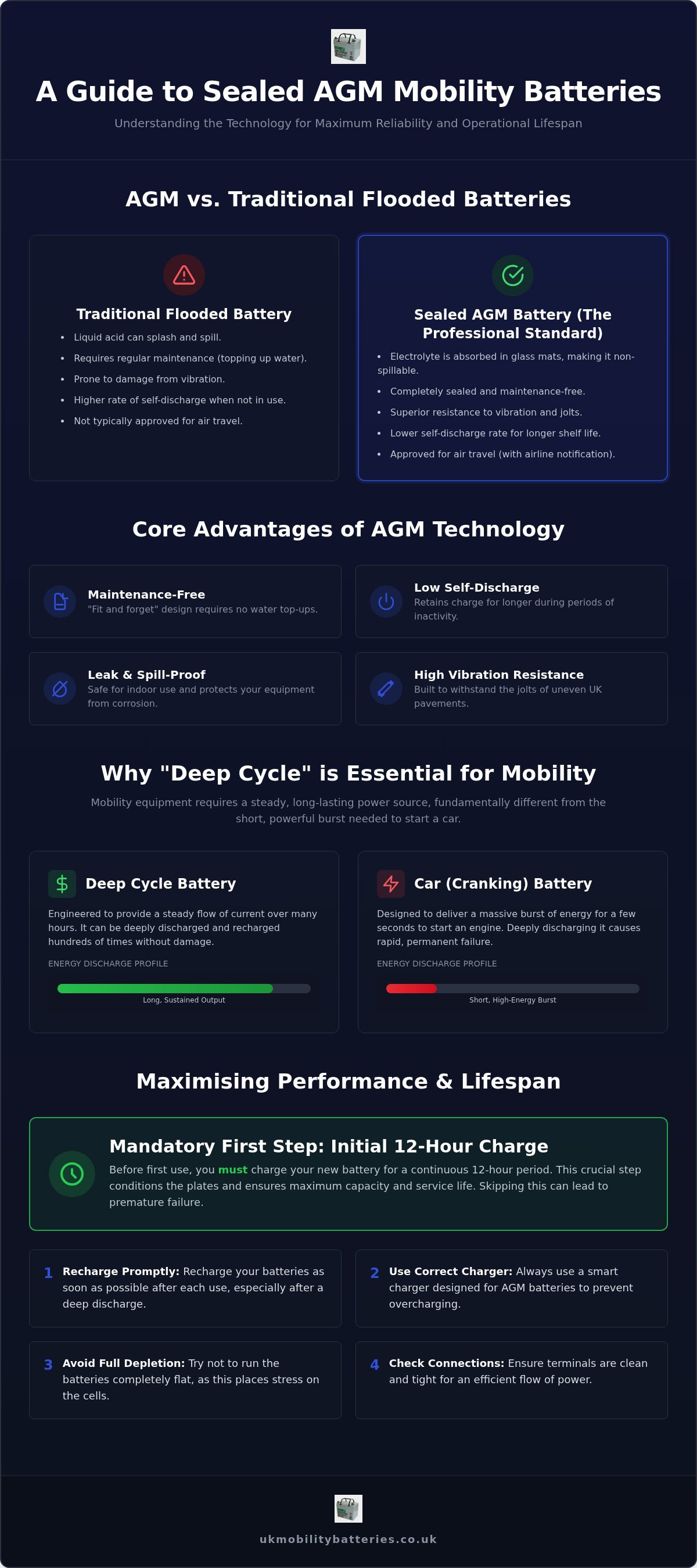
AGM technology represents a significant advancement over traditional flooded lead-acid designs. In these units, the sulphuric acid electrolyte is absorbed into a fine fibreglass mat separator rather than splashing around as a liquid. This "starved" electrolyte system is what makes sealed agm mobility batteries exceptionally safe and reliable for daily use in wheelchairs and scooters. Because the mats are tightly packed between the lead plates, they provide superior resistance to the vibrations encountered on uneven UK pavements. It's vital to distinguish these from standard automotive or UPS (Uninterruptible Power Supply) batteries. While a UPS battery is designed for occasional standby use during a power cut, mobility applications require a battery that can withstand the physical rigours of outdoor terrain and the chemical stress of daily discharge cycles.
Most modern mobility power units fall under the classification of a Valve-Regulated Lead-Acid (VRLA) battery. This design uses a one-way pressure relief valve system. It's engineered to keep the internal pressure at an optimal level while preventing the escape of gases during normal operation. This makes the battery maintenance-free; you'll never need to top up the electrolyte levels with distilled water. This is a primary reason why AGM is the preferred choice for UK users who require a dependable, "fit and forget" power solution for their equipment.
The Anatomy of an AGM Battery
The internal structure of an AGM battery is built for durability. The fibreglass mats do more than just hold the acid; they act as a physical buffer that prevents the active material on the lead plates from shedding over time. During the charging process, oxygen is produced at the positive plate. In a standard battery, this gas would escape. In an AGM unit, the oxygen travels through the porous mats to the negative plate where it recombines to form water. This closed-loop recombination process is the reason these units remain non-spillable and leak-proof, even if the case is accidentally damaged. It's this specific construction that makes the Lucas range safe for transport and indoor storage.
Why "Deep Cycle" Matters for Mobility
A mobility scooter doesn't start like a car. A car battery, or "cranking" battery, delivers a massive burst of energy for a few seconds and then relies on an alternator to take over. If you discharge a car battery deeply, it will fail permanently after just a few cycles. In contrast, sealed agm mobility batteries are "deep cycle" units. They're engineered to provide a steady flow of current over several hours of use. Products like the Lucas 12V 34Ah Sealed AGM Deep Cycle Battery or the larger Lucas 12V 55Ah Sealed AGM Mobility Batteries are designed to handle hundreds of discharge and recharge cycles. This heavy-duty construction ensures your device doesn't lose power halfway through a trip, providing the sustained energy required for consistent long-distance travel.
The Technical Advantages of AGM Technology
The primary benefit of sealed agm mobility batteries is their entirely maintenance-free design. Unlike traditional lead-acid batteries, you don't need to check water levels or top up electrolyte fluids. This is because the internal gases are recombined within the unit, making it a "fit and forget" solution for busy users. This sealed nature also eliminates the risk of acid leaks, which protects the metal frame of your scooter or wheelchair from corrosion. Beyond maintenance, these batteries offer a lower self-discharge rate. While a standard battery might lose significant charge during a few weeks of inactivity, an AGM unit retains its power for longer, ensuring your device is ready to use when you need it.
Safety and transportability are critical for modern mobility. As of August 2026, non-spillable batteries like the Lucas AGM range remain approved for air travel under FAA regulations, provided the airline is notified in advance and terminals are protected. This makes them ideal for users who travel frequently. The technical advantages of AGM also include high vibration resistance. Because the electrolyte is absorbed in glass mats, the battery's internal components aren't damaged by the constant jolts of driving over uneven pavements or kerbs. You can find a wide range of these high-performance units at UK Mobility Batteries for reliable national delivery.
Reliability Amongst Varying Temperatures
The British climate presents unique challenges for battery performance, ranging from winter frosts to summer heatwaves. AGM technology excels here because its low internal resistance allows for consistent power delivery even in cold conditions. This resistance prevents the sluggish performance often seen in standard batteries during January or February. Thermal stability in AGM cells is the capacity of the battery to maintain a consistent internal temperature and chemical state despite fluctuations in external ambient heat or high electrical load. This stability ensures that your Lucas battery won't overheat during long summer excursions or fail prematurely due to seasonal temperature shifts.
Mounting and Orientation Flexibility
Because there's no free-flowing liquid inside, sealed agm mobility batteries offer exceptional mounting flexibility. They can be installed in various orientations without the risk of leakage, which is a vital safety feature for folding wheelchairs or scooters that are frequently dismantled and placed in car boots. The robust ABS casing used across the Lucas range provides an additional layer of protection against physical impacts. This durable housing ensures the internal glass mats and lead plates remain securely aligned, even if the battery is handled roughly during transit or storage. This structural integrity is a hallmark of the deep-cycle units engineered for the UK mobility market.
Choosing the Correct Capacity: From 7Ah to 150Ah
Selecting the right capacity for sealed agm mobility batteries is a balance between required travel range and the physical constraints of the battery compartment. Ampere-hours (Ah) represent the total charge a battery can deliver over time. Essentially, a higher Ah rating acts like a larger fuel tank, allowing for longer excursions before a recharge is necessary. However, you must ensure the physical dimensions of the replacement unit match your existing setup. Even a few millimetres of difference can prevent the battery cover from closing or the terminals from connecting securely. For a comprehensive overview of how these factors influence your choice, refer to The Ultimate Guide to Mobility Scooter Batteries UK.
Weight is another critical technical factor. Larger capacity batteries contain more lead, which increases the overall weight of the vehicle. While this can improve traction on some surfaces, it may reduce the portability of "boot scooters" that are frequently dismantled for transport. You should always verify that the weight of the new batteries does not exceed the manufacturer's specified limit for the scooter's chassis.
Small vs Large Capacity Applications
The required capacity depends heavily on the motor size and intended use of your device. Small-scale applications, such as boot scooters and lightweight travel chairs, typically utilise batteries ranging from 7Ah to 20Ah. Units like the Lucas 12V 7Ah Sealed AGM Batteries or the Lucas 12V 12Ah Mobility Battery are standard for these compact models. They are designed for short trips on flat, even surfaces.
Mid-range pavement scooters and powerchairs require more sustained power, often using 34Ah to 55Ah units. The Lucas 12V 34Ah Sealed AGM Deep Cycle Battery and the Lucas 12V 55Ah Sealed AGM Mobility Batteries are common choices for users who need to navigate inclines or travel several miles. For heavy-duty, road-legal Class 3 scooters, capacities often reach 75Ah to 150Ah to support higher speeds and extended daily ranges.
Can I Uprate My Battery Capacity?
Many users ask if they can install a battery with a higher Ah rating to gain extra range. This is often possible and highly beneficial. For example, you can frequently replace a standard 7Ah unit with a Lucas 12V 9Ah Uprated Sealed AGM Battery. Similarly, a 12Ah battery can often be swapped for a 14Ah or 15Ah version, provided the physical dimensions are identical. This "uprating" provides a significant increase in runtime without changing the scooter's footprint. It's an efficient way to enhance sealed agm mobility batteries performance.
There is one non-negotiable rule: the voltage must remain exactly the same. Mobility systems are designed for 12V or 24V (two 12V batteries in series) configurations. You must never attempt to use a battery with a different voltage rating. Additionally, when significantly increasing the Ah rating, check your charger's output. A charger designed for a small 10Ah battery may take an excessively long time to fully replenish a 50Ah unit, potentially leading to incomplete charging cycles that shorten the battery's lifespan.
Maximising Performance: Care and Charging Protocols
Adhering to strict care protocols is the most effective way to ensure your sealed agm mobility batteries reach their full service life. When you receive new Lucas batteries, they must be charged for a minimum of 12 hours before their first use. This initial "soak" ensures the internal plates are fully chemically active and balances the cells across the pair. Skipping this step can lead to a permanent reduction in total capacity from day one. You should also avoid the common mistake of leaving batteries in a discharged state. If you use your scooter, charge it as soon as you return. Leaving a battery flat for even 24 hours can cause lead sulphate crystals to harden on the plates, which is often irreversible.
Modern AGM units don't suffer from "memory effect". It's far better to top up the charge after every short trip than to wait until the battery is nearly empty. Frequent shallow discharges are significantly less stressful for the internal chemistry than occasional deep discharges. This approach maintains the battery's health and ensures you always have maximum range available. For detailed advice on charging safety, see our guide on Can You Overcharge a Mobility Scooter Battery?
Winter Storage and Cold Weather Care
Cold temperatures naturally slow down the chemical activity inside the cells. You might notice a 20% to 30% reduction in range when temperatures drop below 5°C. This isn't necessarily a sign of a faulty battery, but rather a physical limitation of lead-acid chemistry. If you don't intend to use your scooter whilst it is cold, store the batteries in a dry, frost-free environment. You must follow the "once a month" rule; even if the device is dormant, connect the charger for a full cycle every 30 days to counteract natural self-discharge and prevent the voltage from dropping to a critical level.
Troubleshooting Common Battery Issues
Capacity loss usually manifests as the scooter slowing down on inclines or the battery gauge dropping rapidly under load. If you suspect a fault, check for loose terminal connections or signs of corrosion first. When performance significantly degrades, it's time to consider a replacement. The matched pair rule states that mobility batteries must always be replaced in identical pairs to prevent the older battery from overworking the new one during discharge and recharge cycles. Using a mismatched pair will rapidly destroy the newer battery. For a detailed list of failure signs, consult our Mobility Scooter Battery Troubleshooting Guide.
Maintain your independence by choosing high-performance sealed agm mobility batteries from the Lucas range. You can buy Lucas mobility batteries online for fast national delivery and expert technical support.
Investing in Reliability: Lucas Sealed AGM Solutions
Lucas is a household name in the UK, recognised for over a century as a leader in automotive and industrial electrical components. For users of sealed agm mobility batteries, this heritage translates to a product line engineered for consistent performance and durability. Unlike generic brands, Lucas deep-cycle units are specifically designed to handle the repetitive discharge cycles required by mobility scooters and powerchairs. Choosing an authorised UK specialist ensures you receive fresh stock with full technical backing. The current range is extensive, covering everything from the compact Lucas 12V 7Ah and 9Ah Uprated units for travel scooters to the heavy-duty Lucas 12V 55Ah Sealed AGM Mobility Batteries found in road-legal models.
A critical but often overlooked technical detail is terminal compatibility. Ensuring a seamless fitting requires identifying whether your device uses Faston (spade) connectors, typically labelled as F1 or F2, or bolt-through terminals like M5 or M6. Small boot scooters usually utilise the 6.35mm F2 spade terminal found on the Lucas 12V 12Ah or 20Ah units. In contrast, larger 34Ah to 55Ah batteries usually feature threaded inserts that require specific torque settings to maintain a secure electrical connection. Correct identification prevents the need for terminal adaptors, which can increase electrical resistance and heat build-up during use.
VAT Relief for Mobility Users
Under HMRC Notice 701/7, many customers are eligible for VAT relief on their purchase of mobility equipment, including sealed agm mobility batteries. This exemption applies if the batteries are purchased for a device used by an individual with a chronic illness or a permanent disability. Registered charities also qualify when the equipment is for the personal use of a disabled person. To apply this relief, you don't need a doctor's note; you simply complete a self-declaration form during our online checkout process. The VAT is then automatically deducted from the total before you pay, ensuring the technical solution remains accessible and cost-effective.
Fast National Delivery and Support
Shipping lead-acid batteries requires specialised logistics due to their weight and the nature of the components. We provide national UK delivery using couriers experienced in handling heavy, high-value items to ensure your order arrives in perfect condition. Buying from a specialist retailer also gives you access to expert technical support. If you're unsure about Ah uprating or physical dimensions, our team can provide the specific data needed to confirm compatibility with your scooter's battery tray. Our focus is on providing reliable power solutions that keep you mobile without the stress of technical uncertainty.
Explore our full range of Lucas Sealed AGM Batteries to find the exact match for your mobility requirements.
Secure Your Independence with the Right Power Source
Selecting the correct sealed agm mobility batteries is a technical decision that directly impacts your daily independence. By matching the precise Ampere-hour rating and physical dimensions to your device, you eliminate the risk of fitting issues and ensure a reliable travel range. Maintaining these units through consistent charging protocols, particularly the initial 12-hour charge and avoiding deep discharge states, is the most effective way to protect your investment and maximise operational lifespan.
As an authorised Lucas battery stockist, we provide high-performance deep-cycle solutions designed for the rigours of UK pavements. Our expert UK-based technical support team is available to assist with compatibility queries, ensuring you find the exact match for your scooter or wheelchair. Many of our customers qualify for VAT relief, making premium reliability more accessible for those with chronic illnesses or disabilities. Take the guesswork out of your next battery replacement by choosing a specialist supplier who understands the technical requirements of your equipment.
Browse our full range of Lucas Sealed AGM Mobility Batteries today to ensure your equipment remains ready for every journey. With the right technical care and high-quality components, you can travel with absolute confidence.
Frequently Asked Questions
What is the difference between AGM and Gel mobility batteries?
AGM batteries use fibreglass mats to absorb the sulphuric acid electrolyte, whereas Gel batteries use silica to turn the acid into a thick paste. AGM units typically offer superior high-current performance and are more cost-effective for standard mobility use. While Gel batteries excel in recovery from extremely deep discharges, the vibration resistance and maintenance-free nature of sealed agm mobility batteries make them the preferred choice for most UK pavement scooters.
How long do sealed AGM mobility batteries typically last?
Most units provide a service life of 12 to 18 months with regular daily use. This duration depends heavily on your charging habits and the depth of discharge during each trip. Batteries that are frequently depleted below 50% capacity will degrade faster than those kept topped up. Environmental factors like winter temperatures also impact the chemical lifespan; however, following strict charging protocols can help you reach the upper end of this range.
Can I use a standard car battery charger for my AGM mobility batteries?
You shouldn't use a car charger as it's designed for high-amperage "cranking" batteries rather than deep-cycle units. Car chargers often deliver a high voltage that can cause the pressure relief valves in a sealed battery to open, leading to permanent drying of the internal mats. Mobility scooters require a "smart" three-stage charger that carefully regulates the voltage and current to ensure a full, safe replenishment without overheating the cells.
Do I need to charge my mobility scooter batteries after every use?
Yes, you should recharge your batteries after every trip, regardless of how short the journey was. Lead-acid chemistry is most stable when kept at a full state of charge. Leaving the battery in a partially discharged state leads to sulphation, where lead sulphate crystals harden on the internal plates. This process is the leading cause of premature capacity loss, so regular topping up is essential for maintaining long-term reliability.
Are sealed AGM batteries safe to take on an aeroplane?
Sealed AGM batteries are classified as non-spillable and are generally approved for air travel. Most airlines follow FAA and IATA regulations that allow these batteries in the hold, provided the terminals are protected against short circuits. You must notify your airline at least 48 hours before departure to confirm their specific requirements. Unlike older flooded batteries, the absorbed electrolyte system ensures no hazardous liquids can leak during the flight, making them ideal for travel.
Why should I always replace mobility batteries in pairs?
You must replace both batteries at the same time to ensure the system remains balanced. An old battery has higher internal resistance and lower capacity than a new one. If you mix them, the charger won't be able to accurately read the voltage of each individual unit. This usually results in the new battery being overcharged whilst the old one remains undercharged. This imbalance quickly ruins the chemistry of the new battery, leading to a double failure.
How do I know if my AGM battery is failing?
The most common sign of failure is a significant reduction in your daily travel range. You might also notice the scooter slowing down noticeably on inclines or the battery gauge dropping into the red zone under load but recovering when stationary. Physical indicators like a bulging battery casing or a pungent "rotten egg" smell are serious signs of internal damage. If your batteries are over 18 months old and exhibit these symptoms, they require immediate replacement.
What does the Ah rating on my mobility battery actually mean?
The Ah (Ampere-hour) rating measures the total energy capacity of the unit. It indicates how much current the battery can deliver over a specific period, typically 20 hours. A higher Ah rating acts like a larger fuel tank, providing more energy for longer journeys. When selecting sealed agm mobility batteries, you can often uprate the Ah for more range, provided the physical dimensions fit your battery tray and the voltage remains at the required 12V level.