
Mobility Batteries Buying Guide 2026: Choosing the Right Power for Your Scooter or Wheelchair
Could a battery with the exact same physical dimensions as your current unit actually increase your travel range by 20 per cent? Many users assume that more power requires a larger physical footprint, but technical density varies significantly between standard and uprated mobility batteries. You likely feel the common frustration of range anxiety, wondering if your scooter will manage a full day out or if a new battery will even fit into your existing battery box.
This comprehensive 2026 guide provides the technical specifications and compatibility data required to select the ideal power source for your equipment. You'll learn how to distinguish between AGM and GEL technologies and how to maintain your unit for maximum longevity. We also outline the latest 2026 UK legislative updates and IATA air travel regulations, ensuring your equipment remains compliant and reliable wherever you choose to travel. By focusing on deep cycle capacity and physical footprint, you can optimise your scooter's performance without the fear of purchasing incompatible components.
Key Takeaways
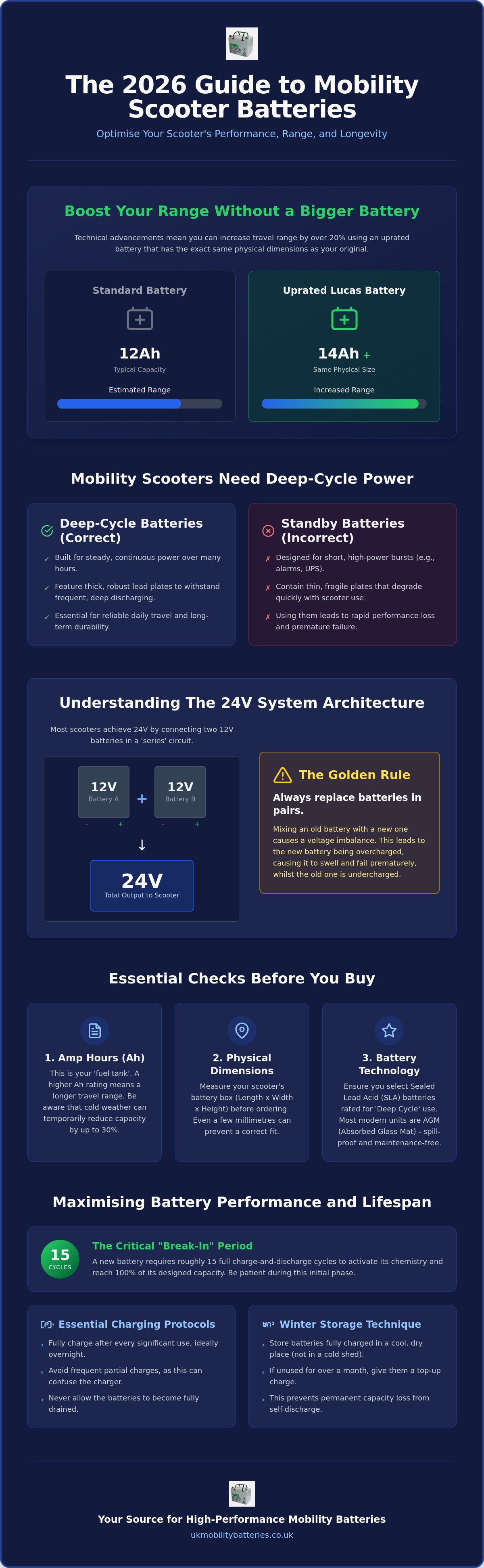
- Learn why mobility scooters require specific deep-cycle technology and why most systems rely on a 24V configuration using two 12V batteries.
- Understand how to calculate Amp Hour (Ah) requirements and the necessity of verifying physical dimensions to ensure a precise fit.
- Discover the performance advantages of Lucas mobility batteries, including the ability to upgrade capacity within the same physical footprint.
- Identify the critical 15-cycle "break-in" period required for new units to reach their full operating capacity.
- Master essential charging protocols and winter storage techniques to prevent permanent capacity loss and extend battery service life.
Understanding Mobility Batteries: Why Specification Matters
Selecting the correct power source for a mobility device requires an understanding of how electrical energy is stored and discharged. Unlike a car battery, which provides a high-intensity burst of power to start an engine, mobility batteries are designed for deep-cycle applications. This means they provide a steady, continuous flow of electricity over several hours to power the motor, lights, and control systems. This mobility scooter overview confirms that these devices are predominantly battery-operated, making the choice of cell critical for reliable daily use.
Most modern equipment utilises Absorbed Glass Mat (AGM) technology. In an AGM battery, the electrolyte is held in glass fibre mats between the lead plates. This design makes the unit spill-proof and maintenance-free, as it doesn't require topping up with water. Because these batteries are sealed, they're safe for indoor use and transport in the boot of a car. Choosing a battery specifically engineered for frequent discharge cycles is essential for maintaining a consistent travel range.
Deep Cycle vs Standby Batteries
It's a common mistake to use standby batteries, often found in alarm systems or Uninterruptible Power Supplies (UPS), in a mobility scooter. Standby batteries are designed to remain on a constant float charge and only discharge during rare power cuts. Their internal lead plates are thin and fragile. Mobility-grade batteries feature significantly thicker plates that can survive the physical and chemical expansion that occurs during deep discharge. The term Sealed Lead Acid (SLA) is an umbrella category that includes both AGM and GEL technologies, but only those labelled as Deep Cycle are suitable for mobility applications. Using a standby battery leads to rapid plate degradation and premature failure.
The 24V System Architecture
The vast majority of mobility scooters operate on a 24V electrical circuit. This is achieved by connecting two 12V batteries in series. You must always replace these batteries in pairs. If you install a single new battery alongside an older unit, the charger cannot balance the voltage correctly. The older battery typically has a higher internal resistance. This forces the charger to work harder, potentially overcharging the new battery and causing it to swell or fail prematurely. You can identify your setup by checking the battery compartment; if you see two separate units connected by a wiring loom, you have a standard dual-battery configuration. Ensuring both units are identical in capacity and age is the only way to maintain a reliable 24V output.
Key Features to Compare: Amp Hours, Dimensions, and Chemistry
Technical specifications determine the real-world utility of your mobility device. Whilst many users focus solely on price, the electrical capacity and physical build of mobility batteries are what dictate independence. Amp Hours (Ah) represent the total electrical charge a battery can deliver, effectively acting as the fuel tank. A higher Ah rating allows for longer travel distances before recharging is required. However, capacity must be balanced against physical size and terminal compatibility to ensure a successful installation.
A heavier battery usually indicates higher quality. This is because deep-cycle performance relies on the density of the lead plates inside the casing. Batteries with more lead provide better durability during frequent discharge cycles. When you compare technical data, you can accurately source the correct mobility batteries for your specific scooter model.
Ah Ratings and Travel Range
The industry standard for measuring capacity is the 20-hour rate. This indicates how much power the battery can provide if discharged steadily over 20 hours. You can estimate your range by comparing the Ah of your current unit with potential replacements. For example, upgrading from a 12Ah to a 14Ah battery within the same footprint can offer a noticeable increase in mileage. Be aware that several variables reduce this range, including steep terrain, user weight, and cold ambient temperatures. In winter, chemical reactions within the battery slow down, which can temporarily reduce available capacity by up to 30 per cent.
Physical Fit and Terminal Security
Physical dimensions (Length x Width x Height) are critical. You must measure your existing battery box carefully before ordering. Even a few millimetres of difference can prevent the lid from closing or the batteries from sitting level. Terminal types also vary by battery size. Small travel scooters typically use F1 (4.75mm) or F2 (6.35mm) spade connectors. Larger, road-legal scooters often require M5 or M6 bolt-through terminals for a more secure, high-current connection. Ensure all cables are tightened firmly; loose connections cause electrical resistance, which leads to heat damage and potential melting of the plastic casing. Always use the original terminal covers to prevent accidental short circuits.
Selecting the Correct Battery: Standout Options from the Lucas Range
Lucas is a leading name in the UK power market. Specialists prefer the Lucas Sealed AGM series because it provides consistent performance under the heavy load of a mobility motor. Unlike generic or reconditioned batteries found on marketplace sites, these units are purpose-built for deep-cycle use. Reconditioned batteries are often unreliable for essential mobility because their internal plates are already degraded, posing a risk of sudden failure during travel. Choosing a new, high-specification unit ensures that the internal chemistry is stable and capable of delivering its rated capacity.
Compact and Travel Scooter Batteries
For users with folding or "boot" scooters, space is the primary constraint. Many of these devices ship with standard Lucas 12V 7Ah Sealed AGM Batteries. However, a significant performance gap exists between the standard 7Ah and the Lucas 12V 9Ah Uprated Sealed AGM Battery. Both units share identical physical dimensions (151mm x 65mm x 94mm), but the uprated version contains denser lead plates. This allows for an approximate 28 per cent increase in capacity without requiring a larger battery box. This is the most effective way to gain extra range for travel-focused scooters.
Mid-range travel scooters often utilise the Lucas 12V 12Ah Mobility Battery or the Lucas 12V 20Ah Mobility Battery. These units provide the necessary current for longer shopping trips or navigating slightly uneven pavement. The 20Ah model is particularly popular for modern, high-torque travel scooters that require a higher discharge rate whilst maintaining a portable form factor. These mobility batteries allow for a balance between weight for transport and sufficient energy for daily tasks.
Heavy-Duty and Long-Range Solutions
Road-legal Class 3 scooters and heavy-duty powerchairs require significantly more energy to operate safely at speeds up to 8mph. The Lucas 12V 34Ah Sealed AGM Deep Cycle Battery is the industry standard for pavement-focused scooters that need reliable daily performance. This specific capacity is frequently used in pairs to create a robust 24V system for medium-sized devices.
For larger vehicles, the Lucas 12V 50Ah Mobility Battery and the Lucas 12V 55Ah Sealed AGM Mobility Batteries are the preferred choices. These high-capacity units are designed to handle the high-current demands of larger motors and integrated lighting systems. For bespoke electric wheelchair configurations or high-mileage requirements, capacities can reach 75Ah to 100Ah. These larger cells provide the stability needed for complex seating systems and power-assisted steering. By selecting from the Lucas range, you ensure your equipment operates within its designed electrical parameters, providing the most reliable path to consistent independence.
Maximising Performance: Fitting, Charging, and Winter Care
Proper maintenance is the most effective way to extend the service life of mobility batteries. Technical performance depends heavily on the chemical state of the lead plates and the electrolyte. Beyond selecting the correct capacity, you must implement a rigorous charging and storage routine. Neglecting these protocols often leads to permanent capacity loss long before the end of the battery's expected lifecycle. To ensure your equipment remains in peak condition, you should buy mobility batteries from a specialist that provides detailed technical data for your specific model.
Terminal health is frequently overlooked during the fitting process. Over time, moisture and air cause oxidation at the metal connection points. This creates electrical resistance, which reduces the power reaching your motor and can cause cables to overheat. You should clean the terminals with a dry cloth and apply a thin layer of petroleum jelly to the metal surfaces. This creates a moisture barrier that prevents corrosion and ensures a consistent electrical contact for the life of the unit.
The First 15 Cycles
New AGM batteries don't deliver their full rated capacity immediately out of the box. They require a specific "break-in" period to reach peak efficiency. During the first 15 discharge and recharge cycles, the internal lead plates undergo a chemical forming process that stabilises the battery's output. The break-in period is the essential phase for chemical stabilisation within the cells.
To support this process, you must follow specific rules for the first two weeks of use:
- Avoid deep discharges where the battery level drops below 50 per cent.
- Charge the batteries fully after every single use, regardless of the distance travelled.
- Ensure the charger remains connected until the "complete" or "green" light is displayed.
Charging and Storage in Cold Weather
The UK winter climate presents specific challenges for battery chemistry. Cold temperatures increase the internal resistance of the cells, which temporarily reduces the available travel range. If you store your scooter in a cold garage or shed, you should bring the battery pack indoors to charge if your scooter design allows for it. Charging in a room-temperature environment ensures the chemical reaction occurs efficiently and the battery reaches a true 100 per cent state of charge.
If you don't intend to use your scooter during the winter months, never leave the batteries connected and forgotten. Lead-acid batteries suffer from self-discharge, where they slowly lose power even when not in use. If a battery remains in a discharged state for too long, a process called sulfation occurs. This hardens the lead plates and permanently reduces the battery's ability to hold a charge. You must provide a monthly top-up charge during the off-season to keep the chemistry active and prevent the voltage from dropping to a critical level.
Why Source Your Replacement Mobility Batteries from UK Mobility Batteries?
UK Mobility Batteries operates as a dedicated specialist within the British power market. Unlike general retailers who manage broad inventories for automotive or industrial sectors, we focus exclusively on the mobility power market. This specialisation ensures that our technical advice and stock management are tailored to the specific requirements of scooter and wheelchair users. We understand the high stakes involved when a device loses its range or fails to start. We prioritise rapid stock rotation to ensure every unit we ship is factory-fresh and at an optimal voltage level. Mobility batteries are heavy, chemically active components that require specific handling and transit protocols. Our logistics network is designed to deliver these essential items across the United Kingdom with speed and reliability, ensuring you aren't left without your primary means of transport for longer than necessary.
Maintaining this independence is crucial for attending important social milestones, such as weddings or group celebrations like those planned via henfactory.com, without worrying about battery failure.
The Specialist Advantage
Buying from a specialist is a safety-critical decision for anyone dependent on their mobility device. Generic retailers often supply batteries that have sat in warehouses for extended periods, leading to natural voltage drop and internal sulfation. We supply only high-quality Lucas stock. This ensures the internal chemistry is stable and ready for the 15-cycle break-in period described in earlier sections. Our customers have access to detailed technical resources, such as our 12V 7Ah fitting guide, which provides the precise measurements and terminal data needed for a successful installation. By focusing on a premium UK-recognised brand like Lucas, we maintain a deep technical knowledge of every SKU in our inventory. This allows us to offer precise compatibility advice that generic retailers simply cannot provide.
Ready to Restore Your Range?
If your current travel distance has decreased, it's time to update your power source. You can browse our full collection of mobility batteries here to find the exact match for your equipment. Our UK-based team is available to assist if you're unsure about compatibility between standard and uprated models. We provide clear data on dimensions and terminal types to eliminate the risk of purchasing the wrong size for your specific scooter model. Because most systems require a 24V output, we offer multi-pack bundles for almost every capacity in the range. These pairs provide the best value and ensure that both batteries in your system are from the same production batch. This prevents the voltage imbalances that occur when mixing old and new cells, which is a primary cause of premature system failure. Choosing factory-fresh pairs from a specialist is the most reliable way to restore your scooter's original performance and independence.
Restore Your Scooter's Range and Reliability
Selecting the correct power source is more than a simple replacement; it's a technical upgrade that directly impacts your daily independence. By prioritising precise physical dimensions and choosing uprated capacities where possible, you ensure your equipment operates at peak efficiency. It's vital to remember that the initial 15-cycle break-in period and consistent charging etiquette are essential for maintaining the long-term chemical stability of your mobility batteries.
Sourcing your components from a specialist provides access to factory-fresh stock and expert technical support that general retailers can't match. Our range of Lucas products utilises premium AGM technology to deliver dependable performance in all UK weather conditions. With fast national delivery and a focus on technical accuracy, we help you avoid the common pitfalls of incorrect sizing or degraded marketplace stock. You can restore your device to its original manufacturer specifications with minimal downtime.
Shop the Full Range of Lucas Mobility Batteries today to secure the most dependable power for your scooter or wheelchair. You can move forward with confidence knowing your equipment is powered by industry-standard technology designed for the road ahead.
Frequently Asked Questions
Can I replace my 33Ah batteries with 34Ah or 35Ah versions?
You can replace 33Ah batteries with 34Ah or 35Ah versions provided the physical dimensions are compatible with your battery box. These slight increases in Amp Hours represent a higher energy density within the same footprint, which effectively increases your travel range. You must verify the Length, Width, and Height measurements before purchase to ensure the new units fit securely without obstructing the battery lid.
How long should I charge my new mobility scooter batteries for the first time?
You should charge your new batteries for a minimum of 12 to 24 hours before their first use. Even if your charger displays a green "complete" light earlier, this extended initial charge is necessary to ensure the cells are fully balanced and chemically ready for service. This process supports the stabilisation required during the early stages of the battery lifecycle.
Is it better to choose AGM or GEL batteries for my electric wheelchair?
GEL batteries are often preferred for heavy-duty electric wheelchairs because they offer superior recovery from frequent deep discharges and a higher total cycle life. However, AGM technology remains the standard for most users as it is maintenance-free, cost-effective, and provides excellent high-current discharge for climbing inclines. Most powerchairs function efficiently on high-quality AGM units unless your daily mileage is exceptionally high.
Why has my mobility scooter range decreased suddenly in the winter?
Your range decreases because cold temperatures slow down the chemical reactions inside your mobility batteries. This increases internal resistance, meaning the battery cannot release its stored energy as efficiently as it does in summer. You might experience a temporary capacity reduction of up to 30 per cent during freezing conditions, though this typically recovers once the weather warms up.
Do I need to replace both mobility batteries at the same time?
You must always replace both batteries simultaneously to maintain a balanced 24V electrical system. If you install a single new battery alongside an old one, the charger cannot balance the voltage correctly across the pair. This imbalance causes the new battery to be overcharged whilst the old one remains undercharged, leading to premature failure of both units within a few months.
What is the average life expectancy of a Lucas mobility battery?
A Lucas mobility battery typically lasts between 12 and 18 months with regular daily use, although this can extend to 3 years with meticulous charging etiquette. Longevity depends heavily on the depth of discharge and storage conditions. Batteries that are charged after every use and kept in a room-temperature environment will consistently outperform those left in a discharged state.
Can I use a car battery charger on my mobility scooter batteries?
You should never use a standard car battery charger on your equipment. Automotive chargers are designed to deliver high-amperage bursts to start engines, which can overheat and warp the internal plates of deep-cycle mobility cells. You must use a dedicated 24V smart charger designed for AGM or GEL chemistry to ensure a controlled and safe charging curve.
Are these batteries safe for air travel (airline friendly)?
Sealed AGM and GEL mobility batteries are classified as non-spillable and are generally permitted for air travel under IATA regulations. You must notify your airline at least 48 hours before your flight to confirm their specific handling requirements. Whilst these batteries are airline-friendly, you should always carry the technical data sheet to prove the units are sealed and safe for the cargo hold. If you would rather not transport your own device when travelling, you can often arrange a rental at your destination through providers such as Locomotion Hawaii.