
Lightweight batteries for travel scooters, lifespan and capacity
Battery chemistry can make a marked difference to how much a travel scooter weighs when you lift it. Lithium-ion batteries are lighter than lead-acid batteries, whilst sealed AGM batteries remain a common option; scooters often use two 12 V batteries connected to form a 24 V system. Choosing lightweight batteries for travel scooters means balancing battery weight with capacity, expected range and compatibility with the scooter.
AGM stands for absorbed glass mat: the electrolyte is held in a glass-fibre mat inside a sealed lead-acid battery. This article explains how AGM and lithium-ion batteries differ, what amp-hour capacity tells you about range, how long batteries typically last, and how battery weight affects the heaviest removable part of a travel scooter. You’ll also learn why a higher-capacity battery isn’t automatically a suitable replacement, and which specifications to compare before choosing lightweight batteries for travel scooters.
Key Takeaways
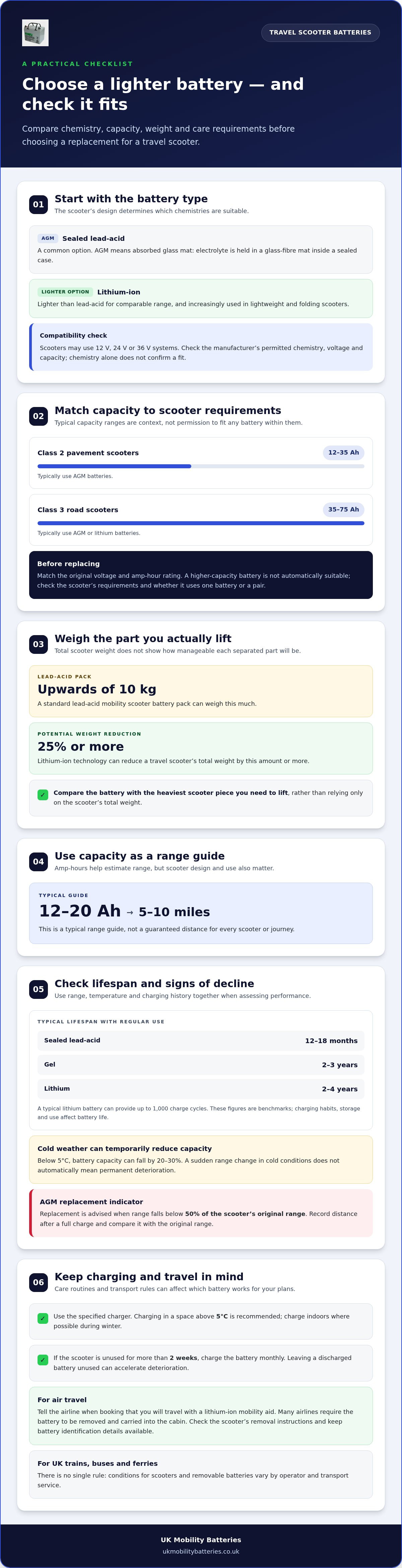
- Travel scooters commonly use sealed AGM or lithium-ion batteries; the right chemistry depends on the scooter’s design and your priorities for weight, range and battery life.
- Regular-use mobility scooter batteries typically last around 12-24 months. Charging habits and storage conditions can affect their working life.
- Capacity helps estimate range: 12-20 Ah batteries typically provide 5-10 miles, although scooter design and use also matter.
- Compare the battery’s weight with the heaviest scooter part you need to lift, not just the scooter’s total weight.
- Before replacing a battery, match its voltage and amp-hour rating to the original specification; a higher-capacity option may not suit every scooter.
What type of batteries do mobility scooters use?
Mobility scooters commonly use sealed lead-acid or lithium batteries. The battery chemistry affects its weight and the scooter’s range, and can also affect travel arrangements.
Sealed AGM batteries are a type of lead-acid battery. Their electrolyte is held in an absorbent glass mat, within a sealed case. Lithium-ion batteries are a lighter alternative, increasingly used in lightweight and folding mobility scooters. A scooter’s electrical system may use 12V, 24V or 36V batteries, so chemistry alone doesn’t determine compatibility.
Lithium-ion and lead-acid weight
A standard lead-acid mobility scooter battery pack can weigh upwards of 10 kg. Lithium-ion batteries weigh less for comparable range, and lithium-ion technology can reduce a travel scooter’s total weight by 25% or more. For lightweight batteries for travel scooters, compare the battery’s weight with the heaviest piece you’ll need to lift. Total scooter weight doesn’t show how manageable each separated part will be.
Battery choices for lightweight and folding scooters
Lithium batteries are increasingly used on lightweight and folding scooters because their lower weight can make transport easier. Before choosing a replacement, check the scooter manufacturer’s permitted chemistry, voltage and capacity. A product name or advertised weight alone doesn’t establish compatibility, and price doesn’t show whether the electrical specifications suit your scooter.
Lead-acid batteries remain common across mobility scooters, including AGM batteries. Class 2 pavement scooters typically use AGM batteries with capacities of 12-35 Ah. Class 3 road scooters typically use AGM or lithium batteries with capacities of 35-75 Ah. These categories describe typical use, not permission to fit any battery within the range. Match the replacement to the scooter’s requirements.
Airline arrangements differ from ordinary ground travel. When booking, tell the airline that you’ll travel with a lithium-ion mobility aid. Many airlines require the battery to be removed and carried into the cabin for safety. Read the scooter’s battery removal instructions before travelling, and keep the battery identification details available.
There isn’t one battery rule for UK trains, buses and ferries. Conditions for mobility scooters and removable batteries vary by operator and transport service.
To remove a battery, switch off the scooter and follow its manufacturer’s instructions; remove it only if designed to be removable. Charge it with the specified charger, indoors where possible during winter. Charging in a space above 5°C is recommended. If the scooter is stored unused for more than 2 weeks, charge the battery monthly. Bring a removable battery indoors during winter where practical.
For eligible purchases by chronically sick or disabled people, UK Parliament states that VAT relief is claimed under Group 12 of Schedule 8 of the Value Added Tax Act 1994.
Battery lifespan and causes of failure
Battery life depends on its chemistry, charging habits, storage conditions and use. When deciding whether to replace a battery, consider its remaining range as well as its expected lifespan.
Battery lifespan and reliability
With regular use, mobility scooter batteries typically last around 12-24 months. Sealed lead-acid batteries commonly last 12 to 18 months with regular use and proper charging habits. Gel batteries typically last 2-3 years with proper maintenance, while lithium batteries often last two to four years. A typical lithium battery can provide up to 1,000 charge cycles.
These figures are useful benchmarks, not a substitute for monitoring performance. A scooter that loses range may have a battery approaching the end of its working life, but cold conditions can also temporarily reduce capacity. Below 5°C, battery capacity can fall by 20-30%. Consider storage temperature and recent weather before treating a sudden range change as permanent deterioration.
Leaving a discharged battery unused can accelerate deterioration, and it may not recover fully. Very cold storage can also shorten battery life. Keep a record of charging and range, and compare journeys made under similar conditions. This can help distinguish a lasting decline from a temporary change caused by temperature or different usage.
Replacement lifespan and costs
For AGM batteries, replacement is advised when range falls below 50% of the scooter’s original range. Record the distance travelled after a full charge, then compare it with the range when the battery was new. If performance repeatedly stays below that threshold, replacement is a practical next step.
Replacement cost depends on chemistry, capacity and the scooter’s required specifications. Check the original battery’s voltage and amp-hour rating, then match both when choosing a replacement. Some scooters use a pair of batteries, so establish whether you need one battery or a complete set. A higher-capacity battery won’t suit every scooter.
Battery age alone doesn’t determine reliability. A sealed lead-acid battery within its typical 12 to 18-month lifespan may still perform poorly after unsuitable charging or prolonged discharge. Conversely, reduced range in cold weather doesn’t automatically mean the battery needs replacing. Use consistent range records, temperature and charging history together when assessing its condition.
VAT relief is separate from battery condition. Eligible purchases by chronically sick or disabled people can receive VAT exemption at 0% rather than 20%. Check eligibility and the product’s VAT treatment when assessing the overall replacement cost. Keep the battery’s voltage, capacity and chemistry details with your scooter records, so the replacement decision starts with the correct specification.
Battery capacities for travel scooters
Capacity, measured in amp-hours (Ah), indicates how much charge a battery can store. It can help you estimate range, but the scooter’s design and how you use it also affect how far you can travel.
As a practical guide, batteries rated at 12-20 Ah typically provide a range of 5-10 miles. A 35-50 Ah battery typically provides 15-25 miles, while 60-75 Ah can typically provide 25-40 miles. These ranges help compare capacity bands, but they aren’t a guaranteed distance for every journey. Terrain, rider weight and frequent stops can change the scooter’s energy use.
- 12-20 Ah: typically 5-10 miles, suited to shorter outings.
- 35-50 Ah: typically 15-25 miles, providing more stored capacity.
- 60-75 Ah: typically 25-40 miles, for scooters designed to accept this capacity.
Start with your actual weekly mileage, including regular errands and return journeys. Add a 20-30% buffer to your calculated weekly distance when estimating the capacity you need. This leaves room for additional trips and changing journey conditions. Most customers underestimate their real weekly mileage by 30%, so use a written journey record rather than relying on memory.
A higher-capacity battery may extend range, but it isn’t a universal upgrade. Some scooters accept a higher Ah battery at the same voltage; others don’t. The battery must also fit the compartment and meet the scooter’s electrical requirements. Check the original battery label and scooter manual before comparing alternatives. Voltage and amp-hour capacity are separate specifications, and matching only one can result in an unsuitable battery.
Capacity matters, but so does carry weight on a travel scooter. A larger battery may store more charge, but the scooter’s approved battery size and physical layout set practical limits. If you regularly lift the scooter into a car, consider whether the extra capacity provides useful range or adds unnecessary weight. Compare the scooter’s components and handling, and confirm the battery specifications for your exact model.
For a powered wheelchair or travel scooter, estimate how far you need to travel between charges, then compare that distance with the battery’s capacity and expected range. Follow the scooter instructions for charging, and record how far it travels under your usual conditions. If the range falls short of your regular needs, review your typical mileage and battery compatibility before considering a higher-capacity replacement.
Lightweight batteries and scooter carry weight
Battery weight affects how manageable a travel scooter is when dismantled for transport. Compare the battery’s weight with that of the heaviest removable scooter part, rather than considering only the complete scooter.
Battery weight and portability
A standard lead-acid mobility scooter battery pack can weigh upwards of 10 kg. Lithium-ion batteries can provide comparable range at a fraction of that weight. For portability, consider whether you lift the battery separately or carry it within a scooter section. The lifting task depends on the scooter’s design, battery position and removable components.
To assess the practical difference, identify the part you need to lift into a car boot or store at home. Then check that component’s weight in the scooter specifications. A lighter battery can reduce the load if it’s carried with that section, but it won’t necessarily make every removable part lighter by the same amount.
Potential reduction in scooter weight
Lithium-ion technology can reduce a travel scooter’s total weight by 25% or more. The reduction matters when you regularly transport the scooter, but total weight alone doesn’t show how easy it is to handle. Check the weight of each separated part, especially the heaviest one, and compare it with your lifting needs.
For easier lifting, look for a travel scooter whose heaviest single piece weighs under 15 kg. That measurement gives a more useful portability comparison than the scooter’s overall weight. For example, a scooter may have a low total weight but still include one heavy section. A battery change also affects the scooter only if its design and approved battery options allow it.
Lightweight replacement battery weights
There isn’t one standard weight for a lightweight replacement battery. Weight depends on chemistry and capacity, so compare batteries that meet the same electrical requirements. Batteries with different capacities can have different weights, even when both are designed for mobility equipment.
Before choosing lightweight batteries for travel scooters, follow this practical sequence: read the original battery label, note its voltage and amp-hour rating, then compare compatible options by weight. Check whether the stated weight is for one battery or the full pack. If the scooter uses two batteries, their combined weight matters more for portability than the weight of either battery alone.
Finally, weigh the expected range against any weight saving. Lithium-ion batteries can provide similar range to standard lead-acid packs at a fraction of the weight, but the right choice must still suit the scooter’s design. Use the manufacturer’s specifications to compare battery weight, pack arrangement and the weight of the heaviest removable part.
Battery types used in mobility scooters
Most mobility scooters use sealed lead-acid or lithium batteries, sometimes in a paired setup. The battery label identifies its chemistry, voltage and capacity, which help establish what can replace it.
AGM batteries are sealed lead-acid batteries, with electrolyte absorbed into a glass mat. Mobility scooters commonly connect two 12 V batteries to create a 24 V system. AGM batteries are used across different scooter designs, including travel scooters. A 20 Ah AGM battery is used on many travel scooters, while 12 Ah AGM batteries are used on many transportable scooters.
Gel batteries are another sealed lead-acid type. Their electrolyte is held in gel form, rather than absorbed in a glass mat. Gel batteries typically last 2-3 years with proper maintenance. As with AGM, compare the scooter’s required voltage and capacity before selecting a replacement. Chemistry, dimensions and connections also need to suit the battery compartment.
Lithium-ion batteries are a lighter alternative to lead-acid batteries. They’re increasingly common on lightweight and folding mobility scooters. Lithium-ion batteries are described as 50% lighter than other battery types, and a typical lithium battery can last nearly three times as long as a standard battery. A typical lithium-ion battery lifespan is 3-5 years. These comparisons don’t remove the need to match the scooter’s specifications.
Voltage varies by scooter design. Mobility scooters may use 12 V, 24 V or 36 V battery systems, so don’t assume that every travel model needs the same arrangement. Class 2 pavement scooters typically use AGM batteries rated at 12-35 Ah. Class 3 road scooters typically use AGM or lithium batteries rated at 35-75 Ah. These ranges are useful context, not a replacement specification for an individual scooter.
- Check the label: note the existing battery chemistry, voltage and Ah rating.
- Check the scooter system: identify whether it uses one battery or two connected batteries.
- Compare like for like: confirm the replacement suits the scooter’s voltage, capacity and battery space.
The practical takeaway is to choose by compatibility first, then compare weight, capacity and battery life. For example, replacing a 24 V system means preserving the system voltage, even if you’re considering a different chemistry. A higher Ah rating isn’t suitable for every scooter, and an incompatible battery can affect performance. Use the scooter manual and battery label together to identify the correct type.
UK Mobility Batteries: Lucas 12V 7Ah Sealed AGM Batteries
UK Mobility Batteries supplies sealed AGM batteries for mobility scooters, including Lucas 12V 7Ah Sealed AGM Batteries. If your scooter uses an AGM battery, compare its original voltage and amp-hour rating before selecting a replacement. A 7Ah battery suits only equipment designed for that specification.
Other available options include the Lucas 12V 9Ah Uprated Sealed AGM Battery, Lucas 12V 20Ah Mobility Battery and Lucas 12V 34Ah Sealed AGM Deep Cycle Battery. Their different capacities and battery types make checking your scooter’s requirements essential; a higher capacity isn’t automatically compatible. Use the existing battery label and scooter manual to identify the correct match, especially if the scooter uses a paired battery system.
Contact UK Mobility Batteries to discuss which listed battery matches your scooter’s specification.
Make your next battery choice with confidence
Make the decision specific to your scooter and how you use it. Consider what matters most: a lighter lift, enough range for regular outings, or a battery that matches the scooter’s existing setup. These priorities can help you compare lightweight batteries for travel scooters without treating one feature as the only measure of suitability.
Before seeking advice, have your scooter’s make and model to hand, along with the battery label or manual if available. This gives the discussion a useful starting point and helps focus on the specifications that matter for your equipment. If you’re weighing up an AGM replacement or comparing battery options, UK Mobility Batteries can help you take the next step.
Contact UK Mobility Batteries for battery advice, and move towards a choice that fits your scooter and your travel needs.
Frequently Asked Questions
What are AGM batteries?
AGM means Absorbent Glass Mat, a type of sealed lead-acid battery. Its electrolyte is absorbed into a glass-fibre mat rather than flowing freely inside the case. AGM batteries use VRLA, or valve-regulated lead-acid, construction and are maintenance-free. For a mobility scooter, check the battery label for voltage, capacity and terminal type. These details help distinguish batteries that look similar but may not fit or connect correctly.
What types of lightweight batteries are compatible with travel scooters?
Travel scooters may use sealed AGM lead-acid or lithium-ion batteries, but compatibility depends on the scooter’s design. Before choosing a lighter option, compare the original battery’s voltage and amp-hour rating with the replacement specifications. Check the battery compartment dimensions and connector type as well. A lighter battery with the wrong electrical rating or terminals isn’t a suitable replacement. Refer to both the scooter manual and original battery label.
What is the typical range of lithium and lead-acid travel scooter batteries?
Range depends chiefly on battery capacity and scooter use, rather than chemistry alone. As a guide, 12-20 Ah batteries typically provide 5-10 miles; 35-50 Ah batteries, 15-25 miles; and 60-75 Ah batteries, 25-40 miles. These are broad capacity-based ranges, not separate guarantees for lithium or lead-acid. Hills, frequent stops, cold weather and passenger weight can affect the distance available from a full charge.
How much do lightweight travel scooter batteries cost in the UK?
UK replacement battery costs depend on chemistry, capacity and whether the scooter needs one battery or a matched pair. Lithium-ion batteries generally cost more than sealed AGM batteries, so compare options only after identifying your scooter’s required voltage and capacity. Check what the purchase includes, including the number of batteries. VAT relief may apply to eligible purchases by chronically sick or disabled people.
How do you check battery voltage, capacity and connector compatibility before buying?
Read the label on the existing battery and record its voltage, capacity in Ah, and terminal type. Then compare these details with the replacement specification and the scooter manual. Check the connector’s shape and size, not just its name; for example, F2 terminals are 6.3 mm spade connectors. If the scooter uses two batteries, confirm the arrangement and match the required specifications for both units.
What are the risks and lifespan of lightweight lithium scooter batteries?
Lithium-ion mobility scooter batteries typically have a lifespan of 3-5 years. Incorrect voltage or incompatible battery electronics can affect scooter performance, so use a replacement specified for the scooter. For air travel, check with the airline in advance about its requirements for lithium-ion mobility aid batteries. Follow the battery maker’s charging and storage instructions to protect battery life.
Which lightweight batteries fit popular folding travel scooter models?
There isn’t one battery that fits every folding scooter. Identify the make and model, then use the manual to find the required battery chemistry, voltage, capacity, dimensions and connector type. Compare these specifications with the battery label and replacement listing. Folding scooters can have compact battery compartments, so physical fit matters as much as electrical compatibility. Don’t assume a battery will fit just because its voltage or capacity matches another scooter.