
Leaving Mobility Scooter on Charge All the Time: Safety, Risks, and Best Practice
Keeping your charger plugged in around the clock might seem like the easiest way to guarantee full travel range, but leaving mobility scooter on charge all the time can quietly compromise internal cell health. It's completely understandable to feel frustrated by contradictory advice. Equipment manuals, mobility dealers, and community forums frequently give opposing recommendations, leaving owners anxious about sudden roadside breakdowns whilst away from home or facing costly battery replacements caused by unintentional charging mistakes.
This guide cuts through the confusion to help you discover whether continuous charging damages your power pack or ensures genuine everyday readiness. You'll gain a clear understanding of the exact technical impact continuous float voltage has on sealed AGM and gel batteries, alongside the safety thresholds recommended by leading equipment manufacturers. We'll also outline a dependable charging routine that preserves internal plates, maintains dependable range, and maximises operating lifespan across every journey.
Key Takeaways
- Whilst modern three-stage chargers automatically switch to float mode, leaving mobility scooter on charge all the time induces gradual electrolyte loss and internal grid corrosion.
- Sealed AGM, gel, and lithium chemistries react differently to continuous current, demanding specific charging protocols to prevent irreversible plate damage.
- An 8 to 12-hour charge cycle after regular daily use maintains peak capacity whilst avoiding the hazards linked to uninterrupted mains exposure.
- Routine top-up charges every fortnight safeguard your pack during prolonged inactivity without the pitfalls of unattended trickle charging.
- Recognising early failure signs such as excessive heat or distorted casings ensures you can replace cells in balanced, matched pairs before a breakdown occurs.
Leaving Mobility Scooter on Charge All the Time: The Direct Verdict
The short answer is straightforward: whilst intelligent multi-stage chargers prevent instantaneous electrical damage, leaving mobility scooter on charge all the time indefinitely is poor maintenance practice. Modern units do not continuously pump high-amperage current into an already replenished battery. Instead, they drop into a low-output maintenance phase. Even so, keeping mains power active across weeks or months exposes internal components to continuous operational temperatures and cumulative stress that shorten service life.
The Mechanics of Modern Multi-Stage Intelligent Chargers
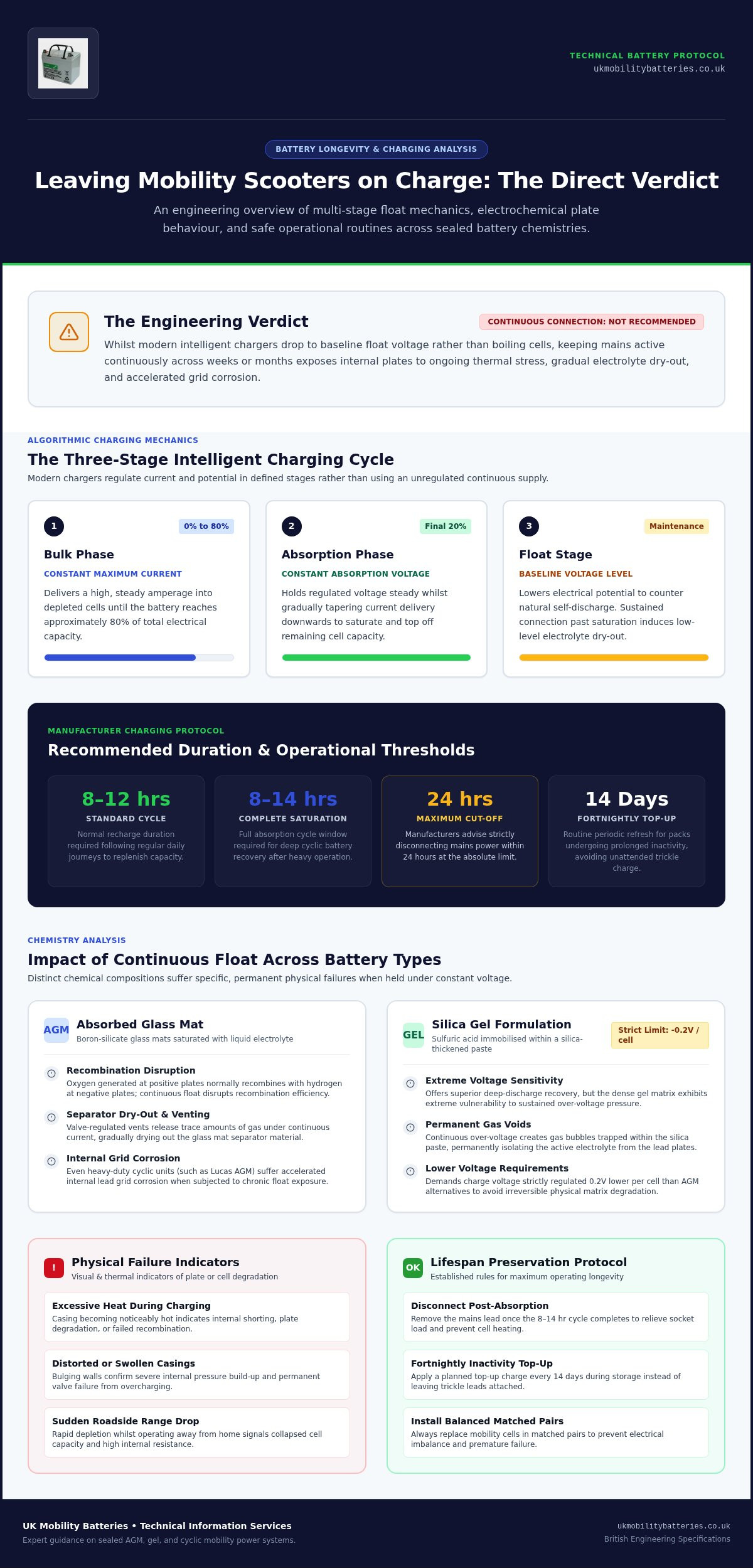
Modern mobility chargers utilise algorithmic charging cycles rather than unregulated electrical feeds. They operate across three specific stages:
- Bulk Phase: Delivers maximum constant current until the battery reaches roughly 80% capacity.
- Absorption Phase: Holds constant absorption voltage whilst gradually tapering current down to top off the remaining 20%.
- Float Stage: Lowers the electrical potential to a steady maintenance level.
Understanding these float voltage mechanics clarifies how the charger offsets natural internal self-discharge without immediate boiling. Unlike legacy unregulated trickle chargers that forced continuous current through cells until electrolyte boiled away, smart chargers regulate supply down to baseline levels. However, holding sealed cells under continuous baseline voltage for weeks still induces low-level electrolyte dry-out.
Overnight Charging vs Unattended Indefinite Connection
A standard replenishment cycle requires between 8 and 14 hours following active daily use. Major equipment manufacturers advise disconnecting the unit within 24 hours at the absolute outside. Prolonged, indefinite connection serves no functional benefit once the chemical absorption phase completes.
Disconnecting the mains lead once charging finishes relieves domestic wall sockets from continuous load and prevents internal heating. Technicians frequently address whether you can overcharge a mobility scooter battery when using modern hardware. The reality sits between common extremes: you won't instantly destroy modern sealed lead-acid cells overnight, but leaving mobility scooter on charge all the time over long periods slowly degrades internal plates through continuous thermal exposure.
Battery Chemistries: How AGM, Gel, and Lithium Handle Continuous Current
A battery's internal construction dictates how it reacts to persistent electrical current. Absorbed Glass Mat (AGM) remains the predominant chemistry across modern British mobility scooters, followed by silica gel and lithium formulations. Subjecting these distinct chemistries to identical charging habits is a primary driver of premature capacity loss. Leaving mobility scooter on charge all the time produces vastly different electrochemical reactions across these designs.
Absorbed Glass Mat (AGM) Deep-Cycle Characteristics
AGM batteries rely on fine boron-silicate glass mats saturated with liquid electrolyte pressed tightly between lead plates. Under standard float current, oxygen generated at the positive plate recombines with hydrogen at the negative plate. Sustained, continuous float voltage disrupts this recombination efficiency. The valve-regulated vents release trace amounts of gas, gradually drying out the glass mat separator material. Heavy-duty cyclic units, such as Lucas sealed AGM deep-cycle ranges, feature robust plate construction to withstand daily discharge cycles, yet chronic float exposure will eventually accelerate internal grid corrosion.
Gel Cell Vulnerability to Voltage Spikes
Gel batteries immobilise sulfuric acid within a silica-thickened paste. This chemistry provides resilient deep-discharge recovery, but the gelled medium exhibits extreme sensitivity to sustained electrical pressure. When subjected to continuous over-voltage, gas bubbles form within the dense silica mass. These gas pockets create permanent voids, mechanically isolating the electrolyte from the active lead plate material. Gel batteries require strictly regulated charge voltages, typically 0.2V lower per cell than AGM variants, to prevent this irreversible matrix damage.
Lithium-Ion Considerations and Integrated Battery Management Systems
Lithium-based mobility packs operate under entirely different electrochemistry and must never remain connected indefinitely. An internal Battery Management System (BMS) balances individual cells and disconnects charging circuits once peak voltage thresholds are achieved. However, leaving mobility scooter on charge all the time holds cells at their maximum operational potential under active mains supply. Storing cells at 100% state-of-charge accelerates chemical degradation within the cathode. In accordance with NFPA lithium-ion battery safety guidelines, users should unplug the equipment promptly once charging concludes, keeping transportable packs at 50% to 80% charge during extended storage.
If your existing cells display diminished runtimes from historical charging errors, selecting matched replacement packs from UK Mobility Batteries restores original operating range with fresh cyclic stock.
What Happens When You Leave a Mobility Scooter Plugged in Continuously?
A widespread misconception suggests that keeping a charger connected permanently causes enormous domestic electricity bills. In reality, a modern three-stage charger in maintenance mode draws negligible standby wattage. The genuine danger of leaving mobility scooter on charge all the time relates directly to internal battery degradation, elevated operating temperatures, and mechanical fatigue within the charging hardware itself.
Electrolyte Loss and Positive Grid Corrosion
Sealed valve-regulated lead-acid (VRLA) batteries depend on internal pressure equilibrium. Sustained exposure to continuous float micro-current steadily accelerates positive grid oxidation. Over months of uninterrupted mains exposure, the internal temperature creeps upward, triggering the pressure-relief safety valves. Each venting episode permanently expels minute amounts of hydrogen and oxygen. Because sealed AGM and gel units cannot be topped up with distilled water, this cumulative moisture loss starves the plates, causing an irreversible drop in ampere-hour capacity and shortening daily travel range.
Thermal Stress and Domestic Mains Hazards
Charging produces heat as a natural electrochemical byproduct. When a scooter remains plugged into mains power inside an unventilated hallway, under-stairs cupboard, or domestic shed, ambient heat accumulates around the battery casing. Excessive ambient temperature accelerates internal self-discharge and grid corrosion exponentially. Furthermore, permanent connection leaves sensitive control circuitry vulnerable to unpredictable voltage spikes across the domestic grid, as detailed in the ultimate guide to mobility scooter batteries.
Charger Component Fatigue and Premature Failure
External chargers consist of electronic switching components, transformers, and smoothing capacitors designed to manage high current loads during active replenishment. Subjecting these components to continuous mains energisation without cooling breaks induces steady hardware fatigue:
- Capacitor Degradation: Prolonged thermal exposure dries out electrolytic smoothing capacitors, resulting in noisy DC output.
- Voltage Drift: Aging internal resistors can cause the float voltage to wander outside strict tolerance limits, silently undercharging or over-volting connected cells.
- Thermal Runaway Risks: A degraded charger paired with aging cells creates an unmonitored hazard, particularly when users leave properties unoccupied during extended holidays.
Avoiding the habit of leaving mobility scooter on charge all the time ensures both the off-board charging unit and the internal cells remain within safe thermal operating parameters.
The Optimal Charging Routine: Practical Rules for Battery Longevity
Maintaining sealed lead-acid packs requires balancing two distinct operational hazards: plate sulphation from undercharging and grid corrosion from chronic over-connection. Establishing an exact, disciplined routine eliminates the temptation of leaving mobility scooter on charge all the time, ensuring your equipment remains ready for daily travel without risking cell desiccation.
Routine Daily and Weekly Recharging Steps
Adopt this sequential charging protocol after every day of active scooter use:
- Power Down and Inspect: Switch off the scooter ignition and remove the key. Check the charging port and cables for accumulated dust, moisture, or bent pins.
- Connect the Scooter First: Insert the three-pin XLR plug securely into the scooter charging port before turning on the domestic mains socket. This prevents harmful electrical arcing across the terminal pins.
- Complete the Cycle: Allow the charger to run uninterrupted through bulk, absorption, and float phases until the status LED indicates steady green, which typically takes 8 to 12 hours.
- Disconnect Promptly: Switch off the mains wall socket and disconnect the charger lead. Always grasp the plug body rather than tugging the cable.
Managing Inactive Periods and Off-Season Storage
Scooters stored away during cold winter months or extended holidays should never remain tethered to the mains indefinitely. Instead of leaving mobility scooter on charge all the time, connect the charger for an 8 to 12-hour refresh session once every fortnight. This bi-weekly top-up counters natural parasitic drain and self-discharge without subjecting internal plates to continuous thermal stress. Store the machine in a dry, frost-free environment kept between 10°C and 20°C. Sub-zero temperatures severely restrict chemical reactivity and can permanently depress capacity.
Avoiding Destructive Deep Discharges
Lead-acid batteries do not possess a memory effect. Allowing the battery gauge to fall into the red sector drives discharge levels below 50% capacity, initiating rapid lead-sulphate crystallization across the plates. These hardened sulphate deposits resist standard recharging cycles and permanently reduce usable ampere-hour capacity. Recharging your pack after every day of use, even following brief trips, keeps the active paste chemically responsive.
When aging cells fail to hold charge despite following a disciplined schedule, upgrading your power pack is essential. Order replacement Lucas deep-cycle mobility batteries from UK Mobility Batteries to restore maximum travel range with fresh, high-grade AGM technology delivered nationwide.
Recognising Damaged Cells and Selecting the Correct Replacement
Identifying the physical and electrical symptoms of damaged cells allows you to intervene before experiencing total power loss away from home. Chronic over-connection accelerates cell degradation, but identifying physical damage early ensures you can arrange a replacement before being stranded. If past habits included leaving mobility scooter on charge all the time, inspect your power pack for visible deformation and abnormal electrical behaviour.
Signs Your Battery Has Suffered Overcharge or Age Fatigue
Damaged sealed lead-acid batteries display clear physical indicators when internal components break down:
- Bulging or Warped Casings: Excessive internal pressure builds up when continuous charging outpaces the valve-regulated venting rate, causing the outer ABS plastic walls to distort or bow outwards.
- Excessive Heat and Acidic Odours: If a battery feels noticeably hot to the touch during float charging or emits an acrid, pungent sulphur smell, internal plate shorting has commenced.
- Immediate Voltage Drop Under Load: A damaged battery might show a green "ready" light on the charger, but the console gauge instantly plunges into the red as soon as you squeeze the throttle on an incline.
For a detailed breakdown of electrical fault-finding steps, consult our comprehensive guide on mobility scooter battery troubleshooting.
Choosing the Right Replacement Capacity for Your Equipment
Mobility scooters operate on a 24-volt circuit powered by two 12-volt batteries connected in series. You must always replace these batteries in balanced, matched pairs. Installing a single new battery alongside an older, tired unit creates an immediate electrical imbalance. The charger cannot assess individual cell health across mismatched pairs; it overcharges the new battery while chronically undercharging the degraded one, ruining both packs within months.
Match your replacement units directly to the physical tray dimensions and electrical specifications of your scooter chassis. Compact boot scooters typically require Lucas 12V 12Ah or Lucas 12V 20Ah mobility batteries. Mid-range pavement models depend on Lucas 12V 34Ah sealed AGM deep cycle batteries, whilst larger road-class machines demand heavy-duty Lucas 12V 50Ah or Lucas 12V 55Ah sealed AGM mobility batteries to support longer travel ranges and high-torque motors.
Selecting fresh, cyclic-rated AGM stock from a dedicated British distributor guarantees optimal internal plate purity and dependable everyday performance. Avoiding the practice of leaving mobility scooter on charge all the time, coupled with high-grade replacement cells, delivers maximum operating life across thousands of miles.
Protecting Your Battery Investment for Dependable Everyday Travel
Adopting a structured replenishment routine remains the most effective way to safeguard your machine's range and plate integrity. Whilst intelligent multi-stage chargers prevent instantaneous overcharging, leaving mobility scooter on charge all the time promotes gradual moisture venting and positive grid corrosion. Disconnecting your charger after a standard 8 to 12-hour cycle shields delicate internal glass mat separators from chronic thermal stress, whilst a bi-weekly refresh during storage periods prevents plate sulphation without the hazards of continuous mains exposure.
When aging cells inevitably reach the end of their service life, restoring full travel capability requires balanced, high-grade replacements. UK Mobility Batteries supplies trusted, maintenance-free Lucas AGM batteries across the United Kingdom, ensuring reliable deep-cycle performance backed by fast national delivery and specialist technical support. Explore our range of premium replacement mobility scooter batteries to secure dependable daily range and travel with total confidence.
Frequently Asked Questions
Is it safe to leave my mobility scooter on charge all night?
Yes, overnight charging is safe and standard operational practice for mobility equipment. Modern multi-stage intelligent chargers automatically reduce current to a low-amperage float maintenance stage once the cells reach full capacity, which usually takes between 8 and 12 hours. Unplugging the unit the following morning ensures the domestic wall socket isn't exposed to continuous electrical load and protects internal components from unnecessary heat buildup.
Can leaving a mobility scooter plugged in ruin the battery permanently?
Yes, leaving mobility scooter on charge all the time across uninterrupted weeks or months causes permanent internal damage. Constant electrical potential forces the pressure-relief valves on sealed AGM or gel units to release trace amounts of gas. This irreversible moisture loss dries out the internal separators, accelerating positive plate corrosion and causing a lasting drop in usable travel range that cannot be restored.
What happens if you leave a mobility scooter charger plugged in without the scooter connected?
Leaving an idle charger plugged into a live wall socket draws continuous phantom electricity and causes needless component fatigue. The internal transformer and smoothing capacitors remain energised under mains voltage, generating low-level heat that shortens the charger's operational life. It also leaves the sensitive electronics vulnerable to unexpected mains power surges. Always switch off the wall socket when the machine isn't connected.
How long should a mobility scooter take to charge from empty?
A standard sealed lead-acid battery set typically requires between 8 and 12 hours to complete a full recharge from a depleted state. Smaller 12Ah packs on compact travel scooters may complete the initial bulk phase slightly quicker, whilst larger 50Ah or 55Ah heavy-duty batteries require the full duration. Allow the charger to complete its absorption stage until the indicator light illuminates solid green.
Should I leave my mobility scooter plugged in during the winter months?
No, you shouldn't leave the equipment continuously connected to mains power throughout winter storage. Rather than leaving mobility scooter on charge all the time, plug the machine in for an 8 to 12-hour top-up once every fortnight. Store the scooter in a dry, frost-free location kept between 10°C and 20°C to counteract natural self-discharge without causing continuous plate wear or electrolyte desiccation.
Does keeping a mobility scooter on charge continuously use a lot of electricity?
No, keeping a charger plugged in continuously does not draw massive amounts of domestic electricity. Once an intelligent multi-stage charger completes the main bulk cycle and enters float maintenance, it consumes negligible standby wattage to balance resting voltage. The primary risk of continuous connection isn't high electric utility costs, but rather thermal stress, charger component fatigue, and accelerated plate degradation within the cells.
How do I know when my mobility scooter batteries are fully charged?
Your batteries are fully replenished when the charging unit's status LED turns to a steady green light. Most multi-stage chargers show red or amber during the constant-current bulk phase before switching over. You shouldn't rely entirely on the scooter dashboard meter immediately after charging, as surface charge can provide an artificially high reading until the motor draws active driving current.
What are the symptoms of an overcharged mobility scooter battery?
Primary warning signs include swollen or bulging plastic outer casings, excessive heat radiating through the battery box, and an acrid, pungent sulphur smell. If a charger remains stuck in bulk mode for over 14 hours or the battery gauge plunges rapidly as soon as you accelerate despite showing green, internal cells have degraded and require immediate replacement in matched pairs.