
How to Make Mobility Scooter Batteries Last Longer: The Ultimate Maintenance Guide
Did you know that nearly 90% of mobility scooter battery failures are caused by poor chemical management rather than actual mechanical wear? Many users find themselves frustrated by a sudden loss of range or the high cost of frequent replacements, largely because they haven't been shown how to make mobility scooter batteries last longer through proper technical care. It is a common struggle; you rely on your scooter for independence, yet conflicting advice online makes it difficult to know which charging habits actually protect your investment.
We understand that reliability is your primary concern, especially when tackling steep hills or long journeys. This guide shares professional maintenance techniques that can double the lifespan of your power cells, often extending their service life to 24 months or more. You will discover a simple, daily routine designed to optimise the cycle life of Lucas AGM batteries and other deep-cycle models. We will move through the technical requirements of charging, storage, and capacity management to ensure your equipment remains dependable and ready for use whenever you need it. By following these expert-led steps, you can eliminate the anxiety of being stranded and maintain peak performance for years to come.
Key Takeaways
- Understand that battery longevity is governed by "Cycle Life," the specific number of full charge and discharge repetitions a unit can perform before chemical depletion occurs.
- Master the essential 8 to 12-hour saturation charging protocol to learn exactly how to make mobility scooter batteries last longer and maintain reliable voltage on inclines.
- Implement a proper conditioning phase for new AGM batteries, as they require a "break-in" period of 10 to 20 cycles to reach their full Ampere-hour capacity.
- Protect your power cells from extreme temperature fluctuations and manage self-discharge rates during storage to prevent permanent loss of chemical performance.
- Identify the technical signs of battery failure and always replace units in matched pairs to ensure balanced power distribution and system health.
Understanding Cycle Life in AGM and Gel Mobility Batteries
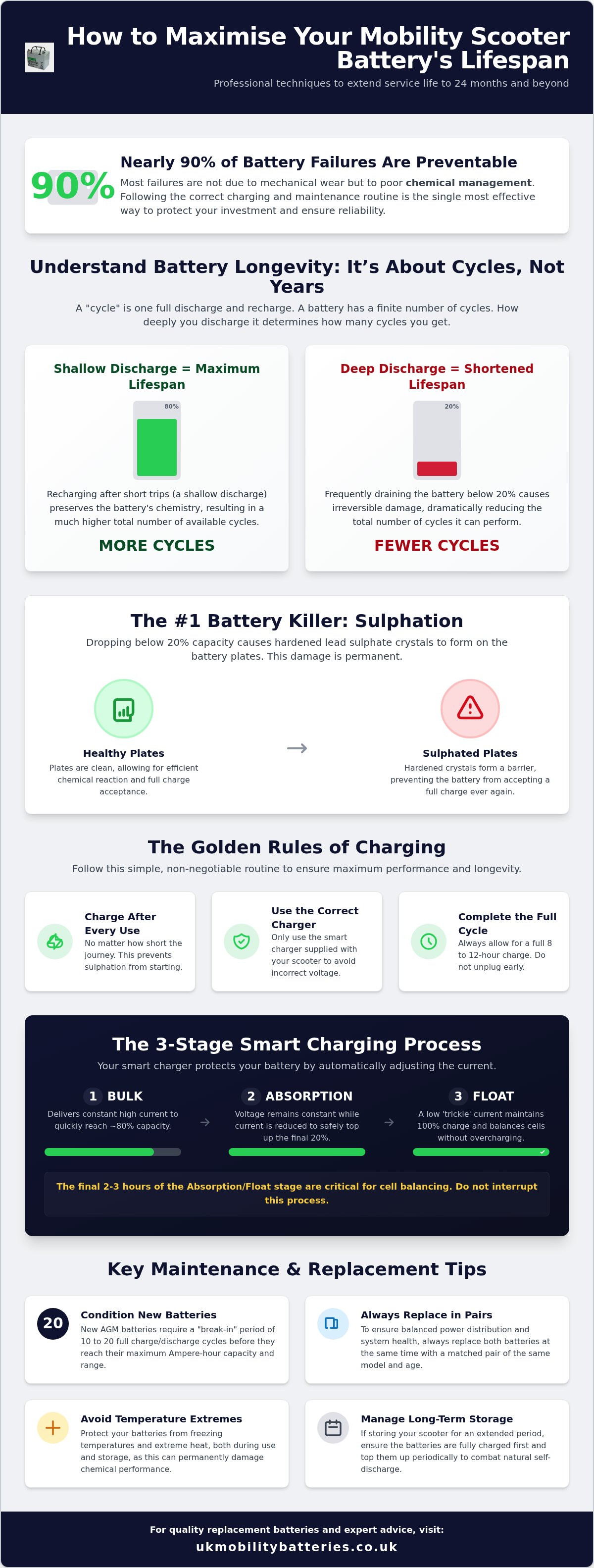
Battery longevity isn't measured in months; it's measured in cycles. A "cycle" represents one full discharge and one subsequent full recharge. Every battery has a finite number of these repetitions before its internal chemistry degrades. Understanding this technical limit is the first step in learning how to make mobility scooter batteries last longer. Unlike a standard car battery designed for a short, high-current burst to start an engine, a Deep-cycle battery is engineered to provide a steady, reliable current over several hours of operation.
In the UK mobility market, Sealed Lead Acid (SLA) technology is the industry standard. Most high-performance scooters utilise Absorbed Glass Mat (AGM) batteries. In these units, the electrolyte is held in a fine fibreglass mat between the lead plates. This construction makes the battery spill-proof and resistant to the vibrations encountered on uneven pavements. The total number of available cycles is directly linked to the Depth of Discharge (DoD). If you frequently drain your battery to near-zero, you will exhaust its cycle life much faster than a user who recharges after every short trip.
The Chemistry of Deep Cycle Performance
Lucas batteries use heavy-duty lead plates that are significantly thicker than those in automotive batteries. These thick plates allow the chemical reaction to penetrate deeper without causing structural damage to the lead. Whilst these batteries are classified as "maintenance-free" because they're sealed and don't require water top-ups, they aren't "care-free". Technical longevity depends on maintaining the correct chemical balance through disciplined charging. Using the correct Ah capacity for your specific scooter model ensures the plates aren't overworked, which is a key factor in how to make mobility scooter batteries last longer.
Why Deep Discharges are the #1 Battery Killer
Deeply discharging your battery below 20% capacity causes a harmful process called sulphation. When a battery stays in a discharged state, lead sulphate crystals form on the internal plates. If the battery isn't recharged immediately, these crystals harden. This creates a permanent barrier that prevents the battery from accepting a full charge in the future. Many users believe in a "memory effect" myth, thinking they should wait until the battery is flat before charging. This is incorrect for lead-acid technology. Frequent, shallow discharges followed by full recharges are far better for the battery's health than occasional deep discharges. Dropping below the critical 20% threshold causes irreversible chemical degradation that no charger can fix.
The Golden Rules of Charging for Maximum Battery Longevity
Discipline in your charging routine is the most effective way to protect your investment. You must charge your batteries after every use, regardless of the distance travelled. Even a ten-minute journey initiates the chemical discharge process. Leaving the battery in a partially discharged state, even for a few hours, allows lead sulphate to begin hardening on the plates. It's a simple habit fundamental to how to make mobility scooter batteries last longer. You should also ensure you use the specific charger supplied with your vehicle; using a non-specialist or automotive charger can deliver the wrong voltage, leading to permanent cell damage.
The Three Stages of a Proper Charge Cycle
Modern smart chargers operate in three distinct phases to ensure battery health. The first is the Bulk stage, where the charger delivers a constant current to reach roughly 80% capacity. This is followed by the Absorption stage, which slows the current to safely push the battery to 100%. Finally, the charger enters the Float stage. This maintains the battery at a full charge without generating excess heat. According to the U.S. Battery care and maintenance guide, this final phase is vital for cell balancing. The final 2 to 3 hours of float charging are critical for ensuring all cells are balanced. A full charge cycle typically requires 8 to 12 hours to reach total saturation. You can't rush this process; unplugging too early prevents the battery from completing the necessary chemical conversion.
Best Practice for Daily and Weekly Charging
Establish a routine of plugging in your scooter as soon as you return home. This prevents the voltage from resting at a low level. Many users ask, Can You Overcharge a Mobility Scooter Battery? The short answer is no, provided you use a functional smart charger that switches to a float mode. In addition to daily charging, we recommend a full 24-hour "equalisation" charge once a week. This extended period ensures all internal cells reach an identical voltage level, which is critical for how to make mobility scooter batteries last longer. If your batteries aren't performing as they should, upgrading to high-quality Lucas mobility batteries ensures you have the technical foundation for long-term reliability.
The Conditioning Phase: Optimising New Batteries
When you install a fresh set of Lucas AGM batteries, they don't immediately operate at their peak rated capacity. The internal chemical structure requires a series of charge and discharge repetitions to activate the lead plates fully. This initial period is vital for anyone searching for how to make mobility scooter batteries last longer, as mismanagement during the first few weeks can permanently limit the battery's total potential lifespan. Proper conditioning ensures the active material on the lead plates is fully utilised, providing the reliable range you expect from a premium power source.
Why New Batteries Seem to Have Shorter Range
It's common for users to notice a slightly reduced range during the first fortnight of scooter use. This isn't a technical defect; it's a characteristic of lead-acid chemistry. The thick lead plates in deep-cycle batteries need to be "exercised" to open up the active material and allow the electrolyte to penetrate deeply. As you use and recharge the battery correctly, the capacity will gradually increase. Expect your batteries to reach their maximum performance level after approximately 15 to 20 cycles. Setting realistic expectations during this period prevents the temptation to over-work the batteries before they're ready.
The First 20 Cycles: A Step-by-Step Protocol
To ensure long-term plate health, you must follow a disciplined protocol during the break-in period. New batteries are more susceptible to heat damage and chemical stress than seasoned ones. Following these steps is a core part of how to make mobility scooter batteries last longer:
- Limit your journeys to approximately 50% of the expected total range for the first 10 trips.
- Avoid heavy electrical stress, such as climbing steep hills or carrying maximum weight loads, during the first week.
- Ensure a full 12-hour charge follows every single journey, regardless of how short the trip was.
- Never use "boost" or "fast charge" settings on your charger if available; the rapid heat buildup can warp new lead plates.
- Do not allow the battery to sit in a discharged state for any length of time during this phase.
By being disciplined during this conditioning phase, you establish the chemical foundation for a battery that remains dependable for 24 months or longer. This period is about building "stamina" within the cells. Once the first 20 cycles are complete, the battery chemistry is stable enough to handle the full range and power demands of your daily routine without the risk of premature degradation.
Environmental Factors and Storage Management
Temperature management is a technical necessity for lead-acid chemistry. High temperatures, particularly those above 30°C, accelerate internal corrosion and electrolyte evaporation. Conversely, extreme cold increases internal resistance, making it harder for the battery to deliver power. This thermal sensitivity is a vital consideration for how to make mobility scooter batteries last longer. Every AGM battery also has a natural self-discharge rate. Even when your scooter is switched off, the internal chemistry slowly depletes, typically losing 3% to 5% of its total charge every month. Ignoring this process during periods of inactivity is a primary cause of premature battery failure.
Managing Batteries in the British Winter
During the UK winter, a drop in temperature directly reduces the available Amp-hour capacity of your cells. At 0°C, a battery might only deliver 70% of its rated performance compared to its capacity at 20°C. This is a temporary chemical slowdown, but it requires planning for shorter journeys to avoid deep discharge. Avoid storing your scooter or batteries on cold concrete floors in garages or outbuildings. This causes "thermal bridging," where the cold floor draws heat directly from the battery casing, further depressing the chemical activity. For more detailed seasonal strategies, consult our guide on Winter Mobility Scooter Battery Care.
Storage Protocol for Infrequent Users
If you don't use your scooter daily, you must implement a strict maintenance schedule to prevent sulphation. The "Once a Month" rule is essential: even if the scooter hasn't been used, you must plug it in for a full 12-hour saturation charge every 30 days. This counteracts the natural self-discharge rate and keeps the lead plates active. We also recommend disconnecting the battery loom or removing the battery pack entirely if the vehicle will be idle for more than two weeks. This prevents "parasitic" power drain from onboard electronics, such as the controller memory or clock, which can pull voltage below the critical 20% threshold.
The ideal storage environment is a dry, ventilated area maintained between 10°C and 15°C. Avoid damp sheds, as moisture can lead to terminal corrosion and electrical shorts. Maintaining a stable environment is a technical pillar of how to make mobility scooter batteries last longer. If your current storage conditions have already compromised your power cells, you can browse our range of Lucas mobility batteries to find a durable replacement specifically engineered for reliable performance in the UK climate.
Identifying Failure and Selecting High-Quality Replacements
Even the most disciplined maintenance routine cannot stop the eventual chemical exhaustion of lead-acid cells. Recognising the technical indicators of end-of-life is a critical skill for any owner concerned with how to make mobility scooter batteries last longer. When internal resistance becomes too high, the battery can no longer provide the necessary current for high-torque demands. This typically manifests during the most strenuous parts of your journey, such as climbing steep inclines or navigating over kerbs. At this stage, chemical degradation is irreversible, and further charging will not restore the lost capacity.
Signs Your Maintenance Efforts Can No Longer Save the Cells
You should monitor your scooter's performance for specific technical red flags. If the vehicle feels sluggish or "struggles" on familiar routes that it previously handled with ease, the batteries are likely failing. Watch the battery indicator carefully whilst driving; if the needle or LEDs drop rapidly under load but immediately recover when you stop, the cells can no longer maintain stable voltage. In extreme cases, batteries may become hot to the touch or emit a distinct sulphur smell during the charging process. These are signs of internal short-circuiting or "thermal runaway," and the batteries must be disconnected and replaced immediately for safety.
Choosing the Correct Replacement for Future Longevity
When replacement becomes necessary, you must replace batteries in matched pairs. Installing a single new battery alongside an old one is a technical error. The older, weaker battery will have a different internal resistance, causing the charger to overwork the new unit and leading to premature failure of both. This is a fundamental rule in how to make mobility scooter batteries last longer. You should also ensure the physical dimensions of the new units match your battery box exactly to prevent vibration damage.
Consider "uprating" your capacity if your scooter's battery tray allows for it. For example, moving from a Lucas 12V 34Ah Sealed AGM Deep Cycle Battery to a Lucas 12V 50Ah Mobility Battery provides a larger energy reservoir. This means that for any given journey, the Depth of Discharge (DoD) is lower. As established in previous sections, a shallower discharge directly correlates to a higher number of available cycles. Choosing a premium brand like Lucas ensures consistent plate quality and technical reliability. To ensure your vehicle remains dependable, browse our range of Lucas mobility batteries for a professional-grade power solution delivered directly to your door.
Maximising Your Mobility Investment
Mastering the technical requirements of lead-acid chemistry is the most effective way to protect your independence and avoid the high cost of frequent replacements. By prioritising a disciplined 8 to 12-hour charging cycle after every journey and managing the initial conditioning phase correctly, you've established the foundation for how to make mobility scooter batteries last longer. Remember that environmental control and regular monthly recharges during periods of inactivity are essential for preventing irreversible sulphation and maintaining reliable voltage on challenging terrain.
As official stockists of Lucas high-performance batteries, we provide the specialist technical support needed to help you select the correct Ah capacity for your specific model. Our deep-cycle AGM units are engineered for durability and are available with fast national delivery to keep you moving without delay. If your current power cells are showing signs of diminished range or capacity, it's time to upgrade to a professional-grade solution. View our full range of premium Lucas mobility batteries today and ensure your scooter remains ready for every journey. With the right care and high-quality equipment, your mobility remains dependable and secure.
Frequently Asked Questions
Can I leave my mobility scooter on charge all the time?
Yes, provided you use a modern smart charger. These devices automatically switch to a "float" mode once the battery reaches 100% saturation, which maintains the voltage without generating excess heat. However, it's technically best practice to disconnect the charger if the scooter will be idle for more than a few days. Constant charging on older, non-smart equipment can lead to electrolyte evaporation and permanent plate damage over time.
How long should a new set of mobility scooter batteries last?
A high-quality set of AGM batteries, such as those from the Lucas range, typically lasts between 12 and 24 months. This lifespan is heavily dependent on your charging discipline and the average depth of discharge. Users who follow professional protocols for how to make mobility scooter batteries last longer often see their units exceed the 24-month mark. Neglecting the conditioning phase or leaving batteries flat can reduce this significantly.
Is it better to charge mobility batteries every day or only when they are flat?
You must charge your batteries every day they are used. Lead-acid chemistry does not have a "memory effect"; instead, it suffers from sulphation when left in a discharged state. Draining a battery until it is flat causes permanent chemical damage to the lead plates. To maintain peak performance, plug in your charger as soon as you return from a trip, regardless of how short the journey was.
Can I use a car battery charger for my mobility scooter?
No, you should never use a standard car battery charger for mobility scooter batteries. Car chargers are designed for starter batteries and deliver a high-amperage burst that can warp the thick plates of a deep-cycle AGM battery. Mobility scooters require a specific three-stage smart charger that manages the bulk, absorption, and float phases. Using the wrong equipment will void your warranty and shorten the battery's service life.
Why do my mobility batteries lose charge faster in the winter?
Cold temperatures increase internal resistance, which slows the chemical reaction required to release energy. At 0°C, a battery's effective capacity can drop by approximately 30% compared to its performance at 20°C. This is a temporary physical effect, but it means you must plan for a reduced range during the British winter. Storing the scooter or the battery pack in a dry, heated area helps maintain the chemical activity needed for longer journeys.
What is the difference between AGM and Gel mobility batteries?
AGM batteries use a fibreglass mat to immobilise the electrolyte, whilst Gel batteries use a silica additive to turn the acid into a thick paste. AGM units generally offer superior vibration resistance and are more cost-effective for daily pavement use. Gel batteries are often reserved for specialised applications requiring extremely deep discharge cycles. Both are sealed and maintenance-free, but AGM remains the industry standard for most UK mobility scooters.
Should I disconnect my batteries if I am not using the scooter for a month?
Yes, disconnecting the battery loom is recommended for storage periods exceeding two weeks. This prevents "parasitic" power drain from the scooter's onboard electronics, which can slowly deplete the cells below a recoverable voltage. Even when disconnected, you must perform a full 12-hour saturation charge every 30 days. This maintenance step is vital for how to make mobility scooter batteries last longer by counteracting the natural self-discharge rate of the chemistry.
Can I replace just one battery if the other one is still working?
You should always replace mobility batteries in matched pairs. If you connect a new battery to an older one, the charger cannot balance the voltage correctly because the internal resistance levels differ. The charger will likely overcharge the new battery whilst undercharging the old one, leading to the premature failure of both units. Using a matched set ensures balanced power delivery and protects your technical investment in the long term.