
How to Dispose of Mobility Scooter Batteries: A Complete UK Guide
Your old lead-acid batteries are more than just a heavy storage burden; they are legally classified as hazardous industrial waste under the Waste Batteries and Accumulators Regulations 2009. It's understandable if you feel concerned about the risk of acid leaks or the physical difficulty of transporting these dense units to a recycling centre. You likely want a straightforward method to clear out old equipment without falling foul of UK environmental laws.
This guide provides a precise technical roadmap on how to dispose of mobility scooter batteries whilst ensuring your vehicle remains operational with the correct power specifications. We'll explain the specific WEEE obligations that apply to retailers and users, alongside a list of approved locations for safe disposal. Beyond the logistics of waste, we will help you verify if your current cells actually require replacement. You'll learn how to identify the correct technical specifications for your next set, whether you require Lucas 12V 20Ah mobility batteries or higher-capacity 55Ah AGM units, to ensure your equipment maintains peak performance and reliability.
Key Takeaways
- Understand why lead-acid units are classified as hazardous waste and how WEEE regulations dictate their legal handling in the UK.
- Follow a safe removal sequence by disconnecting the negative terminal first to prevent short-circuits during the extraction process.
- Identify how to dispose of mobility scooter batteries through Local Authority Household Waste Recycling Centres or authorised retailer take-back schemes.
- Perform essential technical checks on your charger and terminals to confirm whether a full battery replacement is genuinely required.
- Select the correct replacement by matching physical dimensions and technical specifications with high-performance Lucas AGM batteries.
Why Mobility Scooter Batteries Require Specialist Disposal
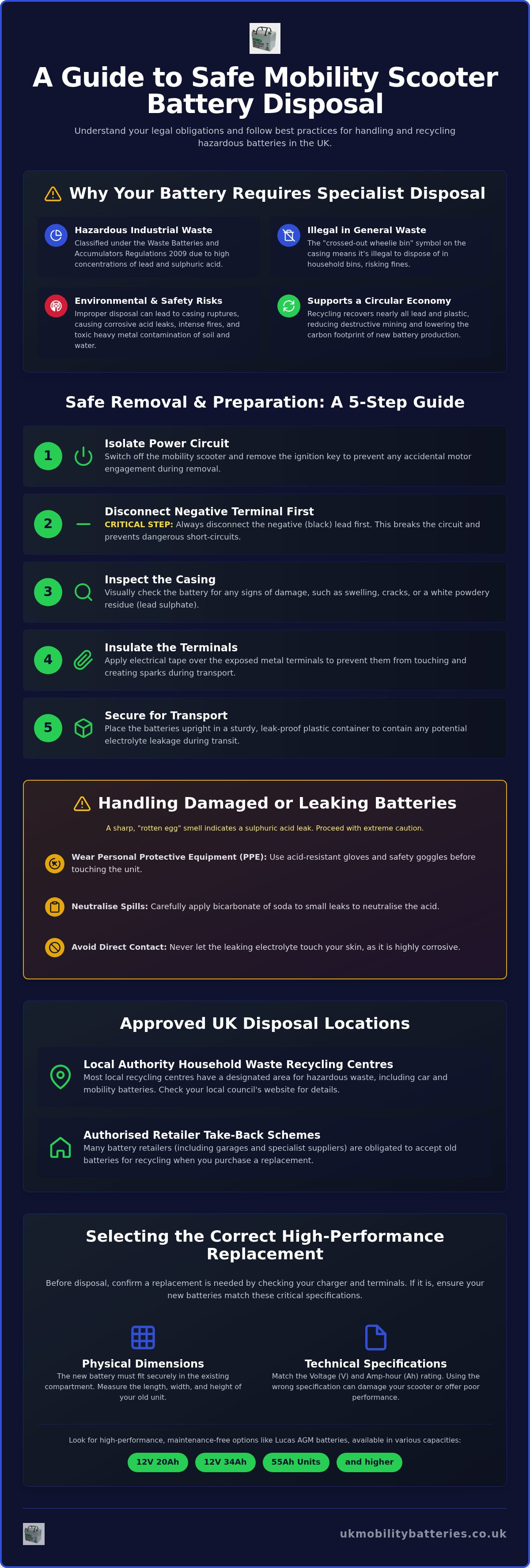
Mobility scooter batteries are classified as hazardous waste in the UK. This classification stems from their internal chemistry, which relies on high concentrations of lead and sulphuric acid. These substances pose significant risks to human health and the environment if they are not managed through professional channels. Under the Waste Batteries and Accumulators Regulations 2009, mobility batteries are categorised as industrial batteries. This means they cannot be placed in your standard kerbside recycling or general waste bins. Understanding how to dispose of mobility scooter batteries is a legal requirement for UK residents to prevent environmental damage and ensure public safety.
The Chemistry of Your Mobility Battery
Most modern mobility aids utilise Sealed Lead Acid (SLA) or Absorbed Glass Mat (AGM) technology. These batteries, such as the Lucas 12V 34Ah or 55Ah units, are maintenance-free and spill-proof under normal conditions. However, they remain chemically volatile at the end of their service life. You will notice a "crossed-out wheelie bin" symbol on the battery casing. This indicates that the unit must be processed through a formal battery recycling process. Lead is a highly valuable material in manufacturing. By recycling your old Lucas 12V 20Ah or 50Ah batteries, you contribute to a circular economy where nearly all the lead and plastic can be recovered to produce new power cells. This reduces the need for destructive mining and lowers the carbon footprint of battery production.
Risks of Incorrect Disposal
Improper disposal creates immediate physical dangers. If a lead-acid battery enters a standard refuse collection vehicle, the compaction process can rupture the outer casing. This often leads to short-circuits and intense fires that are difficult for emergency services to extinguish. There is also a severe risk of chemical burns. Leaking electrolyte (sulphuric acid) is highly corrosive and can cause permanent tissue damage upon contact.
Legal consequences also exist for those who ignore disposal protocols. Dumping hazardous waste or placing it in domestic bins is an offence under UK environmental law. Local authorities have the power to issue fixed penalty notices or pursue prosecutions for fly-tipping. Learning how to dispose of mobility scooter batteries correctly protects you from these liabilities whilst ensuring that toxic heavy metals do not leach into the soil or water table.
Preparing Your Batteries for Safe Transportation and Recycling
Before you transport lead-acid units to a collection point, you must ensure they are stable and electrically inert. Proper preparation is essential for personal safety and compliance with the UK government guidance on battery recycling. Follow these five technical steps to prepare your equipment for extraction and transit.
First, switch off the mobility scooter and remove the key. This isolates the circuit and prevents accidental motor engagement. Second, carefully disconnect the battery terminals. You must always start with the negative (black) lead. Removing the negative lead first breaks the circuit to the chassis; this significantly reduces the risk of creating a short-circuit if your tools accidentally touch the metal frame. Third, perform a visual inspection of the battery casing. Look for swelling, cracks, or white powdery residue, which often indicates lead sulphate buildup. Fourth, apply electrical tape over the exposed terminals to prevent sparks during movement. Finally, place the batteries in a sturdy, leak-proof plastic container to contain any potential electrolyte seepage during the journey.
Handling Damaged or Leaking Batteries
If you detect a sharp, rotten egg smell, the battery is likely "gassing" and may be leaking sulphuric acid. This requires immediate caution and specific handling protocols. Don't handle these units without personal protective equipment (PPE). Wear acid-resistant gloves and eye protection before attempting removal. If you notice small amounts of leaked electrolyte, you can neutralise the liquid using bicarbonate of soda. Avoid direct skin contact with the substance at all times. If the damage to the casing is extensive, it's often safer to consult a specialist before moving the unit. Once you've safely removed the old cells, you can browse replacement Lucas AGM batteries to find a compatible high-performance unit for your device.
Storage Before Disposal
If you can't visit a recycling centre immediately, store the old batteries in a secure location. Keep them out of reach of children and pets. Lead and acid are highly toxic if ingested or touched. Store the units in a cool, dry environment. Extreme temperatures can cause the casing to degrade further, which increases the risk of a rupture. You must never store old batteries in a metal container. Metal is conductive; if the taped terminals fail, the container itself could complete a circuit. This leads to a risk of fire or explosion. A heavy-duty plastic crate is the safest option for temporary storage whilst you finalise how to dispose of mobility scooter batteries in your local area.
Where to Recycle Mobility Scooter Batteries in the UK
Finding a legal and accessible location is the final step in the disposal process. UK residents have several reliable options for managing hazardous industrial waste. The most frequent choice is a Local Authority Household Waste Recycling Centre (HWRC). These facilities are equipped to handle lead-acid chemistry safely. Identifying these sites is vital for safe battery disposal and legal compliance when researching how to dispose of mobility scooter batteries. You can also utilise statutory take-back schemes or professional mobility service providers.
Using Local Authority Recycling Centres
Most councils provide dedicated skips for lead-acid batteries at their HWRCs. To find your nearest facility, use the "Find your local council" tool on the official UK government website. You must check the specific rules for your local centre before travelling. Many sites now require a pre-booked appointment for hazardous waste disposal. It's also necessary to verify that they accept industrial lead-acid units rather than just small portable batteries. Some centres have weight limits per visit. Always inform the site marshals that you are carrying lead-acid batteries upon arrival. They will direct you to the specific hazardous waste zone to prevent cross-contamination with other materials.
Retailer Take-Back Schemes
The Waste Batteries and Accumulators Regulations 2009 impose strict obligations on retailers. Any business selling more than 32kg of portable batteries annually must offer a free take-back service. While mobility batteries are technically industrial, many large distributors and specialist retailers extend these schemes to include them. When you purchase replacements, such as Lucas 12V 50Ah or 55Ah batteries, ask the provider about their recycling protocols. Be aware that standard curbside battery collection schemes, often used for AA or AAA cells, are not suitable for mobility units. The weight and chemical volume of a Lucas 12V 20Ah battery exceed the safety limits for domestic collection vehicles.
Alternative Disposal Routes
Local scrap metal merchants are a viable alternative for how to dispose of mobility scooter batteries. Because lead has a high commodity value, some merchants may pay a small amount based on the weight of the units. Ensure the merchant is a licensed waste carrier before handing over the batteries. Finally, mobility shops and service centres often manage disposal as part of a wider maintenance package. If you are having your scooter serviced or repaired, the technician can usually take the old batteries for professional processing. This removes the logistical challenge of transporting heavy lead-acid units yourself.
Testing Your Batteries Before Deciding to Dispose of Them
Before you commit to the logistics of recycling, you must verify that your power cells have reached the end of their functional life. It's common for users to assume a battery is dead when the fault actually lies with the charging unit or poor electrical connectivity. Determining whether you need to learn how to dispose of mobility scooter batteries or simply clean your terminals can save you significant expense and unnecessary waste. Start with a visual inspection. Look for heavy white or green oxidation on the terminals. This corrosion increases resistance and prevents the battery from receiving a full charge. If the terminals are clean, use a multimeter to measure the resting voltage of each 12V unit after it's been disconnected for at least one hour.
Professional technicians often perform a "drop test" or load test to evaluate a battery's health. This requires specialist equipment that applies a high electrical load to the battery whilst monitoring how quickly the voltage drops. You shouldn't attempt this at home with standard tools. A battery might show a healthy voltage when resting but fail instantly when the scooter motor demands power. If your scooter consistently cuts out under load, the internal plates are likely degraded beyond repair. If your tests confirm a permanent loss of capacity, you can order high-performance Lucas replacement batteries for national delivery.
Interpreting Voltage Readings
A healthy, fully charged 12V AGM battery should show a reading between 12.6V and 12.8V. If your multimeter displays a reading below 10.5V, the battery has likely suffered a cell failure or deep discharge from which it cannot recover. You must be wary of "surface charge," which is a false high voltage reading that appears immediately after charging. To get an accurate measurement, turn on the scooter lights for one minute, turn them off, and then take the reading. A battery reading 12.6V or higher is typically fully charged and may not need disposal.
Common Signs of Genuine Failure
Technical measurements aside, your scooter's behaviour often signals when it's time to research how to dispose of mobility scooter batteries. A primary indicator is a significant loss of torque. If your device struggles to climb small inclines that it previously handled with ease, the batteries can no longer provide the required amperage. Another sign is a deceptive charging cycle. If your charger indicates a "full" state within thirty minutes of being plugged in, the batteries have lost their capacity to store energy. For more detailed diagnostics, read our guide on mobility scooter battery troubleshooting before you proceed to a recycling centre.
Selecting High-Quality Replacements for Your Mobility Device
Once you've identified how to dispose of mobility scooter batteries and cleared your equipment of old units, selecting the correct replacement is critical for vehicle performance. You must match the physical dimensions (length, width, and height) of your original batteries to ensure a secure fit within the battery tray. Premium Lucas AGM batteries are the industry standard for deep-cycle applications. They utilise sealed lead-acid technology, which makes them completely maintenance-free and spill-proof. This technology is essential for mobility devices that are frequently transported or used on varying terrains. Using maintenance-free AGM units ensures that you don't have to monitor electrolyte levels or worry about acid leaks during operation.
Capacity compatibility is equally important. The Amp-hour (Ah) rating determines the range of your scooter. While you must match the voltage, typically 12V units in a 24V series, you have some flexibility with capacity. Ensure your existing charger is compatible with the Ah rating of the new cells. A charger designed for 7Ah batteries might struggle to efficiently charge 55Ah units. Choosing a dependable brand like Lucas ensures that the technical specifications on the label match the actual performance of the battery, providing reliability for high-stakes daily use.
Upgrading Your Capacity
Many users choose to upgrade their range by increasing the Ah rating. Replacing 42Ah batteries with Lucas 12V 50Ah mobility batteries can provide a measurable increase in travel distance per charge. You must verify that the battery tray has sufficient clearance for the larger casing before purchasing. Increasing the capacity is a practical way to enhance your scooter's performance without changing the vehicle itself. For a deeper technical breakdown of these specifications, consult the ultimate guide to mobility scooter batteries UK.
Installation Best Practices
Before fitting your new Lucas 12V 12Ah or 34Ah batteries, clean the cable connectors to remove any residual oxidation. You should always replace batteries in pairs. Mixing a new battery with an old one causes the new unit to discharge into the weaker cell; this significantly reduces the lifespan of both components. Balanced performance is only possible when both units share the same age and charge characteristics. Once you understand how to dispose of mobility scooter batteries safely, you can browse our full range of Lucas replacement mobility batteries to find the exact match for your specific scooter model.
Restoring Your Scooter's Reliability and Range
Managing the end-of-life cycle for your equipment requires a balance of legal compliance and physical safety. By following the correct technical steps for disconnection and utilising Local Authority recycling centres, you ensure that hazardous lead and acid are processed responsibly. Understanding how to dispose of mobility scooter batteries is the first phase of maintaining your vehicle's long-term utility. Once you've safely removed the old units, you can focus on restoring performance with high-specification replacements that match your specific travel requirements.
As an authorised Lucas battery specialist, we provide the technical data and inventory needed to get you back on the move. We offer expert technical advice for all mobility brands to ensure your new 12V units are perfectly matched to your charger and battery tray. With next-day delivery available across the UK, you can minimise downtime and enjoy the enhanced range provided by premium AGM technology.
Find the perfect Lucas replacement batteries for your scooter and regain your independence with confidence.
Frequently Asked Questions
Can I put mobility scooter batteries in my domestic recycling bin?
No, you must never place mobility scooter batteries in domestic recycling or general waste bins. These units contain lead and sulphuric acid, which are classified as hazardous materials. Placing them in standard bins creates a significant fire risk for refuse collection vehicles and processing facilities. Instead, you should follow specific protocols on how to dispose of mobility scooter batteries by using authorised collection points or local recycling centres.
Do recycling centres charge a fee for disposing of lead-acid batteries?
Most Local Authority Household Waste Recycling Centres (HWRCs) do not charge a fee for residents to dispose of lead-acid batteries. Under UK regulations, producers and retailers often fund the recycling infrastructure for these industrial units. However, you should check your local council's website before travelling, as some sites require pre-booking for hazardous waste or have specific limits on the number of units you can bring per visit.
How do I know if my mobility scooter battery is actually dead?
A battery is typically at the end of its life if it shows a resting voltage below 10.5V on a multimeter or fails to hold a charge for more than a few miles. You might notice the scooter loses power on inclines or the charger reaches "full" much faster than usual. If terminal cleaning and a full 12-hour charge cycle don't restore performance, it's time to research how to dispose of mobility scooter batteries.
Can I dispose of a swollen or leaking battery at a normal recycling centre?
Yes, most council recycling centres accept damaged batteries, but you must inform the site marshals immediately upon arrival. Swollen or leaking units are volatile and require placement in dedicated hazardous waste containers. To transport them safely, place the battery in a sturdy, leak-proof plastic crate and neutralise any visible acid with bicarbonate of soda. Do not leave these units in the general battery skip where they could cause a chemical reaction.
Will a scrap yard pay me for my old mobility scooter batteries?
Licensed scrap metal merchants often pay a small amount for old lead-acid batteries because the lead content has a high commodity value. The price is usually calculated based on the weight of the units. If you choose this route, ensure the merchant is an authorised waste carrier. This can be a practical way to offset a small portion of the cost of your new Lucas replacement batteries whilst ensuring legal and environmentally responsible disposal.
What happens if I don’t dispose of my batteries correctly?
Improper disposal can lead to severe environmental contamination and legal penalties. Toxic lead and acid can leach into the soil and water table if batteries are fly-tipped or sent to landfill. Local authorities also have the power to issue fixed penalty notices or pursue criminal prosecutions for the illegal dumping of hazardous waste. Correct recycling ensures that nearly all components, including the lead and plastic casing, are recovered for manufacturing.
How long can I store old batteries at home before recycling them?
You can store old batteries at home for a few weeks, but you should aim to recycle them as soon as possible. Over time, the internal chemistry can degrade further, increasing the risk of the casing swelling or leaking electrolyte. Always store them in a cool, dry place out of reach of children and pets. Use a plastic container rather than a metal one to prevent any risk of short-circuiting the terminals during storage.
Can I recycle the plastic battery box along with the batteries?
The plastic battery boxes or carry cases used on many portable scooters are usually made from recyclable polymers. Most recycling centres allow you to dispose of the plastic casing alongside the batteries in the hazardous waste area, as the lead and plastic are separated during the industrial recycling process. If the box is not contaminated with acid, you might also be able to place it in the rigid plastics skip, but you should ask a site marshal for guidance.