
Extended Range Electric Wheelchair Batteries: The UK Specialist Guide
What if you could double your travel distance without replacing your powerchair? For many users, the anxiety of a battery depleting whilst away from home is a constant concern. This uncertainty often stems from standard factory-fitted units that lack the capacity for longer journeys. Upgrading to extended range electric wheelchair batteries is the most effective way to regain your independence. By selecting higher-capacity Lucas AGM units, such as moving from a 34Ah to a 50Ah or 55Ah model, you can significantly increase your operational radius.
It's common to feel confused about whether a larger 50Ah battery will physically fit into a tray originally designed for 34Ah. You're likely also frustrated by how British winters cause your current range to drop by up to 25 per cent. This specialist guide provides the exact technical data you need to upgrade safely and confidently. You'll learn how to verify physical dimensions, understand the benefits of maintenance-free sealed technology, and implement charging cycles that maximise distance. We'll show you how to achieve the reliability and travel distances you require for daily confidence.
Key Takeaways
- Learn how upgrading to extended range electric wheelchair batteries, such as moving from 34Ah to 50Ah, provides the capacity needed for longer journeys.
- Understand why sealed AGM technology remains the UK standard for maintenance-free reliability and high cyclic durability.
- Determine the physical compatibility of high-capacity Lucas batteries by measuring your powerchair's battery compartment dimensions accurately.
- Implement disciplined charging routines to protect your battery's health and counteract the range-reducing effects of cold British weather.
- Evaluate the technical specifications of the Lucas mobility range to identify the optimum balance between battery weight and travel distance.
Understanding Capacity: What Defines an 'Extended Range' Wheelchair Battery?
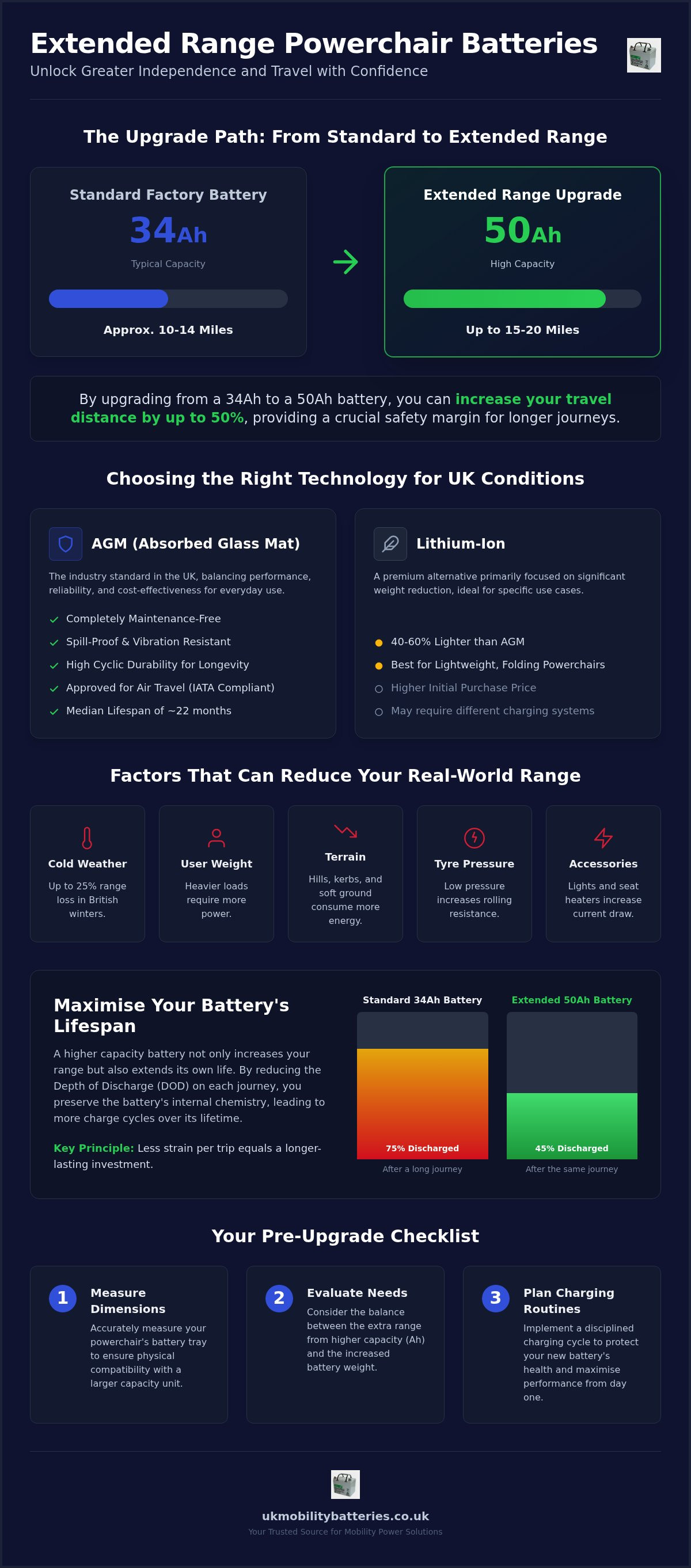
Ampere-hour (Ah) capacity represents the total energy a battery can deliver over a specific period. It effectively acts as the fuel tank for an electric-powered wheelchair. While standard configurations often utilise 34Ah units, moving to 50Ah or 55Ah options provides the classification for extended range electric wheelchair batteries. This increase in capacity relies on higher lead density. Because more active material is packed into the cells to store additional energy, high-capacity batteries are inherently heavier than their standard counterparts. This weight is a direct indicator of the battery's ability to sustain power over long durations.
Amp-Hours (Ah) vs. Miles: Managing Expectations
Estimating travel distance isn't an exact science, but a reliable rule of thumb suggests that for every 10Ah of capacity, you can expect approximately 3 to 4 miles of range. Under ideal conditions, extended range electric wheelchair batteries with a 50Ah rating can provide between 15 and 20 miles of travel. However, several environmental and mechanical factors "steal" this potential distance. Excessive user weight, low tyre pressure, and the use of auxiliary equipment like seat heaters or high-powered lights all increase the current draw. Negotiating steep kerbs or soft ground also consumes energy faster than travelling on flat, paved surfaces.
The Role of Cyclic Life in Long-Term Range
Deep cycle capability is vital for mobility applications because these batteries must endure repeated, significant discharges. Unlike automotive batteries that provide short bursts of power, mobility units are designed for steady energy delivery. Every battery has a finite number of charge cycles. By choosing a higher capacity unit, you often extend the overall lifespan of the set. This happens because a 50Ah battery is discharged less deeply than a 34Ah unit during the same journey. Reducing this Depth of Discharge (DOD) preserves the internal chemistry and maintains performance for longer. This extra reserve capacity also provides a safety margin for unplanned detours or hilly terrain, ensuring you don't reach a critical state of discharge whilst away from home.
AGM vs. Lithium: Selecting the Optimum Technology for UK Use
Sealed Lead Acid (SLA) batteries utilising Absorbed Glass Mat (AGM) technology represent the primary choice for extended range electric wheelchair batteries in the UK market. This design incorporates fine fibreglass mats between the lead plates to absorb the electrolyte, creating a spill-proof and vibration-resistant unit. It's a robust solution for navigating uneven British pavements and outdoor terrain. Because the electrolyte is trapped, these batteries are classified as non-spillable and can be mounted on their side if required by the battery box configuration. This makes them universally accepted for air travel under IATA regulations, provided you check with your specific airline first.
According to real-world wheelchair battery lifespan data, the median functional life for a powerchair battery is approximately 22.3 months. AGM technology remains the industry standard because it balances this lifespan with a lower initial purchase price compared to newer alternatives. It provides a dependable, high-current output necessary for heavy-duty powerchairs, especially those with power-tilt or lift functions that place additional strain on the electrical system.
The AGM Advantage for Electric Wheelchairs
AGM units are completely maintenance-free, meaning you don't need to check acid levels or top up with distilled water. This is a significant practical benefit for users who require a fit-and-forget solution for daily mobility. Their internal structure offers superior resistance to physical shocks, which is essential for the longevity of the internal lead plates when travelling over cobbled streets or dropped kerbs. For more information on selecting the right unit for your specific needs, see The Ultimate Guide to Mobility Scooter Batteries UK.
When to Consider Lithium-Ion Upgrades
Lithium-ion technology is an alternative, particularly for lightweight, folding powerchairs where weight reduction is the priority. These batteries can be 40 to 60 per cent lighter than equivalent AGM units, which makes manual lifting of the chair into a vehicle boot much easier. However, they require a significantly higher upfront investment. You also cannot use a standard AGM charger with a Lithium battery. Doing so is a safety hazard and will damage the cells. If you choose to upgrade, you must purchase a compatible Lithium-specific charger alongside the battery. For most standard powerchair users, the Lucas AGM range remains the most cost-effective way to secure extended range electric wheelchair batteries without the complexity of changing charging hardware. You can view our range of Lucas mobility batteries to find the correct fit for your device.
The Upgrade Path: Moving from Standard to High-Capacity Batteries
Upgrading to extended range electric wheelchair batteries requires a methodical approach to ensure both physical and electrical compatibility. Most mid-sized electric wheelchairs are supplied with 34Ah batteries as standard. A common upgrade path involves replacing these with 50Ah or 55Ah units to increase the available energy reserve. However, it's essential to replace both batteries simultaneously. Mixing a new 50Ah battery with an older 34Ah unit creates a voltage imbalance. This imbalance will damage the internal cells of the newer battery and compromise the safety of the 24V system, as the controller will struggle to manage the mismatched discharge rates.
Before purchasing, you must conduct a physical fitment check. Don't rely solely on the battery model number. Measure the length, width, and height of your current battery tray or compartment. Pay specific attention to the height measurement, including the terminal posts. If the new battery is even 5mm too tall, the seat or shroud may not close correctly, which risks pinching cables or causing a short circuit. You should also verify the terminal types. Larger batteries often use M5 or M6 bolt-hole terminals rather than the spade connectors found on smaller units, which may require you to update your wiring eyelets.
Dimensions and Weight Constraints
In the UK, mobility batteries often follow standardised casing sizes. A 34Ah battery typically fits a 22NF group size, whereas 50Ah and 55Ah units usually occupy a Group 24 footprint. These larger casings are significantly longer and wider. You must also consider the weight increase. A 50Ah battery is roughly 4 to 5kg heavier than a 34Ah unit. Adding 10kg of lead to the base of your chair can lower the centre of gravity. While this may improve stability on slopes, it also increases the load on the motors during acceleration and can affect the responsiveness of the steering.
Charger Compatibility for Extended Range
The output of your charger must align with the Amp-hour rating of your new batteries. A standard 2-Amp charger, often supplied with portable chairs, is insufficient for 50Ah or 55Ah batteries. It will take too long to reach a full charge, which can lead to "undercharging." This occurs when the battery stays in a partially discharged state for too long, causing permanent capacity loss. The industry recommendation is a charger output of approximately 10 per cent of the battery's total Ah rating. For a 55Ah setup, an 8-Amp charger is the ideal choice to ensure efficient energy transfer and long-term cell health. For more details on maintaining your charging hardware, read our guide on Can You Overcharge a Mobility Scooter Battery?.
Maximising Your Distance: Practical Maintenance for Enhanced Range
Lead-acid batteries require specific handling to maintain the capacity gained from an upgrade. The most critical instruction is to avoid leaving the cells in a partially discharged state. Sulphation occurs when lead sulphate crystals harden on the plates, which permanently reduces the available surface area for chemical reactions. Always recharge your extended range electric wheelchair batteries immediately after use, even if you've only travelled a short distance. This practice ensures the battery remains at peak voltage and prevents the premature degradation of the internal lead plates.
Organising your journeys can significantly preserve energy. Avoid stop-start driving where possible, as the initial torque required to move the chair from a standstill consumes more power than maintaining a steady speed. When planning routes, consider these energy-saving factors:
- Choose paved paths over soft grass or gravel to reduce rolling resistance.
- Avoid steep gradients where an alternative flat route exists.
- Check tyre pressure regularly, as under-inflated tyres increase the motor's workload.
Winter Care for Extended Range Batteries
British winters present a specific challenge to battery chemistry. In temperatures below 5°C, you may experience a 20 per cent reduction in range. This isn't a fault with the battery but a result of slowed chemical activity. To mitigate this, store and charge your chair in a heated hallway rather than a cold garage or shed. Starting a journey with a warm battery allows the internal chemistry to perform more efficiently from the outset. Lead-acid battery capacity is rated at 25°C and drops as temperatures fall.
Charging Cycles and Depth of Discharge
Depth of Discharge (DOD) directly impacts the total number of cycles a battery can provide. Discharging to only 50 per cent before recharging is significantly better for longevity than regularly dropping to 80 per cent or until the controller's warning lights flash. Modern AGM batteries don't suffer from the memory effect seen in older nickel-cadmium cells, so there's no benefit to fully depleting them. We recommend organising a weekly deep charge, where the charger is left connected for at least 12 to 24 hours. This allows the charger to enter a float or equalisation mode, ensuring all cells within the 24V set are perfectly balanced.
If you don't use your chair daily, don't leave the batteries disconnected and forgotten. Lead-acid batteries have a natural self-discharge rate. For long-term storage, ensure the batteries are fully charged first. Check the charge level every month and top it up to prevent the voltage from dropping to a level where the charger can no longer detect the battery to begin the cycle. To maintain peak performance throughout the year, ensure you are using a high-quality unit from our range of Lucas mobility batteries.
Choosing Your Replacement: Technical Specifications for Lucas Batteries
Lucas mobility batteries are engineered specifically for deep-cycle applications where reliability is non-negotiable. The range spans from the standard Lucas 12V 34Ah Sealed AGM Deep Cycle Battery to the heavy-duty Lucas 12V 55Ah Sealed AGM Mobility Batteries. These units utilise high-density lead plates and premium separators to ensure high cyclic durability. Every battery in the Lucas mobility line is completely maintenance-free and features a leak-proof, sealed construction. This design ensures safety during transit and eliminates the risk of acid spills. These specifications make Lucas the preferred choice for major powerchair brands including Invacare, Sunrise Medical, and Pride.
Buying from a UK specialist ensures you receive fresh stock. Lead-acid batteries have a finite shelf life; units that sit in a warehouse for months without a top-up charge suffer from permanent capacity loss. Our stock rotation protocols ensure that your extended range electric wheelchair batteries arrive in peak chemical condition. You also benefit from expert technical backup. If you're unsure about terminal configurations or cable clearance, our team provides specific data based on your wheelchair model.
Technical Breakdown: Lucas 12V 50Ah vs 55Ah
Selecting between the 50Ah and 55Ah models requires a close look at the physical dimensions. While both offer a significant capacity increase over standard 34Ah units, the 55Ah model often features a slightly taller casing. You must verify that your battery shroud has sufficient clearance for this height difference. Both models utilise M6 threaded terminals, which provide a secure, low-resistance electrical connection. High-performance chairs with power-tilt functions typically benefit most from the 55Ah upgrade due to the higher energy density required for motorised adjustments. For a detailed comparison of all available options, consult our Best Batteries for Electric Wheelchairs: 2026 UK Buyer’s Guide.
Fast National Delivery and Support
Heavy lead-acid batteries require specialised handling and secure packaging to prevent damage during transit. We utilise reinforced boxing and protective internal padding to ensure your order arrives safely. Our national delivery service covers the entire UK, providing a reliable supply chain for essential mobility equipment. If you encounter any difficulties during the installation process, our technical support desk is available to guide you through the fitting requirements. Our goal is to ensure your chair returns to full service with the maximum possible travel distance. View our full range of Lucas Extended Range Batteries to secure the dependable power your mobility requires.
Securing Your Independence Through Technical Precision
Selecting the right extended range electric wheelchair batteries is a matter of technical precision rather than guesswork. By understanding the relationship between Amp-hour capacity and travel distance, you can transition from standard factory units to high-performance Lucas alternatives with confidence. It's essential to remember that physical dimensions and charger output are just as critical as the Ah rating itself. Maintenance-free AGM technology remains the most dependable standard for the UK market, offering superior vibration resistance and safety for daily use.
Our specialist UK technical support team is available to help you verify compatibility and ensure your upgrade path is seamless. By adhering to disciplined charging cycles and managing thermal conditions during winter, you'll protect your investment and maintain peak performance for the full lifespan of your cells. We provide premium Lucas technical specifications to ensure your device operates at its maximum potential. You don't have to settle for limited mobility when a calculated upgrade is available.
Browse our range of Lucas Extended Range Wheelchair Batteries to find the exact fit for your equipment. You can look forward to longer journeys and greater reliability on every charge.
Frequently Asked Questions
Can I upgrade my wheelchair batteries to a higher Ah rating?
Yes, you can upgrade to a higher Amp-hour rating provided the voltage remains the same and they fit physically. Upgrading from a 34Ah to a 50Ah or 55Ah Lucas battery increases your available energy reserve. You must replace both batteries at once to maintain a balanced 24V system. This ensures the controller manages the discharge rate correctly without damaging the newer cells or causing an electrical imbalance.
How many miles will a 50Ah wheelchair battery last?
A 50Ah battery typically provides a travel distance of 15 to 20 miles under ideal conditions. This estimate is based on the rule of 3 to 4 miles per 10Ah of capacity. Actual mileage depends on user weight, tyre pressure, and terrain. Using extended range electric wheelchair batteries ensures you have a larger reserve for hilly areas or unplanned detours whilst navigating your local area.
Do I need a new charger if I buy extended range batteries?
You may need a higher-output charger when upgrading to significantly larger batteries. A standard 2-Amp charger is insufficient for 50Ah or 55Ah batteries; it takes too long to reach full capacity and can cause undercharging. The ideal charger output is approximately 10 per cent of the battery's Ah rating. For a 55Ah setup, an 8-Amp charger is recommended to ensure efficient energy transfer and to prevent permanent capacity loss over time.
Will larger batteries fit in my existing wheelchair battery box?
Larger batteries often require more space, so you must measure your battery tray dimensions before purchasing. High-capacity 50Ah or 55Ah units are physically larger than standard 34Ah models. Check the length, width, and height, including the terminal posts. Ensure the shroud or seat can still close securely without pinching wires. Even a 5mm height difference can cause fitment issues in compact compartments or underneath the wheelchair's main frame.
How long do extended range electric wheelchair batteries last before they need replacing?
The median lifespan for powerchair batteries is approximately 22.3 months, though this varies based on usage and maintenance. Extended range electric wheelchair batteries often last longer because they are discharged less deeply during standard journeys. Reducing the Depth of Discharge preserves the internal lead plates. Following a disciplined charging routine and avoiding total depletion will help you reach the upper end of the typical 18 to 24-month functional life for your mobility device.
Are high-capacity AGM batteries safe for air travel?
Yes, Lucas AGM batteries are classified as non-spillable and are safe for air travel under IATA regulations. Because the electrolyte is absorbed in glass mats, there's no risk of leakage even if the battery is tilted during handling. You should always notify your airline in advance and provide the technical specification showing they are sealed AGM units. Most airlines accept these without issue, unlike some lithium-ion alternatives that face stricter Watt-hour limits.
Does the cold weather affect the range of my wheelchair batteries?
Cold temperatures reduce the chemical activity inside lead-acid batteries, leading to a range drop of up to 25 per cent in winter. Batteries are rated at an ideal temperature of 25°C; as the mercury falls, the internal resistance increases. To mitigate this, charge your wheelchair in a heated hallway rather than a cold garage. Starting your journey with a warm battery helps maintain the expected travel distance during the British winter months.
What is the difference between a standard battery and a deep cycle battery?
Standard automotive batteries provide high-current bursts for starting engines, whereas deep cycle batteries are designed for steady energy delivery over long periods. Mobility batteries must endure hundreds of deep discharge and recharge cycles without failing. Lucas AGM mobility units are specifically engineered with thicker lead plates to handle this cyclic demand. This design allows them to be depleted to 50 per cent regularly, which would quickly destroy a standard starter battery.