
Expert Guide: Mobility Scooter Batteries for Hilly Terrain
A standard battery might manage a flat journey with ease, but steep inclines demand a level of sustained current that many entry-level cells simply cannot provide. If you've ever felt your motor labouring or watched your range vanish whilst climbing, you're experiencing the strain of a high-discharge event. Selecting the correct mobility scooter battery for hilly terrain is not just about finding a replacement; it's about matching electrical capacity to physical demand to ensure your equipment remains reliable.
We understand that the technical jargon surrounding Amp-hour (Ah) ratings and deep-cycle technology can be confusing when you simply require a dependable way to navigate your local area. This guide provides the technical data you need to select a battery that offers both consistent power and a longer operational lifespan. We'll examine why Lucas sealed AGM batteries are the standard for durability and how choosing uprated capacities can prevent the premature health decline caused by the heavy-duty requirements of steep UK gradients.
Key Takeaways
- Identify how steep inclines increase current draw and learn to mitigate voltage sag to prevent your scooter from stalling on slopes.
- Understand why deep-cycle AGM technology is the necessary standard for a mobility scooter battery for hilly terrain to maintain reliable performance.
- Gain clarity on Amp-hour (Ah) ratings to determine if upgrading your battery capacity is required for the specific gradients in your local area.
- Implement essential maintenance strategies, including the full charge rule and cooling periods, to protect your battery from the strain of heavy-duty use.
- Explore the Lucas mobility range to find the exact technical specifications and compatibility required for your equipment's power needs.
Understanding the Impact of Hilly Terrain on Mobility Scooter Batteries
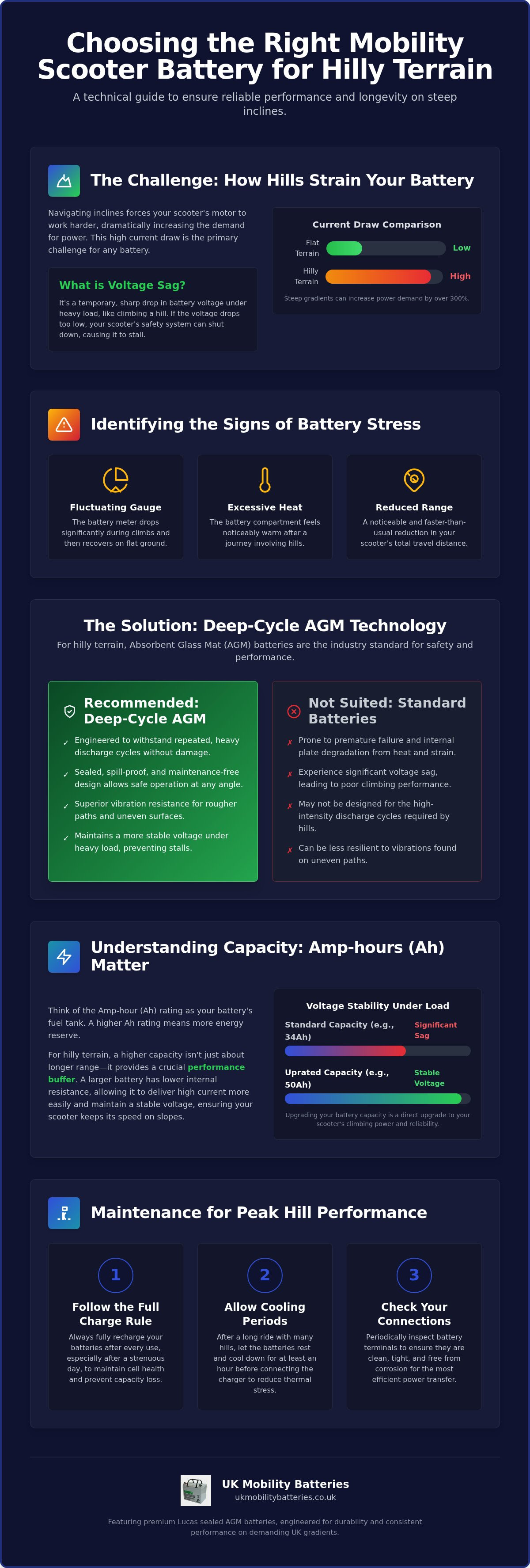
Navigating inclines places an immense electrical load on your equipment. On level pavement, a motor operates at a steady state with minimal resistance. Once the gradient increases, the motor requires significantly more torque to overcome gravity and maintain momentum. This torque is directly linked to current draw, measured in Amps. A high-quality mobility scooter battery must discharge energy rapidly to meet this peak demand. If the battery cannot sustain this discharge, "voltage sag" occurs.
Voltage sag is a temporary drop in voltage that happens when the battery is under heavy load. It's the primary reason scooters stall on steep slopes. If the voltage falls below the controller's safety threshold, the system shuts down to protect the internal electronics. This strain is compounded by user weight and the steepness of the gradient. Standard batteries often fail prematurely in these environments because they aren't built to handle repeated, high-intensity discharge cycles without overheating or internal plate degradation.
The Physics of Climbing: Torque vs. Energy Reserve
The motor demands its highest current the moment you begin an ascent. It's a high-stress event for the chemical components inside the battery. Whilst a set of cells might perform perfectly on level ground at 50% charge, their reduced energy reserve makes them vulnerable on hills. The lower the remaining charge, the more pronounced the voltage sag becomes. Selecting a high-performance mobility scooter battery for hilly terrain ensures better chemical stability. Premium AGM batteries are specifically engineered to maintain a steadier voltage even when the motor is pulling maximum Amps.
Identifying the Signs of Battery Stress
You can often detect when your power source is struggling by watching the dashboard. If your battery gauge fluctuates wildly, dropping into the red during a climb and recovering on the flat, your cells are under excessive stress. Heat is another clear indicator. High resistance during a strenuous climb generates internal heat in the battery compartment. Over time, this thermal stress accelerates the degradation of the lead plates. If your daily route involves significant elevation changes, you'll likely notice a faster reduction in total range. Using a robust mobility scooter battery for hilly terrain helps manage these thermal and electrical loads more effectively.
Key Technical Specifications for Climbing Inclines Safely
Selecting a mobility scooter battery for hilly terrain requires a focus on internal chemistry and discharge capabilities. Whilst many batteries look identical externally, their ability to deliver sustained current varies significantly. Premium deep-cycle AGM (Absorbent Glass Mat) technology is the industry standard for these high-demand environments. Unlike standard starter batteries, deep-cycle cells are engineered to withstand repeated, heavy discharge cycles without losing structural integrity. This durability is vital when the motor pulls maximum Amps to conquer a steep gradient.
Think of Amp-hour (Ah) ratings as the volume of your fuel tank. A higher Ah rating doesn't just increase your total range; it provides a critical buffer against voltage drop. For example, comparing a 12V 34Ah battery to a 12V 50Ah model reveals clear performance differences under load. The 50Ah variant possesses lower internal resistance, allowing it to maintain a higher voltage whilst the motor is working at peak capacity. This ensures the scooter maintains its speed on the slope rather than slowing down as the battery depletes.
Why AGM Technology Beats Standard Lead-Acid for Hills
AGM batteries utilise a glass mat separator to wick the electrolyte between the lead plates. This design provides superior vibration resistance, which is essential for navigating the uneven surfaces often found on hilly paths. Because the electrolyte is absorbed, these batteries are completely sealed and maintenance-free. This allows them to operate safely at various angles without the risk of leaks. Adhering to RESNA safety standards for stability and power delivery ensures that your equipment remains predictable during a strenuous ascent.
Understanding Discharge Rates and Capacity
The C-rating of a battery dictates how quickly it can be discharged relative to its total capacity. In hilly areas, your scooter often operates at a high C-rating, which can "shrink" the effective capacity of a smaller battery. Choosing an uprated model, such as the Lucas 12V 9Ah Uprated Sealed AGM Battery, provides a necessary safety margin over standard 7Ah versions. This extra headroom prevents the plates from buckling under thermal stress. Users requiring maximum reliability should consider Lucas deep-cycle AGM batteries for their superior discharge characteristics and recovery rates after high-current events. Selecting a battery with a higher Ah than the manufacturer's minimum requirement is a practical way to ensure your scooter has the torque needed for local inclines.
Selecting the Correct Battery Capacity (Ah) for Your Terrain
Selecting a mobility scooter battery for hilly terrain requires a precise match between the local landscape and the battery's energy density. A 10% gradient can double the current draw compared to level ground. This places an immense strain on the cells. If your daily route involves frequent ascents, the standard battery capacity provided by the manufacturer may be insufficient for long-term reliability. An upgrade from 42Ah to 50Ah provides a 19% increase in total capacity. This extra headroom reduces the depth of discharge during each climb, which helps maintain the battery's health over hundreds of cycles.
Before purchasing uprated cells, you must verify the physical dimensions of your battery tray. Higher capacity batteries often have a larger footprint. It's essential to ensure the new units fit securely without interfering with the scooter's casing or wiring. For detailed measurements and compatibility data, consult The Ultimate Guide to Mobility Scooter Batteries UK. This resource includes size charts to help you confirm that a higher Ah battery will fit your specific model.
Lightweight Travel Scooters on Mild Inclines
Travel scooters typically utilise Lucas 12V 7Ah or 12V 12Ah batteries. These are designed for portability and perform well on flat pavements or in shopping centres. However, they possess limited reserves for sustained climbing. For users who take their travel scooters onto street inclines, the Lucas 12V 20Ah mobility battery is a common upgrade. It fits many standard travel scooter compartments whilst offering a significantly higher capacity. To further protect these smaller batteries, you should remove unnecessary weight from the scooter's baskets or chassis before navigating slopes.
Heavy-Duty Class 3 Scooters for Steep Slopes
Class 3 scooters are built for road use and frequently encounter the steepest rural gradients. Batteries in the 55Ah to 75Ah range are the standard for these environments. For mid-range performance, the Lucas 12V 34Ah deep cycle battery provides a robust balance between size and power delivery for smaller Class 3 models. If you live in an area with extreme gradients, 100Ah+ configurations are often necessary. These large cells provide the high current required to prevent speed drops during long ascents. Finding the right mobility scooter battery for hilly terrain ensures your Class 3 machine delivers the torque required for safe road navigation.
Maintenance and Care Strategies for Hill-Climbing Batteries
Operating a mobility scooter battery for hilly terrain subjects the internal components to repeated thermal and chemical stress. To ensure long-term reliability, you must follow specific maintenance protocols that differ from those used on flat ground. One of the most critical requirements is the "Full Charge" rule. You should never attempt a significant ascent on a partial charge. Climbing whilst the battery is at 50% or lower forces the cells into a deep discharge state that can cause irreversible plate damage and reduce total cycle life.
Thermal management is equally important. A strenuous climb generates significant heat within the battery casing. We recommend allowing your scooter to rest for at least 15 to 20 minutes after a steep ascent before connecting it to a charger. Charging a hot battery can lead to internal damage where the heat exceeds the battery's ability to dissipate it. Regular health checks are vital for identifying these issues early. You can find more details in our guide on mobility scooter battery troubleshooting.
Charging Protocols for High-Demand Users
For users in hilly areas, an 8-hour charge cycle is non-negotiable. This duration ensures that the AGM plates reach 100% saturation. Short bursts of "opportunity charging" between trips should be avoided. These incomplete cycles prevent the battery from reaching the final "float" stage of charging, which is necessary to balance the cells. You must use a charger specifically calibrated for AGM chemistry. Using a standard lead-acid charger may not provide the precise voltage required to fully restore a mobility scooter battery for hilly terrain after a high-discharge event.
Winter Precautions for Hilly Areas
Cold weather creates a "double drain" effect. Low temperatures increase the internal resistance of the battery, whilst the motor simultaneously pulls more current to navigate winter slopes. Research indicates that battery capacity can drop by up to 30% when temperatures approach freezing. To mitigate this, store your scooter in a temperate environment, such as a heated hallway, whilst it's not in use. Keeping the cells warm preserves their chemical activity. We also advise performing a load test before the winter season begins to ensure your batteries have the necessary headroom for cold-weather climbs. If your current cells are struggling, you can buy replacement Lucas AGM batteries for immediate national delivery.
Premium Lucas Battery Solutions for Reliable Hill Performance
Lucas is the established standard for high-demand mobility applications across the UK. When selecting a mobility scooter battery for hilly terrain, the brand's reputation for engineering consistency is a primary factor for specialists. The Lucas range is comprehensive, spanning from compact 12V 7Ah travel units to heavy-duty 55Ah and 150Ah deep-cycle cells. This variety ensures a scalable solution for every scooter classification, from lightweight boot models to Class 3 road vehicles. Purchasing from a dedicated UK specialist ensures you receive expert technical support and national delivery, which is essential for users whose independence depends on a functioning vehicle.
Fast, national delivery is a core component of our service. We recognise that a failing battery limits your freedom, especially in hilly areas where steep gradients make walking impossible. By maintaining a large inventory of fresh stock, we ensure that your replacement arrives quickly and performs at its peak from the first charge. This direct-to-user model eliminates the delays often found with general retailers whilst ensuring you receive the latest technical specifications.
Why Choose Lucas AGM Batteries?
The technical superiority of Lucas AGM batteries starts with high-purity lead plates. These components are critical for delivering the high current required on steep slopes without causing internal thermal damage. Lower-quality batteries often use lead with impurities that increase internal resistance and heat during high-discharge events. Lucas's robust casing is another essential feature, engineered to withstand the mechanical vibrations of rugged, hilly paths. This structural integrity prevents plate shedding and internal shorts in the demanding UK climate. These batteries are maintenance-free and sealed, allowing them to operate safely at various angles without the risk of electrolyte leakage.
Expert Support for Your Selection
Our role as a specialist is to guide you through the technical specifications of your equipment. We provide detailed advice on battery compatibility, helping you determine if an upgrade to a higher Amp-hour rating, such as moving to a Lucas 12V 50Ah Mobility Battery, is feasible for your specific scooter model. Every battery pack we supply is fresh and fully tested before dispatch. It's a crucial distinction from general retailers who may store batteries for months, leading to sulfation before the product reaches the customer. Our technical support team is available to confirm fitting details and charging requirements for your local terrain. Browse our full range of Lucas mobility batteries to ensure your scooter has the reliable power it needs for every local ascent.
Securing Consistent Power for Every Incline
Navigating steep slopes requires more than just a standard power source; it demands a battery engineered for high-intensity discharge and rapid recovery. By prioritising deep-cycle AGM technology and selecting an appropriate Amp-hour (Ah) rating, you ensure your equipment maintains torque without the risk of voltage sag or premature failure. Proper maintenance remains the final piece of the puzzle. Adhering to full charging cycles and allowing for cooling periods after strenuous climbs will protect your lead plates from thermal degradation.
Choosing a high-performance mobility scooter battery for hilly terrain allows you to navigate your local area with confidence. As an authorised retailer of Lucas mobility batteries, we provide the technical expertise needed to find the perfect match for your scooter's tray and motor requirements. You can access specialist UK technical support and free expert advice on battery upgrades to ensure your investment delivers long-term reliability. Shop Premium Lucas Mobility Batteries for Hilly Terrain. Enjoy the freedom of a reliable, hill-ready scooter today.
Frequently Asked Questions
Can I upgrade my mobility scooter battery to a higher Ah for hills?
Yes, you can upgrade to a higher Amp-hour (Ah) rating as long as the physical dimensions of your battery tray allow it. Moving from a 42Ah to a 50Ah battery provides a larger energy reserve, which reduces the depth of discharge during steep climbs. This upgrade is a practical way to improve the performance of a mobility scooter battery for hilly terrain whilst extending the overall lifespan of the cells through reduced electrical strain.
Why does my mobility scooter stall when going up a steep hill?
Stalling on inclines is typically caused by voltage sag where the battery voltage drops below the controller's safety threshold under heavy load. When the motor demands peak torque to overcome gravity, it pulls maximum current. If your batteries are aged or possess high internal resistance, they cannot sustain this discharge. The system shuts down to protect the electronics, often requiring a reset once the battery voltage recovers on level ground.
How long will 50Ah batteries last on hilly terrain compared to flat ground?
A 50Ah battery will provide significantly less range on hilly terrain than on flat pavements. Inclines increase the motor's current draw, which can reduce your total travel distance by 30% to 50% depending on the gradient and total load. Whilst a 50Ah pack might offer a 20-mile range on level ground, you should plan for a much shorter radius if your daily route involves frequent or sustained climbing.
Are AGM batteries better than GEL batteries for climbing hills?
AGM technology is highly effective for hilly terrain due to its low internal resistance and superior high-current discharge capabilities. Whilst GEL batteries are durable, AGM cells respond better to the sudden, heavy power demands required when starting a climb. Lucas sealed AGM batteries are specifically engineered for these high-demand environments, providing maintenance-free reliability and excellent vibration resistance which is essential for the uneven surfaces often found on steep paths.
Does the weight of the user significantly affect battery life on inclines?
User weight is a primary factor in battery depletion on slopes. The motor must work harder to propel a heavier load against gravity, resulting in a higher Amp draw from the cells. This increased current generates more internal heat and accelerates the discharge rate. If the total weight approaches the scooter's maximum capacity, the mobility scooter battery for hilly terrain will experience significantly more stress, necessitating a higher Ah capacity to maintain performance.
How often should I replace my batteries if I live in a very hilly area?
In very hilly areas, you may need to replace your batteries every 12 to 18 months. Frequent steep climbs subject the lead plates to deep discharge cycles and thermal stress, which can lead to faster degradation than standard use on flat ground. If you notice a significant drop in speed during ascents or a rapidly fluctuating battery gauge, it's an indicator that the cells can no longer provide the necessary peak current.
Can I charge my mobility scooter battery after every short hill climb?
You should avoid charging your battery after every short climb and instead follow a full 8-hour charging protocol. Frequent opportunity charging prevents the battery from completing its necessary saturation and float stages, which can lead to cell imbalance over time. For the best results, wait until you have finished your journeys for the day before connecting the charger to ensure the AGM plates are fully and evenly restored.
What is the maximum incline a standard mobility battery can handle?
The maximum incline is determined by your scooter's motor and transaxle specifications, typically ranging between 6 and 12 degrees. However, the battery must be capable of delivering the sustained high current required to conquer these gradients. A standard mobility battery may struggle if it lacks the deep-cycle stability needed for high-discharge events. Always check your manufacturer's manual for the specific gradient limits of your vehicle to prevent motor or battery damage.