
Emergency Power for Electric Wheelchairs: 2026 UK Guide
What happens if your electric wheelchair’s battery runs low miles from a charging point, or a power cut leaves you unable to recharge? Emergency power for electric wheelchair users isn’t simply a matter of plugging in a generic power bank. Battery voltage, chemistry, charger compatibility and the wheelchair’s design all determine which options are suitable.
It’s understandable to worry about being stranded, especially when it’s difficult to tell whether the charge is running low or the battery may have a fault. A practical plan can help you conserve power, prepare for disrupted charging and decide what to do if mains electricity is unavailable.
This 2026 UK guide covers immediate steps to take when charge is low, how to prepare for a power cut and why spare batteries or portable power sources aren’t automatically compatible. It also explains checks that may indicate a fault, safe charging principles and the specifications to match when choosing a replacement, including voltage, capacity, dimensions and terminals.
Key Takeaways
- Work out whether the issue is low charge, a possible battery fault or a mains power cut before deciding what to do.
- Plan emergency power for electric wheelchair use around your chair’s battery configuration and manufacturer specifications. Don’t assume a power bank will work.
- Compare an approved spare battery, a suitable portable power station and a replacement battery by purpose, compatibility and limitations.
- Charge regularly, check the charger and learn what your wheelchair’s battery indicator means to reduce avoidable power problems.
- Before replacing a battery, match the required voltage, type, capacity, dimensions and terminal details to your wheelchair documentation.
Emergency power for an electric wheelchair: identify the situation first
Emergency power means maintaining safe mobility when normal charging or battery use is disrupted. The right response depends on the situation: the battery may be running low during an outing, the chair may be showing signs of a battery fault, or a power cut may have interrupted charging. These problems call for different responses, so identify what has happened before trying a backup power source.
First, reach a safe, accessible place, conserve any remaining charge and follow the wheelchair manufacturer’s instructions. There isn’t one backup device that suits every chair. Requirements depend on the wheelchair, its battery configuration and its charging system.
What counts as an electric-wheelchair power emergency?
A low-charge warning, reduced performance or an unexpected shutdown can all signal a power problem. Gradual loss of range can have several causes, and sudden failure can also have more than one explanation. These signs don’t establish the cause by themselves, so don’t assume the battery has failed or attempt a repair while out and about.
A mains power cut is different: it interrupts access to charging, but doesn’t automatically mean the wheelchair battery has failed. If you later need a replacement, battery type matters as well as capacity. Deep-cycle batteries are designed for repeated discharge, unlike car starter batteries, which serve a different purpose.
What should you do when the battery is nearly empty?
Stop somewhere safe and accessible. Then consider whether you can reach a suitable charging point without risking a shutdown along the way. Don’t treat the battery indicator as a precise estimate of remaining travel distance. If performance is falling or the charge reading is uncertain, pause the journey and arrange appropriate assistance.
- Reduce avoidable demand: Switch off powered accessories only if the wheelchair manual permits it. Don’t change settings if you’re unsure how they affect safe operation.
- Follow the chair’s procedure: Use the manufacturer’s instructions for stopping, switching off, moving or recovering the wheelchair. Don’t force the drive system or push the chair unless the manual specifically explains how.
- Choose a compatible charging option: Use the charger and charging method specified for your wheelchair. A generic power bank or portable supply isn’t automatically suitable for the chair or its battery.
For emergency power for electric wheelchair use, start by following the chair’s instructions and assessing the immediate situation. Once you’re safe, note whether the warning developed gradually, appeared suddenly or followed a charging interruption. This helps you describe what happened without guessing at the cause.
How electric-wheelchair batteries and backup power actually work
Battery capacity describes how much charge a battery can store, but it doesn’t predict exactly how long a wheelchair will run. Voltage, the number and arrangement of batteries, the chair’s power demand and conditions such as terrain and load all affect practical range. A capacity figure alone can’t show whether a battery or backup source will suit a particular chair.
What do voltage and amp-hours tell you?
Voltage is an electrical requirement of the wheelchair’s battery system. A replacement battery must match the voltage specified by the manufacturer. The battery configuration matters too, so don’t assume one battery’s label tells the whole story about the chair’s system.
Amp-hours (Ah) measure charge capacity, not a direct promise of travel distance. Two batteries with different Ah ratings may both meet a chair’s voltage requirement, but the higher figure alone doesn’t guarantee a particular number of hours or miles. The chair’s power demand and how it’s used also affect the result.
The charger must suit the battery chemistry and meet the wheelchair manufacturer’s charging requirements. A charger intended for one battery type may be unsuitable for another. Using an incompatible charger can damage equipment and create a safety risk, so check the chair and battery documentation before charging or replacing components.
Can a power bank or portable power station run a wheelchair?
A standard USB power bank isn’t a direct substitute for a wheelchair battery. It typically provides power through USB connections, not the voltage and electrical connection the chair requires. Don’t connect one to the wheelchair using improvised wiring or adapters.
A portable power station may be able to supply power to the wheelchair’s own charger, but only if its output and the charger’s input requirements are compatible and the manufacturers’ guidance allows this use. This is a way to power the charger, not permission to connect an external supply directly to the wheelchair battery. Check both devices’ specifications, including the power station’s output type and the charger’s requirements. If they don’t match, don’t use them together.
For emergency power for electric wheelchair planning, treat backup charging as a system: the wheelchair, battery, approved charger and any external power source must work together. A correctly specified replacement battery restores the intended battery system, but it isn’t a universal backup supply. To explore sealed AGM mobility battery options, see mobility battery options.
Spare battery, portable power station or replacement: compare the options safely
These options have different uses. An approved spare battery may provide additional charge if the wheelchair is designed to accept one. A portable power station may power the chair’s charger if the electrical requirements match. A replacement battery restores the specified battery system, but isn’t necessarily designed to be swapped in during an outing.
| Option | Purpose and compatibility | Portability and limitations |
|---|---|---|
| Approved spare battery | Provides additional battery capacity only if the wheelchair is designed for a spare or user-removable battery. Follow the chair manufacturer’s battery and charging instructions. | It must be transported and stored safely. Not every wheelchair accepts a second battery or permits users to swap batteries. |
| Suitable portable power station | May power the wheelchair’s charger if the station’s output, charger load and connection type are suitable, and manufacturer guidance allows it. | It adds equipment to carry and doesn’t directly replace the wheelchair battery. Usable capacity and output affect whether it can support charging. |
| Correctly specified replacement battery | Restores the battery system when the existing battery needs replacing. Match the manufacturer’s required voltage, battery type, capacity and physical fit. | It may not be designed for quick swapping during a journey. Similar voltage or a familiar connector alone doesn’t prove compatibility. |
When might an approved spare battery be practical?
Check whether the wheelchair is designed for a removable or spare battery and whether the manufacturer permits users to replace it. Consider the battery’s weight and how it can be secured during transport. Store and charge it as instructed. Don’t assume a battery will fit just because its voltage or connector looks familiar.
When might portable backup power help with charging?
A portable power station is a potential power source for the charger, not a direct connection to the wheelchair. Check the station’s output against the charger’s input and load requirements, as well as the connection type. Usable capacity affects how much charging it can provide. Use the wheelchair and charger manuals to determine whether an alternative supply is suitable.
For emergency power for electric wheelchair planning, choose an option for its intended use: providing additional battery capacity, charging during a mains interruption or replacing a battery that no longer performs reliably. Avoid improvised wiring and adapters. Before buying a replacement, compare the wheelchair documentation with the existing battery’s specifications, including its dimensions and terminal details.
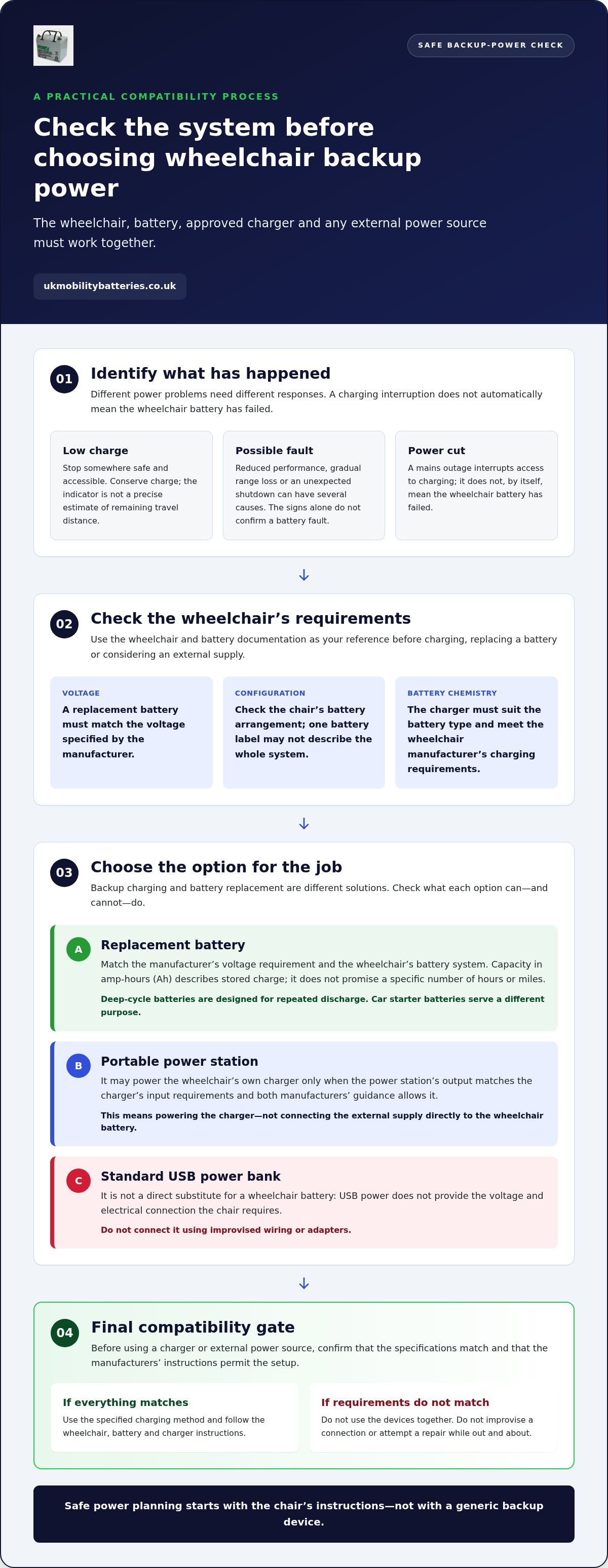
Prepare an electric-wheelchair emergency power plan
A simple routine can reduce avoidable battery problems and make it easier to respond if charging is disrupted. Adapt this checklist to your wheelchair, usual journeys and support arrangements. Follow the manufacturer’s instructions for charging, battery indicators and emergency procedures.
- 1. Charge regularly: Follow the manufacturer’s charging schedule rather than waiting until the battery is nearly empty. Build charging into your routine so the chair is ready before an outing.
- 2. Check the charger: Look for visible damage to the charger, cable and connectors. Use the approved charger as instructed, and don’t use damaged equipment.
- 3. Learn the battery indicator: Check the manual to understand the warnings and how they appear on your chair. Treat a low-charge warning as a prompt to reassess your journey, not as a precise distance estimate.
- 4. Keep key information together: Store the wheelchair and charger instructions where you or a support person can find them. Record the battery’s specified voltage, capacity, dimensions and terminal details to help identify a suitable replacement.
- 5. Plan longer outings: Consider accessible places to pause and charging opportunities along the route. Allow for conditions that may affect battery use, and don’t rely on a fixed travel range as a guarantee.
- 6. Prepare for a power cut: Keep the wheelchair charged as part of your normal routine, and identify how you’ll access essential assistance if mains power is unavailable. Agree in advance who can help and how to reach them.
Plan for an interrupted journey
Before travelling, identify safe places to stop and accessible alternatives if your planned route becomes impractical. Agree with a carer or trusted contact what help they can provide if the wheelchair stops, including how to communicate your location. Keep essential contact details on paper as well as on your phone, so they’re available if the phone battery is flat.
During a mains outage, prioritise safe access and the wheelchair’s remaining charge. Follow the manufacturer’s instructions and don’t try an alternative charging source unless it’s suitable for the chair and charger. Your plan should identify who can assist and how, rather than assuming a spare battery or portable power station will work.
This routine can make emergency power for electric wheelchair needs more predictable while keeping compatibility and safety central. If your records show that the battery needs replacing, browse compatible mobility batteries and compare their specifications with your wheelchair documentation.
Restore reliable wheelchair power with the right replacement battery
A replacement battery should meet the wheelchair manufacturer’s requirements for voltage, battery type and capacity, and fit the available battery compartment. Check the full battery configuration too. Similar voltage or a familiar-looking connector doesn’t prove a battery is suitable: terminal type, dimensions and the wheelchair’s charging system also matter.
Which specifications should you record before replacing a battery?
Use the wheelchair manual and existing battery label to record the required specifications before comparing options. If the label is unclear, use the manufacturer’s documentation rather than guessing.
- Voltage and configuration: Record the specified voltage and how the batteries are arranged in the chair.
- Battery type and capacity: Note the required chemistry and Ah rating. A higher amp-hour capacity isn’t automatically suitable unless the wheelchair permits it.
- Physical fit: Measure the existing battery and available space, then compare the dimensions with the replacement details.
- Connections: Record terminal type and connector details, and compare them with the chair documentation and existing battery.
UK Mobility Batteries supplies sealed AGM mobility battery options, including Lucas 12V mobility and deep-cycle batteries. Compare these replacement options with your wheelchair’s exact requirements. They aren’t universal emergency packs, and compatibility depends on the chair and its battery system.
How do battery condition and replacement decisions differ?
A low-charge warning after a long outing may indicate depletion, while reduced performance or unexpected shutdowns can have several possible causes. These signs alone don’t confirm a battery fault. Follow the wheelchair manufacturer’s instructions first. General guidance on mobility scooter battery troubleshooting may help explain warning signs, but wheelchair-specific guidance takes priority. For general maintenance principles, see the mobility scooter battery care guide.
A correctly matched replacement can support your preparedness plan by restoring the wheelchair’s specified battery system. It isn’t necessarily designed to be carried as a spare or swapped during an outing. For a step-by-step approach to comparing specifications and replacement options, read the electric-wheelchair battery buying guide.
For reliable emergency power for electric wheelchair planning, base a replacement decision on the manufacturer’s specifications, not appearance or capacity alone.
Make your wheelchair power plan dependable
A reliable plan starts with recognising whether charge is low, a battery fault may be present or a power cut has interrupted charging. Follow your wheelchair manufacturer’s instructions, use only compatible charging equipment and don’t assume a spare battery or portable power station will suit every chair.
If a replacement is needed, match its voltage, battery type, capacity, dimensions and terminals to the wheelchair’s specifications. UK Mobility Batteries specialises in sealed AGM batteries for mobility equipment, with nationwide UK delivery and expert technical support.
Compare the specifications and browse electric-wheelchair battery options to find a suitable replacement.
With the right checks and a practical backup plan, you can prepare more confidently for low charge or disrupted mains power.
Frequently Asked Questions
What should I do if my electric wheelchair battery runs out?
Stop in a safe, accessible place and follow the manufacturer’s instructions for switching off, moving or recovering the chair. Don’t force the drive system or continue a journey if the remaining charge is uncertain. Contact your pre-arranged carer or trusted support contact if you need help. Once safe, use only the specified charger and charging method. A generic power bank or improvised connection may not be suitable for your wheelchair.
Can a power bank provide emergency power for an electric wheelchair?
A standard USB power bank isn’t a direct replacement for an electric wheelchair battery and shouldn’t be assumed to provide emergency power for electric wheelchair use. Its output and connection may not match the wheelchair’s requirements. Don’t use improvised wiring or adapters to connect one. A portable power station may be able to power the wheelchair’s own charger, but only if the charger and power station specifications align and the manufacturer’s instructions allow it.
Can I use a spare battery in my electric wheelchair?
Only use a spare battery if your wheelchair is designed to accept one and the manufacturer permits that battery configuration and replacement procedure. Check the required voltage, battery type, capacity, physical dimensions and terminal or connector details. A battery that looks similar or has the same voltage isn’t necessarily compatible. Follow instructions for charging, storage and transport, and don’t assume every wheelchair allows users to swap batteries.
How long will an electric wheelchair battery last in an emergency?
There isn’t a reliable fixed runtime for an emergency situation. Battery capacity, age and condition, wheelchair demand, battery configuration and usage conditions all affect how long charge lasts. Amp-hours describe charge capacity, not guaranteed hours of operation or travel distance. Treat the wheelchair’s battery indicator as a guide, follow the manual’s advice and avoid continuing a journey if the remaining charge or range is uncertain.
Will a portable power station charge an electric wheelchair battery?
A portable power station may be able to power the wheelchair’s charger, but compatibility depends on the station’s output, the charger’s input and load requirements, and the connection type. Check the wheelchair and charger manuals before use. Don’t connect an external power source directly to the wheelchair battery unless the manufacturer specifically instructs you to do so. Avoid improvised wiring or adapters, which can damage equipment or create a safety risk.
How do I know which replacement battery fits my electric wheelchair?
Use the wheelchair manual and existing battery label to identify the required voltage, battery type and capacity. Also record the battery dimensions, terminal type and connector details, then compare them with the replacement specifications. Don’t assume a higher amp-hour rating will fit or be suitable. The replacement must meet the wheelchair manufacturer’s battery and charger requirements. UK Mobility Batteries supplies sealed AGM mobility batteries, including Lucas options in several capacities.