
Disability Scooter Batteries: The Complete Technical Guide to Selection and Care
The reliability of your mobility depends less on the scooter itself and more on the chemical energy stored within its power cells. You likely rely on your equipment for daily independence; however, the fear of a sudden power failure whilst away from home remains a constant concern for many users. Selecting the correct disability scooter batteries involves more than just finding a pack that fits the battery tray. It requires a precise match of Amp-hour ratings and discharge capabilities to your specific motor requirements and daily travel distance.
You don't need to be an electrical engineer to ensure your machine remains operational, but understanding the technical specifications of Lucas AGM units is essential for consistent performance. This guide provides the exact data needed to identify your replacement requirements and master the charging protocols that extend battery service life. We'll examine how to interpret Ah ratings, verify physical dimensions for a secure fit, and implement maintenance routines that prevent premature cell degradation. By the end of this technical briefing, you'll have the knowledge to maintain a dependable power source for every journey.
Key Takeaways
- Identify the specific technical requirements of 24V systems and how Amp-hour ratings directly impact your scooter's maximum travel range.
- Learn to apply the "Like-for-Like" rule to ensure new disability scooter batteries match the exact physical dimensions and voltage of your original equipment.
- Understand why modern Sealed Lead Acid (SLA) and AGM technologies offer a maintenance-free, leak-proof solution for indoor and outdoor mobility.
- Master essential charging protocols, including the requirement to charge after every journey to prevent permanent capacity loss through cell sulphation.
- Recognise the performance advantages of Lucas deep-cycle batteries for heavy-duty use and consistent power delivery in all conditions.
Understanding Disability Scooter Batteries: Types and Technology
Disability scooter batteries are specialised power storage units designed for a specific electrical load profile. Unlike automotive batteries that provide a high burst of current to start an engine, these units are deep-cycle cells. They provide a steady, lower flow of power over a long duration to sustain the motor. Modern disability scooter batteries are almost exclusively valve-regulated lead-acid (VRLA) batteries. This technology is essential because it makes the batteries maintenance-free. You don't need to top up electrolyte levels with distilled water, and the sealed design prevents acid leaks during transport or if the scooter is tilted.
The transition from traditional "wet" lead-acid batteries to sealed units has improved safety for mobility users. These batteries are classified as non-hazardous for transport, meaning they are generally permitted on public transport and aeroplanes. For users with limited dexterity, the maintenance-free nature of a sealed AGM or Gel unit is a significant practical advantage. You only need to ensure the terminals remain clean and the battery stays charged.
AGM vs Gel: Which Technology is Best?
AGM (Absorbent Glass Mat) technology uses a fine fibreglass mat to soak up the sulphuric acid. This makes the battery spill-proof and highly resistant to vibration. Gel batteries use a silica additive to turn the electrolyte into a thick, jelly-like mass. Whilst Gel batteries perform well in extremely hot climates or deep-discharge scenarios, AGM is the industry standard for the majority of disability scooter batteries in the UK. AGM units offer better discharge rates and more reliable performance in typical British temperatures. They are also generally more cost-effective and compatible with standard mobility chargers.
The Importance of Deep-Cycle Design
The internal construction of a deep-cycle battery differs significantly from a standard car battery. Car batteries have many thin lead plates to maximise surface area for instant starting power. Deep-cycle batteries use thicker, solid lead plates. These robust plates withstand the physical stress of repeated discharging and recharging without warping or shedding material. If you use a car battery in a mobility scooter, it will fail within weeks because it isn't built for "deep" discharges. Cycle life refers to the total number of complete discharge and recharge cycles a battery can perform before its capacity drops below a functional level for daily mobility use.
Deciphering Technical Specifications: Ah, Voltage, and Dimensions
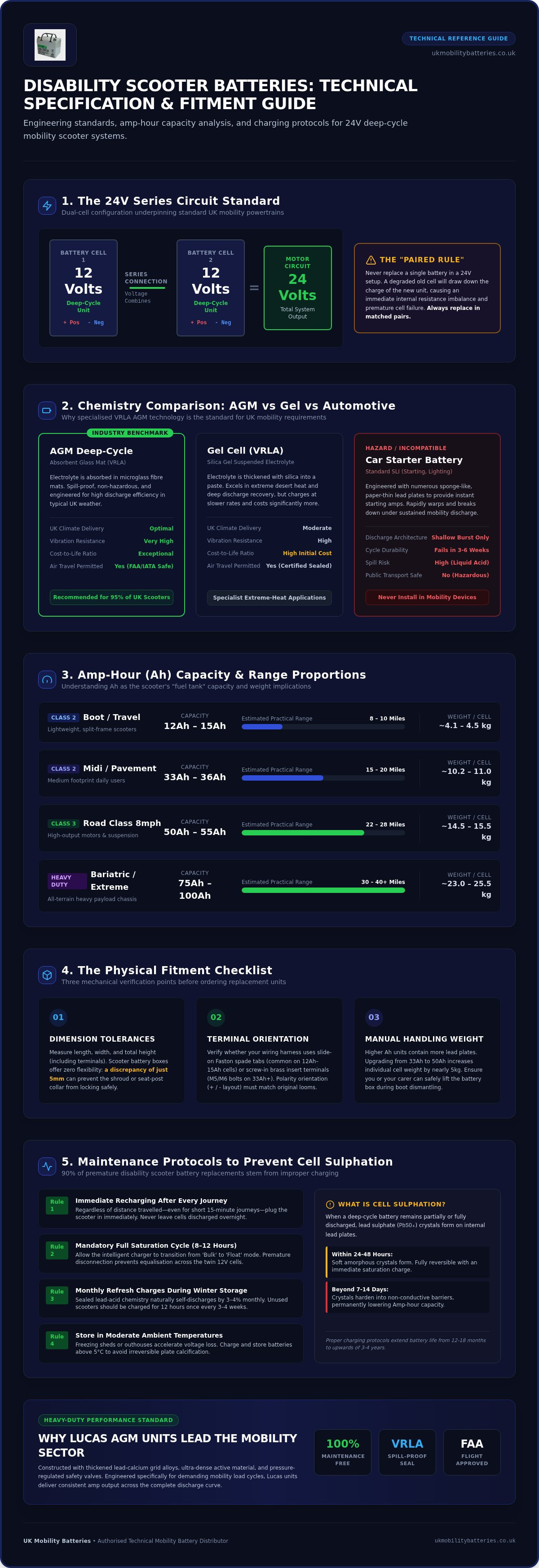
Most modern mobility scooters operate on a 24V circuit. You achieve this by connecting two 12V disability scooter batteries in series. This configuration is standard across the industry, but it's vital to confirm your specific model's requirements before purchase. When selecting new disability scooter batteries, physical dimensions are the most critical constraint. If a battery is even 5mm too wide, it will not fit into the plastic battery box or under the seat shroud. You must measure the length, width, and height of your existing units to ensure a secure fitment.
Weight is another technical factor often overlooked. Higher capacity batteries contain more lead, making them significantly heavier. If you regularly dismantle your scooter for car transport, consider whether you can safely lift the increased weight of a higher Ah unit. For those who travel by air, these sealed units must meet specific safety criteria. You can refer to the FAA PackSafe guidelines for mobility devices to understand the regulatory specifications for non-spillable AGM power cells.
Understanding Voltage and Series Connections
Most scooters use a pair of batteries to reach the required 24V output. You should always replace mobility batteries in pairs. If you mix a new battery with an old one, the older unit will drag down the performance of the new one, leading to premature failure and imbalanced charging. Whilst 12V blocks are the industry norm, some older equipment might utilise 6V units. Check the labels on your current set to verify the voltage and terminal type. If you are unsure which configuration your machine requires, you can browse our technical specifications to find a matching pair.
The Relationship Between Ah and Range
Amp-hours (Ah) represent the battery's capacity, essentially acting as the size of your fuel tank. A small travel scooter typically uses 12Ah batteries, providing a range of roughly 8 to 10 miles. In contrast, heavy-duty, road-legal models often require 75Ah or 100Ah units for distances up to 25 miles. Your actual range depends on several variables including user weight, tyre pressure, and local terrain. Steeper hills and colder temperatures will reduce the distance achieved per charge. For a deeper analysis of performance variables, consult our Ultimate Guide to Mobility Scooter Batteries UK.
Compatibility Guide: Selecting the Correct Replacement
Identifying the correct replacement for disability scooter batteries starts with a physical inspection of your current set. You must locate the specification labels usually found on the side or top of the casing. These labels provide the nominal voltage and the Amp-hour (Ah) rating. The safest approach is the "Like-for-Like" rule. If your machine currently uses a Lucas 12V 34Ah Sealed AGM Deep Cycle Battery, replacing it with the identical model ensures the electrical system and the physical battery tray are perfectly matched. Deviating from these original specifications requires careful verification of the available space and the charger's output capacity.
Upgrading Your Battery Capacity
Moving to a higher capacity can provide significant benefits for users requiring extended range. For instance, if your battery box has sufficient clearance, upgrading from a 34Ah unit to a Lucas 12V 50Ah Mobility Battery increases your potential travel distance without changing the scooter's voltage. However, you must measure your battery tray's internal dimensions before purchasing an uprated unit to confirm it won't foul the seat or casing. You should also verify that your existing charger can handle the higher capacity; a charger designed for small 7Ah units will struggle to fully saturate a 55Ah cell within a reasonable timeframe. Proper planning is essential for reliability, as outlined in the ADA National Network emergency power planning guide, which emphasises the importance of routine maintenance and capacity checks.
Terminal and Connector Types
Terminal types are a critical technical detail often overlooked during selection. Most Lucas mobility batteries utilise threaded insert terminals, typically 5mm (M5) or 6mm (M6). You must identify whether your scooter uses these inserts, or if it requires flag or post terminals. When installing replacements, inspect your existing wiring loom for signs of green corrosion or fraying. Reusing a degraded connector increases electrical resistance, which generates heat and reduces efficiency. Ensure you maintain the correct terminal orientation during installation. Reversing the positive and negative leads will cause an immediate short circuit, potentially damaging the scooter's speed controller or blowing the main fuse. Clean, tight connections are vital for maintaining the high-current flow required for climbing kerbs and hills. Choosing the right disability scooter batteries ensures that these connections remain stable and efficient throughout the battery's service life.
Maximising Battery Life: Essential Charging and Storage Protocols
The golden rule of maintenance for disability scooter batteries is to charge them after every single trip. It doesn't matter if you've only travelled 500 yards or several miles; lead-acid chemistry thrives on being kept in a high state of charge. Allowing the cells to remain partially discharged initiates a chemical process called sulphation. This hardens the lead plates and permanently reduces the battery's capacity to hold energy. You must use a dedicated smart mobility charger rather than a standard automotive unit. Car chargers are designed for starter batteries and use a high-voltage profile that can overheat and damage the delicate internal mats of a sealed AGM mobility unit.
Deep discharge is the primary cause of premature failure in UK mobility equipment. If you leave your batteries flat for more than 24 hours, the chemical damage is often irreversible. During British winters, cold temperatures slow down the chemical reactions inside the cell. You might notice a temporary reduction in range of up to 30% when the thermometer drops below freezing. This isn't a permanent fault, but it requires careful journey planning. Always store your scooter in a garage or hallway whilst not in use to mitigate the impact of the cold on the electrolyte.
The Correct Charging Cycle
Smart chargers operate in three distinct phases to protect the battery. The bulk stage provides a constant current to reach roughly 80% capacity. This is followed by the absorption stage, which tapers the current at a fixed voltage to saturate the plates. Finally, the float stage maintains the charge at a low level to prevent self-discharge. You should allow a minimum of 8 to 12 hours for a full chemical recovery. For detailed information on safety and charging limits, read our guide on Can You Overcharge a Mobility Scooter Battery?
Winter Storage and Maintenance
If you don't intend to use your disability scooter batteries for several weeks, do not leave them plugged in indefinitely unless the charger has a specific long-term maintenance mode. Disconnect the batteries and store them in a cool, dry environment. You must provide a top-up charge at least once every month to counteract natural self-discharge. Extreme heat is equally damaging as it accelerates the chemical breakdown inside the casing and can cause safety valves to vent. Maintaining a stable temperature and a regular charging routine is the best way to preserve the service life of performance-grade disability scooter batteries.
Why Choose Lucas AGM Batteries for Your Mobility Device?
Lucas is a heritage British brand that has become synonymous with electrical reliability in the mobility sector. These disability scooter batteries use a robust, sealed AGM construction, specifically engineered for heavy-duty discharge cycles. The internal design prioritises durability and consistent power delivery, which are essential for users who rely on their equipment for daily independence. The maintenance-free design is a key practical benefit. It removes the need for electrolyte checks and ensures the units are leak-proof, even if the scooter is tilted during transport. Because they are non-spillable, Lucas AGM batteries are generally approved for travel on aeroplanes and public transport, though you should always confirm specific carrier requirements beforehand.
Choosing a reputable brand is about more than just the name; it's about the technical standards of the manufacturing process. Lucas units are built to withstand the physical stresses of outdoor use, including vibrations from uneven pavements and the high-current demands of hill climbing. UK Mobility Batteries acts as a knowledgeable specialist in this field. We ensure that the technical data provided for every Lucas model is accurate, helping you make an informed decision based on your machine's specific power profile.
The Lucas Advantage: Reliability and Performance
Lucas deep-cycle units incorporate high-tin alloy plates. This metallurgical choice enhances the battery's structural integrity and extends its service life compared to standard lead-acid alternatives. The thicker plates are better equipped to handle the chemical stress of deep discharging without warping. Another technical advantage is the low self-discharge rate. This characteristic makes these cells ideal for seasonal users who might store their equipment for several weeks at a time, as the battery retains its charge for longer than traditional wet-cell versions. The product range is comprehensive and covers all major scooter classes. You can select compact units like the Lucas 12V 7Ah Sealed AGM Batteries for lightweight boot scooters, or opt for higher capacity models such as the Lucas 12V 55Ah Sealed AGM Mobility Batteries for heavy-duty, road-legal machines.
Support and Delivery from UK Specialists
Buying from a specialist retailer like UK Mobility Batteries ensures you receive the correct technical match for your equipment. We understand that selecting the wrong size or Amp-hour rating can lead to fitment issues or reduced performance. As an authorised retailer of Lucas mobility batteries, we provide expert technical support to UK customers for compatibility checks and installation advice. Our service includes nationwide fast delivery on all sealed AGM units. This ensures your equipment is back in service as quickly as possible with a power source you can depend on. Our team is available to help you navigate the technical specifications of your scooter to find the most efficient power solution.
Browse our full range of Lucas disability scooter batteries
Optimising Performance for Consistent Daily Independence
Maintaining consistent mobility depends on matching your scooter’s electrical demands with high-quality power cells and disciplined maintenance. You’ve now acquired the technical knowledge to identify the correct Amp-hour ratings and physical dimensions required for a secure fitment. Remember that the longevity of your disability scooter batteries is primarily determined by your charging behaviour; keeping the cells saturated after every journey prevents the permanent capacity loss caused by sulphation.
It’s essential to select a heritage brand like Lucas to ensure the robust construction and deep-cycle performance needed for heavy-duty use in the UK. As an authorised Lucas battery specialist, UK Mobility Batteries offers expert technical support to ensure you find the exact replacement for your specific machine. Our range of deep-cycle AGM technology is designed to provide the maximum possible range and reliable power delivery in all weather conditions.
Shop the full range of premium Lucas mobility batteries at UK Mobility Batteries
Equipping your scooter with the correct technical specifications ensures you remain ready for every journey with total peace of mind.
Frequently Asked Questions
How long do disability scooter batteries typically last?
Typically, disability scooter batteries last between 12 and 18 months with regular use, though well-maintained units can achieve a service life of up to two years. Factors such as the depth of discharge, charging frequency, and total user weight significantly affect longevity. Lucas AGM units are built for deep-cycle performance, but allowing them to sit flat will cause premature failure. Consistent charging after every trip is the most effective way to ensure you reach the maximum capacity of your power cells.
Can I use a car battery in my mobility scooter?
No, you must never use a car battery for mobility equipment. Car batteries are designed for high-current engine starting and have thin lead plates that can't handle the sustained, deep discharge required by a motor. Using one will lead to rapid failure and could potentially damage your scooter's speed controller. Mobility power cells are specifically engineered with thicker plates to provide a steady flow of energy over many hours of continuous operation without warping.
Should I leave my mobility scooter on charge all the time?
You should leave your scooter on charge until the smart charger indicates a full state, usually through a green LED. Most modern mobility chargers have a float mode that prevents overcharging by maintaining a low voltage once the battery is saturated. However, if you aren't using the scooter for several weeks, it's better to charge it fully and then provide a top-up once a month. This prevents the internal plates from sitting in a partially discharged state.
How do I know if my mobility scooter batteries need replacing?
The most common sign is a noticeable decrease in travel range or the scooter struggling to climb hills it previously handled with ease. You might also notice the battery gauge dropping rapidly under load or the charger reaching the full state much faster than usual. If your disability scooter batteries are over 18 months old and showing these symptoms, they likely have high internal resistance and require a technical replacement to restore your machine's performance.
Can I upgrade my scooter batteries to a higher Amp-hour (Ah) rating?
Yes, you can often upgrade to a higher Ah rating if the physical dimensions of the battery box allow for a larger unit. For example, replacing a 34Ah set with Lucas 12V 50Ah Mobility Battery units will increase your travel distance per charge. You must measure the length, width, and height of your battery tray before purchasing, as higher capacity batteries are physically larger and heavier than their standard counterparts, which may affect the scooter's handling.
Are AGM batteries better than Gel batteries for mobility scooters?
AGM batteries are generally preferred for the majority of UK mobility applications due to their high discharge performance and cost-effectiveness. They're completely maintenance-free and handle typical British temperatures very well. While Gel batteries offer advantages in extreme heat or very deep discharge cycles, AGM technology provides the reliability and power density required for most daily journeys. Lucas AGM units are specifically optimised for this type of deep-cycle service and heavy-duty use in various conditions.
How should I dispose of my old disability scooter batteries?
Lead-acid batteries must be recycled at a designated facility and should never be placed in household waste. You can take your old units to a local civic amenity site or a specialist battery recycling centre. Most scrap metal merchants also accept lead-acid units because the lead content has a recyclable value. Proper disposal ensures that hazardous materials like sulphuric acid and lead are processed safely and according to UK environmental regulations to prevent soil contamination.
Why has my scooter range decreased in the winter?
Cold temperatures slow down the chemical reactions inside the battery, which temporarily reduces the amount of energy the cells can deliver. During a British winter, you might experience a range reduction of up to 30% on very cold days. This isn't a permanent fault with your equipment; the capacity will return as temperatures rise in the spring. Storing your scooter in a heated hallway or garage can help maintain battery performance and efficiency during the colder winter months.