
12V 15Ah Battery for a Small Scooter: UK Buying Guide
A higher-capacity battery isn’t automatically the better replacement. A 12v 15ah battery for small scooter use may be suitable, but only if its voltage, configuration, dimensions and terminals match the scooter.
When replacing a battery, it’s easy to focus on the 15Ah rating and overlook whether the scooter takes one battery or two. Many mobility scooters use a pair of 12V batteries to form a 24V system, but check the scooter manual and existing battery labels to confirm your setup.
This guide explains how to identify the required voltage and battery count, compare amp-hour capacity without assuming a higher rating will fit, and check dimensions and terminal type before choosing. You’ll also learn how to compare a 15Ah option with 12Ah or 20Ah batteries when those ratings match the scooter’s verified specification. Check the complete specification, not just the Ah figure, to make an informed choice.
Key Takeaways
- A 12v 15ah battery for small scooter use is suitable only if it meets the scooter’s electrical and fitment requirements.
- Understand what voltage and amp-hour capacity tell you before comparing replacement options.
- Journey frequency, passenger load and terrain can affect battery demand, so prioritise the scooter’s specification over a general preference for higher capacity.
- Use the manual, battery labels and measurements to verify battery count, dimensions, terminal type and orientation.
- UK Mobility Batteries offers sealed AGM mobility batteries across a range of capacities, including 12V 12Ah and 20Ah options.
Is a 12V 15Ah battery suitable for a small mobility scooter?
Possibly, but the 15Ah rating alone can’t confirm suitability. A 12V 15Ah battery for small scooter use must match the scooter’s required voltage, battery layout, available space and manufacturer’s specifications. A compact frame doesn’t mean every small scooter takes the same battery.
Start with the scooter manual and the labels on the existing batteries. These can show the voltage and capacity, as well as whether the scooter uses one battery or more. A mobility scooter overview provides general background on scooter types and components, but the manual for your specific model should guide your replacement choice.
What do 12V and 15Ah tell you?
Voltage, shown as V, is the electrical requirement for the scooter’s system. The replacement battery or battery arrangement must supply the voltage the scooter is designed to use. Amp-hour capacity, shown as Ah, indicates how much electrical charge a battery can store under specified conditions. It helps compare capacity, but doesn’t determine journey distance or running time on its own.
For example, a 12V battery may be one part of a scooter’s higher-voltage system. Two 12V batteries connected in series can provide a 24V system, but don’t assume this arrangement applies to every scooter. The correct voltage and configuration depend on the model.
Why might a small scooter use more than one battery?
A scooter may use multiple batteries to meet its electrical system requirements. The number of batteries and how they’re connected affect the total system voltage, so an individual 12V label doesn’t necessarily describe the voltage of the complete setup. Check the manual and existing battery labels for the required count and arrangement before buying.
Use these sources to cross-check the details:
- Scooter manual: Find the specified voltage, battery count and approved capacity.
- Existing labels: Record each battery’s voltage and Ah rating. If there’s more than one, check whether the labels match.
- Battery compartment: Don’t assume a compact scooter takes a particular battery shape or size.
- Wiring layout: Use the existing configuration as a reference. Don’t infer series or parallel connections from the battery count alone.
If the manual specifies a different system voltage, a single 12V replacement won’t meet that requirement by itself. A higher Ah rating isn’t permission to change the scooter’s setup either. First confirm the complete configuration, then check whether a 15Ah capacity is permitted and whether the battery will fit. This helps distinguish a plausible option from a compatible replacement.
How capacity, voltage and scooter use affect a 15Ah battery choice
Capacity is one part of the decision, not a shortcut to choosing a replacement. Consider a 12v 15ah battery for small scooter use only if the scooter’s documentation permits that capacity and the complete battery system matches. Wanting more capacity doesn’t override the scooter’s electrical or physical requirements.
Your usual journeys can help you understand what capacity may be appropriate. Frequent trips can draw more energy over time than occasional short outings. Passenger load and carried items add demand, while steep slopes, uneven surfaces and repeated starts can place different demands on the scooter than steady travel on level ground. These factors can affect how quickly stored energy is used, but they don’t change the battery specification the scooter requires.
Keep the terms distinct. Ah describes battery capacity; it isn’t a measure of motor power, charging speed or guaranteed travel distance. Voltage must match the scooter’s designed electrical system. Charging performance depends on the battery, charger and system requirements, so a higher Ah figure alone doesn’t mean the battery will charge faster or make the scooter move more quickly.
When could a 15Ah capacity be worth considering?
A 15Ah option may be worth comparing if the scooter documentation allows it and you make regular or longer journeys. More capacity can mean more stored charge, but it doesn’t guarantee a particular increase in mileage. Actual use varies with load, terrain and operating conditions. The battery must also fit the available space, have compatible terminals and suit the complete battery system.
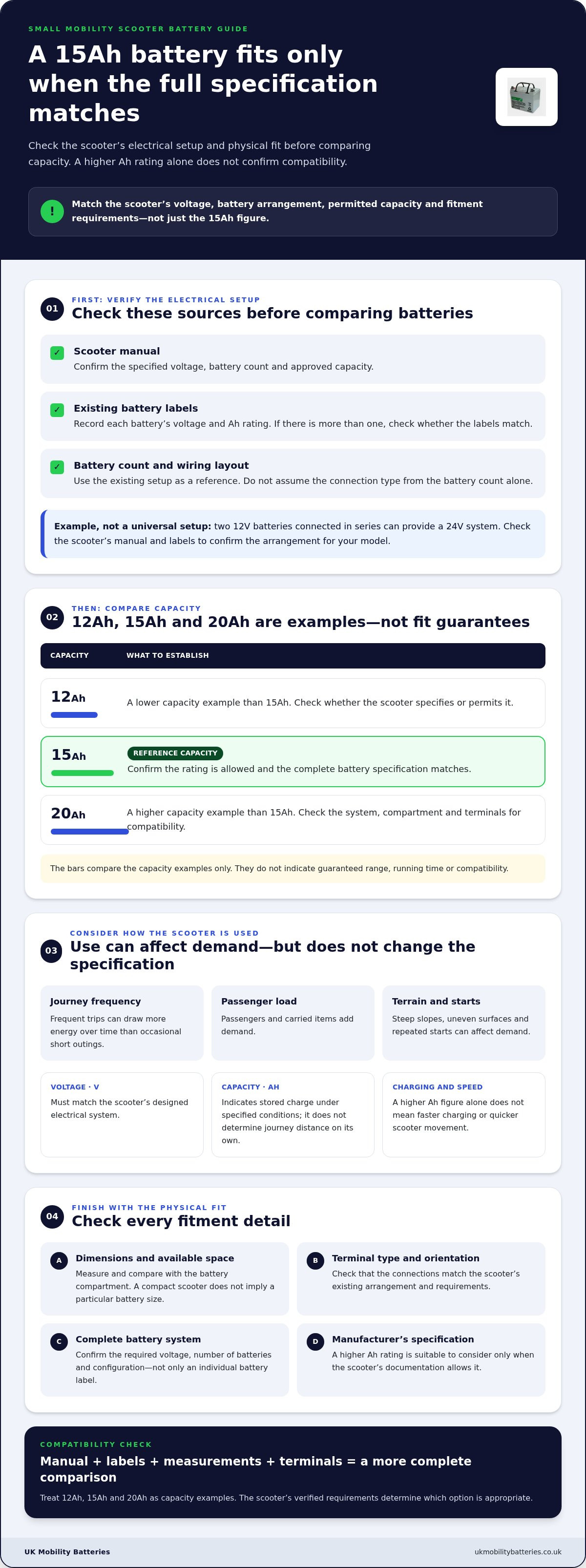
The figures below are capacity examples only, not recommendations or fit guarantees.
| Capacity example | What the Ah figure indicates | What to establish |
|---|---|---|
| 12Ah | A lower capacity example than 15Ah | Whether the scooter specifies or permits it |
| 15Ah | The reference capacity in this guide | Whether the rating and physical specification match |
| 20Ah | A higher capacity example than 15Ah | Whether the system, compartment and terminals are compatible |
Does a higher Ah rating always make a better replacement?
No. A higher rating may offer more stored capacity if the scooter is designed to accept it, but it isn’t a speed upgrade and won’t necessarily be compatible. Batteries with different capacities can also differ in dimensions and other product specifications. Compare the candidate battery with the exact scooter requirements instead of treating a higher number as a universal improvement.
For example, moving from 12Ah to 15Ah is worth considering only if the manufacturer allows it and the battery fits the compartment with the correct connections. Apply the same checks when considering 20Ah. UK Mobility Batteries offers sealed AGM options across a range of capacities. Compare mobility battery options with your scooter’s documented requirements in hand.
12V 15Ah versus 12Ah, 14Ah and 20Ah: compare before choosing
Capacity ratings help you compare how much charge batteries are designed to store, but they don’t identify a suitable replacement by themselves. A 12Ah, 14Ah, 15Ah or 20Ah battery may have the same nominal voltage as another option yet differ in dimensions, terminals or other specifications. Check the scooter maker’s requirements before treating one capacity as a substitute for another.
Some sellers state that a specific 15Ah battery can replace lower-capacity batteries in particular applications. Those claims apply to the product and scooter configurations described, not to every 15Ah battery or small scooter. A claim about one replacement doesn’t establish that another battery will fit or work in your model.
How to interpret nearby capacity ratings
Ah measures capacity, not physical size. A 15Ah unit isn’t necessarily larger or smaller than a 14Ah one, and its rating doesn’t reveal the terminal arrangement. Matching voltage doesn’t prove compatibility either. Use the scooter manufacturer’s specification as your reference, then compare the replacement’s full details with it.
| Capacity example | What the rating indicates | What to check |
|---|---|---|
| 12Ah | Capacity rating of 12 amp-hours | Approval for the scooter and full product fitment |
| 14Ah | Capacity rating of 14 amp-hours | Whether the specification permits this rating |
| 15Ah | Capacity rating of 15 amp-hours | Dimensions, terminals and compatibility with the battery system |
| 20Ah | Capacity rating of 20 amp-hours | Manufacturer approval and all physical and electrical requirements |
When should a buyer consider another listed capacity?
Consider a different capacity only when it matches the scooter’s documented requirements. UK Mobility Batteries lists 12V 12Ah and 20Ah mobility battery options, including Lucas products. These are options to compare with your scooter’s specification, not automatic substitutes for a 15Ah battery. The capacity, voltage, battery arrangement and fitment all need to align.
A 12V 20Ah option may look suitable if you want to compare a higher capacity, but its rating doesn’t establish that it will fit the compartment or meet the scooter’s requirements. The same applies to a 12V 12Ah option. Don’t assume a product is compatible just because its voltage matches or its capacity is close to the original.
Use the manual and existing battery labels to identify the required configuration, then compare the product specifications for your scooter. The mobility scooter battery guide provides broader context for comparing battery choices. For a 12v 15ah battery for small scooter use, treat each replacement claim as specific to the battery and application it describes.
Check these fitment details before buying a small scooter battery
A battery can have the right capacity rating and still be unsuitable if its voltage, size or terminals don’t match. Before selecting a 12v 15ah battery for small scooter use, gather the details from the scooter manual and existing battery labels, then compare them with the replacement specifications. This checklist keeps the comparison specific to your scooter instead of relying on a general product description.
- Confirm the system voltage. Check the manual for the scooter’s required voltage and compare it with the battery labels. If the scooter uses more than one battery, don’t assume the rating on a single battery describes the whole system.
- Record the battery count and arrangement. Note how many batteries the scooter uses and follow the configuration in its documentation. The same number of batteries doesn’t necessarily mean the same wiring arrangement.
- Measure the existing batteries. Record the length, width and height of each battery, then compare those measurements with the replacement listing. Account for the space available in the compartment and any constraints stated by the scooter maker. A 15Ah rating doesn’t guarantee standard dimensions.
- Identify the terminal type. Check whether the existing battery has screw-in or push-on terminals, then compare this with the replacement’s stated terminal type. These connections aren’t interchangeable unless compatible fittings are provided for the application.
- Check terminal orientation. Note where the positive and negative terminals sit relative to the battery case, then compare that layout with the replacement. The correct terminal type alone doesn’t confirm that cables will reach or connect in the required positions.
- Compare the complete specification. Check voltage, capacity, dimensions, terminals and any model-specific requirements together. Don’t approve a replacement based on one matching figure.
Measure the battery compartment and note terminal details
Measure the existing battery itself, not just the compartment opening, and record its length, width and height using the same units. Compare all three measurements with the candidate battery listing. Then note the terminal type and orientation. Dimensions and connections vary by product, so don’t apply measurements from another 15Ah battery to yours. A battery terminal types guide can help you identify the connection style.
Confirm the full replacement configuration
If the scooter uses a matched pair, compare both battery labels and follow the manufacturer’s guidance on replacement. Avoid mixing batteries with different specifications unless the scooter documentation explicitly allows it. For step-by-step replacement context, consult the mobility scooter battery fitting guide.
Once you’ve recorded these details, compare them with the specifications for a suitable battery. Explore mobility battery options with your scooter’s requirements to hand.
Choose a compatible replacement with UK Mobility Batteries
A confident choice starts with the scooter’s documented requirements, not a capacity label in isolation. Before comparing products, confirm the required voltage, manufacturer-approved capacity, number of batteries, dimensions, terminal type and terminal orientation. These details help you compare a replacement with the complete setup instead of relying on a general claim that a particular capacity suits small scooters.
UK Mobility Batteries specialises in sealed AGM mobility batteries, with options across a range from 7Ah to 150Ah. Its listed range includes Lucas mobility batteries in several capacities. The right option depends on your scooter’s requirements: a listed capacity isn’t automatically a substitute for another, and no 12V 15Ah battery should be assumed to fit without comparing its exact specifications with your scooter.
What to have ready when selecting a replacement
Gather the scooter make and model, relevant manual details and clear information from the existing battery labels. Record the battery count and system voltage, then note the stated capacity, measurements and terminal details. If the scooter uses two batteries, capture the information for both so you can compare the full set and follow the manufacturer’s guidance.
Having these details together makes product comparisons more precise. UK Mobility Batteries’ technical support can help interpret battery requirements and compare suitable listed options. Use the manual as your reference if its requirements differ from a general capacity recommendation or a seller’s description for another scooter application.
- Voltage and configuration: Note the required system voltage and number of batteries.
- Capacity: Record the manufacturer-approved Ah rating or permitted capacity range.
- Physical fit: Write down the existing battery’s length, width and height.
- Connections: Identify terminal type and orientation, including the positions of the positive and negative terminals.
- Model information: Keep the scooter make and model available when comparing specifications.
Next steps for a confident battery purchase
Compare your notes with the exact specifications for each candidate battery before ordering. Check every requirement together. Matching voltage alone doesn’t confirm capacity approval, physical fit or compatible terminals, and don’t treat a different Ah rating as an upgrade unless the scooter documentation allows it.
If your manual specifies a 7Ah battery, a Lucas 12V 7Ah option may be relevant for comparison, provided its listed specifications match your scooter. The Lucas 12V 7Ah battery technical guide offers product-specific information for that comparison. It isn’t a general fitment guide for other capacities or scooter models.
With the scooter details and battery measurements to hand, browse the mobility scooter battery range and compare the listed specifications with your requirements before choosing.
Make your next battery choice with confidence
Before ordering, use the scooter’s make and model to resolve any differences between the manual, battery labels and product specifications. If the details don’t align, pause rather than relying on the 15Ah figure alone. A 12v 15ah battery for small scooter use is a sound choice only when it meets the scooter’s stated requirements and fits its battery compartment.
UK Mobility Batteries specialises in mobility scooter and wheelchair batteries, with technical support to help interpret battery information and compare suitable options. Its sealed AGM range covers capacities from 7Ah to 150Ah, giving you alternatives to consider when their listed specifications match your scooter. The aim isn’t to choose the largest capacity, but to select a compatible replacement.
Keep your scooter details and measurements to hand, then browse mobility scooter batteries and compare the specifications. Start with your scooter’s requirements and choose a compatible battery from UK Mobility Batteries.
Frequently Asked Questions
Will a 12V 15Ah battery make a small mobility scooter go faster?
No. A higher Ah rating doesn’t increase the scooter’s designed speed. Speed is determined by the scooter’s motor, controller and settings, not battery capacity alone. A replacement battery must still match the scooter’s electrical requirements. If the scooter seems slower than usual, a different capacity may not address the cause. Check the manual and consider whether the battery or another part of the system needs attention.
Can I use my existing charger with a replacement 15Ah battery?
Possibly, but check the charger’s output and the battery manufacturer’s charging requirements before connecting it. The charger must be suitable for the battery’s chemistry and voltage, and its instructions should cover the replacement capacity. A charger supplied with one battery may not be suitable for a different battery type, even if the voltage appears similar. A matching plug isn’t proof of compatibility.
How much range will a 15Ah battery give a small scooter?
There isn’t a dependable mileage figure based on 15Ah alone. A 12v 15ah battery for small scooter use may deliver different results depending on the scooter, passenger and carried load, terrain, speed and battery condition. Treat range figures in a scooter’s documentation as estimates for specified conditions, not guarantees for every journey. When planning a route, allow for variation and avoid relying on the maximum quoted distance.
What does AGM mean on a mobility scooter battery?
AGM stands for Absorbent Glass Mat. It describes a sealed lead-acid battery design in which a glass-fibre mat holds the electrolyte between the lead plates. AGM is a battery construction type, not a capacity or voltage rating. Check the scooter and charger documentation to ensure the specified battery chemistry is suitable. The AGM label alone doesn’t establish compatibility with every scooter or charger.
Are mobility scooter batteries VAT exempt in the UK?
Not automatically for every buyer. VAT relief may apply to eligible disabled customers purchasing qualifying equipment for personal use, but eligibility and the required declaration depend on current rules. Check the latest GOV.UK guidance before purchasing rather than assuming a battery is VAT-free because it is for a mobility scooter. The displayed price and any relief applied can depend on the buyer’s eligibility and the retailer’s process.
How should I dispose of an old mobility scooter battery?
Don’t put an old mobility scooter battery in household rubbish or a general recycling bin. Use your local council’s guidance to find an appropriate battery recycling or household waste facility, and follow its instructions for transport and drop-off. Keep the battery secure and prevent its terminals from contacting loose metal objects. If it is damaged or leaking, avoid handling it unnecessarily and seek disposal advice from the council.