
When Battery Replacement Is Covered or Excluded
Insurance may cover battery replacement if damage or theft results from an insured event, but ordinary wear and tear is generally excluded. Whether insurance covers battery replacement depends on your policy and its excess: you pay costs up to the excess, and the insurer covers eligible costs above it. A claim may affect your premium, depending on your policy.
Before claiming, weigh the excess and possible effect on your premium, especially if the battery can be replaced without extensive repairs. This guide explains when a battery claim may be covered, how the excess affects a payout, what replacement costs can involve and which exclusions commonly apply.
A battery that has simply reached the end of its working life is treated differently from one damaged in an insured event. Understanding the difference can help you assess the likely value of a claim before deciding what to do next.
Key Takeaways
- Battery damage caused by an insured incident or theft may be covered, while policy terms determine what qualifies.
- Compare the repair or replacement cost with your policy excess to judge whether a claim is financially worthwhile.
- Separate accidental damage from gradual battery wear, which standard car insurance generally excludes.
- For mobility equipment batteries, compare the required voltage, capacity and battery type with suitable replacement options.
Cover for batteries damaged in an insured incident
Insurance may cover battery damage when it results from an incident included in your vehicle policy. For electric vehicles, it matters whether the problem is sudden damage or battery failure.
Damage from insured events
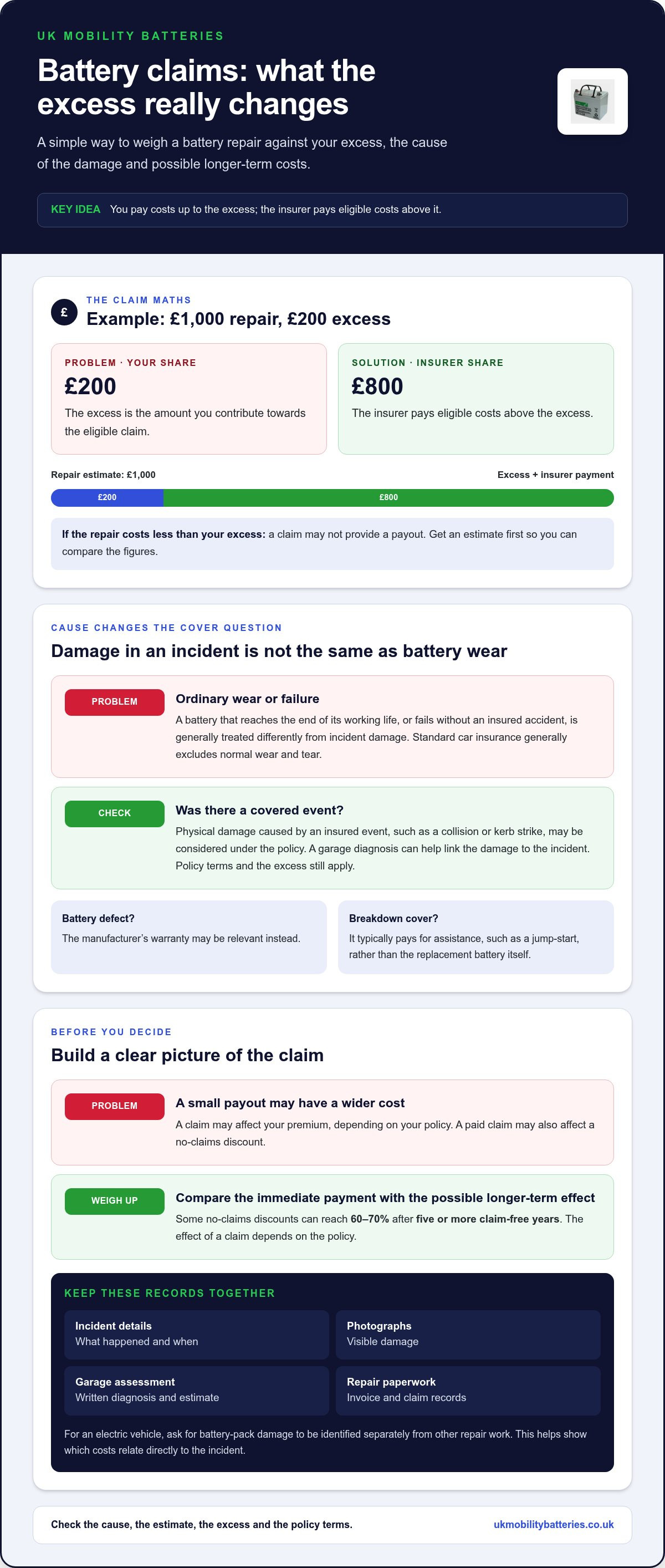
Damage from an insured event is physical harm to a battery caused by something covered by the policy, such as a collision. A garage’s diagnosis can help link the damage to the incident rather than ordinary deterioration. For example, an electric vehicle battery damaged by a kerb strike may be considered under accidental-damage cover. The policy terms and excess affect the claim.
Battery failure, fire and theft
Battery failure means the battery stops working without an insured accident. Fire damage and theft involve separate events. Battery cover varies by policy, and failure may be treated differently from damage caused by an insured event. A stolen car battery may also be covered, depending on the policy. Breakdown cover typically pays for assistance, such as a jump-start, rather than the replacement battery itself.
Damage can have wider consequences for an electric vehicle. The battery pack can account for 40% to 60% of the vehicle’s purchase price. If a kerb strike damages the pack, repair costs may be high enough for the insurer to assess the whole vehicle. UK insurers typically declare a vehicle a write-off when estimated repairs exceed 50-70% of its market value.
Battery impact damage is one possible cause of a claim; fire and theft are other distinct scenarios. Repair costs also affect premiums: according to the Association of British Insurers, EV repairs cost 25% more and take 14% longer on average than petrol or diesel repairs. Its 2024 analysis found average vehicle-damage insurance payouts were 32% higher for EVs than equivalent combustion-engine vehicles. A claim’s effect on your premium depends on the policy, and insurers may ask about claims made in the previous five years when providing a quote.
Insurance deductibles and small battery claims
The excess determines how much you pay towards an eligible battery claim. For a modest repair, compare the garage’s estimate with the excess before deciding whether to claim.
Filing a battery damage claim
A battery damage claim asks your insurer to pay eligible costs after a covered incident. Keep a clear record of what happened and the repairs needed: note the incident details, photograph visible damage and arrange a garage assessment. Give the insurer the garage’s written diagnosis and estimate, then follow its claim process. If the problem is a battery defect rather than incident damage, the manufacturer’s warranty may be relevant instead.
Deductibles and claim costs
The excess is the amount you contribute towards a claim, and the insurer pays eligible costs above it. For example, if repairs cost £1,000 and the excess is £200, the insurer pays £800. If the battery repair costs less than your excess, a claim may not provide a payout. An estimate lets you compare those figures before deciding.
Consider the possible effect on your premium as well as the immediate payment. Whether a claim raises the premium depends on the insurance policy: some increase it after any claim, whilst others apply conditions. A paid claim may also affect a no-claims discount. That discount can reach 60-70% after five or more claim-free years, so a small payout may need weighing against its potential longer-term effect.
Breakdown cover usually pays for battery assistance, such as help getting the vehicle running, rather than the replacement battery itself. Keep the garage’s diagnosis, estimate and invoice with your claim records. These documents separate the battery cost from other repair work and support the insurer’s assessment. For electric vehicles, check that the estimate identifies battery-pack damage separately, since the claim concerns repairs caused by the incident, not routine maintenance.
Getting a repair quote before filing can help establish whether costs exceed the excess.
Average cost of a new battery
Replacement costs differ sharply between a conventional car battery and an electric vehicle battery pack. An electric vehicle battery replacement can cost thousands of pounds, so the vehicle type and damage involved matter when estimating what you might pay.
For a petrol or diesel car, the battery is a separate component that starts the engine and supports electrical systems. A standard car battery lasts an average of three to five years. Frequent short journeys, temperature extremes and repeated deep discharge can shorten its working life. A garage can assess whether the battery needs replacing or another fault is affecting charging.
An electric vehicle’s battery pack is a much larger component. Damage to the pack can make repair decisions more complex than replacing a conventional starter battery. The written repair estimate should separate battery work from other collision damage.
Warranty terms can change who pays. Most electric-car batteries have warranties lasting eight years, whilst conventional car batteries typically have a manufacturer or automaker warranty. EV batteries generally last 10 to 20 years, depending on use, but a warranty covers only the conditions set out in its terms. If a battery fails during its warranty period, warranty cover may be relevant; accidental damage from an accident is a different issue.
Use the estimate to separate the battery replacement cost from labour and related repairs. For example, a collision estimate that includes bodywork and battery diagnostics should itemise each part. This shows which costs relate directly to the battery and makes comparison with the excess easier. Whether to pay for a replacement yourself, claim on insurance or rely on warranty cover depends on the cause, policy and applicable warranty terms.
Battery replacement exclusions
Standard car insurance generally excludes replacement when a battery dies through normal wear and tear. A fault that develops during ordinary driving differs from damage caused by a covered collision, fire or theft. The cause matters: a repair diagnosis can help distinguish gradual failure from sudden incident damage, affecting how the policy applies.
For an electric vehicle, the battery may be covered for accidental damage, fire or theft, while battery failure may be excluded. A stolen battery may be covered, depending on the policy terms. Read the exclusions alongside the insured events: a policy’s price or premium alone does not establish that every battery fault is covered.
Warranty and insurance address different causes. An EV battery warranty usually covers specified defects for a defined period, subject to its conditions. Insurance concerns events listed in the policy, not routine deterioration. If a battery stops working without an insured incident, the warranty may be more relevant than a claim. A garage diagnosis can help identify whether the cause is failure or external damage.
Breakdown cover typically pays for assistance, such as help restarting a vehicle, not the replacement battery itself. If the vehicle is stranded, assistance may address the immediate breakdown without covering a new battery. Optional cover applies only where included in the policy, so check the wording for the relevant event and any exclusions.
Before arranging replacement, record the symptoms and ask the garage to identify the cause in writing. Compare that diagnosis with the policy’s covered events, exclusions and excess. For a mobility battery replacement, use the battery’s voltage, capacity and type to narrow down compatible choices. Compare mobility battery specifications to identify a suitable replacement for your equipment.
UK Mobility Batteries: Lucas 12V 7Ah Sealed AGM Batteries
UK Mobility Batteries supplies sealed AGM batteries for mobility scooters and wheelchairs, offering a replacement option when a battery needs changing rather than an insurance claim. Choose a battery by matching its voltage, capacity and type to your equipment’s requirements.
Available options include Lucas 12V 7Ah Sealed AGM Batteries, the Lucas 12V 9Ah Uprated Sealed AGM Battery, the Lucas 12V 34Ah Sealed AGM Deep Cycle Battery and the Lucas 12V 20Ah Mobility Battery. These distinct capacities and battery types serve different equipment requirements, so use your existing battery details to identify a suitable match.
If you’re sourcing a replacement sealed AGM battery, visit UK Mobility Batteries.
Choose the right next step for your battery
Whether insurance covers battery replacement depends on the cause of the damage and your policy terms. Once you’ve established how the battery failed, focus on the next practical decision: finding a replacement that matches your equipment. For mobility scooters and wheelchairs, compare voltage, capacity and battery type before choosing.
UK Mobility Batteries offers Lucas 12V 7Ah Sealed AGM Batteries, the Lucas 12V 9Ah Uprated Sealed AGM Battery and the Lucas 12V 34Ah Sealed AGM Deep Cycle Battery. These options provide different specifications for mobility equipment, so use your existing battery details to guide your selection.
Contact UK Mobility Batteries for advice on choosing a suitable battery. With the relevant specifications to hand, you can take the next step with greater clarity.
Frequently Asked Questions
Does Filing a Claim for Battery Replacement Raise Your Premium?
It may, depending on how your insurer treats claims under your policy. Some policies increase premiums after any claim, while others apply specific conditions. Before claiming, compare the expected insurer payment with the possible effect on your renewal premium and no-claims discount. A small eligible payout, for example, may be less worthwhile if losing a discount makes future cover more expensive.
What’s not covered?
Standard car insurance generally excludes a battery that stops working through ordinary wear and tear. For example, a conventional battery reaching the end of its useful life without an accident usually isn’t an insured loss. Electric-vehicle policies may also exclude battery failure, even if they cover accidental damage, fire or theft. Breakdown assistance commonly helps with starting or recovery rather than paying for a replacement battery.
How can I check whether my policy covers battery replacement and make a claim?
Read your policy schedule and wording, focusing on insured events, battery exclusions, excess and any optional cover. If you’re asking, “does insurance cover battery replacement?”, match the reported cause to those terms. For a claim, record when and how the damage occurred, keep photographs and obtain a garage diagnosis with an itemised estimate. Submit these details through your insurer’s claims process, and retain copies of correspondence and receipts.