
What Size Spanner for Battery Terminals? A Practical Guide
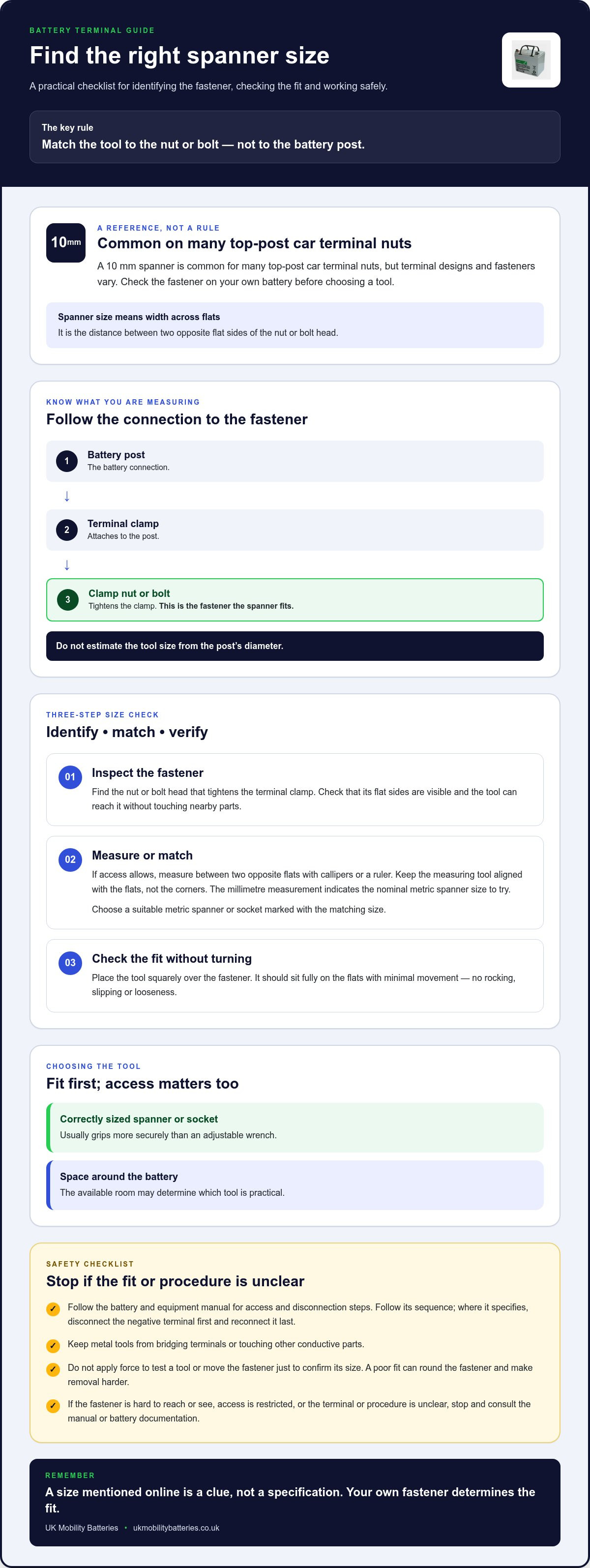
A 10 mm spanner fits many car battery terminal nuts, but it isn’t a universal answer. If you’re searching for “what size spanner for battery terminals”, it can be hard to tell whether advice refers to the post, nut or bolt. The spanner fits the fastener, not the battery post itself.
The right size depends on the terminal design and equipment. Top-post clamps, side-post terminals, hold-down brackets and mobility battery connections can all use different fittings. A tool that doesn’t fit securely may slip or round the fastener, so don’t force it.
This guide shows you how to identify the fastener and choose a fitting spanner or socket, with common automotive sizes as a reference. It also covers basic precautions, including checking the equipment instructions before disconnecting a battery. Follow the manual’s sequence. Where it specifies, disconnect the negative terminal first and reconnect it last. If the terminal or procedure is unclear, stop and consult the manual rather than risk damaging the battery or equipment.
Key Takeaways
- For what size spanner for battery terminals, inspect the nut or bolt itself, then choose a tool that sits fully in place without rocking.
- A correctly sized socket or spanner usually grips more securely than an adjustable wrench. The space around the battery may determine which is practical.
- Follow the battery and equipment manual for access and disconnection steps. Keep metal tools from bridging terminals or touching other conductive parts.
- Mobility batteries can have different terminal arrangements, so check the equipment requirements before choosing a replacement.
- Compare a replacement battery’s specifications and terminal layout with your equipment, not just the tool size needed to fit it.
What size spanner fits a battery terminal, and why is there no universal answer?
The correct spanner size depends on the nut or bolt fitted to that battery terminal. A spanner grips the fastener, not the battery post, so the post’s diameter won’t tell you which tool to use.
A spanner size is the width across the flat sides of the nut or bolt head that the tool must fit. This is known as the width across flats. Match that measurement to the tool rather than choosing a size based on the battery or equipment alone.
Battery layouts vary. A car may have a clamp that tightens around a post, while mobility equipment can use a different terminal arrangement. Even batteries that look similar may be installed with different fasteners. A 10 mm spanner is common for many top-post car terminal nuts, but it’s a reference point, not a universal rule. The fastener itself determines the size.
Which part of the battery terminal does the spanner fit?
It helps to distinguish three parts: the battery post, the terminal clamp and the clamp’s nut or bolt. The post is the battery connection. The clamp attaches to it, and the nut or bolt tightens the clamp. The spanner fits the flat sides of the nut or bolt, not around the post or over the clamp.
Simple assembly guide: Battery post → terminal clamp → clamp fastener (nut or bolt) → spanner fits the fastener flats.
If you’re unsure which part you’re looking at, find the fastener holding the terminal connection in place. That is the part to match with your tool. Don’t estimate its size from the post’s diameter.
Why do online answers give different battery spanner sizes?
Online answers often describe one person’s vehicle or battery setup. A forum reply may give the size that worked for a particular owner, but that doesn’t establish what will fit another installation. Differences in equipment, terminal layout and clamp hardware explain why two people can give different answers about different fasteners.
For “what size spanner for battery terminals”, treat a size mentioned online as a clue, not a specification. Inspect your own battery and identify the fastener. If you can’t measure it safely, try a correctly sized set of tools without applying force. The right spanner should sit fully on the flats without rocking or slipping. If it doesn’t, stop and try another size. Forcing a poor fit can damage the fastener and make removal harder.
How to identify the correct battery-terminal spanner size
Start with the fastener securing the terminal connection, not the battery post. Your aim is to identify its width across the flat sides and find a matching tool. If you’re asking what size spanner for battery terminals, use the fastener on your own battery as the reference rather than relying on a size that worked on a different installation.
Follow this short process:
- Inspect the fastener. Identify the nut or bolt head that tightens the terminal clamp. Check that its flat sides are visible and that the tool can reach it without touching nearby parts.
- Select a matching tool. Use a suitable metric spanner or socket marked with the matching size. If the size is unclear, measure across two opposite flats with callipers or a ruler, if access allows.
- Check the fit. Place the tool squarely over the fastener without turning it. It should seat fully, with minimal movement and no rocking or slipping.
A secure fit matters more than a commonly repeated size. A size that works on one battery may not match another terminal clamp or installation. Don’t apply force to test a tool. Identifying the size should not require loosening the fastener.
How can you measure the fastener across its flats?
Measure the straight-line distance between two opposite flat sides of the nut or bolt head. This is the width across flats. The measurement in millimetres indicates the nominal metric spanner size to try. Keep the measuring tool aligned with the flats, not the corners. If the fastener is difficult to reach or see, consult the equipment manual or battery documentation rather than guessing.
How should a spanner fit a battery-terminal fastener?
A correctly sized spanner sits squarely and fully on the fastener flats. It shouldn’t rock, slide off or feel loose. A poor fit can round the corners and make the fastener harder to remove. If you have safe access, compare another clearly labelled tool without turning the fastener. Stop if you can’t position the tool securely or the equipment instructions restrict access.
Before working around the battery, follow the manufacturer’s access and disconnection instructions. Don’t move a fastener simply to confirm its size, and keep tools clear of other conductive parts. For general background on battery maintenance and longevity, Battery University discusses lithium-based batteries. Its guidance doesn’t replace the instructions for your battery or equipment.
Identifying the fastener is only one part of a battery change. For mobility equipment, compare a replacement battery’s specifications and terminal arrangement with the equipment requirements, and follow the model-specific changing instructions. If you’re comparing sealed AGM battery options, check the product details against your equipment documentation before choosing a replacement.
Spanner, socket or adjustable wrench: which tool suits battery terminals?
A correctly sized tool matters more than its style. A fixed-size spanner, socket or adjustable wrench must grip the fastener securely and fit into the available space. A tool that fits the nut but cannot be positioned squarely isn’t a safe or practical choice.
Use this comparison to assess the options for the fastener you need to reach:
| Tool | Grip on the fastener | Access around the battery | Slipping risk |
|---|---|---|---|
| Correctly sized spanner | Secure when fully seated on the flats | Often useful where there is limited height | Low if the size and position are right |
| Correctly sized socket | Secure when it fits fully over the fastener | Needs enough clearance for the socket and handle | Low with full engagement; poor access can affect control |
| Adjustable wrench | Depends on setting the jaws tightly against the flats | Can be useful where its head fits into the available space | Higher if the jaws move or the fit is loose |
This comparison is a guide, not a rule that one tool suits every battery compartment. Check the surrounding space and equipment instructions before choosing. Don’t use a tool if you can’t position it squarely without touching nearby parts.
When is a fixed-size spanner or socket the better fit?
A correctly sized fixed tool engages the fastener without needing adjustment. Choose a spanner if it sits fully on the flats and you can move its handle safely. A socket can also provide a close fit, but only if there’s enough clearance around and above the terminal for the socket and handle.
Check access before applying force. Battery cases, covers and nearby wiring can limit a tool’s movement or angle. If a socket won’t sit straight, or a spanner only catches the fastener’s corners, stop and choose a better-fitting option rather than working at an angle.
Can an adjustable wrench be used on a battery terminal?
An adjustable wrench can be used if its jaws grip opposite flats without moving. Set the opening to the fastener before applying force, then check that the jaws remain square and tight. A loose fit can slip, damage the fastener or make it harder to remove. If a correctly sized fixed tool fits and access allows, use that instead.
Whichever tool you choose, keep control of its handle and follow the equipment’s instructions for accessing the battery. If you’re choosing a replacement mobility battery, compare its specifications and terminal arrangement with the equipment requirements. You can explore sealed AGM mobility batteries as part of that comparison.
How to use a battery-terminal spanner safely
Before using a spanner, follow the equipment manufacturer’s instructions for accessing and disconnecting the battery. The correct procedure can vary between vehicles and mobility equipment, so don’t assume that a sequence for one battery applies to another. If the manual is unavailable or the terminals are difficult to identify, pause and consult the equipment documentation or seek appropriate technical assistance.
A metal tool conducts electricity. If it touches both battery terminals, or bridges a terminal and another conductive part, it may create a short circuit, causing sparks, heat or damage. Keep the spanner controlled and clear of other terminals, metal frames and conductive surfaces. Don’t place tools on the battery or allow a loose tool to fall across connections.
What precautions should you take before touching a battery terminal?
Switch off and secure the equipment as its manual directs. Make sure the battery area is accessible without moving or straining cables. Check the instructions for model-specific isolation steps before loosening a connection. If the equipment contains more than one battery, don’t assume the layout or connections match a single-battery installation.
- Use a correctly fitting tool and keep its metal parts away from other terminals and conductive surfaces.
- Don’t work on a battery that is swollen, leaking or visibly damaged. Avoid touching it and follow the manufacturer’s guidance for what to do next.
- Stop if the terminal is corroded, hidden or difficult to identify, or if you can’t confidently follow the stated procedure.
Knowing what size spanner for battery terminals is only one part of safe work. The right size can reduce the chance of slipping, but it doesn’t remove the electrical risk or replace the equipment’s instructions.
When should you stop instead of forcing the fastener?
Stop if the spanner slips, the fastener turns with difficulty or the clamp starts to deform. A stuck connection may require a procedure or tool specified by the equipment manufacturer. Don’t force it, lever against the battery case or improvise with a loose-fitting tool. These actions can damage the terminal, clamp or surrounding components.
If the terminal is damaged or corroded, access is restricted, or you’re unsure which connection to work on, leave it in place. Recheck the manual and get appropriate technical assistance before continuing. This is especially important if the battery appears unsafe or the wiring arrangement is unclear.
Once the equipment instructions confirm that a battery replacement is appropriate, compare its specifications and terminal arrangement with your mobility equipment’s requirements. Explore sealed AGM mobility batteries as part of that replacement check.
Replacing a mobility battery: what to check after choosing the spanner
Finding the right spanner answers a tool-fit question. It doesn’t confirm that a replacement battery suits a mobility scooter or wheelchair. Before buying or fitting a battery, use the equipment manual to check the required specifications and connection layout. A battery can have a terminal fastener that fits your spanner yet still be incompatible with the equipment.
Use the model’s stated requirements as your reference rather than relying on the old battery’s appearance alone. If the original battery label is readable, its details can help with comparison, but the equipment instructions take priority. Don’t alter connectors or wiring to make a different battery fit.
What should you check before fitting a replacement mobility battery?
Check the equipment manual for the specified voltage, battery type and capacity. Then compare the terminal position and connector arrangement with the existing installation and the equipment requirements. This matters particularly when space in the battery compartment is limited or connections need to reach specific terminals.
- Voltage: Match the voltage required by the equipment.
- Battery type and capacity: Check both against the manual. Don’t select a battery on capacity alone.
- Terminal layout: Compare terminal position and connector arrangement, not just the fastener size.
- Physical fit: Where the manual specifies dimensions, compare them with the compartment requirements.
The spanner size only identifies the tool needed for a fastener. It says nothing about the battery’s voltage, capacity, dimensions or suitability. If a specification is unclear or the replacement connections don’t match the required layout, pause before fitting it and consult the equipment instructions.
Where can you find guidance for mobility battery replacement?
Follow a procedure written for your equipment rather than applying a general car-battery method. The guide on how to change mobility scooter batteries provides step-by-step replacement guidance. Use it alongside the manufacturer’s instructions, especially for battery access, disconnection and reconnection.
If you’re unsure whether a battery needs replacing, start with the symptoms and checks described in mobility scooter battery troubleshooting. A fault or change in performance doesn’t by itself establish that the battery is the cause, so check the relevant guidance before choosing a replacement.
Once you’ve confirmed the specifications and terminal arrangement your equipment requires, browse mobility scooter and wheelchair batteries to compare suitable options.
Make your next battery decision with confidence
Before starting work or choosing a replacement, set aside the equipment manual and note the battery details it specifies. This gives you a reliable reference, whether you’re checking what size spanner for battery terminals or comparing batteries. If the instructions are unclear, pause rather than guess. Getting the right information first can help you avoid an unsuitable purchase or unnecessary work.
UK Mobility Batteries supplies sealed AGM batteries for mobility scooters and wheelchairs, with technical support for customers across the UK. Use your equipment requirements to guide your selection, then browse mobility scooter and wheelchair batteries.
Take your time, follow the equipment guidance and choose a replacement that matches its requirements. Browse UK Mobility Batteries’ range of mobility scooter and wheelchair batteries to compare options.
Frequently Asked Questions
What size spanner do I need for a battery terminal?
There isn’t one spanner size that fits every battery terminal. To find what size spanner for battery terminals, identify the nut or bolt securing the connection, then match the tool to its width across the flats. Don’t use the diameter of a round battery post to choose a spanner. If the fastener is obscured by a cover or nearby wiring, check the equipment manual for the correct access method before proceeding.
Is a 10mm spanner the right size for battery terminals?
A 10 mm spanner fits many top-post automotive terminal nuts, but it isn’t guaranteed to fit your battery. Other fasteners may be used, including on mobility equipment, so treat 10 mm as a possible starting point, not a specification. Check the tool against the fastener without turning it. If it rocks, catches only at the corners or won’t sit fully in place, don’t apply force.
Can I use an adjustable wrench on a battery terminal?
An adjustable wrench can work if its jaws fit the fastener securely and the tool can be positioned without touching other parts. Before applying force, check that the jaws sit against the flats and don’t shift. A fixed-size tool is generally easier to position consistently when it fits. Don’t add leverage or use the wrench at an awkward angle to reach a restricted connection.
How do I measure a battery-terminal nut for a spanner?
Measure between two opposite flat sides of the nut or bolt head, using callipers if there’s enough room to place them safely. Don’t measure across the corners or the battery post. Compare the reading with the marking on a metric spanner, then check the fit gently without turning the tool. If the fastener is recessed or difficult to reach, use the battery or equipment documentation instead.
Should I disconnect the positive or negative battery terminal first?
Use the sequence specified in the vehicle or mobility equipment manual. Battery arrangements and disconnection procedures can vary, so don’t transfer instructions from another model. A metal tool touching a terminal and a conductive part at the same time can create a short circuit. If you can’t identify the terminals or find the correct instructions, leave the connections in place until you can confirm the model-specific procedure.
Can the wrong spanner damage a battery terminal?
Yes. A loose-fitting spanner can slip and round the fastener, while forcing a smaller tool can damage the nut, bolt or clamp. Once the flats are rounded, even a correctly sized tool may not grip properly. Stop if the fastener is seized, the clamp bends or the terminal looks damaged. Check the equipment manufacturer’s guidance before attempting further work rather than applying more force.
Are mobility scooter battery-terminal spanner sizes different from car battery sizes?
They can be, because mobility scooters and cars don’t necessarily use the same terminal hardware or layout. A spanner that fits a car’s clamp may not suit a scooter battery connection. Some mobility batteries use connectors without a clamp nut for a spanner. Check the scooter’s manual and inspect the existing connection before choosing a tool or planning a replacement.