
What Happens With a Lower Ah Battery? Check Runtime and Fit
A lower Ah battery stores less charge, so it will usually power the same load for less time. Understanding what happens if I use a lower Ah battery starts with one distinction: Ah measures capacity, not voltage. To estimate runtime, divide battery capacity in amp-hours by the device’s current draw in amps.
A higher Ah rating generally means longer runtime, but capacity alone doesn’t determine whether a battery is suitable. Actual operating time also depends on the load and the battery’s usable capacity. A lower-rated battery may work for equipment that draws less current or runs for shorter periods, but it provides less reserve.
This guide explains how to estimate runtime from Ah and current draw, why lower capacity matters under heavier loads, and what to check when matching a replacement battery. Voltage, dimensions and terminal layout all matter too, so a battery that fits physically isn’t automatically compatible.
Key Takeaways
- Estimate operating time by dividing battery capacity in amp-hours by the device’s current draw in amps, then allow for real-world losses.
- Ah measures stored capacity, not voltage; a lower rating generally means less reserve and shorter runtime under the same load.
- For starting applications, compare the required starting-current rating as well as capacity, since Ah alone does not determine cranking ability.
- Before choosing a replacement, match the required voltage and check the battery’s dimensions and terminal layout for a safe, practical fit.
Estimating runtime from Ah and current draw
Use the battery’s amp-hour rating and the equipment’s current draw to estimate operating time. Treat the result as a starting point, not a guaranteed runtime.
Using Ah to estimate runtime
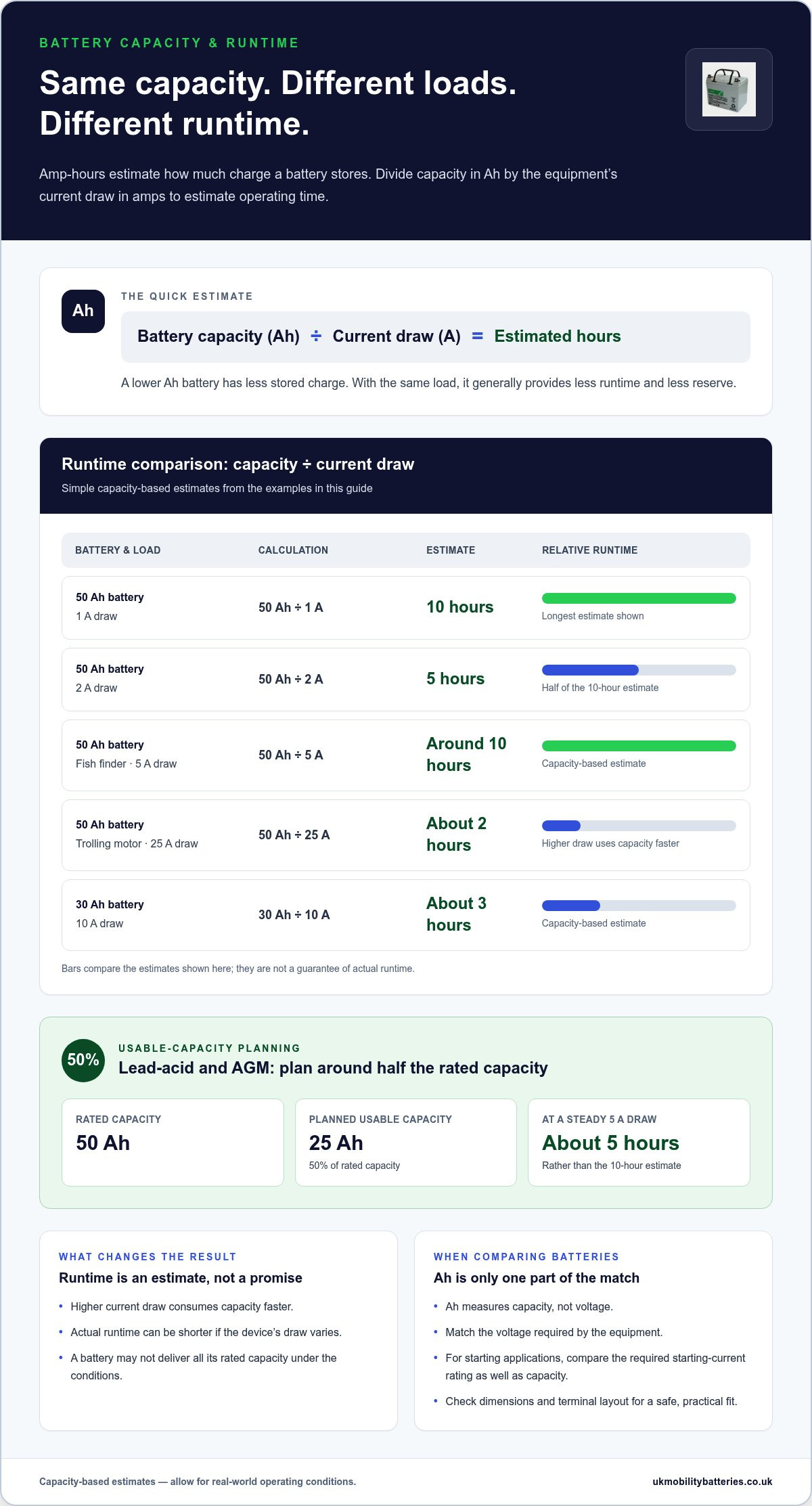
Amp-hours divided by amps gives an estimated runtime in hours. For example, a 10 Ah battery could theoretically supply 1 amp for 10 hours, 2 amps for 5 hours, or 10 amps for 1 hour. This calculation helps compare expected use with available capacity before choosing a battery. A lower Ah rating means less capacity for the same load.
Allowing for current draw
Current draw is the amount of electrical current a device uses, measured in amps. Higher draw consumes a battery’s capacity faster, shortening runtime. A fish finder drawing 5 amps uses a 50 Ah battery for around 10 hours by this estimate. A trolling motor drawing 25 amps uses the same capacity in about 2 hours. The load changes the result.
Apply the same calculation to other combinations: a 30 Ah battery powering a 10-amp device is estimated to last about 3 hours. These are simple capacity-based estimates. Actual runtime can be shorter if the device’s draw varies during operation or the battery cannot deliver all its rated capacity under the conditions.
Battery type also affects how much capacity you should plan to use. Lead-acid and AGM batteries should not be discharged below 50% of rated capacity. For a 50 Ah battery of either type, that guidance means planning around 25 Ah of usable capacity. At a steady 5-amp draw, that gives an estimated 5 hours, rather than 10. Treat this as a planning calculation, not a runtime guarantee.
How Ah relates to battery capacity and runtime
Amp-hours describe charge capacity, but they don’t show the whole energy supply. Voltage matters too: multiply volts by amp-hours to estimate watt-hours. For example, a 100 Ah battery at 12 V provides 1,200 Wh, while a 100 Ah battery at 48 V provides 4,800 Wh. The same Ah rating can therefore represent different energy amounts.
Capacity also changes with the electrical load. A 100 Ah lead-acid battery under heavy loads might deliver only 50 Ah. This means a rating is not always the amount available to power equipment in actual use. Load strength and battery type influence how much capacity can be drawn before performance drops.
Connections affect the resulting capacity in different ways. Two 12 V, 100 Ah batteries connected in series produce a 24 V, 100 Ah setup. Connected in parallel, the same batteries produce a 12 V, 200 Ah setup. Series connection raises voltage; parallel connection adds amp-hour capacity. The equipment’s required voltage determines which arrangement is relevant.
Units can also be converted without changing the capacity: 1.5 Ah equals 1,500 mAh. Comparing Ah and mAh ratings therefore requires converting them to the same unit first. A lower Ah rating means less stored charge at the same voltage, and can reduce the time available before recharging.
Capacity affects how long a battery can support small electrical loads whilst equipment is idle. A battery with 30% less amp-hour capacity is more susceptible to parasitic draw and will lose charge faster whilst sitting than a higher-capacity battery, assuming both are healthy. This matters when standby equipment continues drawing power.
Ah is a capacity rating, not a UK legal classification. Warranty coverage depends on the applicable terms and compatibility requirements; the Ah figure alone doesn’t determine whether a replacement remains covered. Compare the replacement’s stated capacity with the equipment requirements and warranty conditions before fitting it.
Will a lower Ah battery damage a device or vehicle?
A lower Ah rating doesn’t automatically mean a battery will damage its equipment. Capacity and starting current are different: Ah describes stored charge, while cold cranking amps (CCA) indicate the current available to start an engine. A battery may have enough capacity for normal use yet still struggle if its CCA is too low.
Consider a motorcycle with a 250 cc fuel-injected engine. Its original battery is rated at 6 Ah over 10 hours, with a 130-amp CCA rating. A proposed replacement rated at 4 Ah and 70 amps CCA is lower on both measures. The reduced capacity leaves less reserve, whilst the lower CCA can mean less current for the starter. Starting trouble is the practical concern, particularly under high electrical load. The recommendation for that example is to retain the original 6 Ah capacity.
A smaller Ah figure alone doesn’t prove that a motorcycle battery supplies less starting current. Compare the CCA rating separately, along with the equipment’s other battery requirements. A battery that fits physically may still be unsuitable if its starting-current rating is below the vehicle’s requirement.
For a car, the original battery in one example was rated at 40 Ah, whilst 35 Ah batteries were available as replacements. A lower-capacity option may suit a car with limited electrical accessories if its other battery parameters match. The trade-off is reduced reserve for accessories used with the engine off. One indicative comparison gives about 1 hour of stereo use from a 40 Ah battery, against 45 minutes from a 35 Ah battery, before charge falls below the starting threshold.
A lower Ah battery is more likely to mean shorter accessory use or starting difficulty than direct damage from capacity alone. For a vehicle, compare the original Ah and CCA ratings and consider its electrical load. For other equipment, decide whether the reduced operating time suits its intended use.
Does battery voltage need to match when choosing a replacement?
Yes. Match the replacement battery’s voltage to the equipment’s specified voltage. Ah describes capacity, but it cannot compensate for a voltage mismatch. Most cars require a 12 V battery, so a different-voltage battery is not a suitable substitute simply because its dimensions or Ah rating appear appropriate.
Voltage affects how electrical energy is delivered to a vehicle’s systems. Using the wrong voltage can damage a car’s electronic control unit (ECU). Reversing the terminals can also cause ECU damage, so correct polarity matters as much as matching voltage. Treat voltage, terminal polarity and capacity as separate specifications.
Physical fit and terminal position matter too. A battery can have the right voltage and still be impractical if its case does not fit the battery tray, or its cables cannot reach the terminals. Group 24 and Group 24F batteries illustrate this issue: their terminals sit on opposite sides. Choosing the wrong orientation may leave the vehicle cables unable to connect correctly.
Before selecting a replacement, compare the existing battery and equipment requirements for:
- Voltage: match the specified system voltage, such as 12 V for most cars.
- Polarity: check which side carries each terminal, then align the connections correctly.
- Case fit: compare the battery’s shape and dimensions with the available space.
- Capacity and starting rating: check these separately against the vehicle’s requirements.
Never use a higher or lower voltage to compensate for a different Ah rating. The battery voltage must suit the system; capacity determines stored charge. For a replacement mobility battery, compare compatible battery options alongside the equipment’s voltage and fit requirements.
UK Mobility Batteries: Lucas 12V 7Ah Sealed AGM Batteries
UK Mobility Batteries offers Lucas 12V 7Ah Sealed AGM Batteries for readers comparing battery capacity for mobility equipment. The range also includes the Lucas 12V 9Ah Uprated Sealed AGM Battery, Lucas 12V 20Ah Mobility Battery and Lucas 12V 34Ah Sealed AGM Deep Cycle Battery.
Use the existing battery’s voltage and capacity as reference points, then consider the equipment’s expected load and the runtime you need. A lower Ah rating means less stored charge, so compare the stated capacity with your current battery rather than choosing by Ah alone. Physical fit and terminal arrangement also matter.
If you’re weighing up these Lucas options, UK Mobility Batteries can help you consider the available batteries for your requirements. Contact UK Mobility Batteries for assistance with choosing a battery.
Choose a battery around your real use
Before choosing a replacement, consider how the equipment is used between charges. Note its typical operating pattern, whether it needs reliable starting power and whether accessories stay active when it is switched off. These details help you weigh battery capacity against the time available for use.
If you’re still weighing up what happens if I use a lower Ah battery, compare the existing battery label with the equipment’s requirements and your expected use. A lower rating may suit a shorter operating routine, but leaves less reserve for unexpected demand. Base your choice on the equipment’s specifications, not the Ah figure alone.
UK Mobility Batteries offers battery options for mobility equipment, including Lucas sealed AGM batteries. For help considering a suitable option, contact UK Mobility Batteries. A clear comparison of your requirements is a practical next step towards choosing with confidence.
Frequently Asked Questions
Do Higher Ah Ratings Mean Better Batteries?
No. A higher Ah rating means greater charge capacity, but it doesn’t automatically make a battery better for every application. Suitability also depends on voltage, battery type, dimensions and the equipment’s requirements. A higher-capacity battery that doesn’t fit the compartment or suit the charging system isn’t a useful upgrade. Compare the complete specification with the equipment’s intended use.
What Affects Battery Runtime?
Runtime depends on the equipment’s electrical demand, the battery’s available capacity and its condition. Equipment that draws more power or runs continuously uses stored energy sooner than equipment used intermittently. Age and repeated use can also affect the capacity a battery delivers. If equipment uses an inverter, some energy is lost converting battery power to AC.
What Are Amp Hours (Ah)?
Amp-hours measure electrical charge capacity: they describe current supplied over time. For example, a 1.5 Ah battery is equivalent to 1,500 mAh. This conversion helps compare labels that use different units. It doesn’t indicate voltage or starting-current capability, so consider those specifications separately when selecting a battery for equipment.
What does Ah mean on a battery?
Ah on a battery label identifies its rated capacity in amp-hours. It helps compare how much charge different batteries can store, provided you compare like with like. For instance, 1,500 mAh and 1.5 Ah express the same capacity. The Ah figure alone doesn’t identify voltage, dimensions, terminal arrangement or compatibility with particular equipment.
What happens if you use a battery with a lower Ah rating?
If you’re asking what happens if I use a lower Ah battery, expect less stored capacity and a smaller reserve for your equipment. The practical result may be more frequent charging, particularly if it runs for long periods. In a vehicle, assess the starting-current rating separately, because Ah alone doesn’t describe cranking capability.
How does a lower Ah battery affect runtime and performance?
To judge what happens if I use a lower Ah battery in your setup, consider how often the equipment runs and how much power it draws. A lower rating generally means less operating time before recharging. It doesn’t, by itself, show how much current the battery can deliver; its other ratings and design matter too.