
Reliable Wheelchair Batteries for Peace of Mind: A UK Guide
What if a battery that looks like a close match leaves your wheelchair short of power? Choosing reliable wheelchair batteries for peace of mind takes more than comparing capacity. Voltage, dimensions, terminal type, battery chemistry and charger compatibility all matter. The right replacement must meet your wheelchair manufacturer’s specifications and fit the equipment as intended.
When a wheelchair supports everyday journeys, choosing a suitable replacement matters. This guide shows you how to find the specifications you need, compare battery options and follow the relevant charging instructions. Sealed AGM batteries are maintenance-free options, but they still need to be matched to your wheelchair and used with a compatible charger. UK Mobility Batteries supplies batteries for mobility equipment and offers technical support to help you interpret battery specifications.
Key Takeaways
- Start with your wheelchair documentation to identify its battery requirements.
- Compare voltage, capacity, dimensions, terminals, chemistry and charger requirements. Don’t rely on broad reliability claims.
- Amp-hour capacity describes stored charge. It does not guarantee a particular travel distance.
- Reliable wheelchair batteries for peace of mind depend on a correct match, compatible charging and following the equipment instructions.
- Sealed AGM batteries are maintenance-free options. Check that this battery type is permitted for your wheelchair.
What makes a wheelchair battery reliable in everyday use?
A reliable wheelchair battery is one that meets the manufacturer’s requirements, fits the battery compartment and is used and charged according to the relevant instructions. This match supports dependable everyday use, but it cannot guarantee a particular travel distance. Nor is a battery automatically suitable just because its capacity rating is higher than the existing one.
Battery reliability and wheelchair range are related, but they are not the same. Battery condition and usable capacity matter, while distance travelled can also vary with the wheelchair’s setup and how it is used. Terrain, load and driving conditions may affect how quickly power is used. A description such as “long-lasting” does not tell you whether a battery fits or is compatible with your equipment.
Many mobility batteries are designed for sustained power delivery. The overview of deep-cycle batteries explains how this differs from the short bursts associated with starting a vehicle engine. The wheelchair manufacturer must still permit the battery type, and the charger must be compatible with the battery.
What does wheelchair battery reliability actually mean?
In practical terms, dependable power starts with a battery suited to the equipment and used as instructed. Capacity alone cannot establish suitability. A battery with a higher amp-hour (Ah) rating may still have the wrong voltage, dimensions, terminals or chemistry. Begin with the wheelchair manual or the manufacturer’s battery specifications.
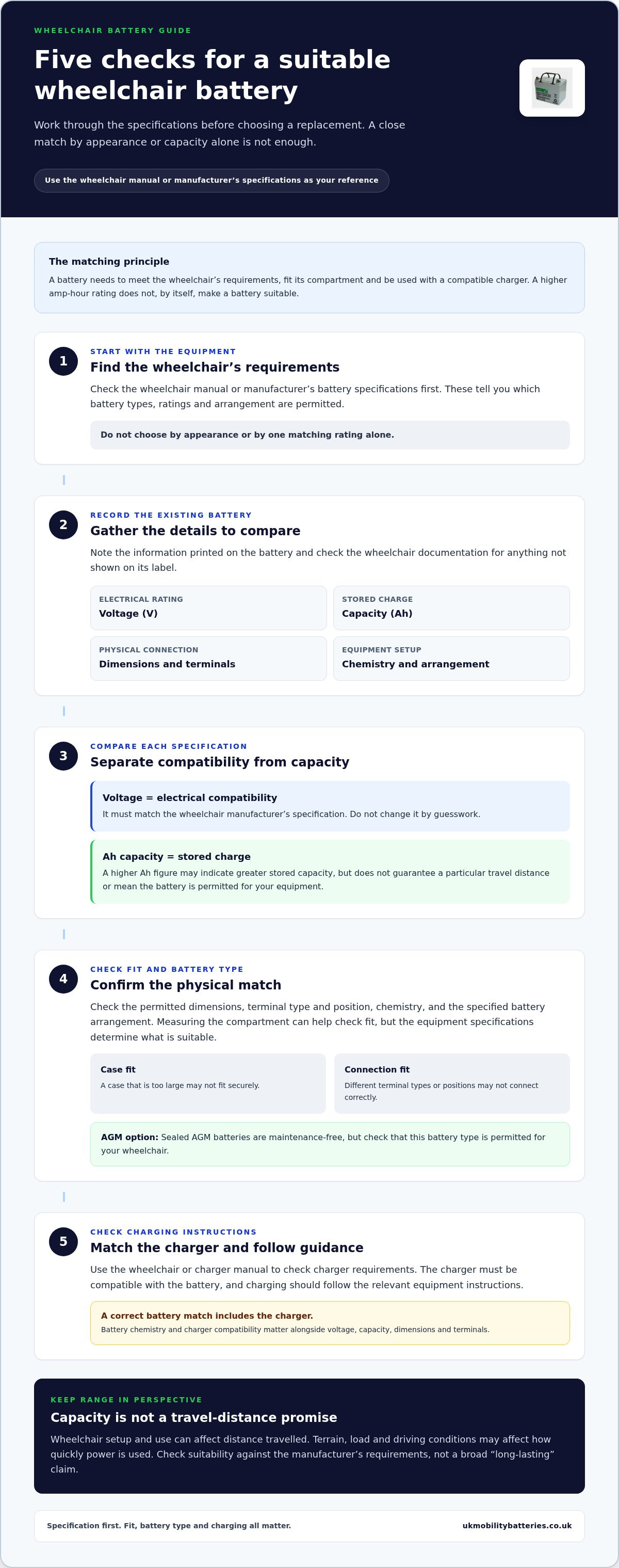
For a suitable replacement, match the voltage, check the physical and terminal fit, and follow the wheelchair manufacturer’s instructions for the battery and charger.
Why does the correct battery match matter?
Check each specification separately. Voltage is an electrical requirement, not a figure to change by guesswork. Capacity, measured in amp-hours, describes stored charge, but does not promise a set range. Dimensions determine whether the battery fits its compartment, while terminal type and position affect how it connects. Battery chemistry and charger compatibility matter too.
Before ordering, record the details printed on the existing battery, including voltage, capacity and terminal information. Compare them with the wheelchair manual or manufacturer’s specifications. Do not assume a battery is suitable because it looks similar or shares one rating with the existing unit.
These checks help you assess reliable wheelchair batteries for peace of mind on practical suitability rather than an unqualified claim. Sealed AGM batteries are maintenance-free options in the UK Mobility Batteries range, but the wheelchair’s specifications must guide your choice.
How wheelchair battery specifications affect dependable performance
Battery specifications describe different requirements, and each must be considered. A battery can have a suitable capacity but still be unsuitable if its voltage, dimensions or terminal arrangement do not match the wheelchair. Use the equipment manufacturer’s documentation as your reference, rather than choosing by appearance or by one rating alone.
What do voltage and amp-hour capacity tell you?
Voltage, measured in volts (V), is the electrical rating required by the wheelchair’s system. It must match the manufacturer’s specification. Do not assume that a different voltage will work or that batteries with different voltage ratings are interchangeable.
Amp-hour capacity (Ah) describes how much charge a battery can store under specified conditions. A higher Ah figure may indicate greater stored capacity, but it does not guarantee a particular travel distance. Range also depends on factors such as the wheelchair’s setup and use. Most importantly, a higher-capacity battery is not automatically permitted for your equipment.
Voltage determines electrical compatibility; amp-hour capacity describes stored charge, not guaranteed range.
How do battery dimensions and terminals affect fit?
Check the label for voltage and capacity. Dimensions and terminal details may also appear on the label, in the battery manufacturer’s information or in the wheelchair documentation. Measuring the battery compartment can help you check the fit, but the equipment specifications should determine the permitted dimensions and connection layout.
Matching the nominal voltage alone does not establish physical or connector compatibility. A case that is too large may not fit securely, while terminals in the wrong position or of a different type may not connect correctly. Some wheelchair arrangements use more than one battery, so check the specified configuration rather than assuming one battery can replace the complete setup.
Before comparing replacements, record:
- Voltage and amp-hour capacity shown on the existing battery
- Case dimensions and terminal type and position
- Battery chemistry and the wheelchair manufacturer’s stated arrangement
- Charger requirements in the wheelchair or charger manual
Keep travel requirements separate from everyday battery compatibility. The FAA’s guidance on wheelchair batteries for air travel relates to US aviation. UK travellers should follow the applicable airline and UK guidance.
Careful specification matching is a practical first step towards reliable wheelchair batteries for peace of mind. UK Mobility Batteries offers wheelchair battery options to compare with the details you have recorded.
How to compare wheelchair batteries without relying on vague claims
Product descriptions are most useful when they provide specifications you can compare with your wheelchair documentation. Treat phrases such as “reliable” or “long-lasting” as general descriptions, not proof of compatibility. Use this checklist to assess each option:
| Specification | What to compare |
|---|---|
| Voltage | Does it match the voltage specified for your wheelchair’s battery system? |
| Capacity | Is the amp-hour (Ah) rating permitted for the equipment? |
| Dimensions | Will the battery case fit the compartment and be secured as intended? |
| Terminals | Do the terminal type and position match the existing connections? |
| Chemistry | Does the wheelchair documentation permit this battery type? |
| Charger | Is the charger suitable for the battery chemistry and specified by the relevant manuals? |
A rule of thumb cannot establish that a particular voltage, chemistry or size will suit every wheelchair. Compare each specification with the equipment manufacturer’s requirements. If the setup uses more than one battery, check the documented arrangement as well.
Is a higher amp-hour rating always the better choice?
No. Consider a higher capacity only if the wheelchair documentation permits it and the battery also fits the compartment and connections. It may affect potential runtime, but the rating alone cannot predict real-world performance or travel distance. Any general guide to the best batteries for electric wheelchairs should be treated as background information. Assess each option against your own equipment specifications.
What should you compare between sealed AGM options?
Sealed AGM batteries are maintenance-free options in the UK Mobility Batteries range. Maintenance-free does not mean charge-free: follow the wheelchair and charger instructions, and use a compatible charger. Compare the voltage, capacity, dimensions and terminal layout with your existing setup, and confirm that the wheelchair permits AGM chemistry.
For example, the range includes Lucas 12V 7Ah Sealed AGM Batteries, a Lucas 12V 9Ah Uprated Sealed AGM Battery and a Lucas 12V 34Ah Sealed AGM Deep Cycle Battery. These products have different specifications, so they are not universal wheelchair recommendations. Compare the exact model details with your equipment before choosing a replacement.
This approach separates measurable suitability from broad claims. Matching specifications, rather than choosing by capacity alone, is a practical step towards reliable wheelchair batteries for peace of mind.
What checks help keep wheelchair batteries dependable?
Start with the equipment instructions rather than relying on a universal charging routine. Use this sequence to keep your checks straightforward:
- Read the manuals: Follow the wheelchair and battery guidance for use and charging.
- Check the charger: Make sure it is specified as compatible with the battery and equipment.
- Charge as directed: Use the charging method and schedule described by the manufacturers.
- Monitor changes: Note differences in charging behaviour or everyday performance, then consult the relevant guidance.
How should wheelchair batteries be charged?
Follow the wheelchair and charger manufacturers’ instructions. The charger needs to suit the battery type and the equipment’s requirements. A charger that appears to connect correctly is not necessarily compatible. Charging guidance can vary between battery and wheelchair combinations, so do not apply a routine intended for another setup. If the instructions are unclear or appear to differ, follow the equipment manufacturer’s guidance before changing your charging routine.
Which changes are worth monitoring?
Note changes over time, such as a noticeable difference in charging behaviour or wheelchair performance during usual activities. These observations are a reason to consult the manuals, not proof that the battery has failed. Equipment setup, usage and charging conditions can also affect performance, so avoid diagnosing a fault from one change alone.
If performance changes, compare what you observe with the wheelchair and battery instructions. A battery troubleshooting guide can help you work through possible causes, but follow the equipment manufacturer’s guidance before deciding the battery is at fault. Technical support can also help you interpret battery specifications or compare replacement options.
Following the correct instructions and keeping track of changes supports reliable wheelchair batteries for peace of mind. UK Mobility Batteries provides technical support for battery selection and offers wheelchair battery options.
Choosing a reliable wheelchair battery from UK Mobility Batteries
Before ordering, gather the wheelchair’s battery requirements and the details of your existing setup. UK Mobility Batteries specialises in batteries for mobility equipment, including wheelchairs, and offers expert technical support to help interpret battery information. A clear checklist makes it easier to compare options against the equipment requirements.
What information should you have ready when selecting a replacement?
Record the wheelchair make and model, then consult its manual or manufacturer’s battery specifications. Note the existing battery label details and arrangement, including voltage and amp-hour capacity. Have the case dimensions, terminal type and position, battery chemistry and charger instructions to hand too. If the wheelchair uses multiple batteries, record that configuration. Together, these details help distinguish a product that matches one rating from a replacement that meets the equipment’s full requirements.
- Wheelchair: make, model and manufacturer’s battery requirements
- Battery: voltage, capacity, chemistry and existing arrangement
- Fit: case dimensions and terminal type and position
- Charging: charger details and instructions from the relevant manuals
How can specialist battery support simplify selection?
Once you have these details, technical support can help you interpret the specifications and compare options. UK Mobility Batteries offers sealed AGM batteries for mobility equipment, including maintenance-free options, alongside Lucas models such as 12V 7Ah, 9Ah, 12Ah, 20Ah, 34Ah, 50Ah and 55Ah batteries. These examples have different specifications and are not universal wheelchair matches. Let the wheelchair manufacturer’s requirements guide your selection.
UK-wide delivery is available. Compare the battery and charger instructions, as a replacement must suit both the wheelchair and its charging requirements. A maintenance-free battery still needs to be charged and used according to the relevant guidance.
For reliable wheelchair batteries for peace of mind, use your recorded specifications as the starting point and compare them with the equipment documentation. The sealed AGM and Lucas battery range from UK Mobility Batteries includes options across a range of capacities.
Choose your next wheelchair battery with confidence
Reliable wheelchair batteries for peace of mind start with a correct match, not a broad reliability claim. Check the wheelchair manufacturer’s requirements for voltage, capacity, dimensions and terminals, then follow the equipment and charger instructions. Capacity alone cannot promise a particular travel distance, and a higher rating is not automatically the right choice.
UK Mobility Batteries specialises in wheelchair and mobility batteries, including maintenance-free sealed AGM options and Lucas battery models. Expert technical support can help you interpret specifications, and UK-wide delivery is available. Compare each battery’s details with your wheelchair documentation before choosing an option.
Use your recorded specifications to find a suitable replacement. Browse wheelchair battery options from UK Mobility Batteries.
Frequently Asked Questions
Is a higher amp-hour wheelchair battery more reliable?
No. Amp-hour capacity is only one specification and does not prove that a battery will fit or suit your wheelchair. Check the manufacturer’s required voltage, permitted capacity, dimensions and terminal connections. Consider a higher-capacity option only if the equipment documentation supports it. Choosing the largest figure on a product label is not a substitute for matching the battery to the wheelchair’s requirements.
Can I replace my wheelchair battery with a different capacity?
The wheelchair manufacturer’s specifications determine whether a different amp-hour rating is suitable. Check voltage, dimensions, connector arrangement and any capacity limits in the documentation. Matching the voltage alone does not guarantee compatibility. If you are unsure how to interpret the existing battery label, use the equipment details and specialist technical support to compare replacement options before ordering.
How do I know which battery fits my electric wheelchair?
Start with the wheelchair manual and the labels on the existing batteries. Record the required voltage and capacity, case dimensions, terminal type, and the number and arrangement of batteries. Compare each detail with the replacement specifications, and check the charger guidance too. The wheelchair manufacturer’s requirements take priority over general battery advice, since matching one specification does not establish a complete fit.
Are sealed AGM batteries suitable for wheelchairs?
Sealed AGM batteries can be suitable if they meet the wheelchair’s stated requirements. Check voltage, capacity, dimensions, terminals and charger compatibility before choosing one. The AGM label alone does not confirm a fit. UK Mobility Batteries supplies sealed AGM batteries for mobility equipment. These are maintenance-free options, but they still need to be charged and used according to the relevant instructions.
How often should I charge wheelchair batteries?
Follow the instructions provided for your wheelchair, batteries and charger. Charging guidance varies between equipment and battery systems, so there is no single schedule for every wheelchair. Do not base your routine solely on advice for another model. If charging behaviour or everyday performance changes, note what you observe and consult the relevant manufacturer guidance before deciding whether the battery needs replacing.
What can cause wheelchair battery performance to change?
Battery condition is one possible factor, but it is not the only one. Wheelchair setup, settings, terrain, load and patterns of use can also affect performance. Compare what you notice with the equipment guidance, and record changes in charging behaviour or everyday use. Do not diagnose a specific battery fault from range alone. A structured check of the battery and equipment can help identify what to investigate next.
Do wheelchair batteries need to be replaced as a pair?
That depends on the wheelchair’s battery arrangement and the manufacturer’s replacement instructions. Some systems use more than one battery, so replacing only one may not suit every setup. Check the manual before ordering and confirm the required specifications for each battery position. Do not assume one replacement rule applies to every wheelchair; follow the guidance for your equipment.
Ready to compare a replacement with your wheelchair’s specifications? Browse wheelchair batteries from UK Mobility Batteries.