
Power Scooter Battery: How to Choose the Right Replacement in 2026
A higher-capacity power scooter battery may offer the prospect of longer range, but it isn’t automatically the right replacement. Check voltage, physical dimensions and terminal arrangement first. If these don’t match the scooter’s requirements, the battery may not fit or connect correctly.
Battery labels can be difficult to compare, especially when voltage and amp-hours are unfamiliar. A higher Ah rating may work in some cases, but capacity alone doesn’t confirm compatibility.
This guide shows you how to use your battery label and scooter manual to identify the specifications you need, then compare them with a replacement. You’ll learn what to check about voltage, capacity, dimensions and connections, and when a different Ah rating calls for extra fitment checks. It focuses on choosing a compatible sealed AGM battery, including how to assess available Lucas 12V options.
Key Takeaways
- A change in battery performance can affect range and everyday usability. Check the specifications before deciding whether a replacement is needed.
- Voltage, amp-hour capacity and battery chemistry describe different things. A 12V label shows voltage, whilst Ah indicates rated capacity.
- A higher Ah rating alone doesn’t confirm that a power scooter battery is suitable. Compare the required voltage, dimensions and terminals.
- Use your scooter manual and existing battery label to record the details you’ll need, including the connector arrangement.
- Compare sealed AGM options from 7Ah to 150Ah, including Lucas 12V models, against your scooter’s specifications rather than choosing by capacity alone.
What is a power scooter battery, and when does it need replacing?
A power scooter battery is the rechargeable source of electrical energy for the scooter’s drive system and, depending on the model, other onboard electrical systems. The battery setup varies: some scooters use one battery, whilst others use more than one. Check the manual or the existing setup before assuming how many replacements you need.
Battery condition can affect the range available between charges and how reliably the scooter can be used day to day. A noticeable performance change is a reason to check the battery and scooter requirements, but it doesn’t prove by itself that the battery needs replacing. The Mobility Scooter overview provides general context on scooter types and design. For your model’s battery setup, use the owner’s manual.
How the battery powers a mobility scooter
The battery stores electrical energy for the scooter’s drive system. Voltage, expressed in volts (V), describes its electrical rating. Amp-hour capacity (Ah) indicates the amount of charge the battery is rated to store. It isn’t a guaranteed range figure: the distance a scooter can travel depends on its design and how it is used. These measurements describe different properties, so neither is enough on its own to identify a replacement.
What to check before assuming the battery is worn out
Start with the scooter manual and the label on the existing battery. Record the specifications, and check whether the model uses one battery or multiple batteries. This gives you a reference for comparing the scooter’s requirements with a replacement.
Charging, storage and use can influence performance, so consider whether any of these have changed before drawing a conclusion. If performance problems keep returning, the battery may not be the only possible cause. A wider scooter fault can produce similar concerns, and replacing the battery alone may not resolve them. For recurring symptoms, see this guide to mobility scooter battery troubleshooting.
Replacing a battery means selecting a unit that matches the scooter’s documented requirements. It isn’t the same as diagnosing a fault elsewhere in the scooter. Treat the battery label and manual as starting points, then compare the specifications carefully before ordering.
Power scooter battery specifications explained: voltage, Ah and AGM
Battery labels show details that describe different aspects of the unit. Voltage identifies its electrical rating, amp-hours (Ah) describe rated capacity, and chemistry indicates how the battery is constructed. A suitable power scooter battery must meet the scooter’s requirements across these specifications, not just one of them.
What do 12V and amp-hour ratings mean?
Look for voltage and Ah on the battery label, often printed alongside the battery type. A 12V label identifies the battery’s voltage. A scooter may require a particular voltage arrangement, including more than one battery, so follow the manufacturer’s guidance rather than assuming a single 12V battery is the complete system.
Voltage describes the electrical rating; amp-hours describe the battery’s rated capacity. A higher Ah figure indicates more rated capacity, but it doesn’t translate directly into a guaranteed travel distance. Scooter load, terrain and operating conditions also affect available range. For a closer explanation of capacity ratings, read the mobility scooter battery amp-hour guide.
What does sealed AGM mean for a replacement battery?
AGM stands for Absorbent Glass Mat. It is a type of lead-acid battery in which the electrolyte is held in glass mat separators. “Sealed” describes the battery construction, whilst “maintenance-free” means it isn’t designed to need routine electrolyte topping-up. It still needs to be charged correctly using a charger suited to the battery and scooter requirements.
Chemistry matters because a replacement must be the type specified or supported by the scooter manufacturer. Don’t treat AGM, gel and lithium batteries as interchangeable simply because their voltage or capacity figures appear similar. Check the manual and existing battery label before comparing options.
UK Mobility Batteries stocks sealed AGM batteries across capacities from 7Ah to 150Ah, including Lucas 12V options. These capacity figures can help narrow your search, but they don’t establish that a particular battery fits every scooter. Compare the required voltage arrangement and other fitment details before choosing. Review the sealed AGM battery range alongside your scooter documentation.
Can you replace a power scooter battery with a higher Ah model?
Possibly, but a higher amp-hour rating on its own doesn’t make a replacement compatible. The scooter must support the battery’s voltage and capacity, and the unit must fit its compartment and connect correctly to the existing terminals. Treat a capacity increase as a fitment decision, not an automatic range upgrade.
For example, UK Mobility Batteries offers Lucas 12V sealed AGM batteries in both 7Ah and 9Ah options. These are examples of available ratings, not evidence that the 9Ah battery will fit or suit every scooter that uses a 7Ah battery. The scooter manufacturer’s requirements and the battery’s physical and terminal specifications determine suitability.
When matching the original capacity is the simplest route
Before comparing replacements, record the original battery’s voltage, Ah rating and dimensions. Also note the terminal type and arrangement. Matching the existing specification, where it agrees with the scooter documentation, reduces uncertainty about fit and electrical requirements.
| Check | What to compare |
|---|---|
| Voltage | Match the rating and battery arrangement specified for the scooter. |
| Capacity | Compare the original Ah rating with the proposed replacement and manufacturer guidance. |
| Physical fit | Check the battery’s dimensions against the compartment, then compare terminal type and position. |
Check each item separately. A battery can have the correct voltage and a higher capacity but still be too large or have terminals that don’t match the scooter’s connections.
When a higher-capacity battery may be worth considering
A different Ah rating may be an option only if the scooter design and manufacturer requirements allow it. More rated capacity doesn’t guarantee a specific increase in travel distance: load, terrain and conditions influence actual range. Before ordering, confirm that the replacement retains the required voltage and meets the compartment and connection requirements.
For a specific example of the information to compare, see the guide to 12V 7Ah mobility scooter battery specifications. Use it alongside your scooter documentation rather than treating any example battery as universally compatible. You can also review the sealed AGM battery options once you have the required specifications.
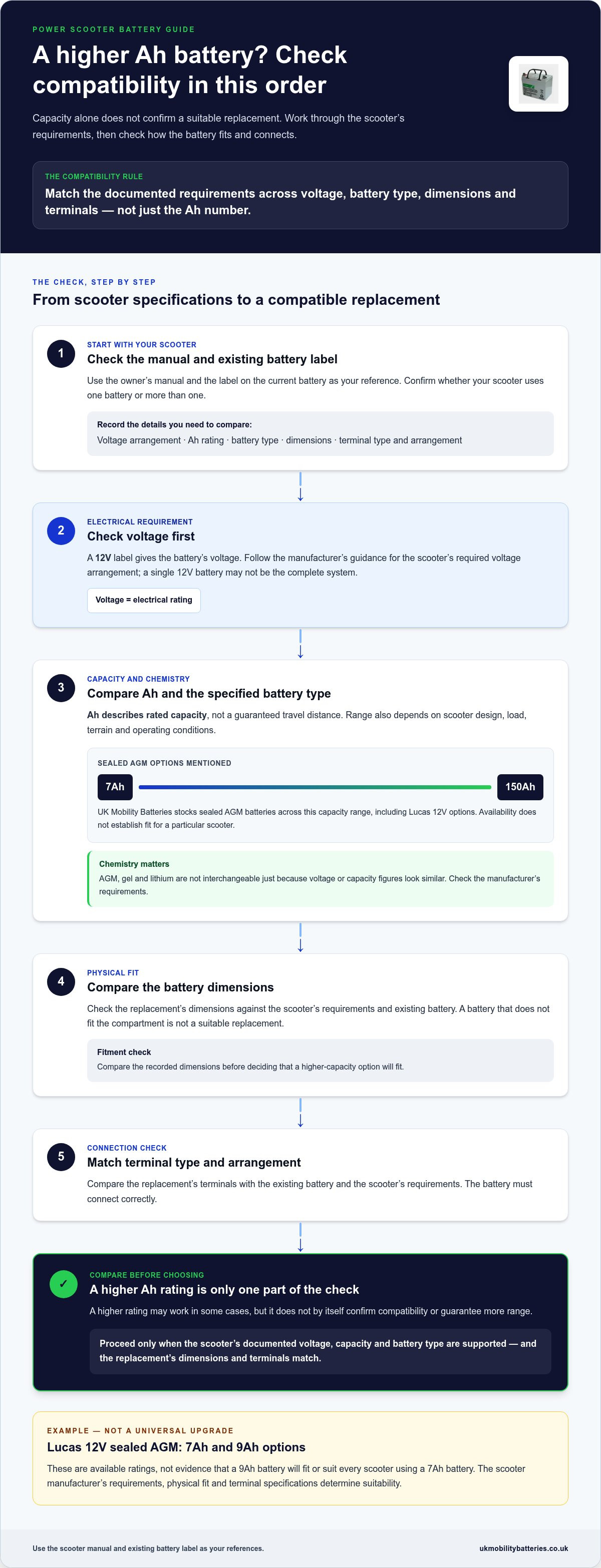
How to check power scooter battery compatibility before ordering
Use the scooter manual and existing battery as your references before selecting a replacement. Record each detail instead of relying on a product photograph or Ah rating alone. You’ll then have a clear set of specifications to compare and can avoid choosing a battery with the right electrical rating but the wrong physical fit.
Read the scooter manual and battery label
Start with the scooter make and model, then check the manual for its battery requirements and recommended configuration. Compare these with the label on the existing battery. If the two sources appear to differ, follow the scooter manufacturer’s guidance and resolve the specification before buying.
Check dimensions, terminals and charging requirements
Measure the existing battery and note its terminal type, position and connector arrangement. Similar voltage and capacity ratings don’t guarantee that a replacement will fit the battery compartment or connect correctly. Also check the charger guidance in the manual. The charger must be suitable for the battery chemistry and scooter setup.
Work through this pre-order checklist:
- 1. Identify the scooter: Record its make and model, then find the battery requirements in the manual.
- 2. Read the battery label: Note the voltage and Ah rating. If the scooter uses multiple batteries, record the number and arrangement specified for the system.
- 3. Measure the battery: Write down its length, width and height, then compare them with the compartment space.
- 4. Inspect the connections: Record terminal type and location, plus the connector arrangement, so you can compare like with like.
- 5. Check charging requirements: Confirm the charger is appropriate for the battery type and scooter configuration, as stated by the manufacturer.
These checks help establish whether a battery is a suitable match. They aren’t fitting instructions. For removal and installation guidance, use the dedicated guide to how to change mobility scooter batteries.
Once you’ve recorded the specifications, compare them with available batteries rather than choosing by capacity alone. Browse sealed AGM battery options using your manual and measurements as the reference.
Choose a suitable power scooter battery from UK Mobility Batteries
UK Mobility Batteries offers sealed AGM batteries across capacities from 7Ah to 150Ah, including Lucas 12V options. These include 7Ah, 9Ah, 12Ah, 20Ah, 34Ah, 50Ah and 55Ah models. The range gives you different capacities to compare, but a rating alone cannot establish that a battery is suitable for your scooter.
Match a confirmed battery option to the specifications you recorded
Use your scooter manual and existing battery label to narrow down the options. Check that the voltage and battery arrangement meet the manufacturer’s requirements, then compare the Ah rating, physical dimensions, terminal type and position, and connector arrangement. A battery that matches in voltage or capacity may still be unsuitable if it won’t fit or connect correctly.
For example, the Lucas 12V 7Ah and 9Ah sealed AGM options have different capacity ratings, whilst both are labelled 12V. That difference doesn’t mean the 9Ah option is an appropriate upgrade for every scooter using a 7Ah battery. Suitability depends on the scooter’s requirements and the replacement’s complete specifications, not the brand or capacity in isolation.
Read the product information for the exact battery specifications and fitment details, then compare them with your notes. Check each requirement: voltage, capacity, dimensions, terminals and the manufacturer’s guidance all matter when selecting a power scooter battery.
What to do next if you are ready to replace the battery
Before choosing, have these details to hand:
- Scooter make and model, plus the battery configuration stated in its manual.
- Existing battery voltage and Ah rating.
- Battery dimensions and terminal type and position.
- Connector arrangement and charger requirements.
If a battery specification is unclear, UK Mobility Batteries’ expert technical support can help you understand the information needed to compare options. This keeps the decision focused on battery selection and documented requirements, rather than assumptions about fit.
When you’re ready, view mobility scooter batteries and compare the specifications with your notes. Match the details before ordering.
Choose your replacement with the specifications in hand
Choose a power scooter battery by starting with the scooter manufacturer’s requirements, not capacity alone. Compare voltage, Ah rating, dimensions, terminals and connector arrangement before ordering. A higher Ah option is suitable only if the scooter supports it and the battery fits correctly.
UK Mobility Batteries specialises in mobility scooter and wheelchair batteries, with sealed AGM options from 7Ah to 150Ah, including Lucas 12V batteries. UK-wide delivery and expert technical support are available for battery-related questions.
Use the details you recorded to compare suitable options, then compare mobility scooter batteries by specification. Browse the range and choose your replacement battery with your scooter’s requirements to hand.
Frequently Asked Questions
What is the difference between a power scooter battery and a mobility scooter battery?
In this context, the terms generally refer to the battery that supplies electrical power to a mobility scooter. The wording may vary, but the important details are the scooter’s required voltage, battery capacity, chemistry and physical fit. Use the scooter manual and existing battery label to identify the correct specification rather than relying on the product name alone.
Can I replace my mobility scooter battery with one that has a higher Ah rating?
Possibly, but a higher Ah rating alone doesn’t establish compatibility. The scooter manufacturer’s requirements, voltage, battery dimensions and terminal arrangement must also match. A higher capacity may be suitable only if the scooter supports it and the battery fits correctly. It also doesn’t guarantee a particular increase in range, since load, terrain and operating conditions affect performance.
How do I know which battery fits my power scooter?
Check the scooter manual and the label on the existing battery. Record the scooter make and model, voltage, Ah rating, battery dimensions, terminal type and position, and connector arrangement. Compare these details with the replacement’s product information and the manufacturer’s requirements. Matching voltage or capacity alone isn’t enough if the battery won’t fit the compartment or connect correctly.
Can I use any 12V battery in a mobility scooter?
No. A 12V label confirms voltage, but doesn’t show whether a battery has the right capacity, chemistry, dimensions or terminals for your scooter. Some scooters use more than one battery in a specific arrangement, so one 12V unit may not meet the system requirement. Follow the scooter manufacturer’s guidance and check that the charger is appropriate for the battery type and setup.
What does Ah mean on a power scooter battery?
Ah means amp-hours and indicates a battery’s rated capacity, or how much charge it can store. It’s separate from voltage: a 12V label gives the voltage, whilst an Ah figure describes capacity. A higher Ah rating doesn’t translate directly into a guaranteed travel distance. Scooter load, terrain, usage and other operating conditions can affect the range available.
Are sealed AGM batteries suitable for mobility scooters?
Sealed AGM batteries can be suitable when they meet the scooter manufacturer’s requirements. AGM stands for Absorbent Glass Mat and describes a type of lead-acid battery. Sealed AGM batteries are maintenance-free, so routine electrolyte topping-up isn’t required, but they still need correct charging. Check the scooter manual for the required battery chemistry and charger guidance before choosing a replacement.
Do I need to replace both mobility scooter batteries at the same time?
It depends on the scooter’s battery configuration and the manufacturer’s guidance. If the scooter uses two batteries as a matched system, check the manual for recommendations on replacing them together. Before ordering, note both batteries’ labels and compare their voltage, Ah rating, age and condition. Don’t assume that replacing one alone is suitable without checking the specified setup and replacement requirements.