
Overnight Charging Safety for Mobility Scooters: 2026 Guide
Is it safe to leave a mobility scooter charging overnight? There isn’t a universal yes-or-no answer. Overnight charging safety for mobility scooter owners depends on the battery’s condition, charger compatibility, charging location and the scooter and charger manufacturers’ instructions, not simply the time on the clock. Chargers can behave differently when charging is complete, so don’t assume every model switches off in the same way.
It’s understandable to feel unsure when advice about leaving a charger connected conflicts, particularly if you’ll be asleep or away from the scooter. This guide explains the main factors that affect charging safety, practical checks to make before plugging in, and warning signs that mean charging should stop. It also explains why a damaged or ageing battery, an unsuitable charger or a mismatch in battery specifications deserves attention. Use these points alongside the manufacturers’ instructions to make an informed decision for your scooter, rather than relying on a blanket rule.
Key Takeaways
- Overnight charging safety for mobility scooter owners depends on the scooter, battery, charger, their condition and the charging environment. Follow the manufacturers’ instructions rather than relying on a blanket rule.
- Before connecting a charger, check that it matches the battery type and the scooter manufacturer’s requirements.
- Use a pre-charge checklist to inspect the equipment for visible damage and assess whether the charging location is suitable.
- Charging whilst awake may make it easier to notice changes, but equipment condition and location matter at any time of day.
- If charging concerns keep recurring, review the battery’s condition and documented specifications before deciding whether a replacement may be needed.
Is overnight charging safe for a mobility scooter?
There isn’t a reliable yes-or-no answer for every scooter. Charging overnight may follow the instructions for one setup and be unsuitable for another. Assess the scooter, battery type and condition, charger design, manufacturer guidance and charging location. Overnight charging safety for mobility scooter owners is about the equipment and conditions, not just the time of day.
Overnight charging safety depends on compatible, undamaged equipment, the scooter and battery instructions, and a suitable charging location.
Why there is no single answer for every scooter
Battery chemistry affects charging requirements, and chargers are designed for particular battery types and equipment. A charger intended for one setup shouldn’t be assumed suitable for another, even if its connector fits. For general background, Lithium-ion battery technology differs from sealed lead-acid battery technology. Don’t apply charging guidance for one chemistry to another.
Some chargers may change their behaviour as charging progresses or once charging is complete, but the details depend on the model. Don’t assume every charger automatically stops or is designed to remain connected indefinitely. Check the scooter and charger manuals for the charging procedure, including what the indicator lights mean and when to disconnect.
Normal behaviour is what the manufacturer describes for that equipment. Visible damage, an unusual smell, excessive heat or another unexpected change during charging needs attention, not a guess that the charger is simply finishing its cycle. Stop charging if you notice a concerning sign and follow the manufacturer’s safety instructions. General advice can help you assess the situation, but it can’t replace guidance for your equipment.
What unattended charging changes
When you’re asleep, you can’t continuously observe the scooter or respond promptly if something changes. That doesn’t establish that overnight charging is unsafe, but it does reduce the chance of noticing a developing problem early. If you’re awake and nearby, you may be able to see an indicator change or notice an unexpected smell or sound. Being at home doesn’t make charging fully supervised if you’re asleep in another room.
Leaving home is a different decision. You may be unable to notice or respond to a warning sign, so consider whether charging needs to continue while nobody is present. Follow the manufacturer’s instructions on charging duration and supervision. Don’t treat advice about overnight charging as permission to leave equipment running while the home is empty.
Think of unattended charging as a risk to manage, not a situation that can be guaranteed safe. If the battery or charger is damaged, compatibility is uncertain, or the instructions don’t clearly support your planned routine, don’t rely on general reassurance. Resolve the equipment question before deciding when to charge.
How the scooter battery and charger affect charging safety
The battery and charger form a matched electrical system. Choosing a charger by appearance alone can lead to a mismatch: a connector that fits doesn’t prove that the charger’s electrical output or charging method suits the battery. Check the scooter handbook and charger label, and use the charger specified for the scooter and battery system. If either item has been replaced, confirm that the replacement meets the scooter manufacturer’s requirements before charging.
Charger compatibility means that the charger’s documented electrical output and charging method are suitable for the specific battery type and scooter requirements.
Why the correct charger matters
Read the charger label alongside the scooter’s instructions. Compare the stated battery type and electrical details with the handbook instead of relying on a matching plug or a general description such as “mobility scooter charger”. If information is missing, unreadable or inconsistent, don’t assume the equipment is compatible. A mismatch can affect charging behaviour, so resolve the specification question before connecting it.
Charging stages and end-of-charge behaviour vary by charger. The manufacturer’s documentation may explain how a model changes its output during charging, what its indicator lights mean and when to disconnect it. Follow the instructions for your equipment. Don’t assume a charger stops completely when charging finishes or can safely remain connected indefinitely. Check the manual for those details.
Battery chemistry and charging instructions
AGM, or absorbent glass mat, is a type of sealed lead-acid battery. It has specific charging requirements, so use instructions written for the battery and scooter in question. Other scooters may use a different chemistry, such as lithium-ion, with different manufacturer guidance. Don’t transfer charging stages, timings or advice from one battery type to another unless the equipment documentation supports it.
A battery label can help identify its type and specification, but it doesn’t replace the scooter or charger manual. If the battery has been changed and you’re unsure whether the charging instructions still apply, compare the battery details with the scooter requirements and charger documentation. For related practical advice, see this guide to avoiding mobility scooter battery overcharging.
These details matter when assessing overnight charging safety mobility scooter concerns: a familiar routine is useful only if the equipment remains compatible and behaves as its manufacturer describes. An ageing or damaged battery may also need attention, but charging instructions can’t diagnose its condition. If you’re considering a replacement, check the scooter’s required battery specification first. UK Mobility Batteries supplies sealed AGM mobility scooter batteries. Compare the battery specifications with the manufacturer’s requirements.
Overnight charging versus supervised charging: risks and trade-offs
Charging whilst awake can make it easier to notice an unexpected change, but it doesn’t remove electrical or fire risks. Overnight, you may be asleep and less able to respond promptly. The practical choice depends on the scooter and battery instructions, equipment condition and charging location. Daytime charging isn’t automatically safe, and overnight charging isn’t automatically unsafe.
If the instructions allow charging only under particular conditions, follow them regardless of the time. Staying nearby may help you notice a change, but it doesn’t make an unsuitable location or damaged equipment safe. Consider separately whether you’ll be asleep and whether the home will be empty. In either situation, you may not be able to act quickly.
When supervised charging may be preferable
Charging while you’re awake and nearby gives you a better opportunity to observe the charger indicators and notice unusual heat, smell or sound. Set up the scooter as the handbook directs, then stay close enough to notice changes without touching or moving the equipment unnecessarily. Follow the stated charging duration and disconnection instructions. Supervision is a practical precaution, not a guarantee that a fault cannot occur.
Charging location and warning signs
Choose a stable, dry, uncluttered position that follows the scooter and charger instructions. Arrange the charger and cables as directed, and keep the area around the equipment clear of items that could obstruct access or add fuel to a fire. Don’t charge where the setup could be knocked, covered or exposed to conditions the manufacturer warns against.
Before connecting the charger, look over the cable, plug and battery for visible damage. During charging, stop and assess the situation safely if you notice a damaged cable, unexpected heat, an unusual smell or sound, or another change not described as normal in the equipment instructions. Don’t handle a damaged or hot component to investigate it. Disconnect only if it’s safe to do so, and follow the manufacturer’s advice.
If there’s smoke, flames or immediate danger, don’t approach or handle the scooter or charger. Move away and call 999. Don’t put yourself at risk trying to disconnect the equipment or tackle a fire. Follow the emergency operator’s instructions.
These checks can help you weigh overnight charging against charging while awake, but they can’t establish that a particular setup is safe. If your concern relates to battery age, condition or specification, use the battery details as context and follow the scooter and charger manufacturers’ instructions. If you’re considering a replacement, compare sealed AGM mobility battery specifications with your scooter’s requirements.
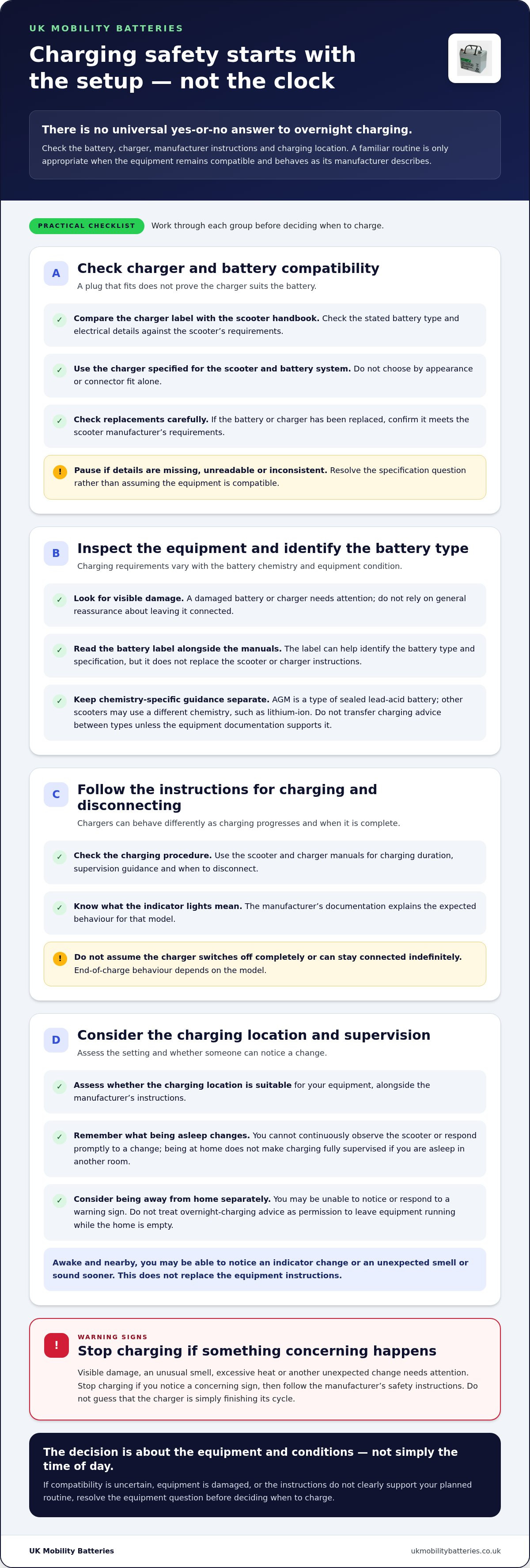
A practical mobility scooter charging safety checklist
A consistent check before each charge can catch obvious problems before the equipment is connected. Use this sequence alongside the scooter, battery and charger instructions. It helps you assess the setup, but can’t diagnose an electrical fault or replace guidance specific to your equipment.
Before connecting the charger
Start with the documentation, then inspect the equipment and prepare the charging area. Don’t charge if the equipment appears damaged or the instructions don’t support the setup. A connector that fits doesn’t prove that the charger suits the battery and scooter.
- Check the instructions. Find the scooter’s charging procedure and any requirements for the battery type, charger and charging location.
- Confirm compatibility. Compare the charger label and battery details with the scooter’s documented requirements. If specifications are unclear or don’t match, pause rather than guessing.
- Inspect the charger and cable. Look for fraying, cracks, loose parts, contamination or other visible damage. Don’t use damaged equipment.
- Look over the battery. Check for visible damage or swelling without opening or dismantling it. If anything looks abnormal, don’t connect the charger.
- Prepare the location. Position the scooter on a stable surface in a dry, uncluttered place, following the manufacturer’s instructions. Keep the charging area accessible and clear of nearby items.
- Connect as directed. Follow the specified connection order and check the charger indicators against the manual. Don’t assume charging has finished because of an unfamiliar light or sound.
If charging seems abnormal
Stop using the equipment if it develops unusual heat, swelling, smell or unexpected noise, or if you spot damage. Don’t open, modify or attempt to repair the battery or charger. If safe, follow the manufacturer’s instructions for stopping the charge. If it isn’t safe, move away and seek appropriate help.
Smoke, flames or immediate danger call for a safety-first response. Don’t approach or handle the scooter, battery or charger. Move away and call 999, then follow the emergency operator’s instructions. If there’s no immediate danger, stop charging and seek advice from the scooter or charger manufacturer, or a suitably qualified professional. Don’t try repeated charging cycles to see whether the problem has gone away.
Recurring performance or charging concerns can have several explanations, so avoid diagnosing a fault from one symptom alone. This practical guide to mobility scooter battery troubleshooting can help you consider signs alongside the manufacturer’s advice.
Battery condition and the correct specification matter when assessing overnight charging safety mobility scooter concerns. If you’re weighing up a replacement, use the scooter’s documented requirements to review sealed AGM mobility batteries before choosing.
When battery compatibility or condition needs attention
Repeated charging concerns are a reason to review the battery’s condition and documented specifications, not proof that the battery is faulty. A change in charging behaviour, for example, may have more than one explanation. Avoid repeated tests or adjustments based on guesswork. Note what you’ve noticed, check the scooter and charger instructions, and seek advice from the relevant manufacturer or a suitably qualified professional if the concern persists.
This distinction matters when assessing overnight charging safety mobility scooter concerns. Replacing a battery without establishing the required specification may not address the underlying issue, and a new battery doesn’t guarantee a particular charging outcome. Keep battery information in context: the scooter and charger manufacturers’ instructions remain the authority for charging and compatibility.
Information to identify before considering a replacement
Use the existing battery label and scooter handbook to note the voltage, capacity and battery chemistry. Compare these details with the scooter’s stated requirements. A similar-looking battery or matching connector alone doesn’t establish suitability. If the label is unreadable, the handbook is missing or the information conflicts, don’t guess. Base battery selection on the scooter’s documented requirements.
A UK mobility scooter battery selection and care guide can help you understand which details to compare. Use it as supporting information, not as a substitute for the instructions for your particular scooter and charger.
A clear next step for battery questions
UK Mobility Batteries specialises in sealed AGM batteries for mobility scooters and wheelchairs, with technical support for battery questions. Its sealed AGM range includes a range of capacities. Match a battery’s specifications to the scooter’s documented requirements rather than assuming compatibility. Battery supply and information are distinct from diagnosing a scooter or charger fault.
If you’re considering a replacement, gather the battery label details and the scooter’s required specification first. This gives you a clearer basis for comparing options and discussing battery information, without treating replacement as a confirmed fix for a charging concern. The manufacturer’s charging instructions still apply after a battery change.
For a practical next step, browse sealed AGM mobility battery information and options and compare the documented specifications with your scooter handbook.
Make your next battery decision with confidence
Keep your scooter’s battery label and handbook details together so you can refer to the specified requirements if the battery is changed or charging behaviour raises questions. This gives you a practical reference point for assessing overnight charging safety mobility scooter concerns, without relying on assumptions about a different battery or charger.
If you’re considering a replacement, UK Mobility Batteries supplies sealed AGM batteries for mobility equipment, including Lucas batteries in a range of capacities. Customers across the UK can access delivery and technical support. Compare battery information with your scooter’s documented requirements, and keep the manufacturer’s charging instructions central to your decision.
Browse mobility scooter batteries and technical information to explore the available options. A clear record of your equipment specifications can make the next step more straightforward.
Frequently Asked Questions
Can I use an extension lead to charge a mobility scooter overnight?
Use an extension lead only if the scooter and charger instructions permit it. Don’t assume it’s suitable. For overnight charging safety, the lead is part of the setup to assess. Don’t use a lead that’s damaged, overloaded or positioned where it could be trapped or walked on, and don’t join leads or improvise a connection. Follow current UK electrical safety guidance.
Is it safe to charge a mobility scooter in a garage overnight?
A garage isn’t automatically safe or unsafe for charging. Check that the manufacturer’s instructions permit the location and that the battery, charger and cables are in suitable condition. Keep the charging area clear and accessible, and avoid damp or other conditions the manufacturer advises against. If the garage is used for storage, make sure nearby items don’t crowd the scooter or interfere with the charging setup.
Can I charge a mobility scooter in cold weather?
Check the scooter, battery and charger manuals for their permitted charging temperatures. There isn’t one temperature range that applies to every setup. A cold garage or shed may be outside the specified conditions, so don’t assume charging is suitable simply because the scooter operates outdoors. Charging guidance is also separate from advice about storing or using the scooter in cold weather. Follow the instructions for each activity.
How do I know whether my mobility scooter charger is compatible with an AGM battery?
Check the charger’s stated battery chemistry and electrical specifications against both the AGM battery details and the scooter handbook. A plug that fits doesn’t demonstrate compatibility. Don’t select a universal setting or rely on another scooter owner’s charger as a guide. If the label and manuals give conflicting information, pause charging and ask the scooter or charger manufacturer to clarify the requirements for that equipment.
What should I do if my mobility scooter battery becomes unusually hot while charging?
Don’t touch or move the scooter, battery or charger if doing so could put you at risk. If there’s smoke, fire or immediate danger, leave the area and call 999, following the emergency operator’s instructions. If the battery is unusually hot but there’s no immediate danger, stop using the equipment only if safe, then follow the manufacturer’s advice. Don’t open the battery or attempt a repair.
Should I charge a mobility scooter battery after every journey?
Follow the charging routine in your scooter and battery instructions rather than assuming every journey needs a charge. The right frequency can depend on the specific equipment and how it’s used. A routine for regular use may differ from instructions for a scooter being stored for a period, so check the relevant storage guidance separately. Avoid applying a charge threshold or schedule taken from a different battery or model.
What happens if a mobility scooter charger indicator stays on after charging?
An indicator staying on doesn’t by itself confirm a fault or show that charging is complete. Light colours and sequences vary by charger, so check the manual’s description of the charging cycle and what to do at its end. Don’t assume the charger switches off automatically. If you also notice damage, unusual heat or an unexpected smell, stop using the equipment if safe and follow the manufacturer’s guidance.