
Mobility Scooter Battery Storage Tips: The Ultimate Care Checklist
Why do so many mobility scooter owners treat their batteries like garden furniture, leaving them to weather the winter in a cold shed only to find them completely dead by March? It's a frustrating and expensive discovery that leads to unexpected replacement costs. Most users simply want the confidence that their equipment will function correctly after a period of inactivity, yet conflicting advice regarding chargers and storage environments often creates unnecessary confusion.
This guide provides professional mobility scooter battery storage tips to help you prevent permanent capacity loss and significantly extend the service life of your power cells. By following a methodical maintenance routine, you can protect the chemical integrity of your Lucas AGM batteries and avoid the degradation caused by deep discharge. We'll detail the precise technical requirements for temperature regulation, charging intervals, and physical preparation to ensure your equipment remains operational and ready for the spring season.
Key Takeaways
- Learn how to prevent sulphation, the primary chemical process that causes permanent capacity loss when batteries are left in a discharged state.
- Identify the optimal environmental conditions, including the specific temperature range and surface types required to preserve battery health.
- Master essential mobility scooter battery storage tips, such as establishing a 4 to 6-week top-up charging routine to counteract natural self-discharge.
- Understand the critical charging protocols, from the initial 12-hour preparation cycle to the 24-hour deep charge required before returning to service.
- Discover how to eliminate parasitic power draw and terminal corrosion through professional cleaning and inspection techniques.
Why Correct Mobility Scooter Battery Storage is Essential
Most battery failures don't happen while the scooter is in active use. Instead, they occur while the equipment sits idle. Storage is the period where lead-acid systems are most vulnerable to permanent capacity loss. Neglecting simple mobility scooter battery storage tips often leads to the chemical degradation of the internal plates, rendering the unit useless when you eventually need it.
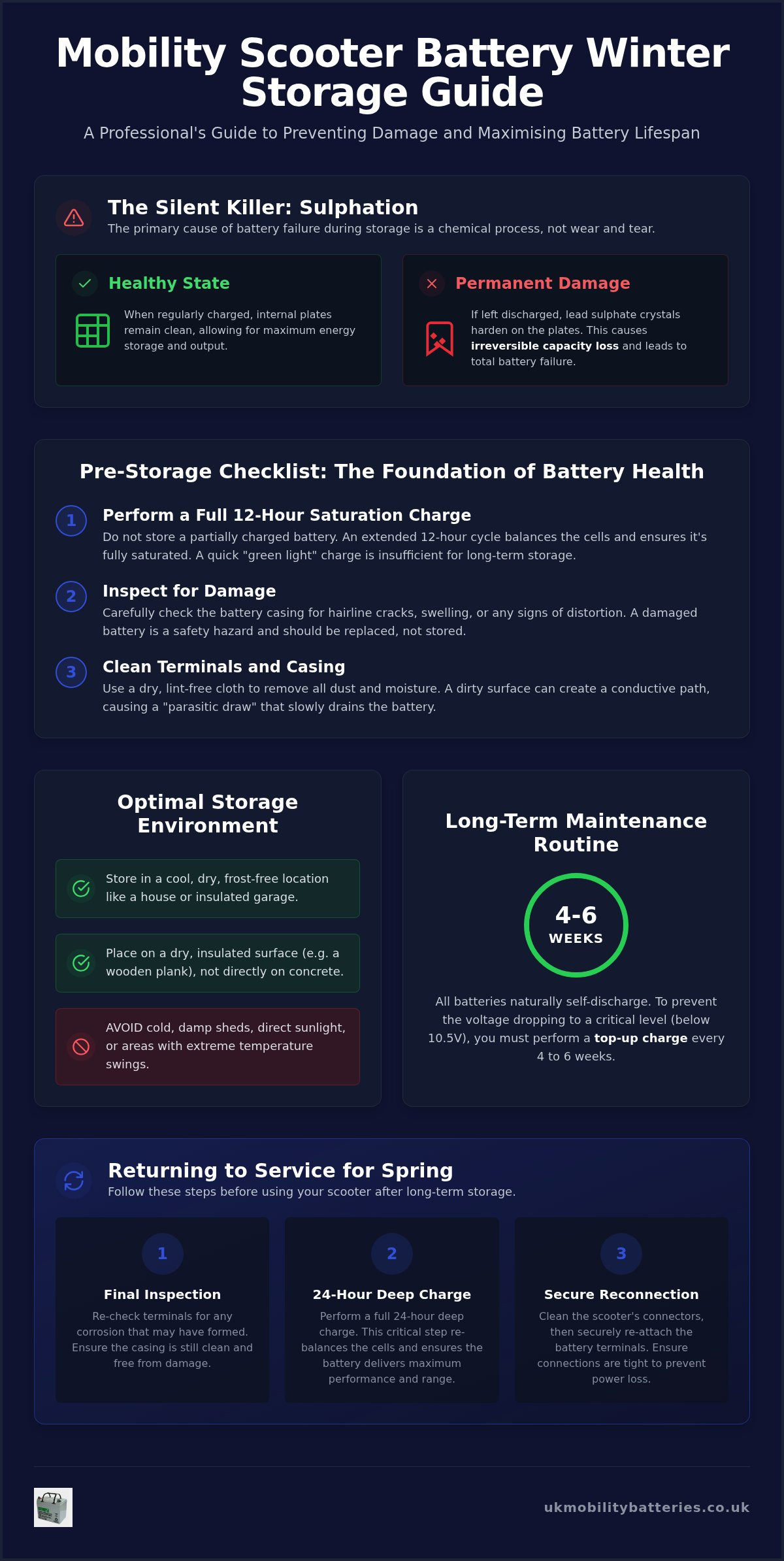
This degradation is primarily caused by a process called sulphation. When a battery remains in a state of discharge, lead sulphate crystals form on the internal plates. If the battery isn't recharged promptly, these crystals harden. Once hardened, they're impossible to dissolve during a normal charging cycle. This reduces the active surface area of the plates, permanently lowering the battery's capacity and eventually leading to total cell failure. Following a strict storage routine provides a significant financial benefit by avoiding the high cost of premature battery replacement.
Even high-quality maintenance free mobility batteries require active storage management. Whilst these units don't need liquid top-ups, their chemical health depends entirely on maintaining a specific voltage level. You cannot simply park the scooter and forget about it for months. You must actively manage the charge levels to preserve the integrity of the Lucas AGM cells.
The Chemistry of Discharge
All batteries experience self-discharge. This is a natural internal chemical reaction that slowly drains energy even when the scooter is turned off. Deep-cycle batteries used in mobility scooters are designed for regular discharging, but they have a point of no return. If the voltage drops below approximately 10.5V for a 12V unit, the damage is often irreversible. AGM (Absorbent Glass Mat) technology, found in Lucas batteries, generally offers a lower self-discharge rate than traditional gel cells, but they still require periodic charging to stay above these critical thresholds.
Short-Term vs. Long-Term Storage
The strategy you choose depends on the duration of non-use. Short-term storage applies to periods under two weeks. For active users, this involves leaving the scooter in a dry area with a full charge. Long-term storage covers any period over four weeks, such as seasonal winter storage. During long-term storage, the risk of sulphation increases significantly. The approach must shift from passive parking to a methodical routine of environmental control and top-up charging. Implementing specific mobility scooter battery storage tips during these longer gaps is the only way to ensure the cells remain healthy for the spring.
Pre-Storage Checklist: Preparing Your Batteries
Preparation is the foundation of effective battery preservation. Before moving your equipment into a garage or storage unit, you must ensure the internal chemistry is stable and the external components are protected. Skipping these initial steps often leads to terminal damage or a deep-discharge state that cannot be recovered. This phase of mobility scooter battery storage tips focuses on electrical saturation and physical cleanliness.
A thorough inspection of the battery pack is mandatory. You should look for any hairline cracks in the casing or signs of swelling. If the battery case is distorted, it indicates previous overcharging or internal heat damage, and the unit should be replaced rather than stored. Ensure the entire assembly is completely dry. Moisture trapped against the battery casing during the winter can lead to mould growth or slow terminal oxidation.
The Final Full Charge
A common mistake is assuming that a short charge until the "green light" appears is sufficient for long-term storage. For the most effective preservation, you must complete a full 12-hour charging cycle. This extended duration allows the charger to enter its "float" or "maintenance" stage, which ensures every cell in the Lucas AGM battery is balanced and fully saturated. Storing a battery in a partially charged state is the single most common cause of winter cell failure. Without this full saturation, the self-discharge process starts from a lower baseline, reaching the critical "point of no return" much faster than a fully prepared unit.
Cleaning and Terminal Care
Dirt, dust, and moisture on the top of the battery casing can create a microscopic conductive path between the positive and negative terminals. This results in a parasitic draw, which slowly drains the battery's energy even when it's not connected to the scooter. Use a dry, lint-free cloth to wipe the casing until it is clean. If your current units show significant terminal damage or casing cracks, it may be time to browse our range of Lucas AGM mobility batteries before the next season begins.
Pay close attention to the terminals. You're looking for a white, powdery substance known as lead sulphate corrosion. This substance increases electrical resistance and can prevent the charger from functioning correctly. Once the terminals are clean and the connections are tightened, apply a thin layer of petroleum jelly to the metal surfaces. This acts as a moisture barrier, protecting the lead from oxidation whilst the battery sits in a damp environment. Ensure all terminal bolts are secure; a loose connection can cause arcing and heat damage when you eventually recommission the scooter.
Selecting the Optimal Storage Environment
The physical location chosen for your equipment significantly influences the rate of chemical decay. Whilst many users default to a garage or shed, these spaces often lack the environmental stability required for long-term preservation. Implementing specific mobility scooter battery storage tips regarding the environment will prevent the acceleration of self-discharge and physical damage to the battery casing.
The ideal temperature range for storing Lucas AGM batteries is between 10°C and 15°C. You should avoid placing batteries directly on a cold concrete floor. Concrete acts as a thermal conductor, drawing heat away from the cells and keeping them at a consistently lower temperature than the surrounding air. This can lead to internal temperature gradients that affect performance. Instead, elevate the batteries using a wooden pallet or a sturdy shelf. The area must be dry and well-ventilated to prevent moisture build-up, which can lead to terminal oxidation and parasitic drain.
Temperature and Self-Discharge Rates
Temperature fluctuations directly impact the internal chemical activity of the battery. High temperatures, specifically those above 25°C, can double the rate of internal self-discharge. This means a battery stored near a boiler or radiator will lose its charge twice as fast as one kept in a cool room. Conversely, freezing temperatures pose a severe risk to discharged batteries. As a battery loses its charge, the electrolyte becomes increasingly composed of water. If the temperature drops below 0°C, this liquid can freeze and expand, which often cracks the plastic casing and causes permanent structural failure. A cool, frost-free environment is the "Goldilocks zone" that keeps chemical activity at a minimum without risking physical damage.
Safety and Physical Security
Physical security is just as critical as temperature control. You must store batteries in a location that is out of reach of children and pets to prevent accidental short-circuits or exposure to lead components. Ensure the chosen area is not prone to flooding or significant damp, as standing water can cause immediate electrical failure. Never store batteries near flammable materials, open flames, or in spaces where petrol and other volatiles are kept. By following these mobility scooter battery storage tips, you create a controlled environment that maximises the lifespan of your Lucas AGM units and ensures they remain safe throughout the winter months.
Maintenance Checklist During Long-Term Storage
Effective battery preservation is not a passive task. Once your equipment is placed into its designated environment, you must implement a proactive monitoring routine to ensure the internal chemistry remains stable. Neglecting your power cells for several months is the primary reason users face high replacement costs in the spring. These mobility scooter battery storage tips focus on the active steps required to maintain voltage levels during periods of inactivity.
You should perform a top-up charge every 4 to 6 weeks. This interval is specifically designed to combat the natural self-discharge rate of Lucas AGM cells, which occurs even when they are not connected to a load. If you have access to a multimeter, use it to monitor the health of your units. A fully charged 12V battery should show a reading of approximately 12.6V to 12.8V. If the voltage drops below 12.4V, you must initiate a refresh charge immediately to prevent the onset of sulphation. Avoid leaving the charger connected 24/7 unless the manufacturer explicitly states it has a dedicated "storage mode" or "intelligent trickle" function. Constant charging without a smart regulation system can lead to electrolyte dry-out. For a technical breakdown of these risks, refer to our guide: Can you overcharge a mobility scooter battery?
The Refresh Charge Routine
Consistency is the most important factor in long-term care. Set a recurring calendar reminder for your monthly "refresh" charge to ensure it isn't forgotten. Each maintenance charge should last between 8 and 12 hours. This duration is necessary to allow the battery to reach its full float voltage and balance the internal cells. During this process, monitor the temperature of the casing. If the battery feels excessively hot to the touch or emits a "rotten egg" smell, disconnect the charger immediately. This often indicates an internal short circuit or a failing cell that can no longer regulate the incoming current.
To Disconnect or Not?
We recommend disconnecting the battery loom from the scooter during long-term storage. This simple action stops "vampire" power drain, where the scooter's onboard electronics, clocks, and controller systems slowly sap energy from the batteries. If your storage area is not frost-free, you should remove the batteries entirely and keep them in a temperature-controlled indoor environment. When handling larger units, such as the Lucas 12V 34Ah or 50Ah mobility batteries, always use the integrated carry handles. These units are heavy, so ensure you use correct lifting techniques to avoid injury. If your current batteries are failing to hold a charge during these monthly checks, you can order new Lucas mobility batteries with national UK delivery to ensure your scooter is ready for the new season.
Recommissioning: Returning Your Scooter to Service
The transition from long-term storage to active use requires a specific protocol to ensure the electrical system is stable. Even if you've diligently followed mobility scooter battery storage tips throughout the winter, you shouldn't expect the equipment to perform at 100% capacity immediately upon reconnection. A methodical recommissioning process identifies potential failures before they leave you stranded away from home.
Before your first journey, conduct a final 24-hour deep charge. This extended duration allows the charger to complete a full saturation cycle, balancing the internal chemistry of the Lucas AGM cells. Once the charge is complete, re-inspect the terminals for any new oxidation or corrosion that may have formed despite your preparation. Ensure all connections are tight and the wiring loom is free from damage. Perform a short test drive within the immediate vicinity of your home. This allows you to verify the battery range and power delivery under real-world conditions. If the scooter feels sluggish or lacks its usual torque, consult our mobility scooter battery troubleshooting guide for a technical assessment of the fault.
The First Discharge Cycle
The internal chemistry of a deep-cycle battery needs to "wake up" after a period of inactivity. Avoid planning a long, demanding journey on the very first day back in service. The first few discharge cycles are critical for re-establishing the chemical flow within the Absorbent Glass Mat. During these initial outings, monitor your battery gauge closely. Look for unexpected drops in power, especially when accelerating from a stationary position. If the gauge needle or digital display fluctuates wildly, it suggests the batteries aren't providing a stable voltage under load, which is often a result of internal resistance built up during storage.
When to Admit Defeat: Signs Storage Failed
Sometimes, despite your best efforts with mobility scooter battery storage tips, a battery may reach the end of its functional life. A primary indicator of failure is if the battery takes a very short time to show a "fully charged" light. This often means the unit has lost its capacity to hold energy, a condition known as "surface charge." You might also find that the scooter cuts out entirely when climbing a small incline or navigating onto a kerb. These symptoms indicate that sulphation has hardened to the point where the plates can no longer support high-current demands. If your units fail to recover after a deep charge, it's time to browse for replacement mobility scooter batteries UK to restore the reliability and performance of your equipment.
Maximising Battery Longevity Through Proactive Care
Implementing these mobility scooter battery storage tips ensures your equipment remains operational throughout the winter months. By maintaining a stable environment between 10°C and 15°C and committing to a monthly top-up charging schedule, you effectively prevent the chemical degradation caused by sulphation. This methodical approach protects your investment and provides the confidence that your scooter will perform reliably when returned to service in the spring.
If your current units are showing signs of capacity loss or fail to respond to a saturation charge, it's time to upgrade your power source. View our range of premium Lucas mobility batteries for reliable power. We provide high-performance deep-cycle technology backed by expert technical support and fast UK-wide delivery. Following a structured maintenance routine is the best way to ensure your mobility remains uninterrupted and your equipment stays in peak condition.
Frequently Asked Questions
Should I leave my mobility scooter on charge all the time during winter?
No, you shouldn't leave a standard charger connected indefinitely unless it has a dedicated "storage mode" or "intelligent float" function. Constant charging from a basic unit can lead to electrolyte dry-out or internal heat damage over several months. It's much safer to follow a periodic charging routine rather than leaving the system permanently active.
Can I store my mobility scooter batteries in a cold garden shed?
Storing batteries in a garden shed is not recommended due to high humidity levels and lack of thermal insulation. Moisture in these environments leads to rapid terminal corrosion, whilst extreme temperature fluctuations can stress the internal components. A dry garage or a cool, ventilated room inside your home provides a far more stable environment for your Lucas AGM units.
How often should I charge my scooter batteries if I am not using it?
You should perform a full top-up charge every 4 to 6 weeks during periods of inactivity. This is one of the most essential mobility scooter battery storage tips to combat the natural self-discharge that occurs in all lead-acid systems. Regular charging prevents the voltage from dropping to a level where lead sulphate crystals begin to harden on the plates.
Is it better to remove the batteries from the scooter for storage?
Removing the batteries is generally the best approach for long-term storage, especially if the scooter is kept in an unheated area. Disconnecting the battery pack physically stops "vampire" power drain from the onboard electronics and controller. This ensures that 100% of the stored energy is preserved for the battery's health rather than sapped by the scooter's standby systems.
Will my mobility scooter batteries freeze if left in the garage?
A discharged battery can freeze at 0°C, which often leads to a cracked casing and total failure. As a battery loses its charge, the internal electrolyte becomes increasingly composed of water, which expands when frozen. Keeping your batteries fully charged significantly lowers their freezing point, protecting them during typical British winter cold snaps.
What is the best temperature to store mobility scooter batteries?
The optimal storage temperature for AGM batteries is between 10°C and 15°C. This specific range is cool enough to slow down the internal chemical reactions that cause self-discharge, yet warm enough to avoid any risk of freezing. Storing batteries in this "Goldilocks zone" is a key part of effective mobility scooter battery storage tips for maximising service life.
Can I use a car battery charger for my mobility scooter batteries during storage?
You must never use a car battery charger for your mobility scooter batteries. Car chargers are designed for high-output starter batteries and often deliver a current that is far too aggressive for deep-cycle AGM cells. Using the wrong charger can cause the battery to gass excessively or overheat, leading to permanent internal damage and safety risks.
How do I know if my batteries have been damaged by poor storage?
Signs of storage damage include the battery reaching a "full" charge state in an unusually short time or the scooter cutting out when navigating a small incline. These symptoms suggest that sulphation has reduced the active surface area of the internal plates. If your batteries exhibit these behaviours after being returned to service, they likely require replacement.